SUBSCRIBE TO OUR FREE NEWSLETTER
Daily news & progressive opinion—funded by the people, not the corporations—delivered straight to your inbox.
5
#000000
#FFFFFF
To donate by check, phone, or other method, see our More Ways to Give page.
The euphemisms will come fast and furious. Our soldiers will be greeted as "heroes" who, as in Iraq, left with their "heads held high," and if in 2014 or 2015 or even 2019, the last of them, as also in Iraq, slip away in the dark of night after lying to their Afghan "allies" about their plans, few here will notice.
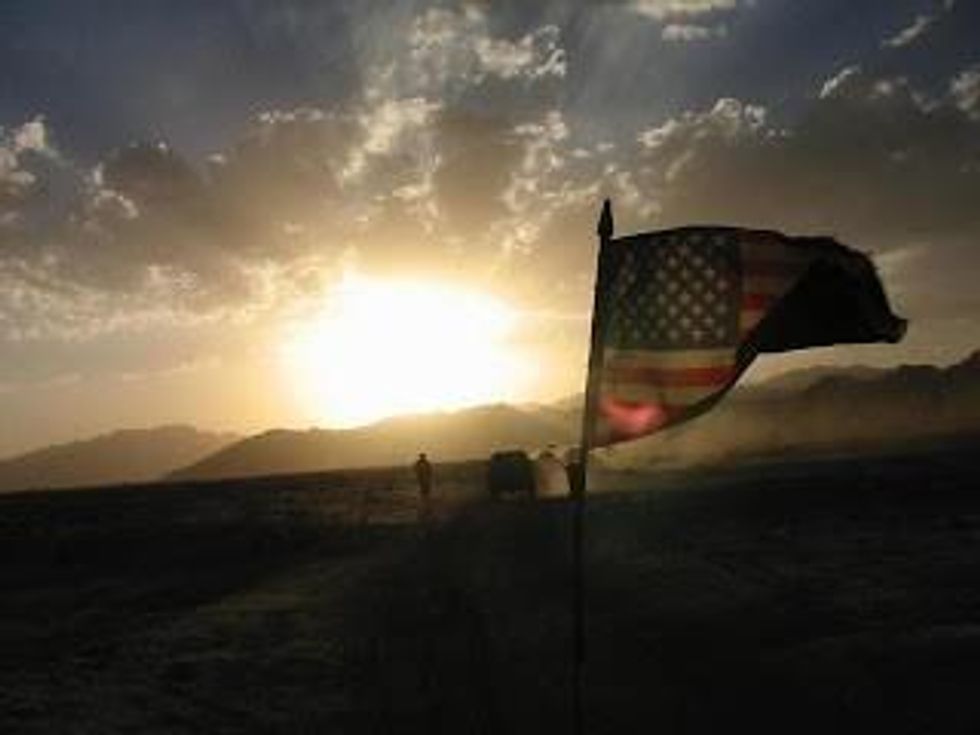
This will be the nature of the great Afghan drawdown. The words "retreat," "loss," "defeat," "disaster," and their siblings and cousins won't be allowed on the premises. But make no mistake, the country that, only years ago, liked to call itself the globe's "sole superpower" or even "hyperpower," whose leaders dreamed of a Pax Americana across the Greater Middle East, if not the rest of the globe is... not to put too fine a point on it, packing its bags, throwing in the towel, quietly admitting--in actions, if not in words --to mission unaccomplished, and heading if not exactly home, at least boot by boot off the Eurasian landmass.
Washington has, in a word, had enough. Too much, in fact. It's lost its appetite for invasions and occupations of Eurasia, though special operations raids, drone wars, and cyberwars still look deceptively cheap and easy as a means to control... well, whatever. As a result, the Afghan drawdown of 2013-2014, that implicit acknowledgement of yet another lost war, should set the curtain falling on the American Century as we've known it. It should be recognized as a landmark, the moment in history when the sun truly began to set on a great empire. Here in the United States, though, one thing is just about guaranteed: not many are going to be paying the slightest attention.
No one even thinks to ask the question: In the mighty battle lost, who exactly beat us? Where exactly is the triumphant enemy? Perhaps we should be relieved that the question is not being raised, because it's a hard one to answer. Could it really have been the scattered jihadis of al-Qaeda and its wannabes? Or the various modestly armed Sunni and Shiite minority insurgencies in Iraq, or their Pashtun equivalents in Afghanistan with their suicide bombers and low-tech roadside bombs? Or was it something more basic, something having to do with a planet no longer amenable to imperial expeditions? Did the local and global body politic simply and mysteriously spit us out as the distasteful thing we had become? Or is it even possible, as Pogo once suggested, that in those distant, unwelcoming lands, we met the enemy and he was us? Did we in some bizarre fashion fight ourselves and lose? After all, last year, more American servicemen died from suicide than on the battlefield in Afghanistan; and a startling number of Americans were killed in "green on blue" or "insider" attacks by Afghan "allies" rather than by that fragmented movement we still call the Taliban.
Whoever or whatever was responsible, our Afghan disaster was remarkably foreseeable. In fact, anyone who, from 2006 on, read Ann Jones's Afghan reports at TomDispatch wouldn't have had a doubt about the outcome of the war. Her first piece, after all, was prophetically entitled "Why It's Not Working in Afghanistan." ("The answer is a threefold failure: no peace, no democracy, and no reconstruction.") From Western private-contractors-cum-looters making a figurative killing off the "reconstruction" of the country to an Afghan army that was largely a figment of the American imagination to up-armored U.S. soldiers on well-guarded bases whose high-tech equipment and comforts of home blinded them to the nature of the enemy, hers has long been a tale of impending failure. Now, that war seems headed for its predictable end, not for the Afghans who, as Jones indicates in her latest sweeping report from Kabul, may face terrible years ahead, but for the U.S. After more than 11 years, the war that is often labeled the longest in American history is slowly winding down and that's no small thing.
So leave the mystery of who beat us to the historians, but mark the moment. It's historic.
The euphemisms will come fast and furious. Our soldiers will be greeted as "heroes" who, as in Iraq, left with their "heads held high," and if in 2014 or 2015 or even 2019, the last of them, as also in Iraq, slip away in the dark of night after lying to their Afghan "allies" about their plans, few here will notice.
This will be the nature of the great Afghan drawdown. The words "retreat," "loss," "defeat," "disaster," and their siblings and cousins won't be allowed on the premises. But make no mistake, the country that, only years ago, liked to call itself the globe's "sole superpower" or even "hyperpower," whose leaders dreamed of a Pax Americana across the Greater Middle East, if not the rest of the globe is... not to put too fine a point on it, packing its bags, throwing in the towel, quietly admitting--in actions, if not in words --to mission unaccomplished, and heading if not exactly home, at least boot by boot off the Eurasian landmass.
Washington has, in a word, had enough. Too much, in fact. It's lost its appetite for invasions and occupations of Eurasia, though special operations raids, drone wars, and cyberwars still look deceptively cheap and easy as a means to control... well, whatever. As a result, the Afghan drawdown of 2013-2014, that implicit acknowledgement of yet another lost war, should set the curtain falling on the American Century as we've known it. It should be recognized as a landmark, the moment in history when the sun truly began to set on a great empire. Here in the United States, though, one thing is just about guaranteed: not many are going to be paying the slightest attention.
No one even thinks to ask the question: In the mighty battle lost, who exactly beat us? Where exactly is the triumphant enemy? Perhaps we should be relieved that the question is not being raised, because it's a hard one to answer. Could it really have been the scattered jihadis of al-Qaeda and its wannabes? Or the various modestly armed Sunni and Shiite minority insurgencies in Iraq, or their Pashtun equivalents in Afghanistan with their suicide bombers and low-tech roadside bombs? Or was it something more basic, something having to do with a planet no longer amenable to imperial expeditions? Did the local and global body politic simply and mysteriously spit us out as the distasteful thing we had become? Or is it even possible, as Pogo once suggested, that in those distant, unwelcoming lands, we met the enemy and he was us? Did we in some bizarre fashion fight ourselves and lose? After all, last year, more American servicemen died from suicide than on the battlefield in Afghanistan; and a startling number of Americans were killed in "green on blue" or "insider" attacks by Afghan "allies" rather than by that fragmented movement we still call the Taliban.
Whoever or whatever was responsible, our Afghan disaster was remarkably foreseeable. In fact, anyone who, from 2006 on, read Ann Jones's Afghan reports at TomDispatch wouldn't have had a doubt about the outcome of the war. Her first piece, after all, was prophetically entitled "Why It's Not Working in Afghanistan." ("The answer is a threefold failure: no peace, no democracy, and no reconstruction.") From Western private-contractors-cum-looters making a figurative killing off the "reconstruction" of the country to an Afghan army that was largely a figment of the American imagination to up-armored U.S. soldiers on well-guarded bases whose high-tech equipment and comforts of home blinded them to the nature of the enemy, hers has long been a tale of impending failure. Now, that war seems headed for its predictable end, not for the Afghans who, as Jones indicates in her latest sweeping report from Kabul, may face terrible years ahead, but for the U.S. After more than 11 years, the war that is often labeled the longest in American history is slowly winding down and that's no small thing.
So leave the mystery of who beat us to the historians, but mark the moment. It's historic.
The euphemisms will come fast and furious. Our soldiers will be greeted as "heroes" who, as in Iraq, left with their "heads held high," and if in 2014 or 2015 or even 2019, the last of them, as also in Iraq, slip away in the dark of night after lying to their Afghan "allies" about their plans, few here will notice.
This will be the nature of the great Afghan drawdown. The words "retreat," "loss," "defeat," "disaster," and their siblings and cousins won't be allowed on the premises. But make no mistake, the country that, only years ago, liked to call itself the globe's "sole superpower" or even "hyperpower," whose leaders dreamed of a Pax Americana across the Greater Middle East, if not the rest of the globe is... not to put too fine a point on it, packing its bags, throwing in the towel, quietly admitting--in actions, if not in words --to mission unaccomplished, and heading if not exactly home, at least boot by boot off the Eurasian landmass.
Washington has, in a word, had enough. Too much, in fact. It's lost its appetite for invasions and occupations of Eurasia, though special operations raids, drone wars, and cyberwars still look deceptively cheap and easy as a means to control... well, whatever. As a result, the Afghan drawdown of 2013-2014, that implicit acknowledgement of yet another lost war, should set the curtain falling on the American Century as we've known it. It should be recognized as a landmark, the moment in history when the sun truly began to set on a great empire. Here in the United States, though, one thing is just about guaranteed: not many are going to be paying the slightest attention.
No one even thinks to ask the question: In the mighty battle lost, who exactly beat us? Where exactly is the triumphant enemy? Perhaps we should be relieved that the question is not being raised, because it's a hard one to answer. Could it really have been the scattered jihadis of al-Qaeda and its wannabes? Or the various modestly armed Sunni and Shiite minority insurgencies in Iraq, or their Pashtun equivalents in Afghanistan with their suicide bombers and low-tech roadside bombs? Or was it something more basic, something having to do with a planet no longer amenable to imperial expeditions? Did the local and global body politic simply and mysteriously spit us out as the distasteful thing we had become? Or is it even possible, as Pogo once suggested, that in those distant, unwelcoming lands, we met the enemy and he was us? Did we in some bizarre fashion fight ourselves and lose? After all, last year, more American servicemen died from suicide than on the battlefield in Afghanistan; and a startling number of Americans were killed in "green on blue" or "insider" attacks by Afghan "allies" rather than by that fragmented movement we still call the Taliban.
Whoever or whatever was responsible, our Afghan disaster was remarkably foreseeable. In fact, anyone who, from 2006 on, read Ann Jones's Afghan reports at TomDispatch wouldn't have had a doubt about the outcome of the war. Her first piece, after all, was prophetically entitled "Why It's Not Working in Afghanistan." ("The answer is a threefold failure: no peace, no democracy, and no reconstruction.") From Western private-contractors-cum-looters making a figurative killing off the "reconstruction" of the country to an Afghan army that was largely a figment of the American imagination to up-armored U.S. soldiers on well-guarded bases whose high-tech equipment and comforts of home blinded them to the nature of the enemy, hers has long been a tale of impending failure. Now, that war seems headed for its predictable end, not for the Afghans who, as Jones indicates in her latest sweeping report from Kabul, may face terrible years ahead, but for the U.S. After more than 11 years, the war that is often labeled the longest in American history is slowly winding down and that's no small thing.
So leave the mystery of who beat us to the historians, but mark the moment. It's historic.