SUBSCRIBE TO OUR FREE NEWSLETTER
Daily news & progressive opinion—funded by the people, not the corporations—delivered straight to your inbox.
5
#000000
#FFFFFF
To donate by check, phone, or other method, see our More Ways to Give page.
Liberals seeking affirmation for their faith in President Obama believed they found it in his second Inaugural Address, with his passionate invocation of Stonewall and Seneca Falls, his soaring rhetoric about government "of, by and for the people" and an American creed forged "through blood drawn by lash, and blood drawn by sword."
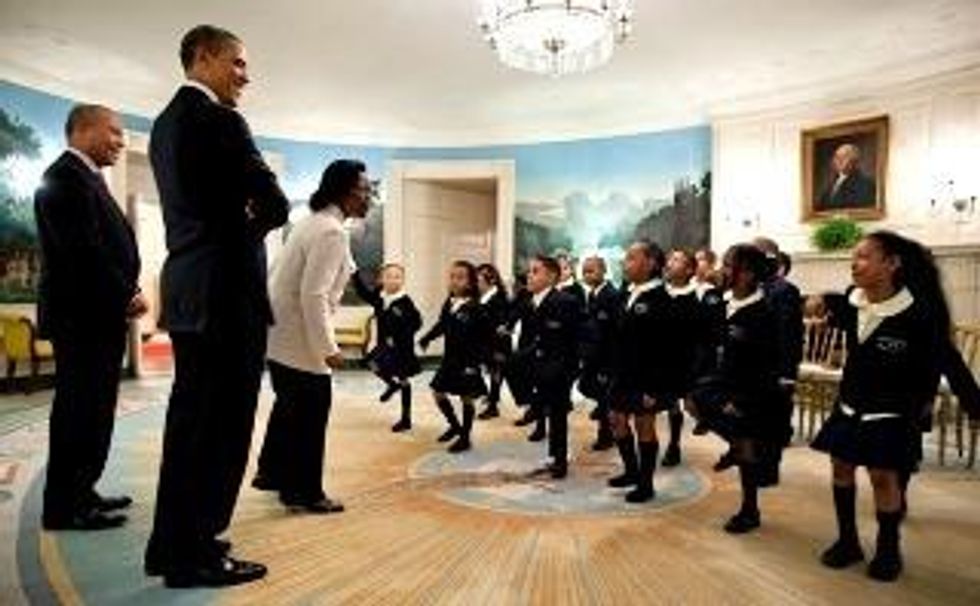
"We are true to our creed when a little girl born into the bleakest poverty knows that she has the same chance to succeed as anybody else because she is an American, she is free, and she is equal not just in the eyes of God but also in our own."
However much we might like to imagine otherwise, a little girl born into the bleakest poverty will never have "the same chance to succeed as anybody else." If you take a step back, could anything be more obvious? And yet this notion is so thoroughly woven into the "American creed" that we barely notice how misleading it is.
The Horatio Alger story was always a myth, of course, as class at birth has always shaped the life outcomes of Americans, just as it does for residents of Sweden, Siberia or anywhere else. But in today's America--where the richest 1 percent have doubled their share of national income since 1980, according to Oxfam--an individual's fate is truly forged by the circumstances of her parents. It's easy to lose sight of this fact when the inspiring stories of Sonia Sotomayor, or the president himself, show us extraordinary individuals beating the odds. But that's the thing about odds--most people don't beat them.
Consider that, according to a Pew report released last July:
There's plenty more where those statistics came from.
In June 2010, the Urban Institute published a report based on a longitudinal survey of 1,795 people, followed between 1968 and 2005. It found that those who are born poor are far more likely to experience poverty as adults. "While 4 percent of individuals in non-poor families at birth go on to spend at least half their early adult years living in poverty, the comparable number for individuals born into poverty is 21 percent," the report noted.
Meanwhile, people born poor are three times as likely not to finish high school. Only 8 percent of children born into poverty graduate from college by the age of 25.
With these grim numbers in mind, it's truly depressing to think about the long-term effect of the Great Recession, with the spike in child poverty it caused, on a new generation of Americans.
Certainly, there is much that can and must urgently be done by government to restore some of the equality of opportunity that has been lost as wealth has concentrated at the top. Truly investing in public education--not just a few charter schools--is arguably most vital. But given the chasm that now separates rich from poor, improving conditions in schools or preserving Medicaid and other existing social programs is not going to give a hard-knocks Bronx kid the chance to compete with his Park Avenue counterpart on a level playing field. Suggesting otherwise is not only dishonest, but by making it seem like his struggles arise from his own weakness, it places yet another hurdle before him.
Liberals seeking affirmation for their faith in President Obama believed they found it in his second Inaugural Address, with his passionate invocation of Stonewall and Seneca Falls, his soaring rhetoric about government "of, by and for the people" and an American creed forged "through blood drawn by lash, and blood drawn by sword."
"We are true to our creed when a little girl born into the bleakest poverty knows that she has the same chance to succeed as anybody else because she is an American, she is free, and she is equal not just in the eyes of God but also in our own."
However much we might like to imagine otherwise, a little girl born into the bleakest poverty will never have "the same chance to succeed as anybody else." If you take a step back, could anything be more obvious? And yet this notion is so thoroughly woven into the "American creed" that we barely notice how misleading it is.
The Horatio Alger story was always a myth, of course, as class at birth has always shaped the life outcomes of Americans, just as it does for residents of Sweden, Siberia or anywhere else. But in today's America--where the richest 1 percent have doubled their share of national income since 1980, according to Oxfam--an individual's fate is truly forged by the circumstances of her parents. It's easy to lose sight of this fact when the inspiring stories of Sonia Sotomayor, or the president himself, show us extraordinary individuals beating the odds. But that's the thing about odds--most people don't beat them.
Consider that, according to a Pew report released last July:
There's plenty more where those statistics came from.
In June 2010, the Urban Institute published a report based on a longitudinal survey of 1,795 people, followed between 1968 and 2005. It found that those who are born poor are far more likely to experience poverty as adults. "While 4 percent of individuals in non-poor families at birth go on to spend at least half their early adult years living in poverty, the comparable number for individuals born into poverty is 21 percent," the report noted.
Meanwhile, people born poor are three times as likely not to finish high school. Only 8 percent of children born into poverty graduate from college by the age of 25.
With these grim numbers in mind, it's truly depressing to think about the long-term effect of the Great Recession, with the spike in child poverty it caused, on a new generation of Americans.
Certainly, there is much that can and must urgently be done by government to restore some of the equality of opportunity that has been lost as wealth has concentrated at the top. Truly investing in public education--not just a few charter schools--is arguably most vital. But given the chasm that now separates rich from poor, improving conditions in schools or preserving Medicaid and other existing social programs is not going to give a hard-knocks Bronx kid the chance to compete with his Park Avenue counterpart on a level playing field. Suggesting otherwise is not only dishonest, but by making it seem like his struggles arise from his own weakness, it places yet another hurdle before him.
Liberals seeking affirmation for their faith in President Obama believed they found it in his second Inaugural Address, with his passionate invocation of Stonewall and Seneca Falls, his soaring rhetoric about government "of, by and for the people" and an American creed forged "through blood drawn by lash, and blood drawn by sword."
"We are true to our creed when a little girl born into the bleakest poverty knows that she has the same chance to succeed as anybody else because she is an American, she is free, and she is equal not just in the eyes of God but also in our own."
However much we might like to imagine otherwise, a little girl born into the bleakest poverty will never have "the same chance to succeed as anybody else." If you take a step back, could anything be more obvious? And yet this notion is so thoroughly woven into the "American creed" that we barely notice how misleading it is.
The Horatio Alger story was always a myth, of course, as class at birth has always shaped the life outcomes of Americans, just as it does for residents of Sweden, Siberia or anywhere else. But in today's America--where the richest 1 percent have doubled their share of national income since 1980, according to Oxfam--an individual's fate is truly forged by the circumstances of her parents. It's easy to lose sight of this fact when the inspiring stories of Sonia Sotomayor, or the president himself, show us extraordinary individuals beating the odds. But that's the thing about odds--most people don't beat them.
Consider that, according to a Pew report released last July:
There's plenty more where those statistics came from.
In June 2010, the Urban Institute published a report based on a longitudinal survey of 1,795 people, followed between 1968 and 2005. It found that those who are born poor are far more likely to experience poverty as adults. "While 4 percent of individuals in non-poor families at birth go on to spend at least half their early adult years living in poverty, the comparable number for individuals born into poverty is 21 percent," the report noted.
Meanwhile, people born poor are three times as likely not to finish high school. Only 8 percent of children born into poverty graduate from college by the age of 25.
With these grim numbers in mind, it's truly depressing to think about the long-term effect of the Great Recession, with the spike in child poverty it caused, on a new generation of Americans.
Certainly, there is much that can and must urgently be done by government to restore some of the equality of opportunity that has been lost as wealth has concentrated at the top. Truly investing in public education--not just a few charter schools--is arguably most vital. But given the chasm that now separates rich from poor, improving conditions in schools or preserving Medicaid and other existing social programs is not going to give a hard-knocks Bronx kid the chance to compete with his Park Avenue counterpart on a level playing field. Suggesting otherwise is not only dishonest, but by making it seem like his struggles arise from his own weakness, it places yet another hurdle before him.