SUBSCRIBE TO OUR FREE NEWSLETTER
Daily news & progressive opinion—funded by the people, not the corporations—delivered straight to your inbox.
5
#000000
#FFFFFF
To donate by check, phone, or other method, see our More Ways to Give page.
Daily news & progressive opinion—funded by the people, not the corporations—delivered straight to your inbox.
I dreamed I saw Joe Hill last night; he was alive as you and me -- although that's not saying much anymore. Maybe it's a dose of 2012 cynicism creeping in, but it's hard to shake the escalating feeling that we're here merely on borrowed time.
I dreamed I saw Joe Hill last night; he was alive as you and me -- although that's not saying much anymore. Maybe it's a dose of 2012 cynicism creeping in, but it's hard to shake the escalating feeling that we're here merely on borrowed time. The strangest part of this sensation is that if one said it openly even just a few short years ago, it may have seemed irrational and alarmist; now, with empirical observations and the grim predictions of most credible scientists firmly in hand, it seems more irrational not to hold the view that the paradigm in which we've been living is rapidly approaching its prophesied closure point.
This does not, of course, relieve us of the obligation to get up every day and keep trying to promote the values of peace and justice in our lives, communities, bioregions, and the larger world. The apocalypse is perhaps the ultimate "off day," but that doesn't mean it's also a day off. Whatever the ineluctable combination of fate and free will has in store for us mere mortals, it remains incumbent upon us to roll up our sleeves and work to avert the self-inflicted cataclysm we've been relentlessly courting. Or, at the least, we might strive to appreciate the blessings we've enjoyed and pass through the eye with love in our hearts and a song in our souls.
After all, why not? If we could do even that much, I surmise that the days ahead might not turn out so bad in the first place. Establishing a predominant ethos of "compassion and beauty" in our outlooks and livelihoods gets pretty close to the root of the matter and could be the ticket for righting the ship in the nick of time. The good news is that we already know how to do this, and once it takes hold it will likely "go viral" (to use the modern vernacular). Us hominids have lived in relative harmony with each other and the world around us for more of our time here than we've been egocentric, militaristic dominators. The post-industrial arc that is pushing to the limit the planet's capacity to continue supporting us is but a mere blip in the cosmic spectrum of existence, even in the time span of our brief human experiment.
I don't want to sugarcoat this by any means. Simply being kind and appreciating the wonder of it all won't apply the brakes to our collective immolation overnight. We also need to immediately wean ourselves off the consumer addictions that have turned most of us into the agents of our own destruction, and we likewise need to promptly abandon both the hardware and software of devastation with which we've laced the culture. Dismantling the weapons of war and violence may be easier than abolishing hatred and aggression, but the two go hand-in-hand (much like capitalism and militarism), and have become mutually reinforcing over time. The act cultivates the attitude, and vice-versa.
Again, there's good news to be found here as well. The very same processes that create positive feedback loops in our economic and political arrangements, and in our ideologies and actions, can also be made to yield mutually supporting "good" results as well. Greater appreciation for the environment lessens our rampant consumption, and transcending our imposed identities as consumers opens up the prospect of being co-creators instead. Being purveyors of peace creates fewer conflicts around us, and fewer "hotspots" in turn promotes greater feelings of peaceableness. Experiencing relationships based on trust and mutual aid cultivates instincts toward greater trustworthiness and adduces behavior motivated beyond the narrow confines of egocentrism and unbridled self-interest.
In this sense, a potential "self-fulfilling apocalypse" can just as likely become a self-fulfilling utopia. It won't be easy, and it will require a reinvigorated spirit of sacrifice and collective responsibility; it will also demand of us an eternal vigilance in order to keep the positive feedback loop, well, "positive." Whatever the challenges, they pale before the ones already beginning to manifest in our midst. In the end, we can either choose to alter course and turn crisis into opportunity, or have the same (for all intents and purposes) imposed upon us by the inescapable laws of nature. I for one prefer the former.
What will the future hold? On the occasional clear night, I can almost see it in my mind's eye. People work for sustenance and pleasure; education and labor are intertwined lifelong pursuits; children are reared collaboratively and joyfully; wealth is measured in relationships and one's willingness to share. The basics of food, water, and energy are firmly entrenched as the collective assets of humankind, and in even more enlightened terms are no longer seen as resources to be consumed but rather as blessings for which to be grateful. Tools replace technologies, actual people supplant abstract politics, conflicts are welcomed as "teachable moments," and the virtues of meaning supersede the value of money. The planet's inherent regenerative processes are celebrated as mechanistic thinking falls into disrepute. Humans willingly take their place among the vast web of life, not in relegation but in celebration. Violence in any manner is an extreme aberration, and is treated restoratively so as not to beget more.
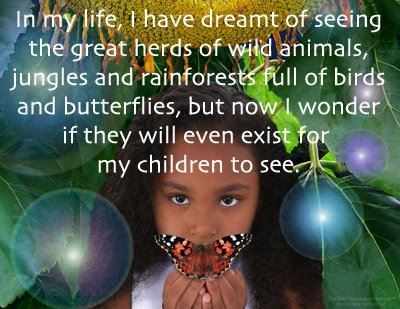
We can get back to this future. We MUST get back to this future, for the sake of ourselves and our progeny. Perhaps, in the end, it's simply a matter of making peace with the generations yet to come...
Dear Common Dreams reader, It’s been nearly 30 years since I co-founded Common Dreams with my late wife, Lina Newhouser. We had the radical notion that journalism should serve the public good, not corporate profits. It was clear to us from the outset what it would take to build such a project. No paid advertisements. No corporate sponsors. No millionaire publisher telling us what to think or do. Many people said we wouldn't last a year, but we proved those doubters wrong. Together with a tremendous team of journalists and dedicated staff, we built an independent media outlet free from the constraints of profits and corporate control. Our mission has always been simple: To inform. To inspire. To ignite change for the common good. Building Common Dreams was not easy. Our survival was never guaranteed. When you take on the most powerful forces—Wall Street greed, fossil fuel industry destruction, Big Tech lobbyists, and uber-rich oligarchs who have spent billions upon billions rigging the economy and democracy in their favor—the only bulwark you have is supporters who believe in your work. But here’s the urgent message from me today. It's never been this bad out there. And it's never been this hard to keep us going. At the very moment Common Dreams is most needed, the threats we face are intensifying. We need your support now more than ever. We don't accept corporate advertising and never will. We don't have a paywall because we don't think people should be blocked from critical news based on their ability to pay. Everything we do is funded by the donations of readers like you. When everyone does the little they can afford, we are strong. But if that support retreats or dries up, so do we. Will you donate now to make sure Common Dreams not only survives but thrives? —Craig Brown, Co-founder |
I dreamed I saw Joe Hill last night; he was alive as you and me -- although that's not saying much anymore. Maybe it's a dose of 2012 cynicism creeping in, but it's hard to shake the escalating feeling that we're here merely on borrowed time. The strangest part of this sensation is that if one said it openly even just a few short years ago, it may have seemed irrational and alarmist; now, with empirical observations and the grim predictions of most credible scientists firmly in hand, it seems more irrational not to hold the view that the paradigm in which we've been living is rapidly approaching its prophesied closure point.
This does not, of course, relieve us of the obligation to get up every day and keep trying to promote the values of peace and justice in our lives, communities, bioregions, and the larger world. The apocalypse is perhaps the ultimate "off day," but that doesn't mean it's also a day off. Whatever the ineluctable combination of fate and free will has in store for us mere mortals, it remains incumbent upon us to roll up our sleeves and work to avert the self-inflicted cataclysm we've been relentlessly courting. Or, at the least, we might strive to appreciate the blessings we've enjoyed and pass through the eye with love in our hearts and a song in our souls.
After all, why not? If we could do even that much, I surmise that the days ahead might not turn out so bad in the first place. Establishing a predominant ethos of "compassion and beauty" in our outlooks and livelihoods gets pretty close to the root of the matter and could be the ticket for righting the ship in the nick of time. The good news is that we already know how to do this, and once it takes hold it will likely "go viral" (to use the modern vernacular). Us hominids have lived in relative harmony with each other and the world around us for more of our time here than we've been egocentric, militaristic dominators. The post-industrial arc that is pushing to the limit the planet's capacity to continue supporting us is but a mere blip in the cosmic spectrum of existence, even in the time span of our brief human experiment.
I don't want to sugarcoat this by any means. Simply being kind and appreciating the wonder of it all won't apply the brakes to our collective immolation overnight. We also need to immediately wean ourselves off the consumer addictions that have turned most of us into the agents of our own destruction, and we likewise need to promptly abandon both the hardware and software of devastation with which we've laced the culture. Dismantling the weapons of war and violence may be easier than abolishing hatred and aggression, but the two go hand-in-hand (much like capitalism and militarism), and have become mutually reinforcing over time. The act cultivates the attitude, and vice-versa.
Again, there's good news to be found here as well. The very same processes that create positive feedback loops in our economic and political arrangements, and in our ideologies and actions, can also be made to yield mutually supporting "good" results as well. Greater appreciation for the environment lessens our rampant consumption, and transcending our imposed identities as consumers opens up the prospect of being co-creators instead. Being purveyors of peace creates fewer conflicts around us, and fewer "hotspots" in turn promotes greater feelings of peaceableness. Experiencing relationships based on trust and mutual aid cultivates instincts toward greater trustworthiness and adduces behavior motivated beyond the narrow confines of egocentrism and unbridled self-interest.
In this sense, a potential "self-fulfilling apocalypse" can just as likely become a self-fulfilling utopia. It won't be easy, and it will require a reinvigorated spirit of sacrifice and collective responsibility; it will also demand of us an eternal vigilance in order to keep the positive feedback loop, well, "positive." Whatever the challenges, they pale before the ones already beginning to manifest in our midst. In the end, we can either choose to alter course and turn crisis into opportunity, or have the same (for all intents and purposes) imposed upon us by the inescapable laws of nature. I for one prefer the former.
What will the future hold? On the occasional clear night, I can almost see it in my mind's eye. People work for sustenance and pleasure; education and labor are intertwined lifelong pursuits; children are reared collaboratively and joyfully; wealth is measured in relationships and one's willingness to share. The basics of food, water, and energy are firmly entrenched as the collective assets of humankind, and in even more enlightened terms are no longer seen as resources to be consumed but rather as blessings for which to be grateful. Tools replace technologies, actual people supplant abstract politics, conflicts are welcomed as "teachable moments," and the virtues of meaning supersede the value of money. The planet's inherent regenerative processes are celebrated as mechanistic thinking falls into disrepute. Humans willingly take their place among the vast web of life, not in relegation but in celebration. Violence in any manner is an extreme aberration, and is treated restoratively so as not to beget more.
We can get back to this future. We MUST get back to this future, for the sake of ourselves and our progeny. Perhaps, in the end, it's simply a matter of making peace with the generations yet to come...
I dreamed I saw Joe Hill last night; he was alive as you and me -- although that's not saying much anymore. Maybe it's a dose of 2012 cynicism creeping in, but it's hard to shake the escalating feeling that we're here merely on borrowed time. The strangest part of this sensation is that if one said it openly even just a few short years ago, it may have seemed irrational and alarmist; now, with empirical observations and the grim predictions of most credible scientists firmly in hand, it seems more irrational not to hold the view that the paradigm in which we've been living is rapidly approaching its prophesied closure point.
This does not, of course, relieve us of the obligation to get up every day and keep trying to promote the values of peace and justice in our lives, communities, bioregions, and the larger world. The apocalypse is perhaps the ultimate "off day," but that doesn't mean it's also a day off. Whatever the ineluctable combination of fate and free will has in store for us mere mortals, it remains incumbent upon us to roll up our sleeves and work to avert the self-inflicted cataclysm we've been relentlessly courting. Or, at the least, we might strive to appreciate the blessings we've enjoyed and pass through the eye with love in our hearts and a song in our souls.
After all, why not? If we could do even that much, I surmise that the days ahead might not turn out so bad in the first place. Establishing a predominant ethos of "compassion and beauty" in our outlooks and livelihoods gets pretty close to the root of the matter and could be the ticket for righting the ship in the nick of time. The good news is that we already know how to do this, and once it takes hold it will likely "go viral" (to use the modern vernacular). Us hominids have lived in relative harmony with each other and the world around us for more of our time here than we've been egocentric, militaristic dominators. The post-industrial arc that is pushing to the limit the planet's capacity to continue supporting us is but a mere blip in the cosmic spectrum of existence, even in the time span of our brief human experiment.
I don't want to sugarcoat this by any means. Simply being kind and appreciating the wonder of it all won't apply the brakes to our collective immolation overnight. We also need to immediately wean ourselves off the consumer addictions that have turned most of us into the agents of our own destruction, and we likewise need to promptly abandon both the hardware and software of devastation with which we've laced the culture. Dismantling the weapons of war and violence may be easier than abolishing hatred and aggression, but the two go hand-in-hand (much like capitalism and militarism), and have become mutually reinforcing over time. The act cultivates the attitude, and vice-versa.
Again, there's good news to be found here as well. The very same processes that create positive feedback loops in our economic and political arrangements, and in our ideologies and actions, can also be made to yield mutually supporting "good" results as well. Greater appreciation for the environment lessens our rampant consumption, and transcending our imposed identities as consumers opens up the prospect of being co-creators instead. Being purveyors of peace creates fewer conflicts around us, and fewer "hotspots" in turn promotes greater feelings of peaceableness. Experiencing relationships based on trust and mutual aid cultivates instincts toward greater trustworthiness and adduces behavior motivated beyond the narrow confines of egocentrism and unbridled self-interest.
In this sense, a potential "self-fulfilling apocalypse" can just as likely become a self-fulfilling utopia. It won't be easy, and it will require a reinvigorated spirit of sacrifice and collective responsibility; it will also demand of us an eternal vigilance in order to keep the positive feedback loop, well, "positive." Whatever the challenges, they pale before the ones already beginning to manifest in our midst. In the end, we can either choose to alter course and turn crisis into opportunity, or have the same (for all intents and purposes) imposed upon us by the inescapable laws of nature. I for one prefer the former.
What will the future hold? On the occasional clear night, I can almost see it in my mind's eye. People work for sustenance and pleasure; education and labor are intertwined lifelong pursuits; children are reared collaboratively and joyfully; wealth is measured in relationships and one's willingness to share. The basics of food, water, and energy are firmly entrenched as the collective assets of humankind, and in even more enlightened terms are no longer seen as resources to be consumed but rather as blessings for which to be grateful. Tools replace technologies, actual people supplant abstract politics, conflicts are welcomed as "teachable moments," and the virtues of meaning supersede the value of money. The planet's inherent regenerative processes are celebrated as mechanistic thinking falls into disrepute. Humans willingly take their place among the vast web of life, not in relegation but in celebration. Violence in any manner is an extreme aberration, and is treated restoratively so as not to beget more.
We can get back to this future. We MUST get back to this future, for the sake of ourselves and our progeny. Perhaps, in the end, it's simply a matter of making peace with the generations yet to come...