SUBSCRIBE TO OUR FREE NEWSLETTER
Daily news & progressive opinion—funded by the people, not the corporations—delivered straight to your inbox.
5
#000000
#FFFFFF
To donate by check, phone, or other method, see our More Ways to Give page.
As gutsy New Yorkers begin the task of drying out the city, here's one thought that occurred to me last night watching the horrifying pictures from a distance. It's obviously not crucial right now -- but in the long run it might make a difference. Why don't we stop naming these storms for people, and start naming them after oil companies?
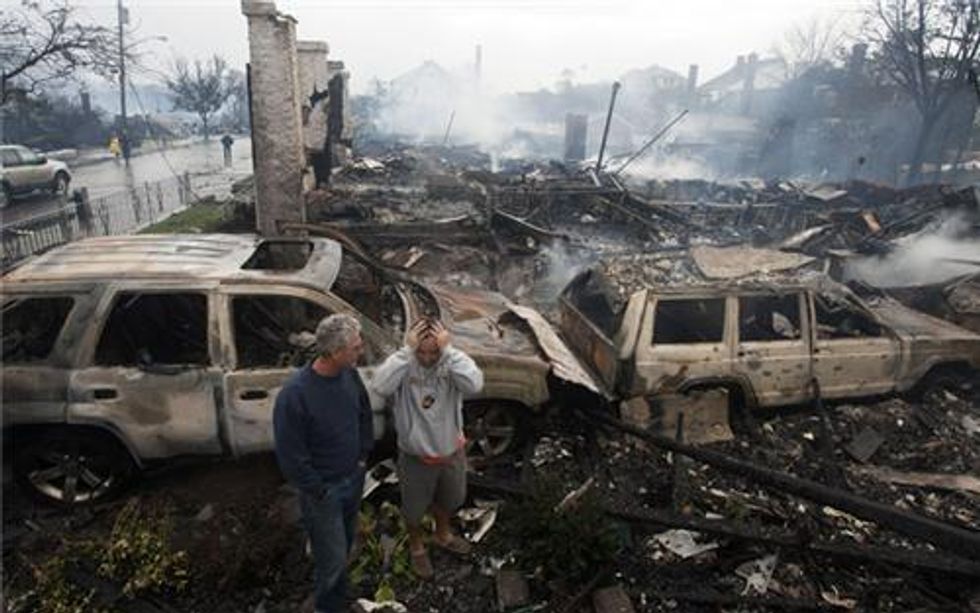
Global warming didn't "cause" this hurricane, of course -- hurricanes are caused when a tropical wave washes off the coast of Africa and begins to spin in the far Atlantic. But this storm rode ocean waters five degrees warmer than normal, so it's no great shock that it turned into a monster. By the time it hit land, it had smashed every record for the lowest barometric pressure, and the largest wind field.
Most of its damage, of course, came from the savage storm surge, washing over the Rockaways, into the Holland Tunnel. It was astonishing to watch on TV as the Lower East Side became a part of the East River. And one reason that surge was so high? The sea level in New York harbor has gone up a foot as the climate has warmed. Sandy had a big head start on flooding out the city.
The fossil fuel companies have played the biggest role in making sure we don't slow global warming down. They've funded climate denial propagandists and helped pack Congress with anti-environmental extremists, making sure that common sense steps to move toward renewable energy never happen. So maybe it's only right that we should honor their efforts by naming storms for them from now on. At the very least it's fun to imagine the newscasters: "Exxon is coming ashore across New Jersey, leaving havoc in her wake." "Chevron forces evacuation of 375,000."
At 350.org, the climate change campaign that I helped found, we're sending out an appeal to our worldwide mailing list today. It asks two things: that people send money to the Red Cross to help with relief efforts along the Atlantic seaboard, and that they send a message to the oil companies asking them to stop funding election campaigns and use the money for recovery efforts instead.
That would help clear the air in DC, and it would also help New York: Chevron, for instance, donated $2.5 million to a GOP Super-PAC last week, the largest single corporate donation since the Supreme Court cleared the way for such influence-buying. In the face of this tragedy, it would be the very least they could do, a tiny start toward repairing the damage they've caused.
For a decade, anyone named Sandy is going to have to endure hurricane jokes. Seems much fairer to pin the blame where it belongs.
As gutsy New Yorkers begin the task of drying out the city, here's one thought that occurred to me last night watching the horrifying pictures from a distance. It's obviously not crucial right now -- but in the long run it might make a difference. Why don't we stop naming these storms for people, and start naming them after oil companies?
Global warming didn't "cause" this hurricane, of course -- hurricanes are caused when a tropical wave washes off the coast of Africa and begins to spin in the far Atlantic. But this storm rode ocean waters five degrees warmer than normal, so it's no great shock that it turned into a monster. By the time it hit land, it had smashed every record for the lowest barometric pressure, and the largest wind field.
Most of its damage, of course, came from the savage storm surge, washing over the Rockaways, into the Holland Tunnel. It was astonishing to watch on TV as the Lower East Side became a part of the East River. And one reason that surge was so high? The sea level in New York harbor has gone up a foot as the climate has warmed. Sandy had a big head start on flooding out the city.
The fossil fuel companies have played the biggest role in making sure we don't slow global warming down. They've funded climate denial propagandists and helped pack Congress with anti-environmental extremists, making sure that common sense steps to move toward renewable energy never happen. So maybe it's only right that we should honor their efforts by naming storms for them from now on. At the very least it's fun to imagine the newscasters: "Exxon is coming ashore across New Jersey, leaving havoc in her wake." "Chevron forces evacuation of 375,000."
At 350.org, the climate change campaign that I helped found, we're sending out an appeal to our worldwide mailing list today. It asks two things: that people send money to the Red Cross to help with relief efforts along the Atlantic seaboard, and that they send a message to the oil companies asking them to stop funding election campaigns and use the money for recovery efforts instead.
That would help clear the air in DC, and it would also help New York: Chevron, for instance, donated $2.5 million to a GOP Super-PAC last week, the largest single corporate donation since the Supreme Court cleared the way for such influence-buying. In the face of this tragedy, it would be the very least they could do, a tiny start toward repairing the damage they've caused.
For a decade, anyone named Sandy is going to have to endure hurricane jokes. Seems much fairer to pin the blame where it belongs.
As gutsy New Yorkers begin the task of drying out the city, here's one thought that occurred to me last night watching the horrifying pictures from a distance. It's obviously not crucial right now -- but in the long run it might make a difference. Why don't we stop naming these storms for people, and start naming them after oil companies?
Global warming didn't "cause" this hurricane, of course -- hurricanes are caused when a tropical wave washes off the coast of Africa and begins to spin in the far Atlantic. But this storm rode ocean waters five degrees warmer than normal, so it's no great shock that it turned into a monster. By the time it hit land, it had smashed every record for the lowest barometric pressure, and the largest wind field.
Most of its damage, of course, came from the savage storm surge, washing over the Rockaways, into the Holland Tunnel. It was astonishing to watch on TV as the Lower East Side became a part of the East River. And one reason that surge was so high? The sea level in New York harbor has gone up a foot as the climate has warmed. Sandy had a big head start on flooding out the city.
The fossil fuel companies have played the biggest role in making sure we don't slow global warming down. They've funded climate denial propagandists and helped pack Congress with anti-environmental extremists, making sure that common sense steps to move toward renewable energy never happen. So maybe it's only right that we should honor their efforts by naming storms for them from now on. At the very least it's fun to imagine the newscasters: "Exxon is coming ashore across New Jersey, leaving havoc in her wake." "Chevron forces evacuation of 375,000."
At 350.org, the climate change campaign that I helped found, we're sending out an appeal to our worldwide mailing list today. It asks two things: that people send money to the Red Cross to help with relief efforts along the Atlantic seaboard, and that they send a message to the oil companies asking them to stop funding election campaigns and use the money for recovery efforts instead.
That would help clear the air in DC, and it would also help New York: Chevron, for instance, donated $2.5 million to a GOP Super-PAC last week, the largest single corporate donation since the Supreme Court cleared the way for such influence-buying. In the face of this tragedy, it would be the very least they could do, a tiny start toward repairing the damage they've caused.
For a decade, anyone named Sandy is going to have to endure hurricane jokes. Seems much fairer to pin the blame where it belongs.