SUBSCRIBE TO OUR FREE NEWSLETTER
Daily news & progressive opinion—funded by the people, not the corporations—delivered straight to your inbox.
5
#000000
#FFFFFF
To donate by check, phone, or other method, see our More Ways to Give page.
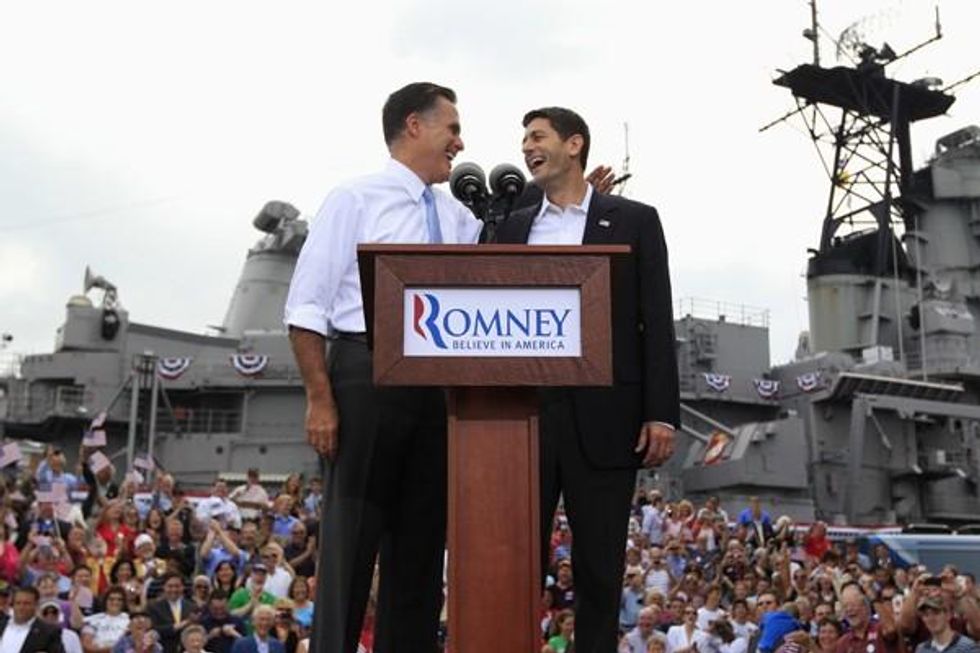
One of the jokes of our era is the Republican Party's claim that it favors "small government." An accurate description might go more like this: the present-day Republican Party (libertarians excepted) has never seen an oppressive power of the national security state it didn't want to bolster or grow. And it loves big government--the bigger the better--as long as we're talking about the military-industrial complex. Mitt Romney, for instance, is eager to build ever more naval vessels, increase the size of U.S. ground forces, and up by an extra $2 trillion or more over the next decade the Pentagon's already staggering budget. As the Bush administration proved and the Obama administration emphasized, stimulus packages, including massive infrastructural projects, are fine and dandy when pursued in Baghdad (biggest embassy on Earth) or Afghanistan (most bases ever). Consider it an irony, that even undocumented aliens are a Republican "go," if they happen to be part of the semi-slave labor force that helps to build and service American bases in war zones abroad.
And lest anyone claim that we're now a can't-do nation with a can't-do government, it's simply not true. Increasingly true, however, is that governmental "doing" only happens these days when the U.S. military is doing it. This is, of course, the definition of a militarizing society. And yet, let's face it, the Pentagon's ability to create infrastructure remains impressive -- and something Americans know remarkably little about.
Take the news that the Pentagon has built 550 bases or more in Afghanistan in TomDispatch associate editor Nick Turse's new piece, "Afghanistan's Base Bonanza." To construct hundreds of bases, some humongous, in a poverty-stricken, landlocked country (with few building resources of its own) thousands of miles from ours is little short of stunning. In fact, thought of a certain way, the whole American way of war has the same quality. Take the largest base built in Iraq, the ill-named Camp Victory with a 27-mile perimeter. Housing 40,000 military personnel and 20,000 contractors, it had, among the usual brand-name fast-food restaurants, Internet cafes, and PXes, "a reverse osmosis water plant that could generate 1.85 million gallons a day, an ice plant, a 50-megawatt power generating station, stadium-sized chow halls, and a laundromat with 3,000 machines able to do 36,000 loads a day."
Since any style of warfare emerges from the society that spawns it, we shouldn't be surprised that we carry our particular version of a consumer society to war with us. Think, for instance, of the final withdrawal from Iraq in 2011, when the U.S. military shipped out much of what we had brought in with us. That turned out to be an estimated three million objects, ranging from tanks and laptop computers to toilets and tables (with at least another four million objects turned over to the Iraqis, "including 89,000 air conditioners worth $18.5 million").
Now, as if to remind us of the profligate nature of the American way of war, comes the news that to withdraw U.S. combat troops from Afghanistan by the end of 2014, the U.S. military may have to send in extra troops to sort through the more than $60 billion worth of equipment and materiel that needs to leave with them. Think of it not as an urge but a surge to depart, and a part of the general madness of war, American-style, in these last years. Those extra troops will, by the way, be sending out at least 200,000 shipping containers and vehicles.
Big government? It couldn't get bigger. Can-do, you bet. Successful? Not for a second. Maybe the next time Washington wants to build the biggest embassy on Earth and hundreds of bases, large and small, it should do so here and create a few of the fantasy 12 million jobs Mitt Romney is promising Americans.
One of the jokes of our era is the Republican Party's claim that it favors "small government." An accurate description might go more like this: the present-day Republican Party (libertarians excepted) has never seen an oppressive power of the national security state it didn't want to bolster or grow. And it loves big government--the bigger the better--as long as we're talking about the military-industrial complex. Mitt Romney, for instance, is eager to build ever more naval vessels, increase the size of U.S. ground forces, and up by an extra $2 trillion or more over the next decade the Pentagon's already staggering budget. As the Bush administration proved and the Obama administration emphasized, stimulus packages, including massive infrastructural projects, are fine and dandy when pursued in Baghdad (biggest embassy on Earth) or Afghanistan (most bases ever). Consider it an irony, that even undocumented aliens are a Republican "go," if they happen to be part of the semi-slave labor force that helps to build and service American bases in war zones abroad.
And lest anyone claim that we're now a can't-do nation with a can't-do government, it's simply not true. Increasingly true, however, is that governmental "doing" only happens these days when the U.S. military is doing it. This is, of course, the definition of a militarizing society. And yet, let's face it, the Pentagon's ability to create infrastructure remains impressive -- and something Americans know remarkably little about.
Take the news that the Pentagon has built 550 bases or more in Afghanistan in TomDispatch associate editor Nick Turse's new piece, "Afghanistan's Base Bonanza." To construct hundreds of bases, some humongous, in a poverty-stricken, landlocked country (with few building resources of its own) thousands of miles from ours is little short of stunning. In fact, thought of a certain way, the whole American way of war has the same quality. Take the largest base built in Iraq, the ill-named Camp Victory with a 27-mile perimeter. Housing 40,000 military personnel and 20,000 contractors, it had, among the usual brand-name fast-food restaurants, Internet cafes, and PXes, "a reverse osmosis water plant that could generate 1.85 million gallons a day, an ice plant, a 50-megawatt power generating station, stadium-sized chow halls, and a laundromat with 3,000 machines able to do 36,000 loads a day."
Since any style of warfare emerges from the society that spawns it, we shouldn't be surprised that we carry our particular version of a consumer society to war with us. Think, for instance, of the final withdrawal from Iraq in 2011, when the U.S. military shipped out much of what we had brought in with us. That turned out to be an estimated three million objects, ranging from tanks and laptop computers to toilets and tables (with at least another four million objects turned over to the Iraqis, "including 89,000 air conditioners worth $18.5 million").
Now, as if to remind us of the profligate nature of the American way of war, comes the news that to withdraw U.S. combat troops from Afghanistan by the end of 2014, the U.S. military may have to send in extra troops to sort through the more than $60 billion worth of equipment and materiel that needs to leave with them. Think of it not as an urge but a surge to depart, and a part of the general madness of war, American-style, in these last years. Those extra troops will, by the way, be sending out at least 200,000 shipping containers and vehicles.
Big government? It couldn't get bigger. Can-do, you bet. Successful? Not for a second. Maybe the next time Washington wants to build the biggest embassy on Earth and hundreds of bases, large and small, it should do so here and create a few of the fantasy 12 million jobs Mitt Romney is promising Americans.
One of the jokes of our era is the Republican Party's claim that it favors "small government." An accurate description might go more like this: the present-day Republican Party (libertarians excepted) has never seen an oppressive power of the national security state it didn't want to bolster or grow. And it loves big government--the bigger the better--as long as we're talking about the military-industrial complex. Mitt Romney, for instance, is eager to build ever more naval vessels, increase the size of U.S. ground forces, and up by an extra $2 trillion or more over the next decade the Pentagon's already staggering budget. As the Bush administration proved and the Obama administration emphasized, stimulus packages, including massive infrastructural projects, are fine and dandy when pursued in Baghdad (biggest embassy on Earth) or Afghanistan (most bases ever). Consider it an irony, that even undocumented aliens are a Republican "go," if they happen to be part of the semi-slave labor force that helps to build and service American bases in war zones abroad.
And lest anyone claim that we're now a can't-do nation with a can't-do government, it's simply not true. Increasingly true, however, is that governmental "doing" only happens these days when the U.S. military is doing it. This is, of course, the definition of a militarizing society. And yet, let's face it, the Pentagon's ability to create infrastructure remains impressive -- and something Americans know remarkably little about.
Take the news that the Pentagon has built 550 bases or more in Afghanistan in TomDispatch associate editor Nick Turse's new piece, "Afghanistan's Base Bonanza." To construct hundreds of bases, some humongous, in a poverty-stricken, landlocked country (with few building resources of its own) thousands of miles from ours is little short of stunning. In fact, thought of a certain way, the whole American way of war has the same quality. Take the largest base built in Iraq, the ill-named Camp Victory with a 27-mile perimeter. Housing 40,000 military personnel and 20,000 contractors, it had, among the usual brand-name fast-food restaurants, Internet cafes, and PXes, "a reverse osmosis water plant that could generate 1.85 million gallons a day, an ice plant, a 50-megawatt power generating station, stadium-sized chow halls, and a laundromat with 3,000 machines able to do 36,000 loads a day."
Since any style of warfare emerges from the society that spawns it, we shouldn't be surprised that we carry our particular version of a consumer society to war with us. Think, for instance, of the final withdrawal from Iraq in 2011, when the U.S. military shipped out much of what we had brought in with us. That turned out to be an estimated three million objects, ranging from tanks and laptop computers to toilets and tables (with at least another four million objects turned over to the Iraqis, "including 89,000 air conditioners worth $18.5 million").
Now, as if to remind us of the profligate nature of the American way of war, comes the news that to withdraw U.S. combat troops from Afghanistan by the end of 2014, the U.S. military may have to send in extra troops to sort through the more than $60 billion worth of equipment and materiel that needs to leave with them. Think of it not as an urge but a surge to depart, and a part of the general madness of war, American-style, in these last years. Those extra troops will, by the way, be sending out at least 200,000 shipping containers and vehicles.
Big government? It couldn't get bigger. Can-do, you bet. Successful? Not for a second. Maybe the next time Washington wants to build the biggest embassy on Earth and hundreds of bases, large and small, it should do so here and create a few of the fantasy 12 million jobs Mitt Romney is promising Americans.