SUBSCRIBE TO OUR FREE NEWSLETTER
Daily news & progressive opinion—funded by the people, not the corporations—delivered straight to your inbox.
5
#000000
#FFFFFF
To donate by check, phone, or other method, see our More Ways to Give page.
Almost a week since the Rio+20 Earth Summit ended, civil society is coming to terms with the 'epic failure' of global leaders to agree meaningful action for addressing the worsening planetary and social crises. Campaigners were near unanimous in decrying the inertia and lack of urgency shown by governments for tackling issues related to sustainable development, with national self-interest overriding any possibility of dealing with global problems in a genuinely cooperative and global manner.
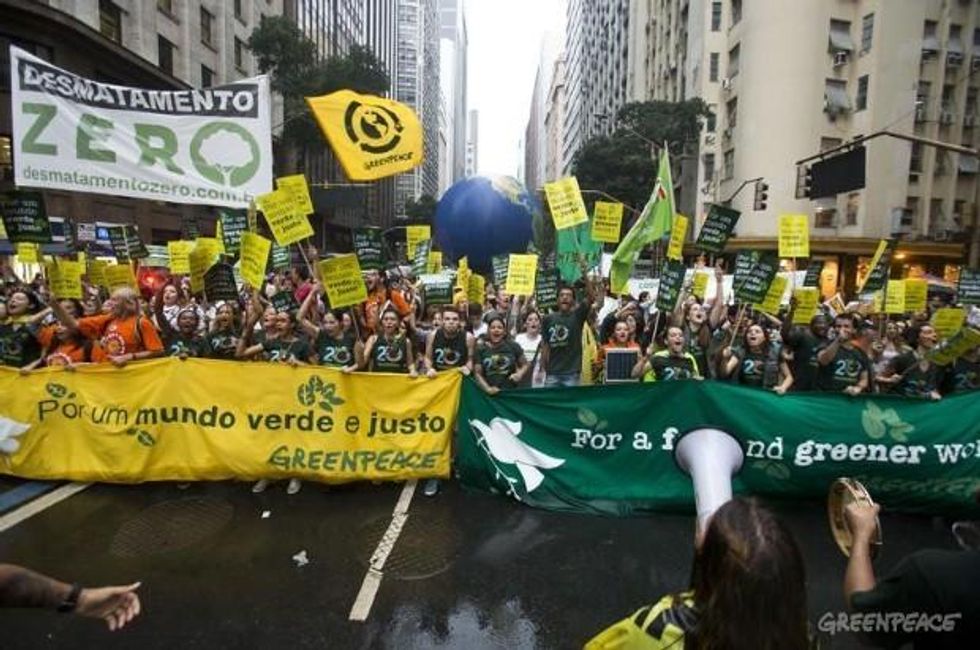
Of particular concern was the ambiguous concept of a 'green economy', which many activists feared is the latest attempt of corporations to use the environmental crisis as an opportunity for making greater profits. Many NGOs observed the growing influence of major corporations and business lobby groups within the United Nations - one of the biggest differences between the first Rio Summit in 1992 and the latest gathering twenty years later, which is reinforcing policies that support the commercial interests of companies and preventing critical measures that serve the public good.
The real talk and action at Rio last week was not among ministers and heads of state, but in the parallel Peoples Summit for Social and Environmental Justice that was held over a 10 day period to propose real solutions to the serious problems that humanity is facing. This was the forum where the true meaning of 'sustainable development' was discussed and understood, with obvious implications for our current way of life and patterns of production and consumption. Clearly, long-term sustainability requires an acceptance that infinite growth is impossible on a finite planet. And living conditions can never be equalised around the world unless the over-consuming nations - the 20 percent of the world population that consumes 80 percent of the Earth's resources - learn to live more simply and embrace the principle of sharing.
Sadly, the Rio+20 Declaration in no way reflected the global level of sharing, unity and cooperation that is needed to set humanity on a sustainable path. For example, instead of acknowledging that the solutions to poverty and inequality lie in 'sustainable' growth, the Declaration pledged 16 times over to pursue 'sustained' growth - i.e. growth at all costs, the root cause of ecological destruction - with only a vague call for "fundamental changes in the way societies consume and produce". The U.S. lobbied to remove the word "equitable" from the text, along with any mention of the right to food, water, healthcare and gender equality.
Following the 'hoax summit' and failure of political leadership at Rio last week, there is no longer any doubt that the responsibility for change rests with us - ordinary, engaged citizens - to forge a united and informed world public opinion that is stronger than any government or vested interest. The challenge is formidable, unprecedented, and urgent.
No firm commitment was made to end the $1 trillion spent globally on fossil fuel subsidies, regardless of a petition signed by 1 million people and massive campaigning on the issue. No new money was pledged to help poorer countries to develop in a sustainable way. And the key principle of Common But Differentiated Responsibilities (CBDR) - in which developed countries accept playing a greater part in protecting the world's resources, considering that they are responsible for most of the damage - was almost side-lined from the text. In short, Rio+20 underscored how viable solutions for the world's multiple crises are now effectively pushed off the table in international forums by minority vested interests and competitive nationalistic thinking.
The question for many people is: what now? If world leaders and policymakers are paying merely lip service to the unfolding human and environmental catastrophe, is the growing power of global civil society sufficient to challenge the immense forces that stand in the way of creating a just and sustainable world? After decades of failed conferences and summits on the world's intractable problems, can we imagine a new movement of ordinary people that can fill the vacuum in global leadership?
This is the greatest question of our time, and could be the most important source of hope if the world is to make a safe passage into the 21st Century. Public uprisings and mass occupations have become a significant force for change on the world stage since 2011, most notably in the Middle East revolutions and Occupy protests across North America and Europe. But we still have a long way to go before realising a truly global citizens movement committed to sharing and conserving the world's resources, with the rights of the poorest and most excluded taking pride of place in our hearts and minds. Following the 'hoax summit' and failure of political leadership at Rio last week, there is no longer any doubt that the responsibility for change rests with us - ordinary, engaged citizens - to forge a united and informed world public opinion that is stronger than any government or vested interest. The challenge is formidable, unprecedented, and urgent.
Almost a week since the Rio+20 Earth Summit ended, civil society is coming to terms with the 'epic failure' of global leaders to agree meaningful action for addressing the worsening planetary and social crises. Campaigners were near unanimous in decrying the inertia and lack of urgency shown by governments for tackling issues related to sustainable development, with national self-interest overriding any possibility of dealing with global problems in a genuinely cooperative and global manner.
Of particular concern was the ambiguous concept of a 'green economy', which many activists feared is the latest attempt of corporations to use the environmental crisis as an opportunity for making greater profits. Many NGOs observed the growing influence of major corporations and business lobby groups within the United Nations - one of the biggest differences between the first Rio Summit in 1992 and the latest gathering twenty years later, which is reinforcing policies that support the commercial interests of companies and preventing critical measures that serve the public good.
The real talk and action at Rio last week was not among ministers and heads of state, but in the parallel Peoples Summit for Social and Environmental Justice that was held over a 10 day period to propose real solutions to the serious problems that humanity is facing. This was the forum where the true meaning of 'sustainable development' was discussed and understood, with obvious implications for our current way of life and patterns of production and consumption. Clearly, long-term sustainability requires an acceptance that infinite growth is impossible on a finite planet. And living conditions can never be equalised around the world unless the over-consuming nations - the 20 percent of the world population that consumes 80 percent of the Earth's resources - learn to live more simply and embrace the principle of sharing.
Sadly, the Rio+20 Declaration in no way reflected the global level of sharing, unity and cooperation that is needed to set humanity on a sustainable path. For example, instead of acknowledging that the solutions to poverty and inequality lie in 'sustainable' growth, the Declaration pledged 16 times over to pursue 'sustained' growth - i.e. growth at all costs, the root cause of ecological destruction - with only a vague call for "fundamental changes in the way societies consume and produce". The U.S. lobbied to remove the word "equitable" from the text, along with any mention of the right to food, water, healthcare and gender equality.
Following the 'hoax summit' and failure of political leadership at Rio last week, there is no longer any doubt that the responsibility for change rests with us - ordinary, engaged citizens - to forge a united and informed world public opinion that is stronger than any government or vested interest. The challenge is formidable, unprecedented, and urgent.
No firm commitment was made to end the $1 trillion spent globally on fossil fuel subsidies, regardless of a petition signed by 1 million people and massive campaigning on the issue. No new money was pledged to help poorer countries to develop in a sustainable way. And the key principle of Common But Differentiated Responsibilities (CBDR) - in which developed countries accept playing a greater part in protecting the world's resources, considering that they are responsible for most of the damage - was almost side-lined from the text. In short, Rio+20 underscored how viable solutions for the world's multiple crises are now effectively pushed off the table in international forums by minority vested interests and competitive nationalistic thinking.
The question for many people is: what now? If world leaders and policymakers are paying merely lip service to the unfolding human and environmental catastrophe, is the growing power of global civil society sufficient to challenge the immense forces that stand in the way of creating a just and sustainable world? After decades of failed conferences and summits on the world's intractable problems, can we imagine a new movement of ordinary people that can fill the vacuum in global leadership?
This is the greatest question of our time, and could be the most important source of hope if the world is to make a safe passage into the 21st Century. Public uprisings and mass occupations have become a significant force for change on the world stage since 2011, most notably in the Middle East revolutions and Occupy protests across North America and Europe. But we still have a long way to go before realising a truly global citizens movement committed to sharing and conserving the world's resources, with the rights of the poorest and most excluded taking pride of place in our hearts and minds. Following the 'hoax summit' and failure of political leadership at Rio last week, there is no longer any doubt that the responsibility for change rests with us - ordinary, engaged citizens - to forge a united and informed world public opinion that is stronger than any government or vested interest. The challenge is formidable, unprecedented, and urgent.
Almost a week since the Rio+20 Earth Summit ended, civil society is coming to terms with the 'epic failure' of global leaders to agree meaningful action for addressing the worsening planetary and social crises. Campaigners were near unanimous in decrying the inertia and lack of urgency shown by governments for tackling issues related to sustainable development, with national self-interest overriding any possibility of dealing with global problems in a genuinely cooperative and global manner.
Of particular concern was the ambiguous concept of a 'green economy', which many activists feared is the latest attempt of corporations to use the environmental crisis as an opportunity for making greater profits. Many NGOs observed the growing influence of major corporations and business lobby groups within the United Nations - one of the biggest differences between the first Rio Summit in 1992 and the latest gathering twenty years later, which is reinforcing policies that support the commercial interests of companies and preventing critical measures that serve the public good.
The real talk and action at Rio last week was not among ministers and heads of state, but in the parallel Peoples Summit for Social and Environmental Justice that was held over a 10 day period to propose real solutions to the serious problems that humanity is facing. This was the forum where the true meaning of 'sustainable development' was discussed and understood, with obvious implications for our current way of life and patterns of production and consumption. Clearly, long-term sustainability requires an acceptance that infinite growth is impossible on a finite planet. And living conditions can never be equalised around the world unless the over-consuming nations - the 20 percent of the world population that consumes 80 percent of the Earth's resources - learn to live more simply and embrace the principle of sharing.
Sadly, the Rio+20 Declaration in no way reflected the global level of sharing, unity and cooperation that is needed to set humanity on a sustainable path. For example, instead of acknowledging that the solutions to poverty and inequality lie in 'sustainable' growth, the Declaration pledged 16 times over to pursue 'sustained' growth - i.e. growth at all costs, the root cause of ecological destruction - with only a vague call for "fundamental changes in the way societies consume and produce". The U.S. lobbied to remove the word "equitable" from the text, along with any mention of the right to food, water, healthcare and gender equality.
Following the 'hoax summit' and failure of political leadership at Rio last week, there is no longer any doubt that the responsibility for change rests with us - ordinary, engaged citizens - to forge a united and informed world public opinion that is stronger than any government or vested interest. The challenge is formidable, unprecedented, and urgent.
No firm commitment was made to end the $1 trillion spent globally on fossil fuel subsidies, regardless of a petition signed by 1 million people and massive campaigning on the issue. No new money was pledged to help poorer countries to develop in a sustainable way. And the key principle of Common But Differentiated Responsibilities (CBDR) - in which developed countries accept playing a greater part in protecting the world's resources, considering that they are responsible for most of the damage - was almost side-lined from the text. In short, Rio+20 underscored how viable solutions for the world's multiple crises are now effectively pushed off the table in international forums by minority vested interests and competitive nationalistic thinking.
The question for many people is: what now? If world leaders and policymakers are paying merely lip service to the unfolding human and environmental catastrophe, is the growing power of global civil society sufficient to challenge the immense forces that stand in the way of creating a just and sustainable world? After decades of failed conferences and summits on the world's intractable problems, can we imagine a new movement of ordinary people that can fill the vacuum in global leadership?
This is the greatest question of our time, and could be the most important source of hope if the world is to make a safe passage into the 21st Century. Public uprisings and mass occupations have become a significant force for change on the world stage since 2011, most notably in the Middle East revolutions and Occupy protests across North America and Europe. But we still have a long way to go before realising a truly global citizens movement committed to sharing and conserving the world's resources, with the rights of the poorest and most excluded taking pride of place in our hearts and minds. Following the 'hoax summit' and failure of political leadership at Rio last week, there is no longer any doubt that the responsibility for change rests with us - ordinary, engaged citizens - to forge a united and informed world public opinion that is stronger than any government or vested interest. The challenge is formidable, unprecedented, and urgent.