SUBSCRIBE TO OUR FREE NEWSLETTER
Daily news & progressive opinion—funded by the people, not the corporations—delivered straight to your inbox.
5
#000000
#FFFFFF
To donate by check, phone, or other method, see our More Ways to Give page.
What's the worst thing you can call female genitalia? I'm guessing Jeremy Hunt just popped into your mind. Yet for Michigan state representatives, the most offensive thing you can say when debating the issue of abortion, is "vagina". In a debate on a bill that would restrict abortion in a number of ways, state representative Lisa Brown finished her opposition speech with: "Finally, Mr Speaker, I'm flattered that you're all so interested in my vagina, but no means no." She was subsequently banned from taking part in a debate on the school employee retirement bill.
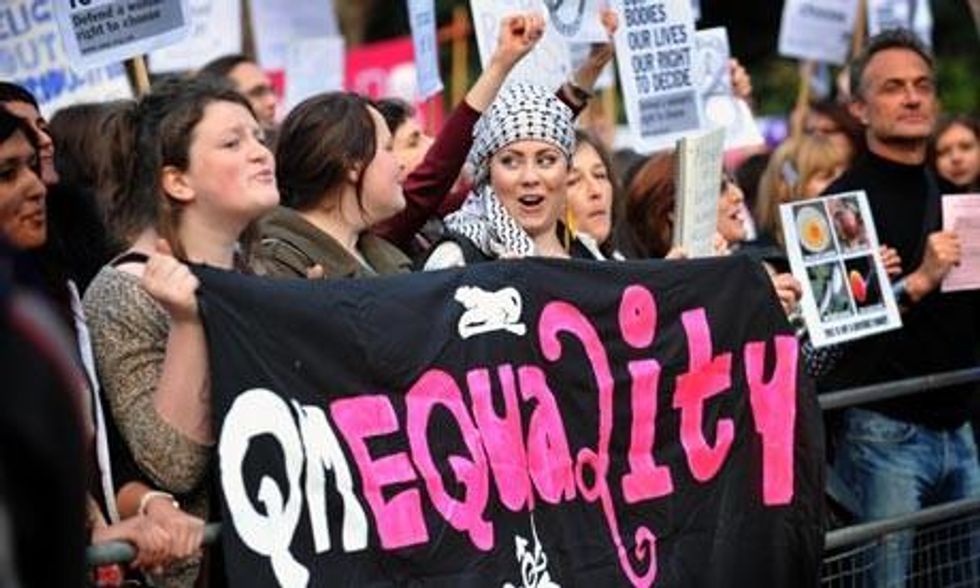
Apparently, when discussing a medical procedure, it's not really appropriate to use medical words. Well not about lady bits anyway. It makes me wonder what euphemisms would be acceptable. "Will the representative get his hand out of the otter's pocket?" "Can the honourable gentleman refrain from trespassing in the lady cave?"
Delicate little flower, representative Mike Callton, reacted to Brown's quim quip with: "It was so offensive, I don't even want to say it in front of women." Well thank you, Mike, the last thing I want is an informed political debate about my genitalia that involves the correct anatomical words.
This comes a month after a woman was thrown off an American Airlines flight for wearing a T-shirt bearing the legend: "If I wanted the government in my womb, I'd fuck a senator."
But while both statements may prove that the pro-choicers have the best jokes, what these clampdowns on legitimate freedom of speech demonstrate is that the tactic of the anti-choice movement (euphemistically called "pro-lifers") to airbrush women's bodies out of the debate on abortion. To be against abortion, you need to get round the uncomfortable fact that women and girls' bodies must play host to your ideological opinions. You need to focus on the foetus and not an actual human being surrounding it.
"...there are a lot of offensive words for vagina; but vagina isn't one of them."
A perfect illustration of this was made by Virginia state, which attempted to pass legislation to make a trans-vaginal (ie up the vagina) ultrasound mandatory for all women seeking an abortion. Owing to the wording, however, even groups campaigning for women's sexual and reproductive rights did not know the reality of this invasive procedure at first. The only way the bill was halted in Virginia was by campaigners pointing out that forcing women to have an unnecessary procedure in which something was inserted into their vagina was an awful lot like rape.
Put this need to remove women's physicality from the abortion debate together with an age-old disgust in what's between women's legs and you have a situation where "vagina" is considered offensive. Where people still blanche with fear and faint in the street at the mere thought of a lady garden.
To be honest I quite like that the worst swearword in the English language is derived from the fanny-fou-fah - and that there are a lot of offensive words for vagina; but vagina isn't one of them. Of course if Brown had referred to her vulva, I would have grimaced. Who wants their fun tunnel to sound a clapped-out car? But whatever accurate or euphemistic term is used for women's genitals, the aim is for legislators to distance themselves and refuse to acknowledge the intimate nature of their regulation. Yes, all of these examples are from the US where abortion continues to be a blue touch paper issue. But it is only a matter of time before these tactics swim the Atlantic and are deployed in the UK.
It is important that the visceral vocabulary of women's bodies is part of the abortion debate. It is difficult to imagine true equality for women when our internal organs are a public space. It is necessary for them to abstract women out of the debate otherwise they may find that forcing a woman through the trauma of an unwanted pregnancy or putting her life at risk by leaving her no other choice than an unsafe abortion, might make them look somewhat vicious.
I'm all for fanny euphemisms. But when an elected representative cannot get up in a legislative chamber and refer to vaginas in a debate about women's health then we are risking uterus erasure. I say no to rubbing out the red snapper. It's time for us to shove our growlers in the faces of the anti-choicers and demand that they chow down on our bodily autonomy.
What's the worst thing you can call female genitalia? I'm guessing Jeremy Hunt just popped into your mind. Yet for Michigan state representatives, the most offensive thing you can say when debating the issue of abortion, is "vagina". In a debate on a bill that would restrict abortion in a number of ways, state representative Lisa Brown finished her opposition speech with: "Finally, Mr Speaker, I'm flattered that you're all so interested in my vagina, but no means no." She was subsequently banned from taking part in a debate on the school employee retirement bill.
Apparently, when discussing a medical procedure, it's not really appropriate to use medical words. Well not about lady bits anyway. It makes me wonder what euphemisms would be acceptable. "Will the representative get his hand out of the otter's pocket?" "Can the honourable gentleman refrain from trespassing in the lady cave?"
Delicate little flower, representative Mike Callton, reacted to Brown's quim quip with: "It was so offensive, I don't even want to say it in front of women." Well thank you, Mike, the last thing I want is an informed political debate about my genitalia that involves the correct anatomical words.
This comes a month after a woman was thrown off an American Airlines flight for wearing a T-shirt bearing the legend: "If I wanted the government in my womb, I'd fuck a senator."
But while both statements may prove that the pro-choicers have the best jokes, what these clampdowns on legitimate freedom of speech demonstrate is that the tactic of the anti-choice movement (euphemistically called "pro-lifers") to airbrush women's bodies out of the debate on abortion. To be against abortion, you need to get round the uncomfortable fact that women and girls' bodies must play host to your ideological opinions. You need to focus on the foetus and not an actual human being surrounding it.
"...there are a lot of offensive words for vagina; but vagina isn't one of them."
A perfect illustration of this was made by Virginia state, which attempted to pass legislation to make a trans-vaginal (ie up the vagina) ultrasound mandatory for all women seeking an abortion. Owing to the wording, however, even groups campaigning for women's sexual and reproductive rights did not know the reality of this invasive procedure at first. The only way the bill was halted in Virginia was by campaigners pointing out that forcing women to have an unnecessary procedure in which something was inserted into their vagina was an awful lot like rape.
Put this need to remove women's physicality from the abortion debate together with an age-old disgust in what's between women's legs and you have a situation where "vagina" is considered offensive. Where people still blanche with fear and faint in the street at the mere thought of a lady garden.
To be honest I quite like that the worst swearword in the English language is derived from the fanny-fou-fah - and that there are a lot of offensive words for vagina; but vagina isn't one of them. Of course if Brown had referred to her vulva, I would have grimaced. Who wants their fun tunnel to sound a clapped-out car? But whatever accurate or euphemistic term is used for women's genitals, the aim is for legislators to distance themselves and refuse to acknowledge the intimate nature of their regulation. Yes, all of these examples are from the US where abortion continues to be a blue touch paper issue. But it is only a matter of time before these tactics swim the Atlantic and are deployed in the UK.
It is important that the visceral vocabulary of women's bodies is part of the abortion debate. It is difficult to imagine true equality for women when our internal organs are a public space. It is necessary for them to abstract women out of the debate otherwise they may find that forcing a woman through the trauma of an unwanted pregnancy or putting her life at risk by leaving her no other choice than an unsafe abortion, might make them look somewhat vicious.
I'm all for fanny euphemisms. But when an elected representative cannot get up in a legislative chamber and refer to vaginas in a debate about women's health then we are risking uterus erasure. I say no to rubbing out the red snapper. It's time for us to shove our growlers in the faces of the anti-choicers and demand that they chow down on our bodily autonomy.
What's the worst thing you can call female genitalia? I'm guessing Jeremy Hunt just popped into your mind. Yet for Michigan state representatives, the most offensive thing you can say when debating the issue of abortion, is "vagina". In a debate on a bill that would restrict abortion in a number of ways, state representative Lisa Brown finished her opposition speech with: "Finally, Mr Speaker, I'm flattered that you're all so interested in my vagina, but no means no." She was subsequently banned from taking part in a debate on the school employee retirement bill.
Apparently, when discussing a medical procedure, it's not really appropriate to use medical words. Well not about lady bits anyway. It makes me wonder what euphemisms would be acceptable. "Will the representative get his hand out of the otter's pocket?" "Can the honourable gentleman refrain from trespassing in the lady cave?"
Delicate little flower, representative Mike Callton, reacted to Brown's quim quip with: "It was so offensive, I don't even want to say it in front of women." Well thank you, Mike, the last thing I want is an informed political debate about my genitalia that involves the correct anatomical words.
This comes a month after a woman was thrown off an American Airlines flight for wearing a T-shirt bearing the legend: "If I wanted the government in my womb, I'd fuck a senator."
But while both statements may prove that the pro-choicers have the best jokes, what these clampdowns on legitimate freedom of speech demonstrate is that the tactic of the anti-choice movement (euphemistically called "pro-lifers") to airbrush women's bodies out of the debate on abortion. To be against abortion, you need to get round the uncomfortable fact that women and girls' bodies must play host to your ideological opinions. You need to focus on the foetus and not an actual human being surrounding it.
"...there are a lot of offensive words for vagina; but vagina isn't one of them."
A perfect illustration of this was made by Virginia state, which attempted to pass legislation to make a trans-vaginal (ie up the vagina) ultrasound mandatory for all women seeking an abortion. Owing to the wording, however, even groups campaigning for women's sexual and reproductive rights did not know the reality of this invasive procedure at first. The only way the bill was halted in Virginia was by campaigners pointing out that forcing women to have an unnecessary procedure in which something was inserted into their vagina was an awful lot like rape.
Put this need to remove women's physicality from the abortion debate together with an age-old disgust in what's between women's legs and you have a situation where "vagina" is considered offensive. Where people still blanche with fear and faint in the street at the mere thought of a lady garden.
To be honest I quite like that the worst swearword in the English language is derived from the fanny-fou-fah - and that there are a lot of offensive words for vagina; but vagina isn't one of them. Of course if Brown had referred to her vulva, I would have grimaced. Who wants their fun tunnel to sound a clapped-out car? But whatever accurate or euphemistic term is used for women's genitals, the aim is for legislators to distance themselves and refuse to acknowledge the intimate nature of their regulation. Yes, all of these examples are from the US where abortion continues to be a blue touch paper issue. But it is only a matter of time before these tactics swim the Atlantic and are deployed in the UK.
It is important that the visceral vocabulary of women's bodies is part of the abortion debate. It is difficult to imagine true equality for women when our internal organs are a public space. It is necessary for them to abstract women out of the debate otherwise they may find that forcing a woman through the trauma of an unwanted pregnancy or putting her life at risk by leaving her no other choice than an unsafe abortion, might make them look somewhat vicious.
I'm all for fanny euphemisms. But when an elected representative cannot get up in a legislative chamber and refer to vaginas in a debate about women's health then we are risking uterus erasure. I say no to rubbing out the red snapper. It's time for us to shove our growlers in the faces of the anti-choicers and demand that they chow down on our bodily autonomy.