

House Republicans voted last week to break last summer's deal to raise the debt ceiling and avoid default. "We are here to meet our legal and our moral obligations to lead," Budget Committee Chairman Paul Ryan (R-Wis.) said of the occasion, without a hint of irony.
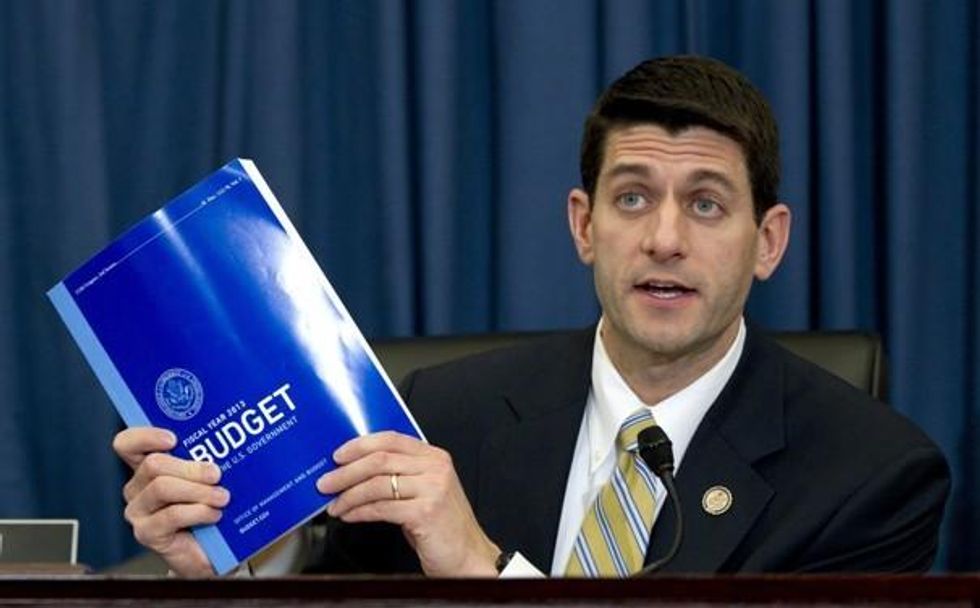
The original debt deal required a bipartisan "supercommittee" to find $4 trillion in deficit savings, or "sequestration" would automatically be triggered -- an across-the-board cut of $1.2 trillion in each party's priority: domestic programs and defense. Even under that self-imposed sword of Damocles, Congress failed to do its job, setting the cuts in motion. But House Republicans argued that the requisite cuts to defense funding would harm national security. Take the money from food stamps and health care for the poor, they cried, as they cradled the defense industry in their arms.
Never mind that the Republicans are, as Jon Stewart said, turning a "suicide pact" into a "murder pact." Is this fear-mongering warranted? Will the looming cuts to the Pentagon's budget really threaten our security?
Not according to many experts on both sides of the aisle. The nuclear policy group Global Zero released a report this month recommending a significant reduction in our nation's nuclear arms arsenal. Signatories included such liberal pacifists as former Republican senator Chuck Hagel and Gen. James E. Cartwright, former vice chairman of the Joint Chiefs of Staff and nuclear forces commander.
Republican Rep. Ron Paul (Tex.), a former presidential candidate, has argued that the doubling of military spending in the past decade "should be extremely troubling for those claiming to be fiscally conservative." In 2010, Paul joined Democratic Rep. Barney Frank (Mass.) to convene a Sustainable Defense Task Force, which identified $1 trillion in defense cuts over 10 years.
Earlier this year the Pentagon itself proposed slowing the growth of its budget by stretching out its purchase of F-35 Joint Strike Fighters, reducing ground forces, and eliminating obsolete or troubled programs. Ending the U.S. combat role in Iraq and Afghanistan will also save $44 billion a year after 2013.
At $700 billion, annual U.S. defense spending represents 57 percent of the federal government's discretionary budget and last year accounted for 41 percent of all global military spending.
Even with the proposed cuts, U.S. military spending would still be the highest in the world by an order of magnitude. "The additional $500 billion in cuts is entirely responsible," Matthew Leatherman, an analyst with the Stimson Center, an independent public policy group, wrote recently, "even if the [sequestration] process is not."
Despite the GOP's overblown rhetoric about security, the American people haven't been fooled. In a recent survey, the Stimson Center, the Program on Public Consultation and the Center for Public Integrity found that after receiving detailed information and arguments on both sides of the issue, the average American favors cutting the defense budget by 18 percent.
In other words, the American people have, once again, proven more rational than some of their representatives.
The GOP hypocrisy on the debt is thinly veiled. With most members having pledged life and limb to anti-tax zealot Grover Norquist, they refuse to consider any revenue increases, including allowing the debt-inducing Bush tax cuts to expire. Defense spending, too, is untouchable. What does it say about their commitment to fiscal responsibility when they treat the biggest pieces of the budget pie like kryptonite?
No, Republicans prefer to put a sledgehammer to the mere 18 percent of the federal budget that funds services for the neediest Americans. Those cuts won't make a significant impact on our debt, but they would have drastic consequences for people's lives. The $60 billion the House recently voted to take from these programs would push at least 300,000 children off their health coverage and 1.8 million people off food stamps.
And for what? To protect the F-35 spending -- long seen and known as a boondoggle -- that will cost at least $1.5 trillion?
Why do House Speaker John Boehner and his right-wing cabal want to sacrifice our most vulnerable citizens to save such programs?
Here's a hint. Last year, the defense industry spent about $131 million lobbying Congress. It contributed almost $23 million to congressional campaigns in 2010. As David Hess, chairman of the lobbying group Aerospace Industries Association, recently boasted, "We're a pretty effective group with a very loud voice." And nothing speaks louder in Washington than cash.
At a time when working families are barely scraping by, the GOP's shameless coddling of the defense industry reveals a great deal about its priorities.
Indeed, the federal budget is more than dry numbers on eye-glazing spreadsheets. It speaks to the values that underpin our democracy and the vision that guides our future.
We can continue pouring money into weapons and wars of the past century. Or we can invest in our nation's health, education, technology and infrastructure -- the real job creators of our nation and the real determinants of our future. Put another way, we can invest in the potential of all our children to drive U.S. success in the global economy.
Forty-eight years ago, President Lyndon B. Johnson challenged us to build "the Great Society." Today, we have the same obligation to pursue a future "where the demands of morality, and the needs of the spirit, can be realized in the life of the nation." Let us not default on it.
House Republicans voted last week to break last summer's deal to raise the debt ceiling and avoid default. "We are here to meet our legal and our moral obligations to lead," Budget Committee Chairman Paul Ryan (R-Wis.) said of the occasion, without a hint of irony.
The original debt deal required a bipartisan "supercommittee" to find $4 trillion in deficit savings, or "sequestration" would automatically be triggered -- an across-the-board cut of $1.2 trillion in each party's priority: domestic programs and defense. Even under that self-imposed sword of Damocles, Congress failed to do its job, setting the cuts in motion. But House Republicans argued that the requisite cuts to defense funding would harm national security. Take the money from food stamps and health care for the poor, they cried, as they cradled the defense industry in their arms.
Never mind that the Republicans are, as Jon Stewart said, turning a "suicide pact" into a "murder pact." Is this fear-mongering warranted? Will the looming cuts to the Pentagon's budget really threaten our security?
Not according to many experts on both sides of the aisle. The nuclear policy group Global Zero released a report this month recommending a significant reduction in our nation's nuclear arms arsenal. Signatories included such liberal pacifists as former Republican senator Chuck Hagel and Gen. James E. Cartwright, former vice chairman of the Joint Chiefs of Staff and nuclear forces commander.
Republican Rep. Ron Paul (Tex.), a former presidential candidate, has argued that the doubling of military spending in the past decade "should be extremely troubling for those claiming to be fiscally conservative." In 2010, Paul joined Democratic Rep. Barney Frank (Mass.) to convene a Sustainable Defense Task Force, which identified $1 trillion in defense cuts over 10 years.
Earlier this year the Pentagon itself proposed slowing the growth of its budget by stretching out its purchase of F-35 Joint Strike Fighters, reducing ground forces, and eliminating obsolete or troubled programs. Ending the U.S. combat role in Iraq and Afghanistan will also save $44 billion a year after 2013.
At $700 billion, annual U.S. defense spending represents 57 percent of the federal government's discretionary budget and last year accounted for 41 percent of all global military spending.
Even with the proposed cuts, U.S. military spending would still be the highest in the world by an order of magnitude. "The additional $500 billion in cuts is entirely responsible," Matthew Leatherman, an analyst with the Stimson Center, an independent public policy group, wrote recently, "even if the [sequestration] process is not."
Despite the GOP's overblown rhetoric about security, the American people haven't been fooled. In a recent survey, the Stimson Center, the Program on Public Consultation and the Center for Public Integrity found that after receiving detailed information and arguments on both sides of the issue, the average American favors cutting the defense budget by 18 percent.
In other words, the American people have, once again, proven more rational than some of their representatives.
The GOP hypocrisy on the debt is thinly veiled. With most members having pledged life and limb to anti-tax zealot Grover Norquist, they refuse to consider any revenue increases, including allowing the debt-inducing Bush tax cuts to expire. Defense spending, too, is untouchable. What does it say about their commitment to fiscal responsibility when they treat the biggest pieces of the budget pie like kryptonite?
No, Republicans prefer to put a sledgehammer to the mere 18 percent of the federal budget that funds services for the neediest Americans. Those cuts won't make a significant impact on our debt, but they would have drastic consequences for people's lives. The $60 billion the House recently voted to take from these programs would push at least 300,000 children off their health coverage and 1.8 million people off food stamps.
And for what? To protect the F-35 spending -- long seen and known as a boondoggle -- that will cost at least $1.5 trillion?
Why do House Speaker John Boehner and his right-wing cabal want to sacrifice our most vulnerable citizens to save such programs?
Here's a hint. Last year, the defense industry spent about $131 million lobbying Congress. It contributed almost $23 million to congressional campaigns in 2010. As David Hess, chairman of the lobbying group Aerospace Industries Association, recently boasted, "We're a pretty effective group with a very loud voice." And nothing speaks louder in Washington than cash.
At a time when working families are barely scraping by, the GOP's shameless coddling of the defense industry reveals a great deal about its priorities.
Indeed, the federal budget is more than dry numbers on eye-glazing spreadsheets. It speaks to the values that underpin our democracy and the vision that guides our future.
We can continue pouring money into weapons and wars of the past century. Or we can invest in our nation's health, education, technology and infrastructure -- the real job creators of our nation and the real determinants of our future. Put another way, we can invest in the potential of all our children to drive U.S. success in the global economy.
Forty-eight years ago, President Lyndon B. Johnson challenged us to build "the Great Society." Today, we have the same obligation to pursue a future "where the demands of morality, and the needs of the spirit, can be realized in the life of the nation." Let us not default on it.
House Republicans voted last week to break last summer's deal to raise the debt ceiling and avoid default. "We are here to meet our legal and our moral obligations to lead," Budget Committee Chairman Paul Ryan (R-Wis.) said of the occasion, without a hint of irony.
The original debt deal required a bipartisan "supercommittee" to find $4 trillion in deficit savings, or "sequestration" would automatically be triggered -- an across-the-board cut of $1.2 trillion in each party's priority: domestic programs and defense. Even under that self-imposed sword of Damocles, Congress failed to do its job, setting the cuts in motion. But House Republicans argued that the requisite cuts to defense funding would harm national security. Take the money from food stamps and health care for the poor, they cried, as they cradled the defense industry in their arms.
Never mind that the Republicans are, as Jon Stewart said, turning a "suicide pact" into a "murder pact." Is this fear-mongering warranted? Will the looming cuts to the Pentagon's budget really threaten our security?
Not according to many experts on both sides of the aisle. The nuclear policy group Global Zero released a report this month recommending a significant reduction in our nation's nuclear arms arsenal. Signatories included such liberal pacifists as former Republican senator Chuck Hagel and Gen. James E. Cartwright, former vice chairman of the Joint Chiefs of Staff and nuclear forces commander.
Republican Rep. Ron Paul (Tex.), a former presidential candidate, has argued that the doubling of military spending in the past decade "should be extremely troubling for those claiming to be fiscally conservative." In 2010, Paul joined Democratic Rep. Barney Frank (Mass.) to convene a Sustainable Defense Task Force, which identified $1 trillion in defense cuts over 10 years.
Earlier this year the Pentagon itself proposed slowing the growth of its budget by stretching out its purchase of F-35 Joint Strike Fighters, reducing ground forces, and eliminating obsolete or troubled programs. Ending the U.S. combat role in Iraq and Afghanistan will also save $44 billion a year after 2013.
At $700 billion, annual U.S. defense spending represents 57 percent of the federal government's discretionary budget and last year accounted for 41 percent of all global military spending.
Even with the proposed cuts, U.S. military spending would still be the highest in the world by an order of magnitude. "The additional $500 billion in cuts is entirely responsible," Matthew Leatherman, an analyst with the Stimson Center, an independent public policy group, wrote recently, "even if the [sequestration] process is not."
Despite the GOP's overblown rhetoric about security, the American people haven't been fooled. In a recent survey, the Stimson Center, the Program on Public Consultation and the Center for Public Integrity found that after receiving detailed information and arguments on both sides of the issue, the average American favors cutting the defense budget by 18 percent.
In other words, the American people have, once again, proven more rational than some of their representatives.
The GOP hypocrisy on the debt is thinly veiled. With most members having pledged life and limb to anti-tax zealot Grover Norquist, they refuse to consider any revenue increases, including allowing the debt-inducing Bush tax cuts to expire. Defense spending, too, is untouchable. What does it say about their commitment to fiscal responsibility when they treat the biggest pieces of the budget pie like kryptonite?
No, Republicans prefer to put a sledgehammer to the mere 18 percent of the federal budget that funds services for the neediest Americans. Those cuts won't make a significant impact on our debt, but they would have drastic consequences for people's lives. The $60 billion the House recently voted to take from these programs would push at least 300,000 children off their health coverage and 1.8 million people off food stamps.
And for what? To protect the F-35 spending -- long seen and known as a boondoggle -- that will cost at least $1.5 trillion?
Why do House Speaker John Boehner and his right-wing cabal want to sacrifice our most vulnerable citizens to save such programs?
Here's a hint. Last year, the defense industry spent about $131 million lobbying Congress. It contributed almost $23 million to congressional campaigns in 2010. As David Hess, chairman of the lobbying group Aerospace Industries Association, recently boasted, "We're a pretty effective group with a very loud voice." And nothing speaks louder in Washington than cash.
At a time when working families are barely scraping by, the GOP's shameless coddling of the defense industry reveals a great deal about its priorities.
Indeed, the federal budget is more than dry numbers on eye-glazing spreadsheets. It speaks to the values that underpin our democracy and the vision that guides our future.
We can continue pouring money into weapons and wars of the past century. Or we can invest in our nation's health, education, technology and infrastructure -- the real job creators of our nation and the real determinants of our future. Put another way, we can invest in the potential of all our children to drive U.S. success in the global economy.
Forty-eight years ago, President Lyndon B. Johnson challenged us to build "the Great Society." Today, we have the same obligation to pursue a future "where the demands of morality, and the needs of the spirit, can be realized in the life of the nation." Let us not default on it.