SUBSCRIBE TO OUR FREE NEWSLETTER
Daily news & progressive opinion—funded by the people, not the corporations—delivered straight to your inbox.
5
#000000
#FFFFFF
To donate by check, phone, or other method, see our More Ways to Give page.
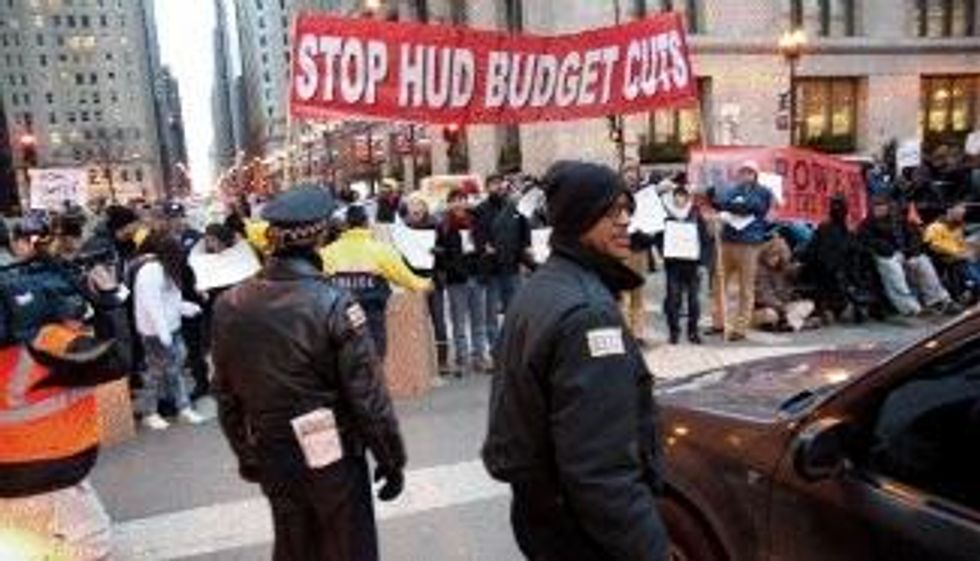
On Friday evening February 25th, 400 people, mostly low-income tenants, braved a chilly winter day to take to the streets in Chicago to stand up against the proposed Republican budget cuts. The cuts would decimate many of the nation's affordable housing programs. Initiated by the Chicago Housing Initiative, a coalition of organizations focused on preserving subsidized housing, the demonstration included acts of civil disobedience. Although many of the organizations had never previously engaged in civil disobedience, the Coalition felt that the situation is so dire that we have to take stronger action. Eleven people blocked a main downtown street to send a message that low-income and working families are ready to fight.
People came to the demonstration to tell elected representatives that the economic crisis is not over for the majority of people living in this country. Rents are too high. Foreclosures have not slowed down. Millions are still looking for work or working at jobs that don't pay enough. So many people are struggling just to survive and to meet the basic needs of themselves and their families. Ms. Adrena Townsend, one of the protestors, said, "I came here because I cannot tighten my belt any more. I cannot do without my home. The House's proposed cuts are aimed at basic human needs such as housing, food, education, and health care. These are not extra trimmings, they are basic necessities."
Just before it left for its February recess, the U.S. House of Representatives voted to slash $61 billion from the current federal budget. They want to cut the Low Income Home Energy Assistance Program (LIHEAP) by 66%. The program provides people with money to pay for heat in the winter. Are these lawmakers willing to turn down or turn off their heat to cut the deficit? They want to cut Women, Infants and Children (WIC) program by 10 %. This program helps pregnant women, new mothers and young children eat well. The House's spending bill would discontinue housing assistance for homeless veterans and cut housing subsidies, job programs and more. In addition the House wants to cut programs like the Community Development Block Grants (CDBG) that fund the agencies that provide necessities such as rental subsidies and energy assistance. These cuts are direct hits to "human services" programs the help meet the basic needs of so many.
The government may need to make cuts, but who decides what to cut? On February 11, 2011 House Majority Leader Eric Cantor (R-Va.) promised that budget cuts will be historic. The Republican controlled House proposed cutting the Housing and Urban Development's $43.5 billion 2011 budget by over 21%. Yet on February 24th we learned that the Air Force is awarding Boeing a $35 billion contract to build air tankers. Why do the House's proposed cuts almost solely target human need programs? Why is it that Congress does not ask working families what is most important to them?
During the demonstration, protestors chanted, "Tax cuts for the rich, service cuts for the poor, we can see who you're for and we won't take it anymore," a slogan that highlights a very real division in this country. One aspect of this division is defining the role of government. The Tea Partiers and their (billionaire) backers want people to think that government is too big and business can handle things on its own without any government interference. According to Herman Bonner, a subsidized tenant and protestor at Friday's demonstration, "I believe the role of government is to ensure that the basic needs of everyone are met and that people have a voice in how this is done."
How you view the government and its role shapes what you think causes the crisis facing this country. For those Tea Party budget cutters in Washington the crisis facing our country is the huge deficit. If nothing is done about the deficit then the country will fall into default and decay. Yet less than two months ago those same representatives voted to cut the taxes on the rich. These cuts were pushed through in the face of growing evidence that wealth disparity in this country has reached epidemic proportions. According to the Institute for Policy Studies, the wealthiest 1 % of the population owns 33 % of all the wealth and the top 10 % own over 70 % of all the wealth. The last time there was such inequality was the 1920's just before the depression. Rather than ask the rich to pay their fair share, the Tea Party plans to cut the deficit and to do it on the backs of the poor.
For millions of Americans, the day to day struggle to maintain food on the table and a roof over one's head defines the crisis. For many families, the economy is stuck in a depression. They worry whether they will have a job next week or next year and what will happen if they don't. Young and old alike worry about social security benefits and retirement. They are afraid that the government will abandon any commitment to help and that they will be left to fend for themselves. They don't expect handouts but they do expect - and deserve - support.
The tenant representatives who blocked traffic on Friday are the beginning signs of a budding movement to demand economic justice. This brewing discontent can also be seen in Madison, Wisconsin where union workers are battling for their right to collective bargaining. There will be more protests as people are asked to "compromise" and to forgo basic necessities. In January, the wealthy won their tax cuts and now they want more. It is in this context that the tenants took to the street chanting "They say cut backs and we say fight back." It is for this reason that people need to unite and fight the draconian cuts to human services that are happening across the country on the local, state, and federal level.
On Friday evening February 25th, 400 people, mostly low-income tenants, braved a chilly winter day to take to the streets in Chicago to stand up against the proposed Republican budget cuts. The cuts would decimate many of the nation's affordable housing programs. Initiated by the Chicago Housing Initiative, a coalition of organizations focused on preserving subsidized housing, the demonstration included acts of civil disobedience. Although many of the organizations had never previously engaged in civil disobedience, the Coalition felt that the situation is so dire that we have to take stronger action. Eleven people blocked a main downtown street to send a message that low-income and working families are ready to fight.
People came to the demonstration to tell elected representatives that the economic crisis is not over for the majority of people living in this country. Rents are too high. Foreclosures have not slowed down. Millions are still looking for work or working at jobs that don't pay enough. So many people are struggling just to survive and to meet the basic needs of themselves and their families. Ms. Adrena Townsend, one of the protestors, said, "I came here because I cannot tighten my belt any more. I cannot do without my home. The House's proposed cuts are aimed at basic human needs such as housing, food, education, and health care. These are not extra trimmings, they are basic necessities."
Just before it left for its February recess, the U.S. House of Representatives voted to slash $61 billion from the current federal budget. They want to cut the Low Income Home Energy Assistance Program (LIHEAP) by 66%. The program provides people with money to pay for heat in the winter. Are these lawmakers willing to turn down or turn off their heat to cut the deficit? They want to cut Women, Infants and Children (WIC) program by 10 %. This program helps pregnant women, new mothers and young children eat well. The House's spending bill would discontinue housing assistance for homeless veterans and cut housing subsidies, job programs and more. In addition the House wants to cut programs like the Community Development Block Grants (CDBG) that fund the agencies that provide necessities such as rental subsidies and energy assistance. These cuts are direct hits to "human services" programs the help meet the basic needs of so many.
The government may need to make cuts, but who decides what to cut? On February 11, 2011 House Majority Leader Eric Cantor (R-Va.) promised that budget cuts will be historic. The Republican controlled House proposed cutting the Housing and Urban Development's $43.5 billion 2011 budget by over 21%. Yet on February 24th we learned that the Air Force is awarding Boeing a $35 billion contract to build air tankers. Why do the House's proposed cuts almost solely target human need programs? Why is it that Congress does not ask working families what is most important to them?
During the demonstration, protestors chanted, "Tax cuts for the rich, service cuts for the poor, we can see who you're for and we won't take it anymore," a slogan that highlights a very real division in this country. One aspect of this division is defining the role of government. The Tea Partiers and their (billionaire) backers want people to think that government is too big and business can handle things on its own without any government interference. According to Herman Bonner, a subsidized tenant and protestor at Friday's demonstration, "I believe the role of government is to ensure that the basic needs of everyone are met and that people have a voice in how this is done."
How you view the government and its role shapes what you think causes the crisis facing this country. For those Tea Party budget cutters in Washington the crisis facing our country is the huge deficit. If nothing is done about the deficit then the country will fall into default and decay. Yet less than two months ago those same representatives voted to cut the taxes on the rich. These cuts were pushed through in the face of growing evidence that wealth disparity in this country has reached epidemic proportions. According to the Institute for Policy Studies, the wealthiest 1 % of the population owns 33 % of all the wealth and the top 10 % own over 70 % of all the wealth. The last time there was such inequality was the 1920's just before the depression. Rather than ask the rich to pay their fair share, the Tea Party plans to cut the deficit and to do it on the backs of the poor.
For millions of Americans, the day to day struggle to maintain food on the table and a roof over one's head defines the crisis. For many families, the economy is stuck in a depression. They worry whether they will have a job next week or next year and what will happen if they don't. Young and old alike worry about social security benefits and retirement. They are afraid that the government will abandon any commitment to help and that they will be left to fend for themselves. They don't expect handouts but they do expect - and deserve - support.
The tenant representatives who blocked traffic on Friday are the beginning signs of a budding movement to demand economic justice. This brewing discontent can also be seen in Madison, Wisconsin where union workers are battling for their right to collective bargaining. There will be more protests as people are asked to "compromise" and to forgo basic necessities. In January, the wealthy won their tax cuts and now they want more. It is in this context that the tenants took to the street chanting "They say cut backs and we say fight back." It is for this reason that people need to unite and fight the draconian cuts to human services that are happening across the country on the local, state, and federal level.
On Friday evening February 25th, 400 people, mostly low-income tenants, braved a chilly winter day to take to the streets in Chicago to stand up against the proposed Republican budget cuts. The cuts would decimate many of the nation's affordable housing programs. Initiated by the Chicago Housing Initiative, a coalition of organizations focused on preserving subsidized housing, the demonstration included acts of civil disobedience. Although many of the organizations had never previously engaged in civil disobedience, the Coalition felt that the situation is so dire that we have to take stronger action. Eleven people blocked a main downtown street to send a message that low-income and working families are ready to fight.
People came to the demonstration to tell elected representatives that the economic crisis is not over for the majority of people living in this country. Rents are too high. Foreclosures have not slowed down. Millions are still looking for work or working at jobs that don't pay enough. So many people are struggling just to survive and to meet the basic needs of themselves and their families. Ms. Adrena Townsend, one of the protestors, said, "I came here because I cannot tighten my belt any more. I cannot do without my home. The House's proposed cuts are aimed at basic human needs such as housing, food, education, and health care. These are not extra trimmings, they are basic necessities."
Just before it left for its February recess, the U.S. House of Representatives voted to slash $61 billion from the current federal budget. They want to cut the Low Income Home Energy Assistance Program (LIHEAP) by 66%. The program provides people with money to pay for heat in the winter. Are these lawmakers willing to turn down or turn off their heat to cut the deficit? They want to cut Women, Infants and Children (WIC) program by 10 %. This program helps pregnant women, new mothers and young children eat well. The House's spending bill would discontinue housing assistance for homeless veterans and cut housing subsidies, job programs and more. In addition the House wants to cut programs like the Community Development Block Grants (CDBG) that fund the agencies that provide necessities such as rental subsidies and energy assistance. These cuts are direct hits to "human services" programs the help meet the basic needs of so many.
The government may need to make cuts, but who decides what to cut? On February 11, 2011 House Majority Leader Eric Cantor (R-Va.) promised that budget cuts will be historic. The Republican controlled House proposed cutting the Housing and Urban Development's $43.5 billion 2011 budget by over 21%. Yet on February 24th we learned that the Air Force is awarding Boeing a $35 billion contract to build air tankers. Why do the House's proposed cuts almost solely target human need programs? Why is it that Congress does not ask working families what is most important to them?
During the demonstration, protestors chanted, "Tax cuts for the rich, service cuts for the poor, we can see who you're for and we won't take it anymore," a slogan that highlights a very real division in this country. One aspect of this division is defining the role of government. The Tea Partiers and their (billionaire) backers want people to think that government is too big and business can handle things on its own without any government interference. According to Herman Bonner, a subsidized tenant and protestor at Friday's demonstration, "I believe the role of government is to ensure that the basic needs of everyone are met and that people have a voice in how this is done."
How you view the government and its role shapes what you think causes the crisis facing this country. For those Tea Party budget cutters in Washington the crisis facing our country is the huge deficit. If nothing is done about the deficit then the country will fall into default and decay. Yet less than two months ago those same representatives voted to cut the taxes on the rich. These cuts were pushed through in the face of growing evidence that wealth disparity in this country has reached epidemic proportions. According to the Institute for Policy Studies, the wealthiest 1 % of the population owns 33 % of all the wealth and the top 10 % own over 70 % of all the wealth. The last time there was such inequality was the 1920's just before the depression. Rather than ask the rich to pay their fair share, the Tea Party plans to cut the deficit and to do it on the backs of the poor.
For millions of Americans, the day to day struggle to maintain food on the table and a roof over one's head defines the crisis. For many families, the economy is stuck in a depression. They worry whether they will have a job next week or next year and what will happen if they don't. Young and old alike worry about social security benefits and retirement. They are afraid that the government will abandon any commitment to help and that they will be left to fend for themselves. They don't expect handouts but they do expect - and deserve - support.
The tenant representatives who blocked traffic on Friday are the beginning signs of a budding movement to demand economic justice. This brewing discontent can also be seen in Madison, Wisconsin where union workers are battling for their right to collective bargaining. There will be more protests as people are asked to "compromise" and to forgo basic necessities. In January, the wealthy won their tax cuts and now they want more. It is in this context that the tenants took to the street chanting "They say cut backs and we say fight back." It is for this reason that people need to unite and fight the draconian cuts to human services that are happening across the country on the local, state, and federal level.