SUBSCRIBE TO OUR FREE NEWSLETTER
Daily news & progressive opinion—funded by the people, not the corporations—delivered straight to your inbox.
5
#000000
#FFFFFF
To donate by check, phone, or other method, see our More Ways to Give page.
Daily news & progressive opinion—funded by the people, not the corporations—delivered straight to your inbox.

"Right now we are in the middle of the last official public comment period for Keystone XL -- one of the very last steps before President Obama makes his decision on the pipeline, and the final opportunity to give your input (in an official way)," writes 350.org on their website, which offers a one-step form to file a comment with the State Department.
"The State Department is accepting comments on the Final Environmental Impact Statement, and the last time State was accepting comments, we submitted over 1 million as a movement--let's see if we can beat that goal this time around," the group writes.
The 30-day public comment period ends on March 7th, at which point Obama will be open to make his final decision.
And on Thursday night, campaigners plan to submit those comments in a less formal way: projecting them on the outside walls of the State Department building.
Groups The Other 98%, 350.org, and the Light Brigade will use what they call "The Illuminator," a large-scale projector, to project comments asking the administration to say no to the pipeline and other anti-Keystone XL messages on the State Department building.
"We are fed up with the State Department's conflict-ridden, Big Carbon influenced, Keystone XL consideration process," said Nicole Carty, actions coordinator for The Other 98%. "That's why, with the help of 'The Illuminator,' we're going to light up the State Department with the comments they'd prefer to ignore."
A report released this week by The Carbon Tracker Initiative showed that the development of the Keystone XL pipeline would have far greater ramifications for the climate than was highlighted in the State Department's recently released final environmental impact analysis. President Obama has said he would approve the pipeline "only if this project doesn't significantly exacerbate the problem of carbon pollution."
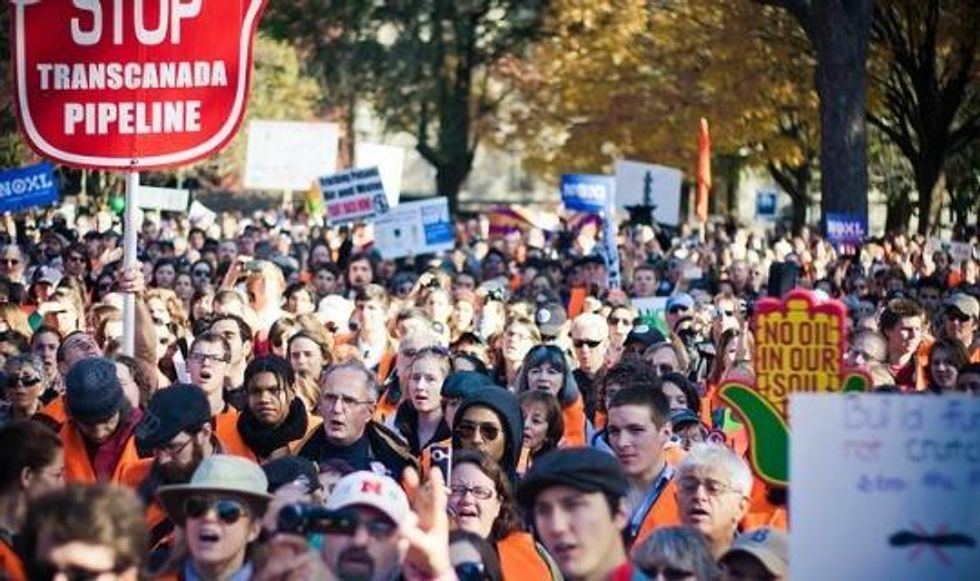
On Sunday, hundreds of students were arrested in the largest single day of civil disobedience throughout the Keystone XL "saga," protest organizers said. Over 1,200 students conducted a mass sit-in in front of the White House, demanding the Obama administration reject the pipeline.
______________________
The Keystone XL tar sands pipeline into the highest profile environmental fight in recent memory

Earlier this morning, I took a break from press calls and preparations for this weekend's big XL Dissent protest in Washington, D.C. to go back and watch some of the original videos we made during Tar Sands Action, the two-weeks of sit-ins in August 2011 that helped turn the Keystone XL tar sands pipeline into the highest profile environmental fight in recent memory.
In a video from the first day of the protests, Gus Speth, a former White House official and co-founder of the Natural Resources Defense Council, says, "We have to draw a line in the sand somewhere and this is a perfect place to draw it. It's a new, controversial, unconventional fossil resource with tremendous potential to harm the global climate, and for Obama to do something in his own power which doesn't require Congress, that would be electrifying and send a powerful signal around this country and around the world that we are going to act."
Tar Sands Action: Come Join Us!A short film capturing first day of 2-weeks of sit-ins at the White House to stop the proposed Keystone XL Pipeline. More info: ...
He continues, "Power responds to a demand and we have to let that demand be heard. It's time to step outside the system and do some things we haven't done before."
Speth was arrested that day and spent two nights in DC central cell block. He got a message out from jail that read, "The only thing we need is more company."
"From the fossil fuel divestment movement to the increasing levels of direct action and civil disobedience, young people are finding powerful ways to make an impact and stand in solidarity with the frontline communities who are feeling the impacts of our dirty energy economy and the climate crisis."
And boy, did he get it. Over the two weeks of Tar Sands Action, 1,253 people were arrested during daily sit-ins protesting the pipeline. Since then, arrests have continued across the country, from the Tar Sands Blockade in Texas, to young people in Michigan (who are still fighting charges), to more civil rights and environmental leaders back at the White House. Those that have gone to jail have been joined by tens of thousands more protesters in the streets during events like Forward on Climate, which brought over 40,000 people to the Capitol last February.
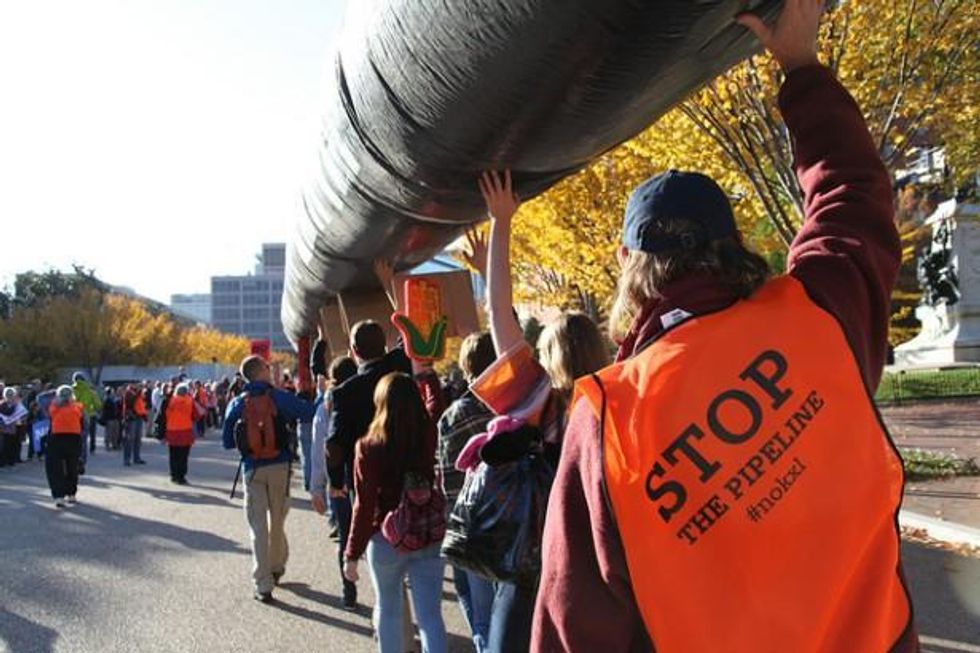
This weekend, will be the largest single act of civil disobedience yet. Over 1,000 students and young people are expected to take part in the XL Dissent protest at the White House. More than 300 of them are planning on risking arrest. If the action goes according to plan, it could turn out to be the largest youth-led act of civil disobedience at the White House in a generation.
I've had the chance to talk with some of the students involved in XL Dissent and the thing that continues to strike me is how level-headed and pragmatic they are. They're risking arrest this weekend not because they're wild-eyed radicals, but because they agree with Speth that power responds to a demand, and that getting that demand heard often requires working outside traditional channels.
Howard Zinn wrote, "Protest beyond the law is not a departure from democracy; it is absolutely essential to it." After years of greening campuses, pushing for recycling and carbon neutrality, and educating their classmates about the threat of climate change, students are increasingly adopting protest as a tool for social change. From the fossil fuel divestment movement to the increasing levels of direct action and civil disobedience, young people are finding powerful ways to make an impact and stand in solidarity with the frontline communities who are feeling the impacts of our dirty energy economy and the climate crisis.
President Obama should know something about the power of principled protest. As he recounts in his autobiography "Dreams From My Father," his first public speech was at a college rally pushing for divestment from apartheid South Africa. As the President looks out from the windows of the White House this Sunday at the hundreds of student activists getting taken away from his fence in handcuffs, many of them divestment organizers back on campus, perhaps it will remind him of the reasons that got him into politics in the first place.
Keystone XL is more than an environmental issue, it's a test of character. The young people taking part in XL Dissent are demonstrating theirs. Now, it's time for the President to show his.
Architecturally, a keystone is the wedge-shaped piece at the crown of an arch that locks the other pieces in place. Without the keystone, the building blocks of an archway will tumble and fall, with no support system for the weight of the arch.

This is a dangerous place to be. Once Barack Obama makes his decision on the pipeline, be it approval or rejection, the keystone will disappear. Without this piece, we could see the weight of the arch tumble down, potentially losing throngs of newly inspired climate activists. As members of Rising Tide North America, a continental network of grassroots groups taking direct action and finding community-based solutions to the root causes of the climate crisis, we believe that to build the climate justice movement we need, we can have no keystone -- no singular solution, campaign, project, or decision maker.
The Keystone XL fight was constructed around picking one proposed project to focus on with a clear elected decider, who had campaigned on addressing climate change. The strategy of DC-focused green groups has been to pressure President Obama to say "no" to Keystone by raising as many controversies as possible about the pipeline and by bringing increased scrutiny to Keystone XL through arrestable demonstrations. Similarly, in Canada, the fight over Enbridge's Northern Gateway tar sands pipeline has unfolded in much the same way, with green groups appealing to politicians to reject Northern Gateway.
However, the mainstream Keystone XL and Northern Gateway campaigns operate on a flawed assumption that the climate movement can compel our elected leaders to respond to the climate crisis with nothing more than an effective communications strategy. Mainstream political parties in both the US and Canada are tied to and dependent on the fossil fuel industry and corporate capitalism. As seen in similar campaigns in 2009 to pass a climate bill in the United States and to ratify an international climate treaty in Copenhagen, the system is rigged against us. Putting Obama and Canadian Prime Minister Stephen Harper at the keystone of the archway creates a flawed narrative that if we, as grassroots groups, work hard enough to stack the building blocks correctly to support them, then elected officials will do what we want. Social change happens when local communities lead, and only then will politicians follow. While we must name and acknowledge power holders like Obama, our movement must empower local communities to make decisions and take action on the causes of the climate crisis in their backyards.
Because of the assumption that the climate movement can trust even "sympathetic" politicians like Obama, these campaigns rely on lifting up one project above all else. Certain language used has made it seem like Keystone XL is an extreme project, with unusual fraud and other injustices associated with it. Indeed the Keystone XL project is extreme and unjust, as is everyfossil fuel project and every piece of the extraction economy. While, for example, the conflict of interests between the State Department, TransCanada and Environmental Resources Management in the United States, and Enbridge and federal politicians in Canada, must be publicized, it should be clear that this government/industry relationship is the norm, not the exception.
The "game over for climate" narrative is also problematic. With both the Keystone and Northern Gateway campaigns, it automatically sets up a hierarchy of projects and extractive types that will inevitably pit communities against each other. Our movement can never question if Keystone XL is worse than Flanagan South (an Enbridge pipeline running from Illinois to Oklahoma), or whether tar sands, fracking or mountaintop removal coal mining is worse. We must reject all these forms of extreme energy for their effects on the climate and the injustices they bring to the people at every stage of the extraction process. Our work must be broad so as to connect fights across the continent into a movement that truly addresses the root causes of social, economic, and climate injustice. We must call for what we really need -- the end to all new fossil fuel infrastructure and extraction. The pipeline placed yesterday in British Columbia, the most recent drag lines added in Wyoming, and the fracking wells built in Pennsylvania need to be the last ones ever built. And we should say that.
This narrative has additionally set up a make-or-break attitude about these pipeline fights that risks that the movement will contract and lose people regardless of the decision on them. The Keystone XL and Northern Gateway fights have engaged hundreds of thousands of people, with many embracing direct action and civil disobedience tactics for the first time. This escalation and level of engagement is inspiring. But the absolutist "game over" language chances to lose many of them. If Obama approves the Keystone XL pipeline, what's to stop many from thinking that this is in fact "game over" for the climate? And if Obama rejects Keystone XL, what's to stop many from thinking that the climate crisis is therefore solved? We need those using the "game over" rhetoric to lay out the climate crisis' root causes -- because just as one project is not the end of humanity, stopping one project will not stop runaway climate change.
The fights over Keystone XL and Northern Gateway have been undoubtedly inspiring. We are seeing the beginnings of the escalation necessary to end extreme energy extraction, stave off the worst effects of the climate crisis, and make a just transition to equitable societies. Grassroots groups engaging in and training for direct action such as the Tar Sands Blockade, Great Plains Tar Sands Resistance, the Unist'ot'en Camp, and Moccasins on the Ground have shown us how direct action can empower local communities and push establishment green groups to embrace bolder tactics. Our movement is indeed growing, and people are willing to put their bodies on the line; an April poll by the Yale Project on Climate Change Communication found one in eight Americans would engage in civil disobedience around global warming.
However, before the Keystone XL and Northern Gateway mainstream campaigns come to an end, we all must recognize the dangers of having an archway approach to movement building. It is the danger of relying on political power-holders, cutting too narrow campaigns, excluding a systemic analysis of root causes, and, ultimately, failing to create a broad-based movement. We must begin to discuss and develop our steps on how we should shift our strategy, realign priorities, escalate direct action, support local groups and campaigns, and keep as many new activists involved as possible.
We are up against the world's largest corporations, who are attempting to extract, transport and burn fossil fuels at an unprecedented rate, all as the climate crisis spins out of control. The climate justice movement should have no keystone because we must match them everywhere they are -- and they are everywhere. To match them, we need a movement of communities all across the continent and the world taking direct action to stop the extraction industry, finding community-based solutions, and addressing the root causes of the climate crisis.
This article appears through a collaboration with Earth Island Journal and was jointly published there.

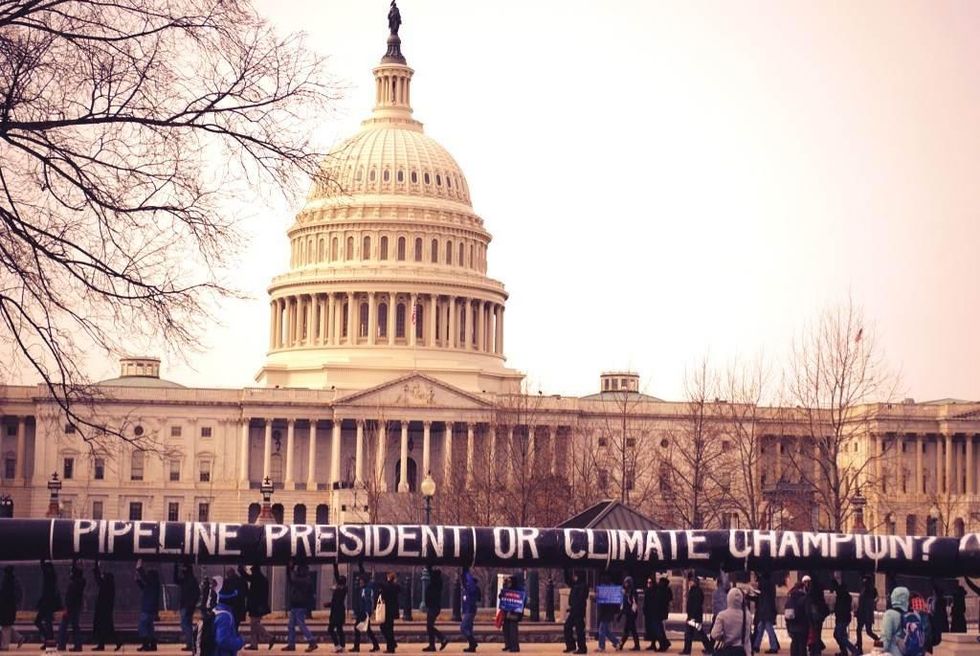
In a coordinated day of action this Saturday, people in the U.S. will gather in their own communities nationwide to deliver what they hope will be a dramatic final public salvo in their multi-year campaign aimed at forcing President Barack Obama to reject the proposed Keystone XL pipeline.
The fight against the project remains the main focus of the climate advocacy group 350.org--which is spearheading the "Draw The Line" protests--and thousands of their supporters have signed up to "protect their communities from climate change and show President Obama that there is no turning back--to keep his climate promises" by rejecting the pipeline that would transport the world's "dirtiest fuel" from Alberta, Canada to the U.S. Gulf coast.
Though it remains uncertain when Obama might make a final decision, according to 350.org co-founder Bill McKibben, the president's recent rhetoric on climate change indicates that he will not approve the project.
"The president said this summer that if Keystone would significantly increase carbon emissions then he would block it," said McKibben in an interview with Politico published on Tuesday. "If he follows that standard in good faith, he can't support the pipeline. The science and economics of it are completely clear. If he does what he says he'll do, he won't approve it. And if he doesn't approve it, it'll be a good deal. It'll be the first time a world leader said a major project would not happen because of climate change. ... If he does approve it, then I'm afraid, on this issue, it'll be clear he talks small action."
Despite welcoming Obama's recent rhetoric, however, climate activists are not yet prepared to declare victory over the pipeline fight. As McKibben signaled in a recent email to supporters, even if "the endgame on KeystoneXL" might be fast approaching, opponents will have their "fingers crossed" and "fists clenched" during the final weeks or months before an official announcement by the White House.
In preparation for Saturday, 350.org has been promoting this single Facebook event page to which more than 40,000 people have already RSVP'd.
"The idea is simple," said Duncan Meisel, an online organizer for 350.org, explaining the social media approach. "We'll use our collective reach as a network to invite as many of our friends to one Facebook Event with information about the day of action, and in the process reach tens of thousands of our friends as we prepare to take to the streets to stop Keystone XL and the tar sands."
The group also created this online organizers guide to help local groups plan and execute events and released this video to engage and energize potential participants:
Bill McKibben: On Sept. 21st, Draw the Line on Keystone XLFor the past two years, a grassroots movement has erupted to confront President Obama over the Keystone XL tar sands pipeline.
Not organized in isolation, however, the day is being co-sponsored by a bounty of other environmental and social justice organizations, including Friends of the Earth, Bold Nebraska, Sierra Club, Better Futures Project, Credo Action, the Energy Action Coalition, Oil Change International, Rainforest Action Network. the Tar Sands Blockade, and others.

On that day President Barack Obama kicked the can down the road for permitting TransCanada's Keystone XL pipeline's northern half until after the then-forthcoming November 2012 presidential election.
"Northern half" is the key caveat: just two months later, on March 22, 2013 - even deeper into the weeds of an election year - President Obama issued Executive Order 13604. Among other key things, the order has an accompanying memorandum calling for an expedited review of the southern half of Keystone XL stretching from Cushing, Okla. to Port Arthur, Texas.
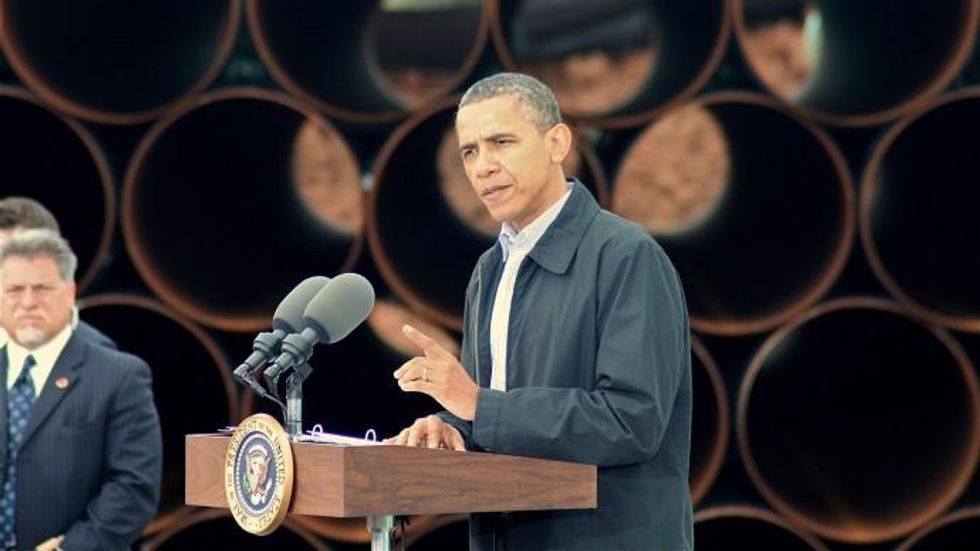
The day before, March 21, Obama flew on Air Force One to a pipe yard in Cushing - the "pipeline crossroads of the world" - for a special stump speech and photo-op announcing the executive order and memorandum.
Dubbed the Gulf Coast Pipeline Project by TransCanada - 95 percent complete and "open for business" in the first quarter of 2014 - the 485-mile tube will ship 700,000 barrels of tar sands crude per day from Cushing to Port Arthur, where it will then reach Gulf Coast refineries and be exported to the global market. It will eventually have the capacity to ship 830,000 barrels per day.
The subject of a large amount of grassroots resistance from groups such as Great Plains Tar Sands Resistance and the Tar Sands Blockade, the Gulf Coast Pipeline Project - when push comes to shove - is only the tip of the iceberg.
That's because Obama's order also called for expedited permitting and review of all domestic infrastructure projects - including but not limited to pipelines - as a reaction to the Keystone XL resistance.
A months-long Mint Press News investigation reveals the executive order wasn't merely a symbolic gesture.
Rather, many key pipeline and oil and gas industry marketing projects are currently up for expedited review, making up for -- and by far eclipsing -- the capacity of Keystone XL's northern half. The original TransCanada Keystone pipeline - as is - already directly connects to Cushing from Alberta, making XL (short for "extension line") essentially obsolete.
Keystone XL's northern half proposal is key for marketing oil obtained from the controversial hydraulic fracturing ("fracking") process in North Dakota's Bakken Shale basin.
Dubbed the Bakken Marketlink Pipeline, the segment has lost its importance with the explosive freight rail boom for moving Bakken fracked oil to market and other pipeline proposals. One of those pipelines, in fact, has received fast-track approval under the March 2012 Obama Executive Order.
Feeling the pressure from protest against the Keystone XL from groups such as the Tar Sands Action, Indigenous Environmental Network and others, Obama pulled a fast one: "wait and see" for XL's northern half - which many claimed as a victory - and expedited approval of everything else via executive order.
Obama's Keystone XL southern half March 2012 memo reads like Big Oil talking points.
"[W]e need an energy infrastructure system that can keep pace with advances in production," Obama states in the Memo. "To promote American energy sources, we must not only extract oil -- we must also be able to transport it to our world-class refineries, and ultimately to consumers."
A metaphorical slap in the face to environmentalists who spent months working on opposing Keystone XL, Obama argued a more efficient, less bureaucratic means of approval was compulsory.
"[A]s part of my Administration's broader efforts to improve the performance of Federal permitting and review processes, we must make pipeline infrastructure a priority ... supporting projects that can contribute to economic growth and a secure energy future," the memo reads.
Though the order issued an expedited permitting process for Keystone XL's southern half, it also foreshadowed that expedited permitting would become the "new normal" going forward for all domestic oil and gas pipeline projects.
"To address the existing bottleneck in Cushing, as well as other current or anticipated bottlenecks, agencies shall ... coordinate and expedite their reviews ... as necessary to expedite decisions related to domestic pipeline infrastructure projects that would contribute to a more efficient domestic pipeline system for the transportation of crude oil," the memo states in closing.
The memo also notes all projects placed in the expedited permitting pile can have their statuses tracked on the online Federal Infrastructure Projects Dashboard, with 48 projects currently listed.
Little time was wasted building the XL's southern half after Obama issued the Order and within a slim two years, TransCanada will have its first direct line from Alberta to Gulf Coast refineries in southern Texas.
It's not as if the Keystone XL southern half expedited permit has gone unopposed. It's just that activists who have chosen to resist the pipeline have paid a heavy price for doing so.
A case in point: opposition to Keystone XL's southern half has earned many activists the label - on multiple occasions - as potential "eco-terrorists," named as such by TransCanada, the U.S. FBI and Department of Homeland Security's Nebraska-based "fusion center" and local undercover police.
Other activists were threatened by TransCanada with a strategic lawsuit against public participation (SLAPP), all of whom made an out of court settlement in January 2013.
Activists agreed to "no longer trespass or cause damage to Keystone XL property including the easements within private property boundaries," explained FireDogLake's Kevin Gosztola in a January 2013 article.
The agreement was a quintessential "lesser of two evils" choice, given activists could have found themselves bogged down in legal fees from TransCanada and may have eventually owed the corporation big bucks.
"The activists had a choice: either settle or face a lawsuit in court where TransCanada would seek $5 million for alleged financial damages ... that could have much worse consequences," Gosztola further explained.
Beyond SLAPP threats, key lawsuits aiming to fend off TransCanada have also failed.
One of those lawsuits in particular - filed on April 25, 2013 by a Douglass, Texas-based citizen named Michael Bishop representing himself in court - paints a picture of what President Obama meant when he said he would fast-track permitting for infrastructure projects going forward.
Before filing the lawsuit, Bishop penned a four-part series for EcoWatch in February and March of 2013 on his experiences as a landowner living a mere 120-feet from pipeline construction and dealing with TransCanada in Texas.
"I am amazed by the lack of understanding about this project by the general public and even more amazed that people in other parts of the country are so focused on the 'northern segment' while the pipeline is actually being laid right here in Texas and will begin transporting diluted bitumen, tar sands crude oil, to Gulf Coast refineries by the end of the year," Bishop wrote in Part III. "So many seem oblivious to this fact."
Bishop alleges in his Complaint for Declaratory Relief and Petition for Writ of Mandamus that on-the-books bread-and-butter environmental laws were broken when fast-tracked permitting for Keystone XL's southern half unfolded.
The permitting mechanism utilized by the U.S. Army Corps of Engineers - following Obama's March 2012 executive order and memorandum - was a Nationwide Permit 12.
Nationwide Permit 12 has also been chosen for fast-tracked permitting of Enbridge's Flanagan South Pipeline. That pipeline is set to fill the gap - and then some - for Keystone XL's northern half, bringing tar sands crude along the 600-mile long, 600,000 barrels per day pipeline from Pontiac, Ill. to Cushing, Okla.
Bishop cited the National Environmental Protection Act (NEPA), arguing Nationwide Permit 12 as applied to Keystone XL's southern half violated the spirit of that law because no environmental assessment was conducted and no public hearings were held.
"Given the fact that the Corps was involved in the preparation of the TransCanada Keystone Pipeline XL for the State Department ... knowledgeable of the toxic nature of the material to be transported and massive public opposition to the project, public hearings should have been held in accordance with the law," wrote Bishop.
In following the dictates of the March 2012 executive order and memorandum, Bishop argues the U.S. Army Corps of Engineers acted in total disregard for long-established environmental law.
"The use of Nation Wide Permit-12 is not a substitute for following NEPA and the Corps, while having some degree of latitude, failed in its ministerial duty," Bishop wrote. "There was a blatant disregard for established environmental law...which not only included public input, but also directed the agency to consider human health and safety."
To date, the lawsuit has not been heard in court.
While the environmental community hones in on Keystone XL's northern half, the business community has focused on expediting permits in the Bakken Shale and filling in the gap left behind by the lack of a TransCanada "Bakken Marketlink."
Big Business has done so - in the main - by using pipelines to ship Bakken crude to key rail hubs.
One of the pipelines listed in the Federal Infrastructure Projects Dashboard is the Bakkenlink pipeline - not to be confused with the "Bakken Marketlink" - a 144-mile-long tube set to carry fracked oil from the Bakken to rail facilities that would then carry the product to strategic markets.
"Currently, crude oil from this region of the Bakken field is transported to rail facilities via truck," explains the Dashboard. "The proposed BakkenLink pipeline provides an opportunity to eliminate a vast amount of overland truck traffic."
Petroleum News Bakken, an industry news publication, explains Bakkenlink was proposed when the northern half of Keystone XL was put on hold by the Obama Administration.
"Originally the BakkenLink was intended to run all the way to Baker, Mont., where it was to connect to the Keystone XL pipeline, but when the Keystone XL project was put on hold in 2011, BakkenLink LLC modified its plan and opted to terminate the pipeline at the Fryburg rail facility," Petroleum News Bakken explained.
The Bismarck Tribune explained Great Northern Midstream LLC - which wholly owns BakkenLink LLC as a subsidiary - has built capacity to load fracked Bakken oil onto 110-car unit trains that can carry up to 300,000 barrels per day to market via the Fryburg rail facility.
For sake of comparison, TransCanada's Bakken Marketlink Pipeline - aka Keystone XL - was slated to bring 100,000 barrels per day of crude to market.
The freight trains scheduled to carry this oil are owned by Burlington Northern Sante Fe (BNSF). BNSF itself is owned by Warren Buffett, the fourth richest man on the planet and major campaign contributor to President Barack Obama in 2008 and 2012.
Another key data point: a 70-unit train carrying 51,428 barrels of fracked Bakken Oil to a Canadian east coast export terminal owned by Irving Oil derailed and exploded in a fireball on July 2013, killing 47 people in Lac-Megantic, located in Quebec province.
Coming full circle, Irving Oil and TransCanada announced a joint venture to develop and construct an export facility in St. John, Canada on August 1, less than a month after the lethal Lac-Megantic derailment. That facility would take tar sands crude shipped from the 1.1 million barrels per day proposed TransCanada Energy East pipeline and export it to the global market.
Bakkenlink isn't the only game in town for the March 2012 executive order's impact on expedited permitting in the Bakken Shale.
Enter the Bakken Federal Executives Group - helped along by Obama's Assistant for Energy and Climate Change Heather Zichal - the Obama White House's industry-friendly liaison to Big Oil.
"[I]dentified by the President as one of five priority regional initiatives under Executive Order 13604 ... [the] [g]roup represents a dozen federal bureaus with review and permitting responsibilities that are working collaboratively to address common development obstacles associated with the Bakken boom...," explains an August 7 U.S. Department of Interior press release.
Newly-minted U.S. Secretary of Interior Sally Jewell - a former petroleum engineer for Mobil Oil Company - recently took a trip to the Bakken Shale oil fields to advocate for the dictates of the March 2012 Executive Order.
"The group's Aug. 6 itinerary began with a tour of a rig operated by Continental Resources Inc., followed in the afternoon by a tour of facilities operated by Statoil, which has invested more than $4 billion in the Bakken," explained the Oil and Gas Journal.
Continental Resources' CEO is Harold Hamm, who served as energy advisor to Mitt Romney, the Republican Party presidential nominee for the 2012 election.
"Interior continues to be a leader in implementing President Obama's vision for a federal permitting process that is smarter [and] more efficient," David Hayes, Department of Interior Deputy Secretary said in a June press release. "By coordinating across the many federal agencies involved in the Bakken region ... we are able to offer a better process for industry."
On May 17, 2013, President Obama issued an updated memorandum titled, "Modernizing Federal Infrastructure Review and Permitting Regulations, Policies, and Procedures."
Citing his March 2012 executive order as precedent, this memo called for cutting the time it takes to approve major infrastructure projects - pipelines included - in half.
"By the authority vested in me as President by the Constitution and the laws of the United States of America, and to advance the goal of cutting aggregate timelines for major infrastructure projects in half," he states in the memo, with a final goal to "institutionalize or expand best practices or process improvements that agencies are already implementing to improve the efficiency of reviews."
Adding insult to injury, a recent story appearing in The Wall Street Journal explains Keystone XL's northern half is no longer a priority for refiners, investors or the industry at large.
With a further delay in the cards due to conflicts of interest in the State Department's environmental review process, it may start to matter less and less for Big Oil as it plans out its other options for getting its product to market going forward.
"U.S. companies that refine oil increasingly doubt that the controversial Keystone XL pipeline [northern half] will ever be built, and now they don't particularly care," explained the Journal.
Enbridge recently proposed an expansion for its Alberta Clipper pipeline (approved by Obama's State Department in August 2009, now known as "Line 67") from 450,000 barrels per day to 570,000 barrels per day to theState Department in a November 2012 application.
It upped the ante since the original Clipper expansion application -- a move met with activist opposition -- requested 800,000 barrels of tar sands run through it per day.
That's on top of Enbridge's recently proposed Nationwide Permit 12 - paralleling what TransCanada did for Keystone XL's southern half - set to bring 600,000 barrels per day of tar sands to Cushing, Okla from Pontiac, Ill.
The reaction to pressure against building Keystone XL's northern half has been - put simply - "build more and faster." Simple math and geography shows - as The Wall Street Journal boasted - project permitting parameters have tilted more and more in Big Oil's favor under President Obama's watch.
With full-throttle expansion of the tar sands described as "game over for the climate" by now-retired NASA scientist James Hansen -- and with fracked oil and gas found to be dirtier than coal when examined in its entire lifecycle according to a May 2011 Cornell University study -- it makes for scary math indeed.
Two years ago I was among more than a thousand people who committed civil disobedience at the White House to oppose the building of the Keystone XL pipeline.

All along I believed that these actions were justified, even though they meant breaking the law. After all, leading NASA climate change specialist Jim Hansen says that the Alberta tar sands, which the pipeline will carry, "must be left in the ground" because "if the tar sands are thrown into the mix it is essentially game over" for a viable planet.
"Those who perpetrate climate change, and those who allow them to do so, should not be able to claim that the law is on their side."
Since being arrested at the White House, my perspective on the nature of such actions has changed. After learning about a fundamental principle of American law known as the public trust doctrine, I have come to believe that the U.S. government and other governments around the world are violating their own most fundamental responsibilities to their own people when they allow fossil fuel producers and users to devastate the earth's atmosphere with greenhouse gases.
Governments will no doubt continue to treat protesters who block pipelines, coal mines and power plants as criminals. But such governments come into court with dirty hands, stained by their dereliction of the duty to protect the common inheritance of their own people.
Res communes
The public trust doctrine has roots and analogues in ancient societies from Europe to East Asia to Africa, and from Islamic to Native American cultures. It was codified in the Institutes of Justinian, issued by the Roman Emperor in 535 A.D. The Justinian code defined the concept of res communes (common things): "By the law of nature these things are common to mankind -- the air, running water, the sea and consequently the shores of the sea." The right of fishing in the sea from the shore "belongs to all men." The Justinian code distinguished such res communes from res publicae, things which belong to the state.
Based on the Justinian Code's protection of res communes, governments have long served as trustees for rights held in common. In American law this role is defined by the public trust doctrine, under which the state serves as trustee on behalf of the present and future generations of its citizens. Even if the state holds title to a given resource, the public is the "beneficial owner." As trustee, the state has a fiduciary duty to the owner -- a legal duty to act solely in the owners' interest. This principle is accepted today in both common law and civil law systems in countries ranging from South Africa to the Philippines and from the United States to India.
International law, furthermore, recognizes regions that lie outside of the political reach of any one nation state -- specifically, the high seas, the atmosphere, Antarctica and outer space -- as "global commons" governed by the principle that they are "the common heritage of humankind." But there has been no effective vehicle for asserting our right not to have our common heritage destroyed.
Suing for an inheritance
In a series of suits and petitions on behalf of young people in 2011, the Atmospheric Trust Litigation Project brought legal actions to all 50 U.S. states and the federal government demanding that they fulfill their public trust obligation to protect the atmosphere as a common property. Sixteen-year-old Alec Loorz, founder of Kids v. Global Warming and lead plaintiff in the federal lawsuit, said, "The government has a legal responsibility to protect the future for our children. So we are demanding that they recognize the atmosphere as a commons that needs to be preserved, and commit to a plan to reduce emissions to a safe level."
The suits seek declarative judgment applying the public trust doctrine to the earth's atmosphere. They ask courts to issue injunctions ordering federal and state governments to reduce carbon emissions to fulfill their duty to protect it. Similar suits are projected for countries around the world. While the courts have turned down some of these suits, in 2012 a federal district court ordered that a case brought in New Mexico go forward.
There is precedent supporting the public trust doctrine in the United States. The U.S. Supreme Court decided, in a leading public trust case at the end of the 19th century, that the state's power resulted from "common ownership" of the public trust asset. That power, the decision stated, should be exercised as "a trust for the benefit of the people," not as a "prerogative for the advantage of the government, as distinct from the people." The ownership is "that of the people in their united sovereignty."
"Future climate protesters can proudly proclaim that they are actually climate protectors, upholding the law, not violating it."
The trustee has an active duty of vigilance to prevent decay or "waste" -- permanent damage to the asset. If the asset is wasted in the interest of one generation of beneficiaries over future generations, it is in effect an act of generational theft.
When a trust asset crosses the boundaries of sovereign governments, all sovereigns with jurisdiction over the natural territory of the asset have legitimate property claims to the resource. Thus, all nations on Earth are "co-tenant trustees" of the global atmosphere. As co-tenants they have an undivided right to possess the property. But they also have a duty not to allow the waste of the common property.
As compelling as the logic of such an argument may be, it is easy to imagine that many American courts will refuse to force governments to meet their obligations. In a brief to dismiss the Kansas suit, lawyers called the claim "a child's wish for a better world," which is not something a court can do much about. "No order issued by the District Court of Shawnee County can hold back global warming, any more than King Canute could order the tide to recede."
The sad fact is that virtually all the governments on earth -- and their legal systems -- are deeply corrupted by the very forces that profit from destroying the global commons. These governments exercise illegitimate power without regard to their obligations to those they claim to represent, let alone to the future generations to whom they are mere trustees.
Civil disobedience, reconsidered
Protecting the global commons is not just a matter for governments. The failure of governments to protect the global commons is currently driving the climate protection movement to turn to mass civil disobedience, as witnessed by the campaigns against the Keystone XL pipeline, mountaintop-removal coal mining and coal-fired power plants. Looked at from the perspective of the global commons, however, these actions are far from disobedient. Indeed, they embody the effort of people around the world to assert their right and responsibility to protect the global commons. They show people acting in an emergency situation on an evident necessity. They represent people stepping in to provide law enforcement where corrupt and illegitimate governments have failed to meet their responsibility to do so.
Legal rationales have played a critical role in many nonviolent movements. They strengthen participants by lending a sense of clarity that they are not promoting personal opinions by criminal means but rather performing a public duty. And they strengthen a movement's appeal to the broader society by presenting action not as wanton lawbreaking but as an effort to rectify governments and institutions that are themselves in violation of the law.
For the civil rights movement, the Constitution's guarantee of equal rights meant that sit-inners and freedom riders were not criminals but rather upholders of Constitutional law. For war resisters during U.S. wars from Vietnam to Iraq, the international law that since the Nuremberg trials has forbidden war crimes has defined civil disobedience as an obligation under international law. For those who took part in the nonviolent revolution that overthrew communism in Poland, their struggle was not criminal sedition, but an effort to implement the international human and labor rights laws ratified by their own government.
The legal obligation of governments to protect the public trust can play a role similar to governments' obligation to protect human rights and eschew war crimes. Those who perpetrate climate change, and those who allow them to do so, should not be able to claim that the law is on their side. Those who blockade coal-fired power plants or sit down at the White House to protest the Keystone XL pipeline can -- and should -- insist that they are simply exercising their right and responsibility to protect the atmospheric commons they own along with all of present and future humankind.
Future climate protesters can proudly proclaim that they are actually climate protectors, upholding the law, not violating it. Nobody should expect American judges to start acquitting protesters on public trust grounds any time soon. But juries that try climate protesters should keep in mind that they have the right and the responsibility to acquit those they believe have violated no just law.

At the beginning of this week, eleven climate activists in Michigan were arrested for blocking construction of an expansion of a tar sands pipeline that just three years ago caused the largest on-land oil spill in US history.
Of the eleven arrested, four now face felony charges and possible two-year prison sentences for chaining themselves to construction equipment at the project which is owned by Canadian pipeline company Enbridge.
Asked if this would or should deter future activists, Lisa Leggio, ones of those facing felony charges, said simply: "Hell, no. We're doing what we have to do."
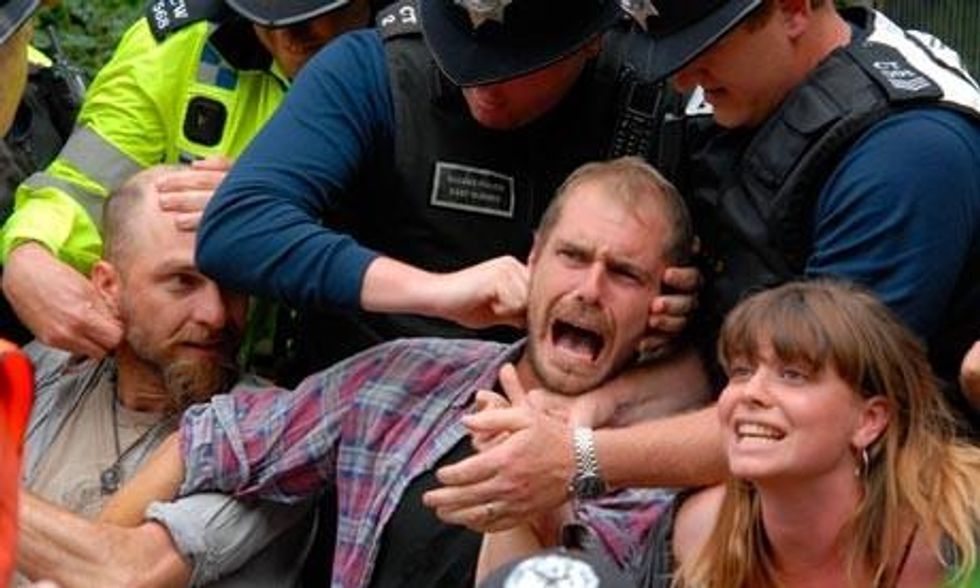
On Thursday, fourteen people were arrested after bringing a halt to operations at a proposed gas fracking site in Sussex, England. The anti-fracking activists formed a human chain and refused to leave the roadway and police responded by physically separating the individuals by force.
"They just started taking people out one by one," one witness told the Guardian. "Not everyone went voluntarily and there were some struggles. A girl was shouting at one point and seemed to be quite upset and the police seemed to be quite rough. I saw a policeman with his knuckles pressing on the side of a guy's face until he released the man he was holding onto. He was obviously hurting him. Another looked like he was bending someone's little finger back."
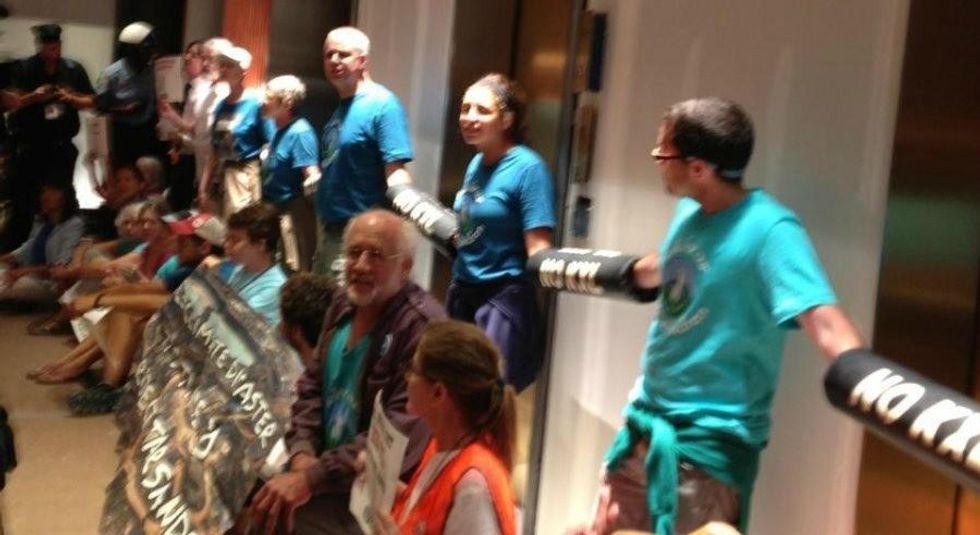
Demanding that the State Department's final Supplemental Environmental Impact Statement (SEIS) of Keystone XL be fair, balanced, and free from the influence of the fossil fuel industry, the activists surrounded the offices, locked arms, and refused to leave until they were arrested by local police.
So what is all this?
Even if not all formally labelled as such, the actions this week paint a picture of a mid-summer campaign organized by the climate group 350.org called "Summer Heat." Designed as a series of direct actions against the fossil fuel industry, the campaign is the manifestation of an escalation in tactics by the global climate movement that says it is taking its efforts to combat global warming and educate the public about the dangers of climate change to the next level.
Focusing on the impacts of the fossil fuel industry on local "frontline" communities, the activists hope they can show that though the climate emergency is global in scale, every person--no matter where they live--has a role to play in challenging the energy paradigm that is threatening the world's vital ecosystems.
"We've reached a point where every local fight over dirty energy is also a fight for the planet's survival," explained 350.org co-founder Bill McKibben, who said that the SummerHeat campaign shows how frontline groups like the ones in Michigan, Washington, and Essex are "battling for people around the world."
The campaign, which has been ongoing throughout July, is culminating in a series of actions over this weekend nationwide:
Richmond Summer Heat - Bay Area
President Obama -- Keep your Promises - DC
Flotilla to keep New England tar sands free - Maine
2013 Walk for our Grandchildren - Maryland
Shut Down Brayton Point - Massachusetts
Oil and Water Don't Mix: A Rally for the Great Lakes - Michigan
Rally at the Rio! - New Mexico
Ohio vs. Frackers - Ohio
Pacific Northwest stands up to fossil fuel exports - Portland, OR
Utah Tar Sands Action Camp - Utah
Texas Keystone XL Showdown - Texas
Follow the #summerheat hashtag on Twitter:
Tweets about "#SummerHeat #350"
____________________________________________________
Documents recently obtained by Bold Nebraska show that TransCanada - owner of the hotly-contested Keystone XL (KXL) tar sands pipeline - has colluded with an FBI/DHS Fusion Center in Nebraska, labeling non-violent activists as possible candidates for "terrorism" charges and other serious criminal charges.
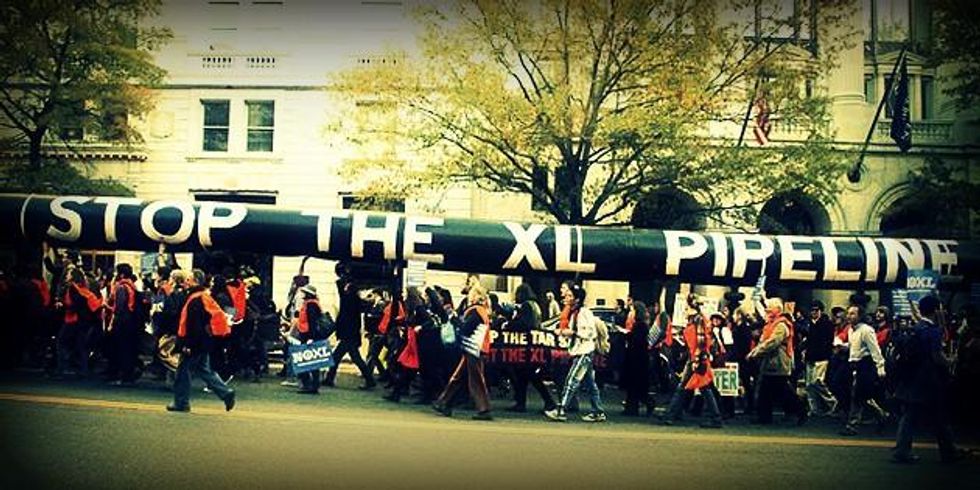
Further, the language in some of the documents is so vague that it could also ensnare journalists, researchers and academics, as well.
TransCanada also built a roster of names and photos of specific individuals involved in organizing against the pipeline, including 350.org's Rae Breaux, Rainforest Action Network's Scott Parkin and Tar Sands Blockade's Ron Seifert. Further, every activist ever arrested protesting the pipeline's southern half is listed by name with their respective photo shown, along with the date of arrest.
It's PSYOPs-gate and "fracktivists" as "an insurgency" all over again, but this time it's another central battleground that's in play: the northern half of KXL, a proposed border-crossing pipeline whose final fate lies in the hands of President Barack Obama.
The southern half of the pipeline was approved by the Obama Admin. via a March 2013 Executive Order. Together, the two pipeline halves would pump diluted bitumen ("dilbit") south from the Alberta tar sands toward Port Arthur, TX, where it will be refined and shipped to the global export market.
Activists across North America have put up a formidable fight against both halves of the pipeline, ranging from the summer 2011 Tar Sands Action to the ongoing Tar Sands Blockade. Apparently, TransCanada has followed the action closely, given the level of detail in the documents.
"The Hot Springs School District practiced a lockdown procedure after pretending to receive a letter from a group that wrote 'things dear to everyone will be destroyed unless continuation of the Keystone pipeline and uranium mining is stopped immediately," explained the Rapid City Journal. "As part of the drill, the district's 800 students locked classroom doors, pulled down window shades and remained quiet."
This latest revelation, then, is a continuation of the troubling trend profiled in investigative journalist Will Potter's book "Green Is the New Red." That is, eco-activists are increasingly being treated as domestic eco-terrorists both by corporations and by law enforcement.
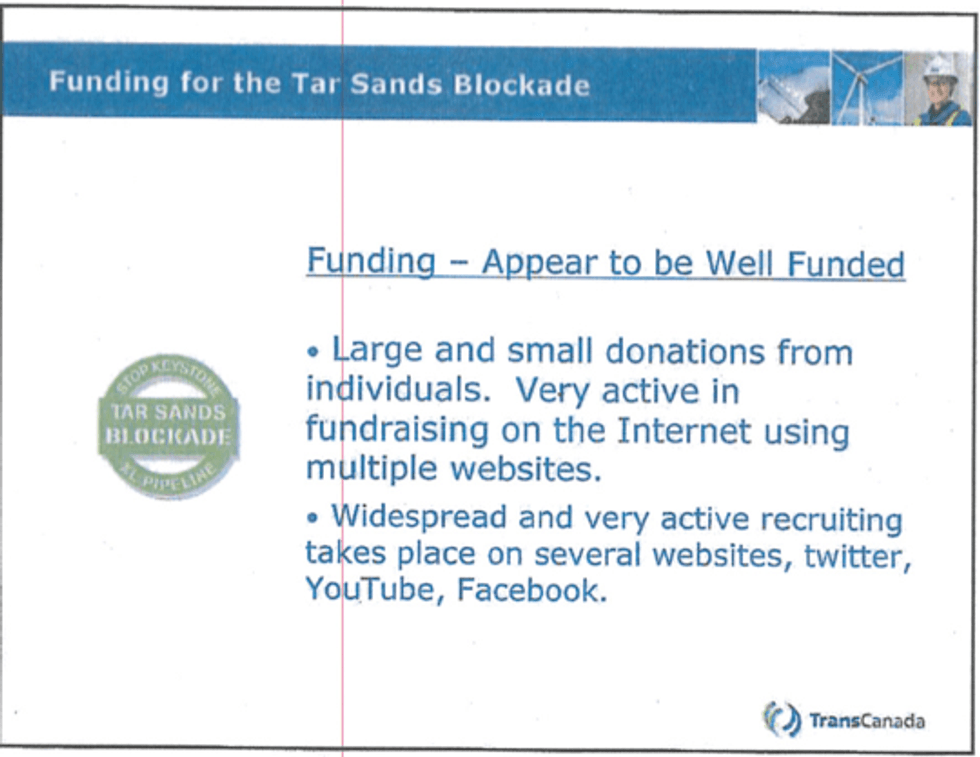
The documents demonstrate a clear fishing expedition by TransCanada. For example, TransCanada's PowerPoint presentation from Dec. 2012 on corporate security allege that Bold Nebraska had "suspicious vehicles/photography" outside of its Omaha office.
That same presentation also says TransCanada has received "aggressive/abusive email and voicemail," vaguely citing an incident in which someone said the words "blow up," with no additional context offered. It also states the Tar Sands Blockade is "well-funded," an ironic statement about a shoe-string operation coming from one of the richest and most powerful industries in human history.
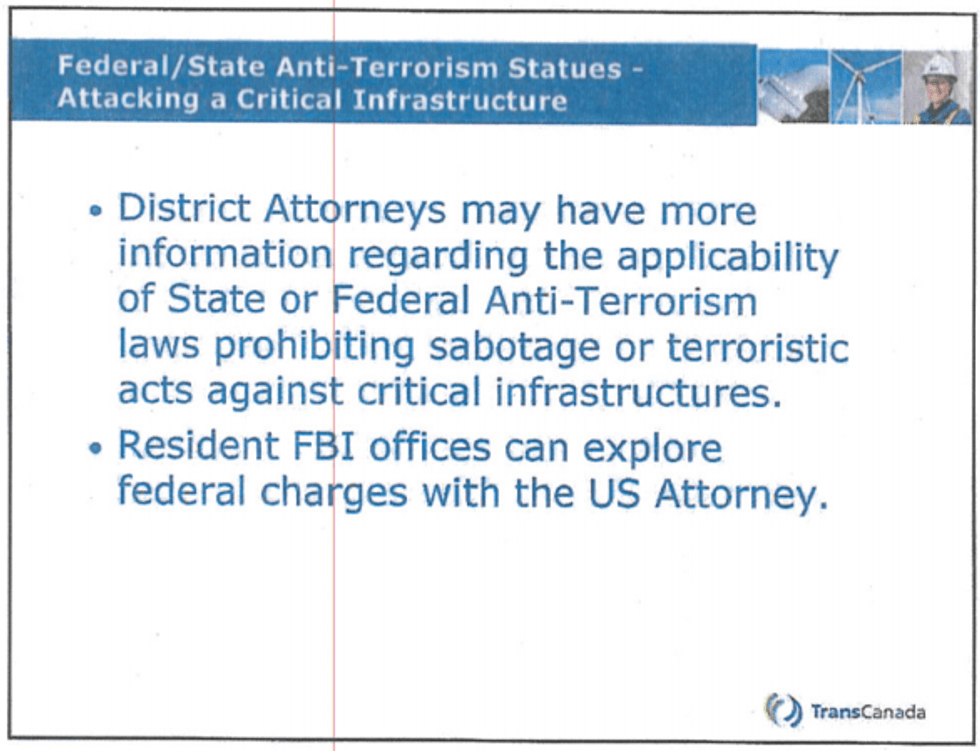
Another portion of TransCanada's PowerPoint presentation discusses the various criminal and anti-terrorism statutes that could be deployed to deter grassroots efforts to stop KXL. The charge options TransCanada presented included criminal trespass, criminal conspiracy, and most prominently and alarmingly: federal and state anti-terrorism statutes.
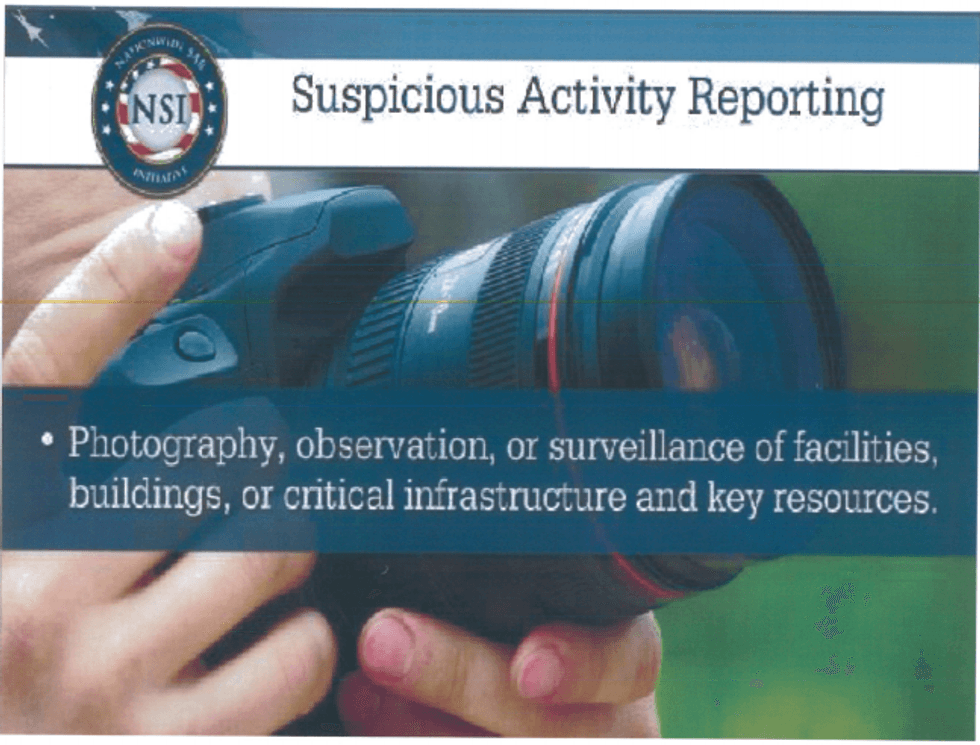
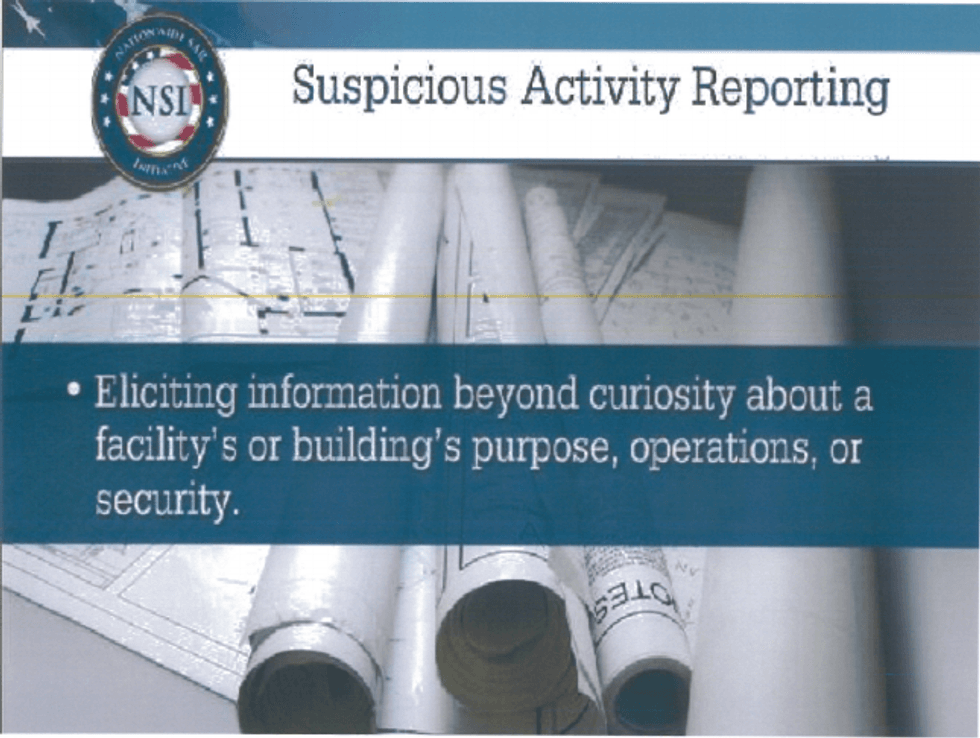
An April 2013 presentation given by John McDermott - a Crime Analyst at the Nebraska Information Analysis Center (NIAC), the name of the Federal Bureau of Investigation (FBI) and Department of Homeland Security (DHS) funded Nebraska-based Fusion Center - details all of the various "suspicious activities" that could allegedly prove a "domestic terrorism" plot in-the-make.
NAIC says its mission is to "[c]ollect, evaluate, analyze, and disseminate information and intelligence data regarding criminal and terrorist activity to federal, state, local and tribal law enforcement agencies, other Fusion Centers and to the public and private entities as appropriate."
Among the "observed behaviors and incidents reasonably indicative of preoperations planning related to terrorism or other criminal activity" is "photography, observation, or surveillance of facilities, buildings, or critical infrastructure and key resources." A slippery slope, to say the least, which could ensnare journalists and photo-journalists out in the field doing their First Amendment-protected work.
Another so-called "suspicious activity" that could easily ensnare journalists, researchers and academics: "Eliciting information beyond curiosity about a facility's or building's purpose, operations, or security."
Melissa Troutman and Joshua Pribanic - producers of the documentary film "Triple Divide" and co-editors of the investigative journalism website Public Herald - are an important case in point. While in the Tioga State Forest (public land) filming a Seneca Resources fracking site in Troy, Pennsylvania, they were detained by a Seneca contractor and later labeled possible "eco-terrorists."
"In discussions between the Seneca Resources and Chief Caldwell, we were made out to be considered 'eco-terrorists' who attempted to trespass and potentially vandalize Seneca's drill sites, even though the audio recording of this incident is clear that we identified ourselves as investigative journalists in conversation with the second truck driver," they explained in a post about the encounter, which can also be heard in their film.
"We were exercising a constitutional right as members of the free press to document and record events of interest to the public on public property when stripped of that right by contractors of Seneca."
Activists protesting against the American Legislative Exchange Council (ALEC) during its April 2013 meeting in Arizona were also labeled as possible "domestic terrorists" by the Arizona FBI/DHS Fusion Center, as detailed in a recent investigation by the Center for Media and Democracy.
It'd be easy to write off TransCanada and law enforcement's antics as absurd. Will Potter, in an article about the documents, warned against such a mentality.
"This isn't empty rhetoric," he wrote. "In Texas, a terrorism investigation entrapped activists for using similar civil disobedience tactics. And as I reported recently for VICE, Oregon considered legislation to criminalize tree sits. TransCanada has been using similar tactics in [Canada] as well."
And this latest incident is merely the icing on the cake of the recent explosive findings by Glenn Greenwald of The Guardian about the National Security Agency's (NSA) spying on the communcations records of every U.S. citizen.
"Many terrorism investigations (and a great many convictions) are politically contrived to suit the ends of corporations, offering a stark reminder of how the expansion of executive power -- whether in the context of dragnet NSA surveillance, or the FBI treating civil disobedience as terrorism -- poses a threat to democracy," Shahid Buttar, Executive Director of the Bill of Rights Defense Committee told DeSmogBlog.

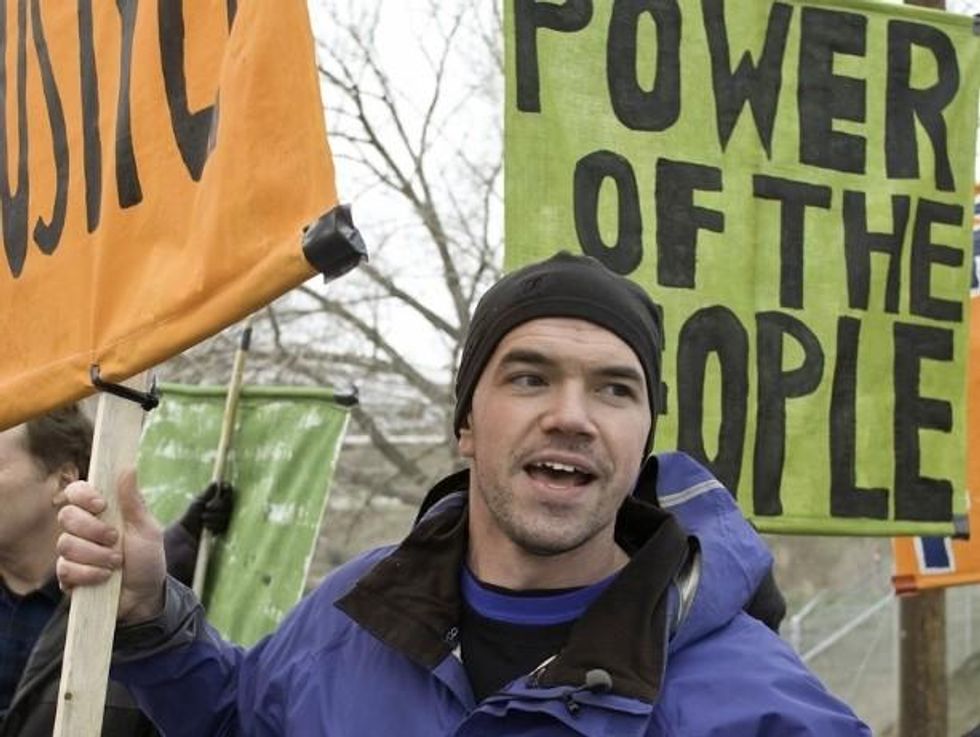
Designed to increase the size of their movement and up the pressure on politicians and the fossil fuel industry that has laid seige to Washington and Ottawa decision-making, activists in the US and Canada say they are willing to put their bodies on the line to fight the power of big industry.
"It's time to stand up - peacefully but firmly -- to the industry that is wrecking our future."
Calling their seasonal campaign "Summer Heat," a letter sent to 350.org supporters on Tuesday night by movement leaders Naomi Klein, Bill McKibben, Winona LaDuke, Sandra Steingraber, and Rev. Lennox Yearwood staked out a call for a movement whose moment has arrived for an important next phase.
"As the planet lurches past 400 parts per million concentrations of CO2, the moment has come," the letter said, "the moment to ask you to do hard, important, powerful things. The last two weeks of July are, statistically, the hottest stretch of the year. This year we want to make them politically hot too. Which means we need you, out on the front line. We need some of you to risk going to jail, and all of you to show up and speak out."
Just last week, scientists called the 400 ppm milestone evidence of humanity's "march towards disaster."
In order to shake the establishment out of its proven complacency (and complicity), the coalition behind 'Summer Heat' present a variety of tactics and specific campaigns, including a direct action component called "Fearless Summer" which will build on the work already seen in communities where the controversial Keystone XL pipeline is already being built.
"From the Pacific Northwest to the coast of Maine," the group states, "from the Keystone pipeline route to the White House where the administration has broken its promise to put solar on the roof, to the Utah desert where they're getting ready for the first tar sands mine in the US, we're going to try and get across the essential message: it's time to stand up - peacefully but firmly -- to the industry that is wrecking our future."
First Nations in Canada will continue their fight against the Harper government and treaty violations in what they're calling "Sovereignty Summer," designed to strengthen the efforts of those "trying to protect lands, waters and air for everyone." The goal, according to a statement by those groups, is "to win recognition of marine protections, of sustainable forestry, of local, just economies, and the principle that we must respect the environment that" all Canadian share in.
The various groups involved in the campaign include Canada's Defenders of the Land and the Idle No More indigenous movement, a mix of front-line community groups--like Bold Nebraska and New Yorkers Against Fracking--who have picked up local battles against the fossil fuel industry, more aggressive activist/blockaders--such Tar Sands Blockade and the Great Plains Tar Sands Resistance who have staged direct actions against oil and gas infrastructure project, online organizing outfits like CREDO Action which continues to build a list of those willing to engage in civil disobedience, and other large groups like 350.org and the Hip Hop Caucus which are both spearheading the organizing effort and building their own capacity by supporting the work of others.
So far the group says they have active events planned for the following areas, with more to come:
Bay Area Shuts Down Chevron - Bay Area, California
President Obama -- Keep your Promises - DC
2013 Walk for our Grandchildren - Maryland
Shut Down Brayton Point - Massachusetts
Nebraska vs. Keystone XL - Nebraska
Ohio vs. Frackers - Ohio
Utah Tar Sands Action Camp - Utah
Texas Keystone XL Showdown - Texas
The message to recipients was simple: Find an action nearest you. Start making plans. Show up.
"Our hope is that this summer will be a historic show of solidarity not just with the Americans who suffer most from the fossil fuel industry, but with the people across the planet whose lives are at risk as the world warms -- and indeed with the planet itself, beleaguered but still so worth fighting for," the letter from leaders said.
"If you weren't needed, we wouldn't ask. But in a fight this big, we are all needed, now more than ever."
__________________________________________________

During his sermon, he said that he had never expected to change the oil and gas industry alone. "But I thought that I could change people like you, and I knew people like you have a lot of power."
The story of how DeChristopher landed in prison is well known. On Dec. 19, 2008, he walked into an oil and gas auction in Salt Lake City, where the Bureau of Land Management was auctioning off leases to drill on public lands. When asked if he had come to bid, DeChristopher, somewhat startled, said yes. He took a paddle, labeled "Bidder 70," and without any plan as to what he would do with it, entered the auction. But then, when he saw a friend across the room break down in tears over the potential loss of wild lands, an idea came to him. He began raising his paddle to bid. By the end, he'd amassed a total of 22,500 acres at a price of $1.8 million.
"We hold the power right here to create our vision of a healthy and just world, if we are willing to make the sacrifices to make it happen." -Tim DeChristopher in 2011
Although the Obama administration later declared the auction illegal, and DeChristopher eventually raised enough money to buy the land he had bid on, two of the felony charges against him stuck. After a trial delayed nine times by the prosecution, he finally received a two-year sentence in July 2011.
But that's the Tim DeChristopher story you already know. What often gets overlooked in this folk-hero tale of a man who went to jail for his principles is that DeChristopher didn't want to be the only hero. And so he became one of the most consistent and strongest voices for direct action and civil disobedience in the movement, urging environmental groups to use personal sacrifice as means of becoming more effective.
By showing that people who don't hold positions of authority can successfully confront injustice, his example helped to build the climate justice group Peaceful Uprising, changed the tactics of the nation's most established environmental organizations and helped shape the mass climate movement, which turned out nearly 50,000 people on the National Mall in Washington, D.C., in February.
Realizing the time to act is now
It's important to remember how much things have changed over the past few years in the climate justice movement, which emphasizes the effects of climate change on human rights -- particularly on the world's most marginalized people. When DeChristopher began speaking publicly about his action, the most popular approach in the movement could be described as "Let's wait until we're big enough and act then."
DeChristopher saw things differently, and he wasn't afraid to say so. He thought the movement already had the numbers it needed to succeed if people would step up and act -- with the belief that their actions would propel more people into motion and build the movement's numbers. He began to argue that groups like 350.org needed to stop waiting and start using civil disobedience now.
"We hold the power right here to create our vision of a healthy and just world, if we are willing to make the sacrifices to make it happen," he said at the 2011 Power Shift conference in Washington, D.C. "Mountaintop removal and climate change and all the other injustices we are experiencing are not being driven solely by the coal industry, solely by lobbyists or solely by the failure of our politicians. They're also happening because of the cowardice of the environmental movement."
Shortly after the Bidder 70 action, DeChristopher founded Peaceful Uprising, or PeaceUp, with his friend from the University of Utah, Ashley Anderson. Their intention was to radicalize the movement by making civil disobedience more the norm than the exception.
"Peaceful Uprising realized something was building," Anderson said, referring to public understanding of climate change. But the group's members believed that taking full advantage of that was "going to require revolutionary change."
PeaceUp aimed to push people to sacrifice their own comfort and take bolder action for the sake of a liveable future. That may sound a little austere, but the group managed to make it rejuvenating and joyful by cultivating a supportive community.
Before his imprisonment, DeChristopher continued to speak publicly about the need for escalation. While he didn't berate 350.org or other climate justice groups, his message was clearly aimed at them. He criticized the movement for focusing on mass gatherings that resulted in statements rather than action.
A movement transformed
Little by little, DeChristopher's message was catching on through a series of events -- each one larger than the last -- that used civil disobedience. In April 2011, more than 350 climate justice supporters staged a sit-in at the Department of the Interior, and 21 were arrested. Among the participants was 58-year-old University of Utah librarian Joan Gregory, a founding member of Peaceful Uprising, who remains active to this day. It was her first arrest.
The demonstrators stormed the building despite a line of guards attempting to block the entrance. Police threatened them with felony charges, but Joan refused to leave. "I knew I couldn't get up, no matter what it was," she said. "I couldn't not take action at that point."
According to Peaceful Uprising director Henia Belalia, the Department of the Interior action stemmed from frustration over the movement's lackluster response to the BP oil spill in 2010, as well as Tim's impending imprisonment. "People were outraged and heartbroken," she explained, "and they were going to do something about it, rather than just sit with the pain."
A few months later, in August 2011, DeChristopher's message came to life in a monumental way. During two weeks of sit-ins organized by the 350.org-affiliated Tar Sands Action, 1,253 people were arrested while protesting the Keystone XL pipeline. It was not only the largest civil disobedience demonstration by the climate movement but also the largest in decades for any environmental issue in the United States.
"Tim's act helped break civil disobedience out of the domain of radicals and marginal activist culture," said Tar Sands Action coordinator Matt Leonard. "That openness is a big part of how we mobilized the 1,253 people that were arrested in the Tar Sands Action, and a part of the near-daily actions that have happened on the Keystone pipeline this past year."
350.org founder Bill McKibben agreed, saying that DeChristopher "was and is a complete inspiration to all of us. His courage permeated everyone's thinking." While McKibben's current work does not revolve solely around civil disobedience -- he's been building a successful divestment campaign over the course of the past year -- the mass civil disobedience actions have demonstrated the campaign's resolve.
In turn, those actions likely provided the inspiration for the Sierra Club's recent reversal of its 121-year-old ban on civil disobedience. Soon after, club leaders cuffed themselves to the White House gates, again over the issue of the Keystone XL pipeline.
Not just peaceful, but joyful
Peaceful Uprising's emphasis on community-building is another testament to the lasting impact of DeChristopher's work. The group strives to maintain an attitude of joy and resolve, with the goal of drawing new members and keeping them in the movement for the long haul by fostering a supportive, fun, community-centered culture. As DeChristopher often said, "We will be a movement when we sing like a movement."
PeaceUp members have taken those words literally. At actions, its members can always be found singing upbeat, folksy songs, from "If I Had a Hammer" to "Have You Been to Jail for Justice?" Through song, colorful art like its giant paper mache puppets and the deep sense of camaraderie its members share, Peaceful Uprising has been successfully building a nurturing culture.
Maintaining a joyful presence is part of Peaceful Uprising's strategy of merging resilience and resistance. Instead of getting bogged down in campaigns that do nothing but oppose unwanted things, PeaceUp goes a step further and tries to embody the world its members want to create. For example, group members select a "hot spot" and "cool spot" for every campaign -- the hot spot representing an injustice members want to stop and the cool spot representing a positive change that they want to create or bolster.
Peaceful Uprising also models how a small group of committed people with little background in activism can quickly become a powerful force for change. Members have gained experience in legal observation, media relations, jail support and other elements of direct action, and they now serve as a valuable resource for the local community by providing trainings in nonviolent direct action.
The continued influence of Peaceful Uprising in Utah and within the broader climate justice movement testifies to the significance of Tim's closing statement at his sentencing in July 2011: "You can steer my commitment to a healthy and just world if you agree with it, but you can't kill it. This is not going away. At this point of unimaginable threats on the horizon, this is what hope looks like. In these times of a morally bankrupt government that has sold out its principles, this is what patriotism looks like. With countless lives on the line, this is what love looks like, and it will only grow."
And that is precisely what happened, which is why the celebration yesterday and today is not just about one man's release from prison. It's also his influence on the powerful movement that transpired in his absence.
Already, others are taking his place in prison. As Tim mentioned in his sermon yesterday, biologist and author Sandra Steingraber and two other activists were just imprisoned for 15 days after blocking access to a fracking gas storage site in New York to protect drinking water.
This Earth Day, we thank Tim DeChristopher for steering our movement toward the path of courage. With countless lives on the line, it's the path we need to take.
This piece was written as a special Earth Day collaboration between YES! Magazine and Waging Nonviolence.