

SUBSCRIBE TO OUR FREE NEWSLETTER
Daily news & progressive opinion—funded by the people, not the corporations—delivered straight to your inbox.
5
#000000
#FFFFFF
To donate by check, phone, or other method, see our More Ways to Give page.
Daily news & progressive opinion—funded by the people, not the corporations—delivered straight to your inbox.
I am a great & sublime fool. But then I am God's fool, & all His works must be contemplated with respect.
-- Mark Twain, Letter to William Dean Howells
It all made sense thanks to a simple trumpian tweet. At first glance it had seemed to be just another in the never-ending tweet storm inflicted on the country by the boy in the Oval Office. Placed in the proper context, however, it makes perfect sense.
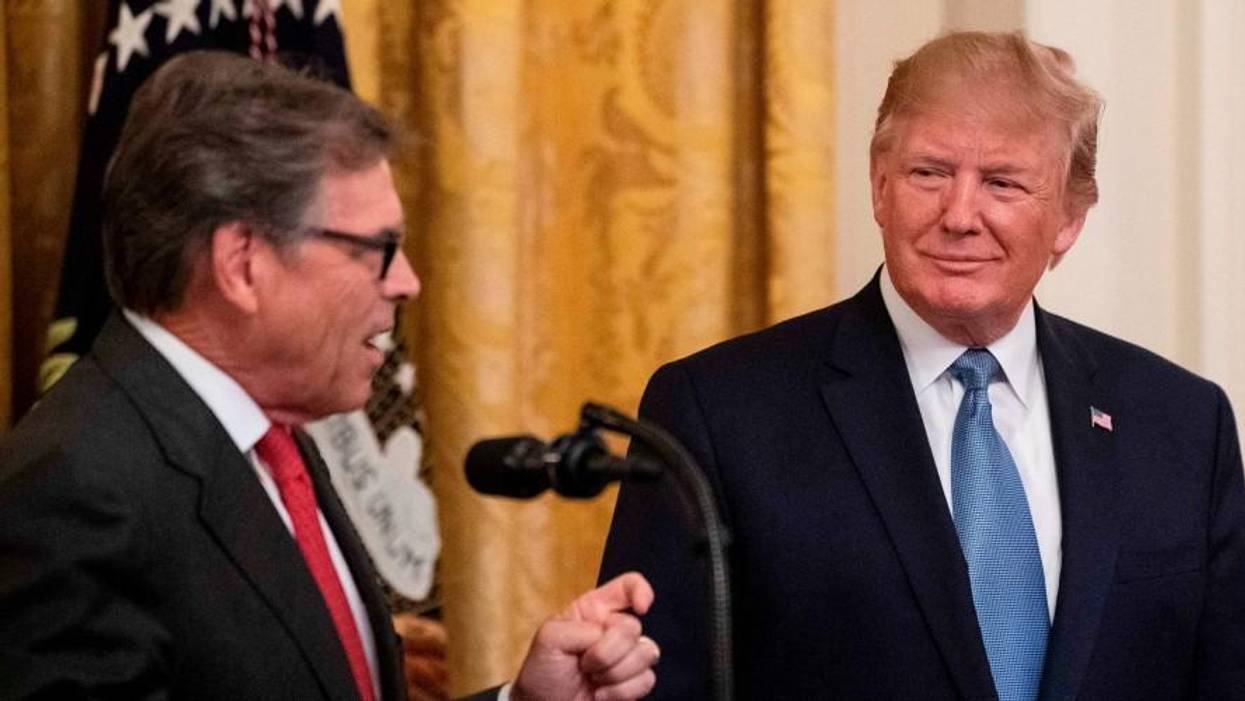
It started on August 24, 2019, with a proclamation that caused surprise in some, astonishment in others, and cries of jubilation from yet others. It began when the trump was answering questions from reporters about the trade war with China. Without warning, he suddenly turned his gaze heavenward and proclaimed: "I am the chosen one." Although his innate modesty caused him a few days later to tweet that he was "kidding, being sarcastic, and just having fun," his modesty was soon for naught when Rick Perry, the outgoing Energy Secretary, confirmed the trump's proclamation. Mr. Perry was not being sarcastic and "just having fun." He was being dead serious.
In an interview on Fox News, the Secretary said he believed the trump was chosen by God to lead the country. Acknowledging something virtually all democrats, and perhaps a handful of Republicans such as Mr. Perry are aware, Mr. Perry said that the trump is not perfect. He said: "God's used imperfect people all through history. King David wasn't perfect. Saul wasn't perfect. Solomon wasn't perfect."
Not content to make that proclamation on Fox News, Mr. Perry said that he had personally said the exact same thing to the president. He told him: "Mr. President . . . you are here in this time because God ordained you."
Mr. Perry is obviously a biblical scholar and a deeply religious man. He is one of the regular attendees at Bible study gatherings of cabinet members in the White House. And being a religious man, he got it right when he used King David as the reason God got it right when he picked the trump. That is because King David and the trump have a great deal in common.
For my insights into the comparison between King David and the trump, I am indebted to Msgr. Charles Pope who has written regularly for the Catholic Registry, publishes on the internet and has travelled widely lecturing on matters liturgical. He was, of course, not drawing parallels between the trump and King David, since his writing, on which I am relying, was published in 2012, long before the trump was on the scene.
In a piece published in 2012 entitled "David, A Great King, Yet with a Critical flaw. What is the Lesson for us Today?" he describes David in a way that immediately causes the reader to think of the trump. David, like the trump, liked women. Instead of bragging about how he could grab women by their private parts whenever he wanted, as the trump did, David simply married them. He had at least eight wives and, according to Msgr Pope, probably more. In addition, notwithstanding his many wives, David had Uriah the Hittite killed so that he could marry Uriah's wife, Bathsheba. According to Msgr. Pope, David eventually felt bad about what he had done and to do penance as it were, wrote Psalm 51 known as the Miserere.
Mr. Perry gave further solace by observing that David was not the only king, who like the trump, had serious flaws. David's son, Solomon was another. King Solomon, like his dad and like the trump, also liked women. In the Bible, 1 Kings chapter 11, the author says that Solomon had 700 wives, princesses and 300 concubines. Those sorts of statistics would, if known by the trump, infuse him with a sense of envy that might well cause him to collapse in a jealous rage because of the injustice of the Lord dealing him such a lousy hand that all he had were several wives (not even in the dozens), and many, but probably not hundreds of occasional sexual encounters.
The pronouncements from Mr. Perry explaining that trump is the "chosen one," helped me understand the recent tweet by the trump. It was designed by the trump to show that he was more than a mere mortal like those over whom he proudly rules. Since it is now uniformly recognized, not only by the trump but by his thousands of evangelical followers, that he is God's chosen one, the trump realized that he is deserving of more than the hundreds of thousands of pictures that have been taken of him since his ascendancy. He needs a portrait that properly glorifies him. And thus, his tweet.
At 8:45 AM on November 27th, the trump tweeted a picture of his head superimposed on the magnificent body of a shirtless Sylvester Stallone. Many who saw that magnificent portrait of our president, came away with a new appreciation of the trump and a sense of gratitude to the trump and God for sharing with us with this portrait of God's chosen one. A few of us came away thinking that the trump and God have presented us with the portrait of a fool.
You can run from the climate crisis, but you can't hide. On the front lines of this global environmental calamity, entire communities are being consumed by fire, submerged by typhoons and hurricanes, or baked under the sun amid historic droughts. President Donald Trump, the climate change denier in chief, has formally begun the process of withdrawing from the Paris Agreement. Originally signed by President Barack Obama in 2015, the accord established a cooperative, global path to limit global temperature rise to 1.5 degrees Celsius (2.7 degrees F) above preindustrial levels. The United States is now the only nation on the planet that has pulled out of the agreement. A new statement signed by over 11,000 scientists from over 150 countries warns of "untold suffering" unless global society undergoes a "major transformation." Trump's denial of the climate crisis is unconscionable and should be added to the articles of impeachment against him.
One Trump official with a role in both the climate crisis and in the impeachment proceedings is Wells Griffith, currently a special assistant to the president and senior director for international energy and environment for the National Security Council, serving under departing Energy Secretary Rick Perry. Griffith is a longtime Republican operative who served as deputy chief of staff to Reince Priebus when Priebus was chair of the Republican National Committee.
Wells Griffith's appointment to the Department of Energy makes sense; his family has run a gas station in Mobile, Alabama, for over 50 years. Griffith moved from pumping gas to pushing coal, successfully negotiating the sale of 700,000 metric tons of coal from Pennsylvania to Ukraine in 2017.
He then showed up as the top representative of the Trump administration at the U.N.'s "COP 24" climate conference in Katowice, Poland, in December 2018. The U.S. held just one public event during the two-week summit, which Griffith chaired, promoting fossil fuel and nuclear energy. Amid mocking laughter and a walkout by protesters, he stated, "We strongly believe that no country should have to sacrifice economic prosperity or energy security in pursuit of environmental sustainability."
Afterward, we approached Griffith in a large central hall of the convention center (which was designed to look like the coal mine that it was built on top of) to ask questions for the "Democracy Now!" news hour. To our shock, rather than answering, he bolted, first walking quickly, then running away. Cameras rolling, we ran after him, asking questions as we weaved in and out of the crowd of climate negotiators, scientists and activists.
"Do you agree with President Trump calling climate change a hoax? Can you talk about why the U.S. is here, since President Trump is saying he's pulling the U.S. out of the Paris climate accord? Can you talk about why you're pushing coal?" He dodged our questions, but did accuse us of harassing him. "A reporter asking you a question, sir, is not harassment," we replied.
Just this Tuesday, Wells Griffith continued his refusal to answer questions when he failed to appear before the House Permanent Select Committee on Intelligence's closed-door session of the Trump impeachment inquiry.
While public testimony is expected to begin next week, an unrelated court case is wrapping up in a New York state courtroom. New York is suing ExxonMobil, alleging the fossil fuel giant defrauded its investors for years by understating the risk that climate change posed to shareholder value. Rex Tillerson, the former CEO of ExxonMobil and Trump's first secretary of state, testified at length under oath. He repeatedly claimed he could not recall details when grilled by the New York state attorneys.
Outside the courtroom, 30 children participating in the Fridays for Future weekly climate strike engaged in a die-in. Thirteen-year-old Maria Riker told us, "We held the die-in for 42 minutes, one minute for each of the 42 years that Exxon was aware of the dangers of climate change but lied about it."
Tillerson's successor, Secretary of State Mike Pompeo, announced Monday, via tweet, "Today we begin the formal process of withdrawing from the Paris Agreement." Trump declared that the U.S. would withdraw in June 2017, but legal procedures in place when the agreement was signed have prevented the formal exit until now.
In response, 350.org founder and author Bill McKibben said on "Democracy Now!," "The fossil fuel industry had its most profitable years in the last three decades. On the other hand, we're now missing half the sea ice in the summer Arctic. The Great Barrier Reef is half-dead. The oceans are 30% more acidic. California is on fire more weeks than not. We're in deep, deep trouble."
The climate crisis imperils the planet. To deny it is impeachable, the highest of high crimes and misdemeanors.
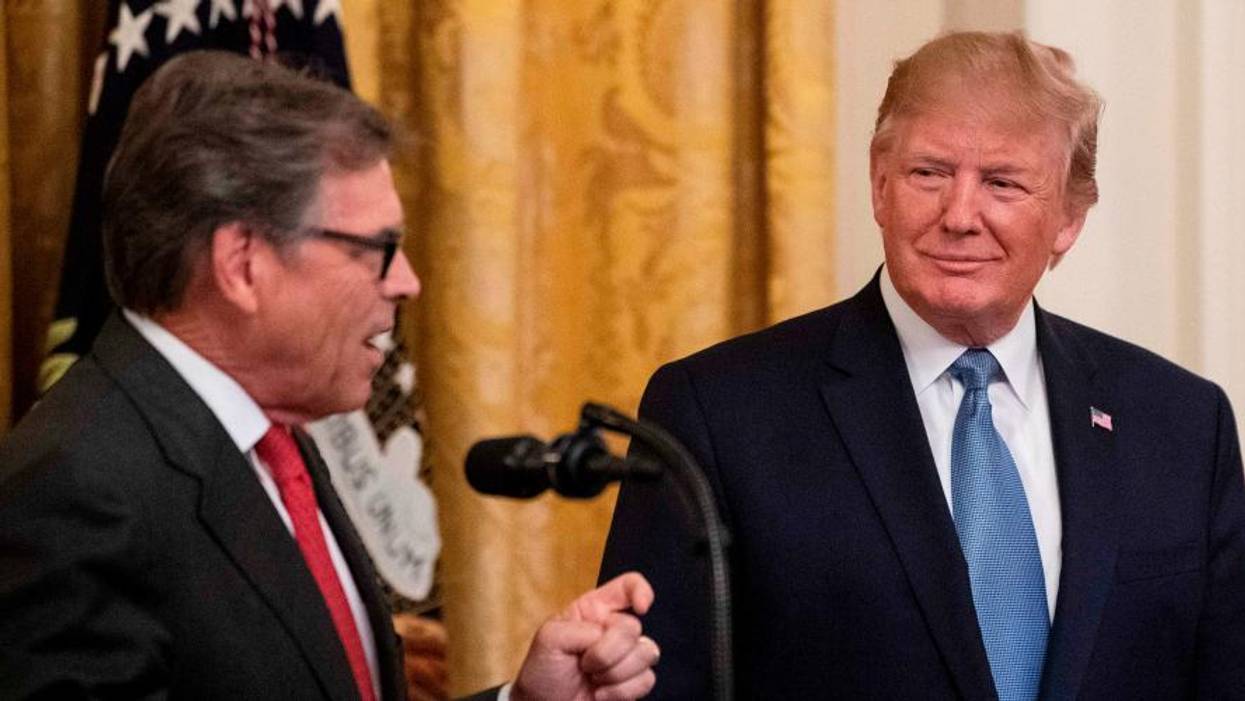
During a conference call with House Republicans on Friday, President Donald Trump reportedly blamed Energy Secretary Rick Perry for the July 25 call with Ukrainian leader Volodymyr Zelensky that is at the center of Democrats' impeachment inquiry.
Citing three anonymous sources who were on the conference call, Axios reported Saturday that "Trump rattled off the same things he has been saying publicly--that his call with Zelensky was 'perfect' and he did nothing wrong."
"But he then threw Perry into the mix and said something to the effect of: 'Not a lot of people know this but, I didn't even want to make the call. The only reason I made the call was because Rick asked me to. Something about an LNG [liquified natural gas] plant,'" Axios reported, citing one source's recollection of the president's remarks.
"Another source on the call," according to Axios, "said Trump added that 'more of this will be coming out in the next few days'--referring to Perry," who is reportedly planning to leave the White House by the end of November.
There is no mention of an LNG plant in the memo of Trump's call with Zelensky that the White House released last month.
As the Daily Beast reported, Trump's claim that Perry is responsible for the Ukraine conversation is "contradicted by text messages released earlier this week between top U.S. diplomats and Andrey Yermak, an aide to Zelensky, which suggest Trump's personal lawyer Rudy Giuliani was a primary advocate for arranging the call."
Critics were not impressed by Trump's attempt to deflect blame for the call, during which the U.S. president pressed Zelensky to launch an investigation into former Vice President Joe Biden.
"'I was talked into my crime by Rick Perry' is the most implausible alibi I've ever heard," tweeted Esquire's Charles Pierce.
Others similarly lambasted the president's reported comments:
This is not the first time Trump has thrown a member of his administration under the bus during the Ukraine scandal.
"I think you should ask for Vice President [Mike] Pence's conversation, because he had a couple of conversations also," Trump told reporters last week.
In response to Axios's reporting, writer Thor Benson tweeted, "Giuliani, Pompeo, and others should pay attention to what Trump is doing to Rick Perry. They're next."

The revelation that the Trump administration secretly authorized several U.S. companies to sell nuclear technology and assistance to Saudi Arabia is generating alarm over ongoing negotiations about a broader deal that critics worry could eventually lead to a nuclear-armed Saudi Arabia.
The Daily Beast and Reuters reported Wednesday that Energy Secretary Rick Perry had approved at least six Part 810 authorizations, which "allow companies to do preliminary work on nuclear power ahead of any deal but not ship equipment that would go into a plant."
Those reports provoked concerns from lawmakers that the development of nuclear reactors in Saudi Arabia, with crucial assistance from the American government and companies, could potentially enable the key U.S. ally--and serial human rights abuser--to also pursue a nuclear weapon.
"This is incredibly dangerous," Rep. Ilhan Omar (D-Minn.) tweeted Thursday with a link to the Daily Beast article. "We must do everything we can to make sure the Saudi regime cannot develop nuclear weapons."
Worries over a nuclear-armed Saudi Arabia have been mounting since Crown Prince Mohammad bin Salman (MBS) said on CBS's "60 Minutes" last year that "Saudi Arabia does not want to acquire any nuclear bomb, but without a doubt if Iran developed a nuclear bomb, we will follow suit as soon as possible."
While Iranian leaders also insist they do not want a nuclear weapon, President Donald Trump has continued to ratchet up regional tensions since last year, when he ditched the international deal designed to prevent Iran from acquiring one, despite assurances from U.N. watchdogs that nation was complying with the agreement.
Amid the new reports and rising concerns about nuclear weapons, Perry testified before the Senate Armed Services Committee on Thursday.
Pointing to concerns about the administration's nuclear talks with Saudi Arabia and potential legal violations--which whistleblowers recently brought to the House Committee on Oversight and Reform--Sen. Elizabeth Warren (D-Mass.) grilled Perry on the Department of Energy's (DOE) compliance with federal rules:
Following the committee hearing, DOE issued a statement--which Perry tweeted at Warren--clarifying that he has actually signed seven Part 810 authorizations for Saudi Arabia. The statement emphasized that "a Part 810 authorization does not authorize the transfer of nuclear material, equipment, or components," and so far, "no enrichment or reprocessing technology has been authorized to Saudi Arabia."
Part 810 authorizations do not require congressional oversight, but they are often open to public review. However, according to DOE, "the specifics of these authorizations have not been made public because the companies determined that the authorizations contain proprietary business information."
After Perry's testimony, Sen. Ed Markey (D-Mass.), who has criticized the administration for its nuclear talks with Saudi Arabia, vowed to introduce legislation requiring the DOE to make Part 810 authorizations available to Congress.
"We must ensure that Saudi Arabia never ends up with the American technology or materials to make a nuclear bomb."
--Sen. Ed Markey
"This administration has shown no qualms about going around Congress to assist authoritarians and promote private interests over public ones," Markey said. "We must ensure that Saudi Arabia never ends up with the American technology or materials to make a nuclear bomb."
Saudi Arabia, already infamous for its poor track record on human rights, has faced heightened scrutiny since the murder of Washington Post contributor Jamal Khashoggi at the Saudi consulate in Turkey last year. Despite the CIA's conclusion that MBS likely ordered the hit on Khashoggi--whose body was potentially dismembered with a bone saw and then incinerated--Trump and key members of his administration maintain cozy relations with the Saudi regime.
Asked Thursday by Sen. Tim Kaine (D-Va.) whether he had signed the Part 810 authorizations before or after Khashoggi was killed in October, Perry said he did not know but would get back to the senator with the details.
Both Perry and U.S. Secretary of State Mike Pompeo, in his testimony before House Foreign Affairs Committee on Wednesday, claimed that any deal with Saudi Arabia would include safeguards to ensure the kingdom doesn't build a nuclear weapon.
However, some lawmakers remain skeptical. Rep. Brad Sherman (D-Calif.) told Pompeo, "If you cannot trust a regime with a bone saw, you should not trust them with nuclear weapons."
"If you cannot trust a regime with a bone saw, you should not trust them with nuclear weapons."
--Rep. Brad Sherman
Last month, Sherman--along with Markey, Sen. Marco Rubio (R-Fla.), and Rep. Ted Yoho (R-Fla.)--introduced legislation that would increase congressional oversight of any wider nuclear deals, called 123 agreements.
As DOE explained, a 123 agreement "allows the Nuclear Regulatory Commission to license the export of nuclear material, equipment, and components from the U.S." Congress already reviews such deals and can block them with joint resolutions of disapproval passed by veto-proof majorities, but the bill would require congressional approval for any 123 agreement with Saudi Arabia.
After news broke about the secret authorizations for Saudi Arabia this week, some experts suggested the authorizations could be part of a wider effort to work around a 123 agreement with the country.
Richard Nephew, former director for Iran on the National Security Council, told ThinkProgress it is "absolutely normal" for the DOE to issue authorizations without an agreement, but these authorizations make him feel "uneasy," "nervous," and "suspicious" because "there are now indications that they [the administration] weren't approaching this entire issue the right way... it suggests an attempt to end run the 123 agreement."
Thomas Countryman, former assistant secretary of state for international security and nonproliferation, told the outlet, "It does seems clear that the administration has not acted consistently with either the spirit or the letter of the Atomic Energy Act, in failing to notify the Congress of the 810 approvals, and failing to brief Congress on the course of the 123 negotiations with Saudi Arabia."
Earlier this month, Rubio and Sen. Bob Menendez (D-N.J.) requested the Government Accountability Office (GAO) probe the administration's nuclear talks with Saudi Arabia, along with any other negotiations by the executive branch since December of 2009. The Financial Times reported Tuesday that the GAO agreed to launch an investigation.
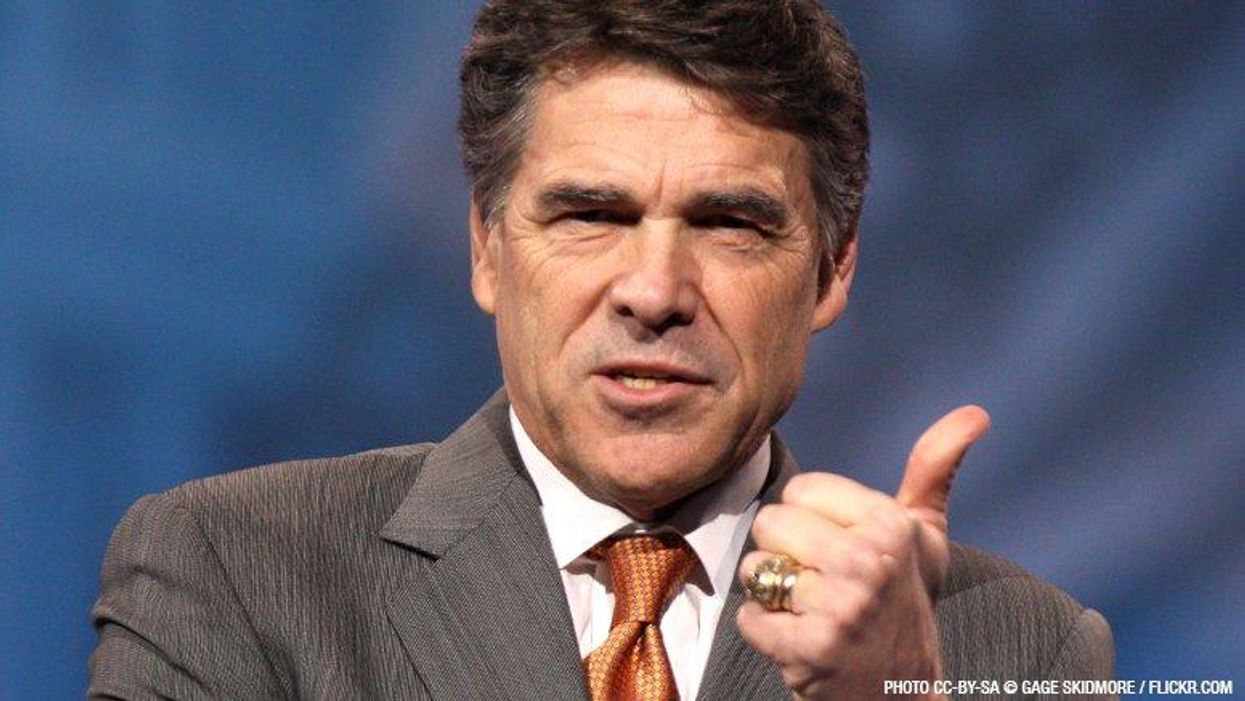
When he took the job, Energy Secretary Rick Perry didn't seem to know what the Department of Energy actually did. But since then, he has committed himself to one mission: promoting fossil fuels and petrochemicals.
Specifically, Perry is pushing a massive petrochemical buildout in Pennsylvania, Ohio and West Virginia, which would turn the Tri-State area into a new epicenter of highly polluting petrochemical manufacturing to rival the Gulf Coast. Last week, the Energy Department released a Report to Congress boasting the erroneous benefits of a key piece of infrastructure called the Appalachian Storage Hub. Secretary Perry also gushed about the storage hub on the op-ed page of the Pittsburgh Post-Gazette.
The Trump administration's push for petrochemicals is perfectly in sync with what major corporate powers are proposing. Right now, investors are pouring billions of dollars into Appalachia to create a cluster of gas infrastructure and plastics and petrochemical factories. An alliance of industry players, government officials and regional universities have also been promoting this substantial investment.
The whole reason the industry and its lackeys are pushing this petrochemical proliferation is to ride to the rescue of the struggling fracking industry.
Two of the facilities are petrochemical crackers that turn the natural gas liquid ethane into a chemical used to make plastic (one in Pennsylvania is under construction, while the other is proposed in Ohio). The third piece is the Appalachian Storage Hub in Ohio, which received partial approval early this year for a $1.9 billion Department of Energy loan. The Storage Hub would hold natural gas liquids like ethane underground and connect with a web of pipeline infrastructure to supply regional petrochemical and plastics facilities.
The whole reason the industry and its lackeys are pushing this petrochemical proliferation is to ride to the rescue of the struggling fracking industry. Surging fracked gas production has collapsed natural gas prices, spawning a crisis for the frackers. From 2008 to 2017, the real wholesale price for natural gas fell by 60 percent as total gas production rose. The Energy Department report even admits that the fracking boom in the Tri-State area is producing way more natural gas (and ethane) than can be used, outpacing the growth in associated infrastructure.
In his recent op-ed, Secretary Perry boasted, "My home state of Texas has the premier NGLs [natural gas liquids] hub in the Western Hemisphere... I've seen the tremendous opportunities it provides." Petrochemical cheerleaders like Perry mean opportunities for the chemical, gas and plastics industries, because the people of the Gulf Coast are left to deal with some of the highest pollution levels and pollution-related illnesses and diseases due to refineries, petrochemical and plastics plants.
The Gulf's petrochemical environmental injustice has tremendously disproportionate impacts on communities of color and lower-income neighborhoods.
The Gulf's petrochemical environmental injustice has tremendously disproportionate impacts on communities of color and lower-income neighborhoods. In Louisiana, the concentration of petrochemical plants between Baton Rouge and New Orleans has been called "cancer alley." Similarly, the populations near petrochemical facilities in Houston live in high-cancer-risk areas. For example, there were 16 chemical plants within a three-mile radius of the Manchester-Harrisburg neighborhood, one of Houston's lower-income communities of color. And children living within two miles of the Houston Ship Channel, where many plants are located, have a 56 percent greater chance of developing leukemia than children living 10 miles away.
Bringing Gulf Coast style petrochemical pollution to the Tri-State area is no economic boon, it's an ecological nightmare. The buildout of the Storage Hub and associated facilities would likely harm the region's socially and economically marginalized communities that lack the resources to fight back. Already, lower-income communities in Appalachia are more likely to have toxic neighbors and be disproportionately affected by pollution.
Secretary Perry claims that oil and gas production helps the economy "while protecting our environment." The Pennsylvania communities that have been hard hit by fracking have had to endure polluted drinking water supplies, increased air pollution and truck traffic and a range of other negative health impacts.
Appalachia's plentiful fossil fuel resources have not delivered widespread economic prosperity. The region endures higher rates of unemployment and poverty than the rest of the nation. A University of Pittsburgh Law Review article has also noted that natural resource development led to "a history of marginalization, extraction-related health issues, and a cycle of poverty."
The Storage Hub just promises more fracking and more petrochemical pollution. Investing in more fracking infrastructure locks us into a fossil fueled future that threatens communities and the climate.

While warning of ongoing efforts to bolster polluting industries, environmental and anti-nuclear activists are cautiously welcoming reports that President Donald Trump's latest ploy to bail out the money-losing coal and nuclear power industries has stalled due to lack of support within the administration.
"Whether it's a dictator who says he didn't interfere in our elections or that global warming will fix itself, this president will believe almost anything he's told," noted Environmental Working Group president Ken Cook. "But this scheme to bail out the dying coal industry on the backs of ratepayers was too far a stretch even for the Trump White House."
Citing four unnamed sources with knowledge of the discussion, Politico reported late Monday that "the White House has shelved the plan amid opposition from the president's own advisers on the National Security Council and National Economic Council."
Another anonymous official told E&E News that "efforts to ensure resilience of the grid continue" even as the "poorly articulated policy" put forth by the Department of Energy (DOE) under the direction of Secretary Rick Perry "flounders," failing to win over the president's top economic advisers.
A DOE memo detailing the plan leaked to the press in May. According to the draft proposal, officials were considering using emergency authority under federal law to force grid operators to buy electricity from at-risk coal and nuclear facilities in order to help them avoid shutdowns. The proposal claimed such a move was necessary for energy independence and homeland security.
The memo came after Perry, in January, struck out with a previous "ludicrous" plan that would have forced taxpayers and ratepayers to subsidize the coal and nuclear industries under the guise of safeguarding the nation's power grid. While the Federal Energy Regulatory Commission (FERC) is dominated by Trump appointees, they unanimously rejected it. That plan had followed a DOE-commissioned study last year that critics denounced as an effort to "justify bailing out" the coal and nuclear industries.
Coal and nuclear facilities across the U.S. are struggling to compete with cheaper energy sources--from cheaper fossil fuels like oil and gas to renewable options like wind and solar. While the recent reports suggest it is unlikely that Trump's hopes of putting these failing facilities on federal life support will be realized, activists are still urging the public to remain vigilant and warning of other threats such as privatized regional markets.
Tyson Slocum, director of Public Citizen's Energy Program pointed out that, in June, one privatized regional market "received a green light from a bitterly divided [FERC] to bail out uneconomic generation by forcing higher bidding costs for renewable energy." In other words, he explained, "the privatized market operators, susceptible to undue influence by their powerful coal, gas, and nuclear members, are actively attacking cheap renewables through complex market redesigns."
"Right now, FERC probably is handcuffed from finalizing the approval of any market bailout, as the commission is deadlocked 2-2," Slocum noted, but the commission could soon shift back to a makeup that favors the president's overt coal-friendly agenda. Trump just selected "coal- and nuclear-bailout ringleader" Bernard McNamee for the open slot--likely because of "his reliable pro-coal background," which includes serving under Perry at DOE as well as at the right-wing Texas Public Policy Foundation.
"If confirmed, McNamee would be the most overtly political person to serve on FERC in decades," E&E reported when his nomination was announced earlier this month. Additionally, "he has no experience in the electric or natural gas utility industry or as a regulator of those sectors." McNamee's appointment is subject to Senate approval.

Responding to questions from reporters during a joint press conference with Italy's Prime Minister Giuseppe Conte at the White House on Monday, President Donald Trump echoed his "And-Mexico's-Gonna-Pay-for-It" routine by announcing plans to build liquefied natural gas (LNG) terminals across the continent for the expressed purpose of importing fracked gas from the United States.
"The Trump administration continues to not only ignore climate change, the greatest economic and security threat the world faces, when imagining that the world needs all this LNG, but also ignores economic reality."
--Lorne Stockman, Oil Change International"We are already talking to the European Union about building anywhere from nine to 11 ports--which they will pay for--so that we can ship our LNG over to various parts of Europe," Trump stated. "And that will be more competition."
In response to a question about a gas pipeline from Russia, Trump said, "I'd like to see a competing pipeline" to that. Turning to Conte, Trump added, "So Mr. Prime Minister, I hope we're going to be able to do that competing pipeline."
The comments come on the heels of Trump boasting last week that the EU would "be buying vast amounts of LNG!" after he reached an agreement with European Commission President Jean-Claude Juncker.
Critics, however, quickly denounced the president's latest comments for both environmental and economic reasons.
"The Trump administration continues to not only ignore climate change, the greatest economic and security threat the world faces, when imagining that the world needs all this LNG, but also ignores economic reality," Lorne Stockman, senior research analyst at Oil Change International, explained to Common Dreams in an email.
Despite the president's claims about what the EU will do, there's little evidence to support the idea that Europe is on the verge of a giant LNG import binge. As Reuters noted, "three-quarters of Europe's existing import facilities lie empty while demand for U.S. LNG on the continent remains limited." According to an analysis by Food & Water Watch Europe released earlier this year, the utilization rate of Europe's existing LNG import terminals shows there is no need for new facilities.
"If we don't want to lock Europe into even more fossil fuels and move to a renewable energy system, we cannot waste money on LNG infrastructure but have to channel as much financial and political support as possible to renewables," wrote Andy Gheorghiu and Frida Kieninger, the authors of the group's analysis, in April.
As Stockman added, "Europe's existing LNG import terminals are being utilized at very low levels. The need for more is like most of Trump's trade policy--illusory."
Politico, meanwhile, called it "the art of the no-deal," as the "U.S. is already exporting LNG to Europe. Market forces will largely determine whether its share will go up in the future."
Trump's Energy Secretary, Rick Perry, for his part, has been on an LNG promotion circuit. Last week he appeared at the dedication of the controversial Cove Point LNG export expansion project, where he said, "We're now exporting natural gas to 30 nations."
"While a number of states and most countries are smartly turning away from filthy, antiquated fossil fuels, the Trump administration is senselessly pushing ahead with climate-killing LNG exports."
--Wenonah Hauter, Food & Water WatchTouting fracked gas, he asserted in a CNBC op-ed over the weekend that "we must continue to expand our extraction capabilities and domestic transmission infrastructure." The Energy Department also announced last week a final rule to expedite approval for small-scale natural gas exports, including LNG, to non-free trade agreement countries.
In addition, as DeSmogBlog reported:
the DOE is currently considering 25 projects that combined would raise exports to a staggering 21.35 Bcf [billion cubic feet] per day.
That volume is so high that the DOE found it necessary to produce a study assessing the impacts of greenlighting those export projects could be on both America's gas markets and the nation's overall economy.
Environment groups including Food & Water Watch, Oil Change International, and Friends of the Earth-U.S., took issue with the report, calling it fundamentally flawed because the "findings exaggerate both the likelihood of elevated levels of U.S. LNG exports and, consequently, the projected macroeconomic benefits from LNG exports."
In particular, the groups say the study failed to take into consideration climate polices nations would take to work towards Paris climate agreement goals, which would likely entail a reduction in global gas demand.
"While a number of states and most countries are smartly turning away from filthy, antiquated fossil fuels, the Trump administration is senselessly pushing ahead with climate-killing LNG exports. The world will increasingly reject our gas exports in favor of truly clean, renewable power, and as a result the costs of this policy to Americans will skyrocket," said Wenonah Hauter, executive director of Food & Water Watch.
"Trump makes up his own science," she added, "and our country and the world suffers."

Environmental advocates on Friday responded with outrage to confirmation from the White House that President Donald Trump has ordered Energy Secretary Rick Perry to plot what's being called an "unprecedented intervention" by the federal government to bail out financially strapped coal and nuclear power plants that can't compete with the renewable energy sector.
"The taxpayers should never be asked to bail out wealthy fossil fuel executives who are trying to pollute our air and water with their dirty, dangerous fuels, and bad decisions."
--Mary Anne Hitt,
Sierra Club
"This is an outrageous ploy to force American taxpayers to bail out coal and nuclear executives who have made bad decisions by investing in dirty and dangerous energy resources," declared Mary Anne Hitt, director of the Sierra Club's Beyond Coal campaign.
Ahead of a National Security Council meeting on Friday, Bloomberg News obtained an Energy Department memo detailing plans to use emergency authority under two federal laws to require grid operators to buy electricity from at-risk coal and nuclear facilities and establish a "Strategic Electric Generation Reserve."
The document argues such moves are necessary for homeland security and energy independence. White House Press Secretary Sarah Huckabee Sanders responded to the report with a statement confirming Trump has instructed Perry "to prepare immediate steps to stop the loss of these resources," claiming the need to protect the grid "from intentional attacks and natural disasters."
Rejecting the administration's argument that preserving coal plants is essential to national security as "surreal" and "madness" contradicted by experts, Earthjustice staff attorney Kim Smaczniak pointed out that clean energy sources like wind and solar "make the grid safer from attack," and even "the U.S. military is increasingly turning to solar, not coal, to ensure resilience at military bases."
The Energy Department proposal outlined in the memo follows a previous plan rejected by federal regulators last year, which would have given subsidies to nuclear and coal plants on the grounds of providing "resilience" to the electric grid.
"That attempt was rightfully denied by the Federal Energy Regulatory Commission, which determined that market rates and processes are indeed sufficient to meet national energy demand," noted Mike Jacobs, a senior energy analyst for the Union of Concerned Scientists.
"The Trump administration is trying, once again, to fleece ratepayers by giving coal and nuclear power plants billions of dollars in guaranteed profits," he added, calling the new proposal an "absurd" abuse of authority.
While green groups refuted the administration's claims that the new plan would further protect the grid, chief executive of Bloomberg L.P. and former New York City Mayor Mike Bloomberg posited that "bailing out polluting, unprofitable coal plants has nothing to do with national security and everything to do with special interests in Washington."
Throughout his first term, Trump has often catered to the fossil fuel industry's demands, and has even stocked his administration with former lobbyists.
"Trump will clearly try anything to help millionaire coal and nuclear executives," Hitt concluded. "Every grid operator has unequivocally stated that there is no grid emergency, yet Donald Trump is trying to invent one to help his rich friends."
"The taxpayers should never be asked to bail out wealthy fossil fuel executives who are trying to pollute our air and water with their dirty, dangerous fuels, and bad decisions," Hitt added, vowing that Trumps's "effort to push these illegal directives will be met with fierce resistance in the courts and in the streets."
The developments come on the one-year anniversary of Trump's announcement he would withdraw the United States from the Paris climate agreement, which aims to decrease fossil fuel use to reduce greenhouse gas emissions and limit global temperature rise within this century to 2 degrees Celsius above pre-industrial levels.

Two Pennsylvania children and a Philadelphia-based environmental organization filed suit on Monday against the Trump administration for its gutting of climate regulations, laws, and policies--actions which show the government's "reckless and deliberate indifference to the established clear and present dangers of climate change."
"We must hold the federal government accountable for the long-term environmental harm that is propagating under its direction. It's time to fight back," said Clean Air Council executive director and chief counsel Joseph Minott.
The suit (pdf), filed in the U.S. District Court for the Eastern District of Pennsylvania, names as defendants President Donald Trump, the Energy Department, Energy Secretary Rick Perry, the Environmental Protection Agency (EPA), and EPA administrator Scott Pruitt, and argues that through the administration's rollbacks, which interfere "with a stable climate system," they violated the public trust doctrine and infringed upon the defendants' Fifth and Ninth Amendment rights.
Among the actions cited in the suit are ditching the Paris climate accord, stopping methane emissions reporting by oil and gas companies, approving the Keystone XL pipeline, proposing cuts to federal agencies dealing with climate change, proposing the repeal of the Clean Power Plan, and purging scientists from the EPA board of scientific counselors.
All such actions, the suit argues, "will cause irreversible and catastrophic harm to the natural systems critical to plaintiffs' rights to life, liberty, and property." They will also "cause human deaths, shorten human lifespans, result in widespread damage to property, threaten human food sources, and dramatically alter the planet's ecosystem, thereby violating plaintiffs' fundamental right to a life-sustaining climate system."
The suit adds that the administration has relied "on junk science to wage a war on facts, data, and reliable principles and methods arising out of scientific, technical, and specialized knowledge" in its threats to "a life-sustaining climate system and an atmosphere and oceans that are free from dangerous levels of anthropogenic CO2." That's despite the fact that "the United States government has known for decades that climate change presents a clear and present danger to the health and welfare of its citizens and an immediate threat to the planet."
The child plaintiffs are directly impacted by the administration's actions, the suit says.
The seven-year-old plaintiff is experiencing direct harm as a result of the worsening climate situation, not only because of his allergies but because of increasing temperatures and extreme weather that have interfered with his enjoyment of outdoor activities. For the 11-year-old plaintiff, climate change is worsening his asthma. On top of that, he's "experienc[ing] anxiety about the potentially irreversible impact of climate change on the planet and future generations, including his own children and grandchildren."
According to Carroll Muffett, president of the Center for International Environmental Law (CIEL), "While the U.S. government's actions on climate change prior to this administration fall far short of what is needed, they provide a baseline level of protection that cannot and must not be reversed"--yet "the Trump administration continues its campaign to eviscerate vital climate protections and destroy the scientific tools needed to assess, reduce, and respond to climate risks."
"From undermining the Paris agreement to dismantling vital climate satellites to jettisoning guidance on climate and infrastructure, the defendants have demonstrated a reckless disregard for the lives, livelihoods, and rights of U.S. residents and people around the world. In so doing," he continued, "they have created a clear violation of fundamental rights that can and should be urgently addressed by the courts."

U.S. Energy Secretary Rick Perry provoked outrage on Thursday with his "absurd" suggestion that fossil fuel expansion could play a role in preventing sexual assault. The backlash was swift and damning, with the Sierra Club and others calling for Perry's immediate resignation.
"It was already clear that Rick Perry is unfit to lead the Department of Energy, but to suggest that fossil fuel development will decrease sexual assault is not only blatantly untrue, it is an inexcusable attempt to minimize a serious and pervasive issue," said Sierra Club executive director Michael Brune.
"Women, and particularly women of color, are among some of the most severely impacted by the climate crisis, and it is these same communities that are most at risk of sexual assault," Brune added. "Rick Perry's attempt to exploit this struggle to justify further dangerous fossil fuel development is unacceptable. He does not deserve to hold office another day with these twisted ideas, and he should resign from his position immediately before he causes any more damage."
The environmental advocacy group NextGen America, also urged him to resign, tweeting: hey rick, quit.
Perry was attending an energy policy event hosted by Axios and NBC News, where he discussed a recent trip to Africa, and the importance of bringing electricity to the villages he visited. Timothy Cama, a reporter for The Hill, tweeted a partial transcript that highlights the controversial comment about sexual assault.
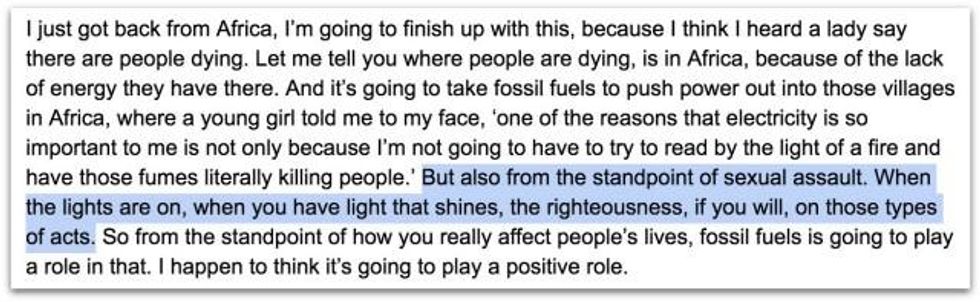
Watch:
Jezebel's Joanna Rothkopf pointed out that Perry's comment could be "a play on Proverbs 13:9: 'The light of the righteous rejoices, but the lamp of the wicked goes out,'" and noted that "the connection between Christianity and climate change denial is one the anti-science right has been pushing for some time, a connection that Perry seems to be actively embracing."
An Energy Department spokesperson attempted to walk back the remark, claiming that Perry "was making the important point that while many Americans take electricity for granted there are people in other countries who are impacted by their lack of electricity," and that during his trip, "one person told him about how light can be a deterrent to sexual assault and security in remote areas."
Emily Atkin, an environment reporter for the New Republic, outlined in a series of tweets that "Perry's use of sexual assault victims to promote Trump's fossil fuel agenda is offensive," as well as ill-informed.
"Perry's comments also willfully ignore the renewable energy boom and increasing potential in the developing countries he claims he wants to help," Atkin wrote. "Developing countries know renewable energy is a better option. In fact, developing countries invest more in renewables than rich countries do.
Wenonah Hauter, executive director of Food & Water Watch, called Perry's comments "absurd" while also noting the consequences of using fossil fuels, and presenting renewable power as "the better path forward."
"We all need light in the dark," Hauter said, "but what we don't need are the host of calamitous impacts of dirty fossil fuels on society: air and water pollution, destruction of natural landscapes, deadly human health effects and global climate chaos. There are better ways to keep the lights on, Mr. Perry."
Rick Perry's name was trending on Twitter Thursday afternoon as others weighed in: