SUBSCRIBE TO OUR FREE NEWSLETTER
Daily news & progressive opinion—funded by the people, not the corporations—delivered straight to your inbox.
5
#000000
#FFFFFF
To donate by check, phone, or other method, see our More Ways to Give page.


Daily news & progressive opinion—funded by the people, not the corporations—delivered straight to your inbox.
As April 15 approaches, we can reflect on the life and work of Berrigan and undertake our own ministry of risk for peace—to ease the suffering, to restore human dignity, and to challenge our doomed policy of warmaking.
Each year Americans forfeit a sizable slice of their income to the United States Treasury to fund the government. Tax Day is dreaded. No one likes surrendering their hard-earned cash. But rather than a resigned shrug, Americans should look closely at what they are getting for their money when it comes to government services and policy.
In fiscal year 2023, the Pentagon received $858 billion for the preparation of war. This doesn’t include hidden costs for intelligence services, veterans’ benefits, Homeland Security, or the Department of Energy, which oversees the nation’s nuclear arsenal. All totaled, over $1 trillion a year is allotted for warmaking. By comparison, the 2023 budget for the U.S. Department of State, this nation’s department tasked with making peace across the globe, was a relatively miniscule $63 billion.
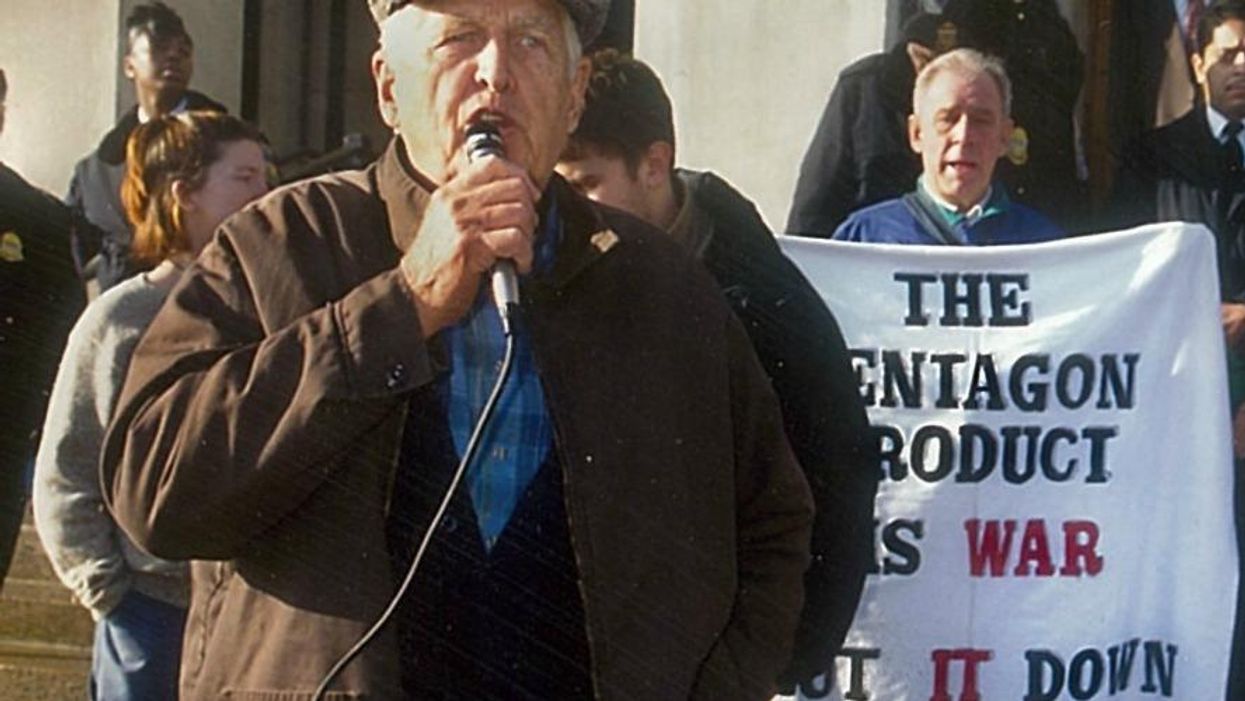
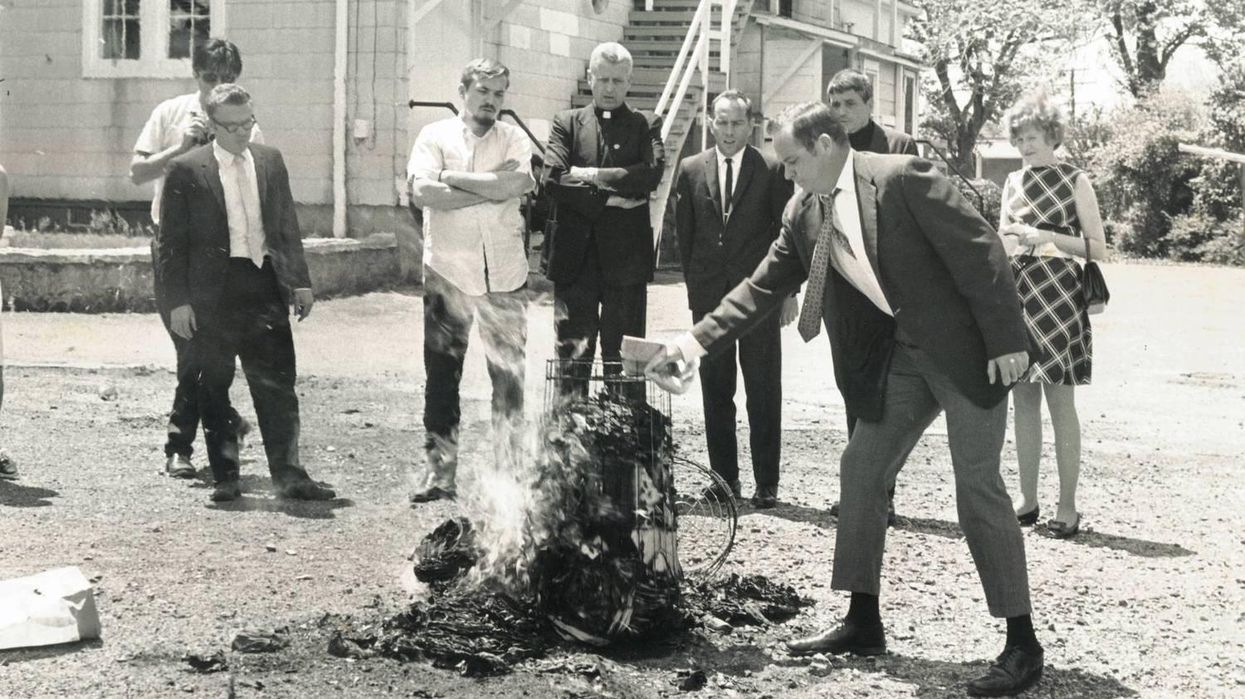
One way to register resistance to this profligate spending on warmaking is that of renowned peace activist and Catholic priest Philip Berrigan. During the Vietnam War, Phil initiated the destruction of U.S. military draft files in Baltimore and Catonsville, Maryland, to save the lives of both Vietnamese and Americans, actions for which he received lengthy prison sentences.
Whether it be gold, fruit, rubber, or sugar in Latin America; oil in the Middle East; or rare earth minerals in Africa, the U.S. taxpayer has long funded the corporate theft of natural resources from Indigenous lands for the benefit of U.S corporations and their wealthy shareholders.
These draft file actions by Phil initiated a new form of resistance to the Vietnam War, since no copies were kept of the draft files. Hundreds of similar actions followed at draft board offices across the country with hundreds of thousands of draft files destroyed, all stopping young men from being conscripted to kill or be killed.
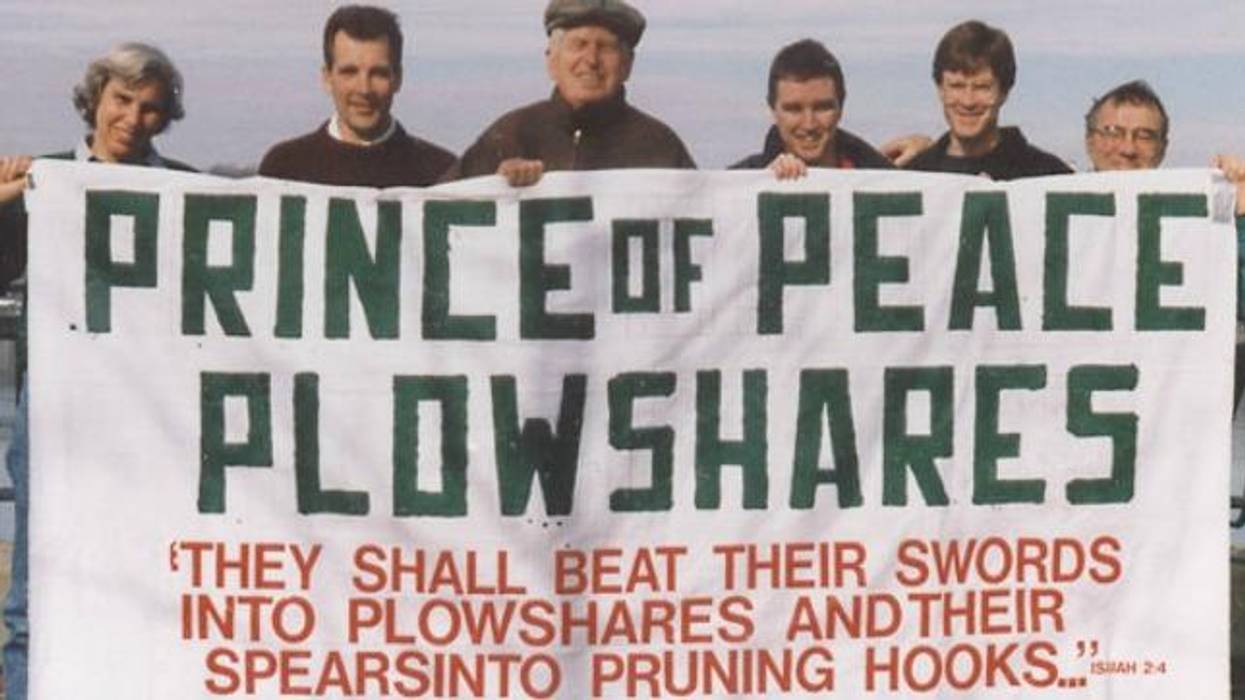
In 1980, Phil initiated the Plowshares movement—which continues to this day—as he and others entered the General Electric nuclear weapons facility in King of Prussia, Pennsylvania, pouring blood on weapons blueprints and symbolically hammering on the nosecones of missiles, “Beating swords into plowshares.” A Christian metaphor indeed, but a universal message. Since that first action, there have been over 70 Plowshares actions around the world.
Phil strongly objected to the notion that U.S. citizens should fund needless death and destruction abroad through their taxes, or possibly fund their own destruction by nuclear war. He repeated nonviolent actions time and again, serving a total of 11 years in prison to stop the slaughter of innocents and protest the use of U.S. tax dollars for arms proliferation, nuclear warmaking, and endless wars of choice.
For U.S. citizens, the well-known waste and fraud of the Pentagon should be one outrage. The Pentagon remains the only federal department to never pass a required federal audit. The Pentagon cannot account for 63% of the tax money it receives. That’s our money. Gone. Unaccounted for. Lining the pockets of weapons manufacturers.
But the more pressing concern with these war dollars is their use to initiate wars of choice, often against impoverished countries, because those countries have natural resources beneath the soil that the U.S seems to think belong to them. The cruel joke is, “How dare they put their country over our oil.” And so, we take it. With extreme violence and death.
The U.S. currently has soldiers in northern Syria where massive quantities of oil is extracted for Western fossil fuel companies. The war in Iraq was for oil. We are building new bases in Somalia where oil fields have been found. These wars for corporate profit have gone on for over a century. As decorated war hero Smedley Butler said in the 1930s about his many years in the U.S. military, “I was a racketeer, a gangster for capitalism... Looking back on it, I might have given Al Capone a few hints.”
Whether it be gold, fruit, rubber, or sugar in Latin America; oil in the Middle East; or rare earth minerals in Africa, the U.S. taxpayer has long funded the corporate theft of natural resources from Indigenous lands for the benefit of U.S corporations and their wealthy shareholders. Innocents in foreign lands die as a result, while U.S. taxpayers struggle to pay mortgages, rent, healthcare bills, and food costs.
According to Brown University’s Costs of War Project, the United States spent some $8 trillion in the last 23 years for the Wars on Terror. Four-and-a-half to 4.7 million people in foreign lands died because of those wars, most of them innocent civilians. Mothers and fathers and children.
And so, as this Tax Day approaches, perhaps we can reflect on the life and work of Philip Berrigan and undertake our own ministry of risk for peace in whatever form that may take, to ease the suffering, to restore human dignity, to challenge our doomed policy of warmaking. Only in this way can we reconcile ourselves with justice and democracy. Only in this way can we save ourselves, our country, and perhaps the world.
As Phil said, “These blind leading the blind have done more than threaten us with doomsday scenarios. They have, with a devilish ingenuity, convinced us that we ought to pay, through taxes, for our own destruction.”
Phil Berrigan's challenge must become ours: "Meet me at the Pentagon!" Or at its corporate outposts.
Days after a U.S. warplane bombed a Doctors Without Borders/Médecins Sans Frontières (MSF) hospital in Kunduz, Afghanistan, killing forty-two people, twenty-four of them patients, the international president of MSF, Dr. Joanne Liu walked through the wreckage and prepared to deliver condolences to family members of those who had been killed. A brief video, taped in October, 2015, captures her nearly unutterable sadness as she speaks about a family who, the day before the bombing, had been prepared to bring their daughter home. Doctors had helped the young girl recover, but because war was raging outside the hospital, administrators recommended that the family come the next day. “She’s safer here,” they said.
The child was among those killed by the U.S. attacks, which recurred at fifteen minute intervals, for an hour and a half, even though MSF had already issued desperate pleas begging the United States and NATO forces to stop bombing the hospital.
Dr. Liu’s sad observations seemed to echo in the words of Pope Francis lamenting war’s afflictions. “We live with this diabolic pattern of killing one another out of the desire for power, the desire for security, the desire for many things. But I think of the hidden wars, those no one sees, that are far away from us," he said. “People speak about peace. The United Nations has done everything possible, but they have not succeeded.” The tireless struggles of numerous world leaders, like Pope Francis and Dr. Joanne Liu, to stop the patterns of war were embraced vigorously by Phil Berrigan, a prophet of our time.
“Oppose any and all wars,” he urged. “There has never been a just war.” “Don’t get tired!” he begged people, adding, “I love the Buddhist proverb, ‘I will not kill, but I will prevent others from killing.’ ”
People who’ve embraced his message continue meeting at the Pentagon, as happened December 28 when activists commemorated the “Feast of the Holy Innocents.” Christians traditionally dedicate this day to the remembrance of a time when King Herod ordered the massacre of children under two years of age because of a paranoid belief that one of the recently born children in the region would grow up to oust Herod from power and kill him. Activists gathered at the Pentagon held signs decrying the slaughter of innocents in our time. They’ll protest the obscenely bloated military budget which the U.S. Congress just passed as a part of the Consolidated Appropriations Act of 2023.
As Norman Stockwell of The Progressive recently noted, “The bill contains nearly $1.7 trillion of funding for FY2023, but of that money, $858 billion is earmarked for the military (‘defense spending’) and an additional $45 billion in ‘emergency assistance to Ukraine and our NATO allies.’ This means that more than half ($900 billion out of $1.7 trillion) is not being used for ‘non-defense discretionary programs’—and even that lesser portion includes $118.7 billion for funding of the Veterans Administration, another military-related expense.”
By depleting funds desperately needed to meet human needs, the U.S. “defense” budget doesn’t defend people from pandemics, ecological collapse, and infrastructure decay. Instead it continues a deranged investment in militarism. Phil Berrigan’s prophetic intransigency, resisting all wars and weapons manufacturing, is needed now more than ever.
Outraged by the reckless slaughter of innocent people in wars ranging from Vietnam to Afghanistan, Phil Berrigan insisted that weapons manufacturers profiting from endless wars should be held accountable for criminal activity. The weapons corporations rob people, worldwide, of the capacity to meet basic human needs.
The appallingly greedy Pentagon budget represents a corporate takeover of the U.S. Congress. As the coffers of weapons manufacturers swell, these military contractors hire legions of highly paid lobbyists tasked with persuading elected officials to earmark even more funds for companies like Lockheed Martin, Boeing, Raytheon United, and General Atomics. According to militarists, stockpiles of weapons must be used up, in order to justify more weapons manufacturing. Media complicity is necessary, and can be purchased, in order to frighten U.S. taxpayers into the continued bankrolling of what could become worldwide annihilation.
Phil Berrigan, who in his lifetime evolved from soldier to scholar to prophetic anti-nuclear activist, astutely linked the racial oppression he opposed as a civil rights activist to the rising oppression caused by militarism. He likened racial injustice to a terrible hydra that contrives a new face for every area of the world. Throughout his life, Phil Berrigan identified with people menaced by the hydra’s new faces of war. Elaborating on this theme in a book called No More Strangers, published in 1965, he wrote that the dispassionate decision of people in the United States to practice racial discrimination made it “not only easy but logical to enlarge our oppressions in the form of international nuclear threats.”
How can we in the United States prevent the killing that goes on, in our name, in multiple wars, exacerbated by weapons made in the U.S.A? How can we resist the growing potential, acute scourge of a nuclear exchange as warring parties continue issuing nuclear threats in Ukraine and Russia?
One step we can take involves both political and humanitarian efforts to hold accountable the corporations profiting from the U.S. military budget. Drawing on Phil Berrigan’s steadfastness, activists worldwide are planning the Merchants of Death War Crimes Tribunal scheduled to be held November 10 to 13, 2023. The Tribunal intends to collect evidence about crimes against humanity committed by those who develop, store, sell, and use weapons to commit crimes against humanity. Testimony is being sought from people who’ve borne the brunt of modern wars, the survivors of wars in Afghanistan, Iraq, Yemen, Gaza, and Somalia, to name but a few of the places where U.S. weapons have terrified people who’ve meant us no harm.
“We render you, corporations obsessed with war profiteering, accountable; answerable!,” declares the Reverend Dr. Cornel West on the Tribunal’s website.
On November 10, 2022, organizers of the Merchants of Death War Crimes Tribunal and their supporters served a “subpoena” to the directors and corporate offices of weapons manufacturers Lockheed Martin, Boeing, Raytheon United, and General Atomics. The subpoena, which will expire on February 10, 2023, compels them to provide to the Tribunal all documents revealing their complicity in aiding and abetting the United States government in committing war crimes, crimes against humanity, bribery, and theft.
People menaced by the hydra’s new faces of war often have nowhere to flee, nowhere to hide. Thousands upon thousands of the victims are children.
Mindful of the children who are maimed, traumatized, displaced, orphaned, and killed by all of the wars raging today, we must hold ourselves accountable as well. Phil Berrigan’s challenge must become ours: “Meet me at the Pentagon!” Or at its corporate outposts.
Humanity literally cannot live in complicity with the patterns that lead to bombing hospitals and slaughtering children.
"Nuclear warfare is not on trial here, you are!" said Judge Samuel Salus, in exasperation.
Before him were eight activists, including two priests and a nun. As Judge Salus tried to preside over the government's prosecution of them for their trespass onto -- and destruction of -- private property, the eight were trying to put nuclear warfare, nuclear weapons, nuclear policy and U.S. exceptionalism on trial.
That was 40 years ago this week -- ancient history by some measures. And no one reading this will be surprised to find that the eight were found guilty and the human family is still threatened by almost 15,000 nuclear warheads. So, four decades later, why isn't nuclear warfare on trial?
They are the crime responsible for the deaths of hundreds of thousands of Japanese civilians 75 years ago. They have littered the landscape with radioactive waste. They have cost the United States more than $5 trillion from the public coffers. They are the apocalyptic nightmare on hair-trigger alert that haunt our children's dreams.
On September 9, 1980, my father, Philip Berrigan, along with his brother Daniel, John Schuchardt, Dean Hammer, Elmer Maas, Molly Rush, Sister Anne Montgomery, and Father Carl Kabat, gained entry into the General Electric plant in King of Prussia, Pennsylvania. Once inside the complex, they poured blood over two nuclear weapons' nose cones, and used household hammers to dent the metal. They came to be known as The Plowshares Eight. They were motivated by the prophets of the Hebrew scriptures who enjoined that "they shall beat their swords into plowshares, and their spears into pruning hooks; nation shall not lift up sword against nation, neither shall they learn war any more."
As we mark this 40th anniversary in a strange and fearful time of pandemic, white violence, political instability and economic insecurity, it is heartening and instructive to reflect back on the origins of the Plowshares movement. It was largely white, largely Catholic and relatively small. Their purpose was to take personal responsibility for nuclear weapons -- these implements of mass destruction shrouded in almost mystical secrecy and reverence -- and label them improper property, converting, transforming, exposing and ultimately abolishing them. Plowshares activists don't just hold these views or espouse these beliefs. They conspire. They pray. They act through nonviolent means.
As we mark this 40th anniversary in a strange and fearful time of pandemic, white violence, political instability and economic insecurity, it is heartening and instructive to reflect back on the origins of the Plowshares movement. Over and over in the last 40 years, small groups of activists have gained entry to military installations, warships, submarines, missile silos, weapons manufacturer's office parks and warehouses, air shows, communication hubs and other sites. They have carried bibles and banners, densely researched indictments, blood, hammers and other household tools. More than a hundred of these actions have happened since the Plowshares Eight, and the activists involved have cumulatively spent lifetimes in jails and prisons.
As a priest, my dad has resisted the Vietnam War, trespassed and destroyed property -- at that earlier time, it was the draft records that were calling young men to the killing fields of Indochina. While inviting his older brother Daniel into this new nuclear age conspiracy, Dad called it "a second Catonsville," referring to their May 1968 draft board raid. In a letter included in Daniel Cosacchi and Eric Martin's "The Berrigan Letters," Dad wrote to Dan that; "Quite nearby and we hope, accessible, lies a noxious toy assembly line to which stalwarts may gain entry for an admiring view and perhaps something more."
It is a testament to their well-honed connection and commitment that Uncle Dan did not need a decoder ring to parse out the meaning here. That letter was written on March 4, 1980, and after just six months of planning, the eight acted. In their action statement they declared: "We come to GE to beat swords into plowshares and to expose the criminality of nuclear weapons and corporate piracy. We want to expose the lethal lie spun by GE through its motto 'we bring good things to life.' At GE, darkness shuts out light, death reigns over life. GE is helping the Pentagon prepare for atomic holocaust."
Arrested and jailed, tried and found guilty, my father and his friends faced 25 years in jail. My brother Jerry and I were 5 and 6 years old at the time, and our sister Kathleen was conceived in the midst of the trial. The dire consequences did not temper the activists' spirits or dull their courage. In fact, they were so adamant that they carried their resistance into the courtroom, turning their backs on Judge Salus when he refused to admit some of their expert witnesses and walking out of the court house and heading back to General Electric for a demonstration. When they refused to return to court the next day, vigiling again at the gates of GE instead, they were arrested there and brought back to court in cuffs. In the end, four of the eight received sentences of 3-10 years, three were sentenced to 1.5 -5 years, and Molly Rush, a first-time offender, got 2-5 years.
That first Plowshares action set off a chain reaction. Over the last 40 years, there have been more than 100 similar actions. People are attracted to, and inspired by, the alchemic mixture of symbolic disarmament and real transformation that carries through the action, jail witness, courtroom saga and time in prison. It is a long haul commitment that measures effectiveness in the ineffable stirrings of conscience, the trim-tab turnings toward nonviolence, new strands of conversation and musings -- rather than in Senate bills passed, dollars raised or ground gained.
Arthur Laffin, who compiled "Swords Into Plowshares: Nonviolent Direct Action for Disarmament, Peace, Social Justice," writes of the process of community building and prayer that is a key component of the Plowshares witness, sharing that "People who have been involved in Plowshares actions have undertaken a process of intense spiritual preparation, nonviolence training and community formation, and have given careful consideration to the risks involved. Plowshares activists, accepting full responsibility for their actions, remain at the site of their action so that they can publicly explain their witness."
Indeed, many see the prayer and preparation as the piece of the work that "makes the magic happen." My Uncle Dan recalled the furor around the action as they were first arrested. How did they gain entry? How did they know about the weapons? Was there a leak? Was there inside information? In "Swords Into Plowshares" Dan wrote "Of course we had inside information; of course there was a leak -- our informant is otherwise known in the New Testament as Advocate, Friend, Spirit. We had been at prayer for days."
From King of Prussia to Kings Bay, Georgia
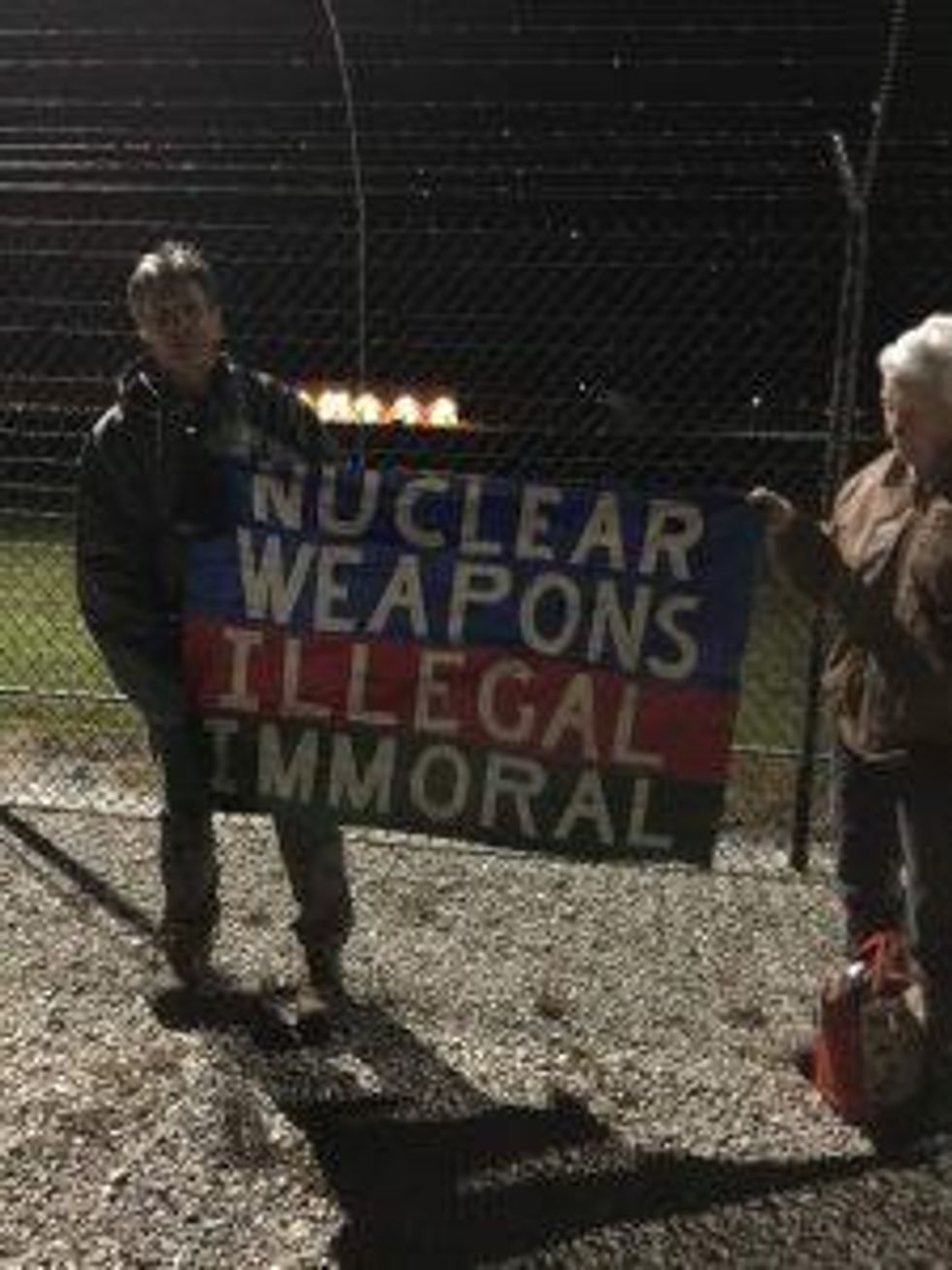
My mother, Elizabeth McAlister, is a veteran of two Plowshares actions herself. Jonah House -- the community she, my father and their friends founded in the early 1970s -- was the incubator of countless others. Mom's most recent Plowshares action took place in April 2018, at the Kings Bay Naval Base in Georgia. She and six others gained entry to the 16,000-acre base on the 60th anniversary of Martin Luther King Jr.'s assassination. They trekked through the night to reach sites on the base where nuclear weapons are celebrated and memorialized. Four of the group dismantled the memorials and marked office buildings with blood and messages. Mom and two others were apprehended as they tried to reach bunkers where Trident submarines are stored. Their banners read: "Nuclear Weapons: Illegal - Immoral" and "'The Ultimate Logic of Racism is Genocide' Dr. Martin Luther King" and "The Ultimate Logic of Trident is Omnicide."
"Nuclear weapons forfeit our future."
--Elizabeth McAlisterSix Trident submarines operate out of Kings Bay, and they are the likely launchers of a first-strike nuclear attack. They are armed with D5 missiles capable of traveling over 1,370 miles in less than 13 minutes, allowing for a U.S. nuclear strike anywhere on planet Earth within 15 minutes. The Navy plans to replace its aging fleet of Tridents with the Columbia-class submarine. These new submarines are estimated to cost $122.3 billion. In the indictment they carried on to the base, the Kings Bay Plowshares activists highlighted that "each day this program steals from all in our nation and world by its theft of much-needed resources."
In October 2019, they were tried and found guilty in relatively short order. The judge was willing to engage with the activists about their conscience and formation, but would not allow expert testimony about nuclear weapons, foreign policy or international law. In the end, it took her longer to instruct the jury than it took for the jury members to find the defendants guilty.
In January 2020, the Bulletin of the Atomic Scientists moved the hands of the Doomsday Clock 20 seconds closer to midnight. We stand at 100 seconds to midnight, closer than ever before, because they say "Civilization-ending nuclear war -- whether started by design, blunder, or simple miscommunication -- is a genuine possibility. Climate change that could devastate the planet is undeniably happening. And for a variety of reasons that include a corrupted and manipulated media environment, democratic governments and other institutions that should be working to address these threats have failed to rise to the challenge."
Most of the Kings Bay Plowshares still await sentencing. Mom was sentenced to time served by video conference in June -- a surreal and dislocating experience that is now more and more common in our criminal justice system. Her co-defendants opted to postpone sentencing in hopes that it could be in person, but it is unclear if that will happen.
Waging Nonviolence depends on your support. Become a sustaining member today and receive this gift.
Reaping the peace dividends
Last week, my mom and I sat at the edge of a playground watching my 6 and 8 year olds climb and jump. I asked her what she remembered of September 1980. "I remember the feeling of utter relief when I heard that your dad and the rest of the eight were still alive. I felt such gratitude that they were able to do the action without being hurt or damaged. Your dad, when I finally talked to him from jail, was tired but satisfied. He was prayerfully grateful."
My mom, who has spent years in prison after following her conscience, mused, "No one in their right mind wants to take these weapons on. No one wants to take on the consequences. Jail is dehumanizing and removes you from the people you love. Going up against that which defines the United States of America as 'number one' is terrifying. But, I think, that we can address these weapons of mass destruction and help people understand how wrong they are, how destructive they are. We can show people that these weapons take away from every good effort people engage in. They undercut everything we try to do. Nuclear weapons forfeit our future. But our 'no' is heard and inspires others."
Just as there is a direct line between King of Prussia and Kings Bay, we can also draw a line of inspiration and mutual respect between the actions of religiously-motivated nuclear disarmers and the (perhaps more secular) racial justice activists who are toppling, dismantling and replacing racist statues and monuments.
We hope that by the time we mark 50 years since the Plowshares Eight, we are erecting windmills for energy, planting sunflowers to detox the soil, practicing mutual aid, building community and finally prosecuting nuclear warfare and reaping the peace dividends that flower from global nuclear abolition.
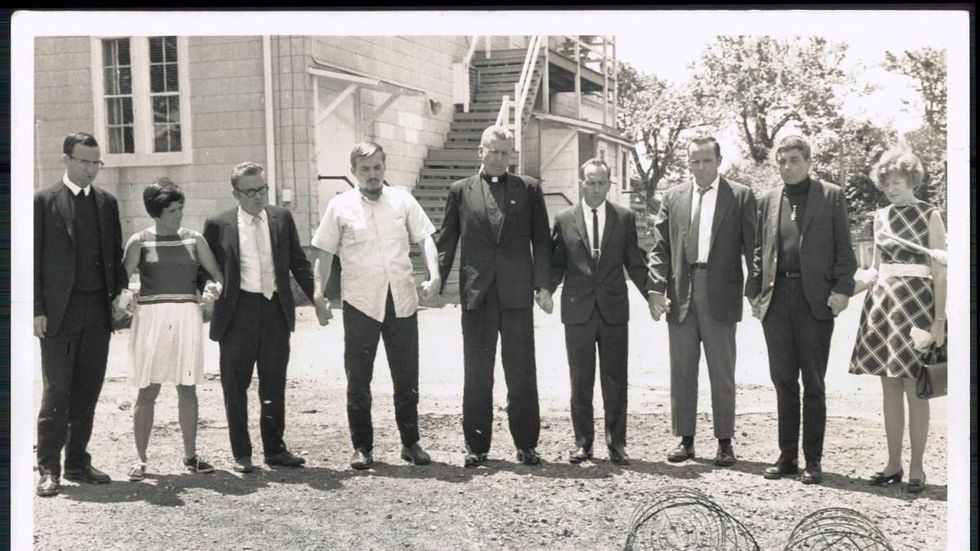
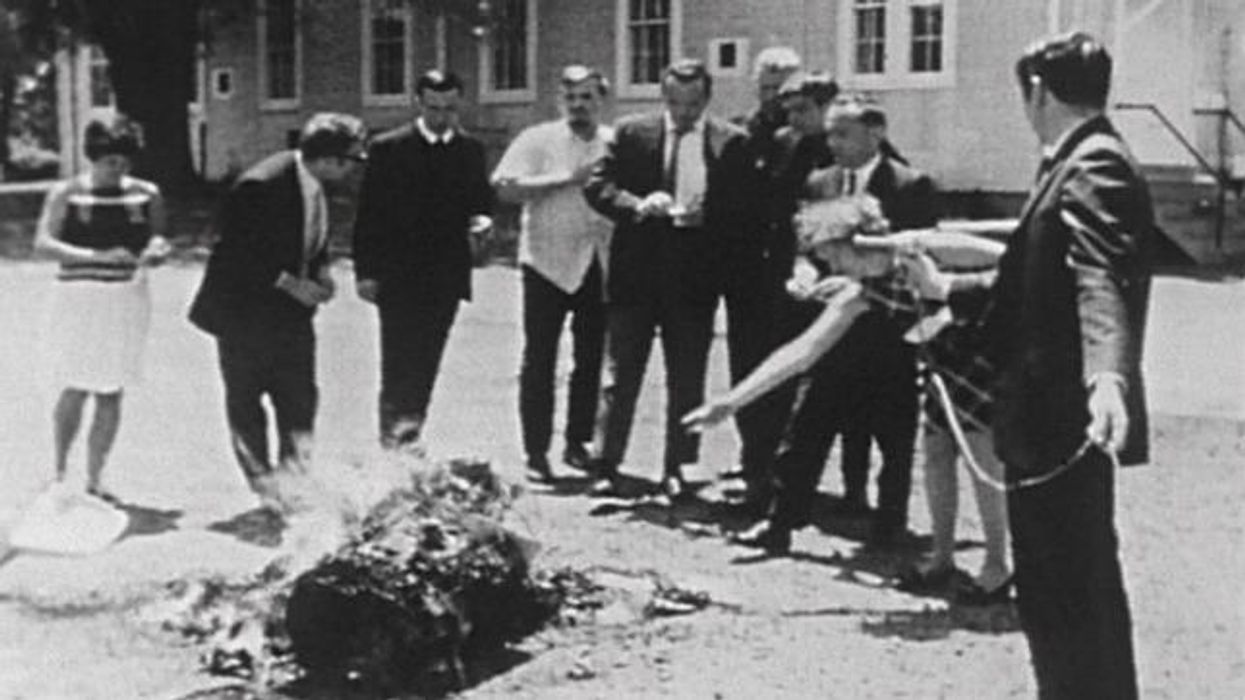
Fifty years ago today--on May 17, 1968 in the small town of Catonsville, Maryland--nine Catholic Worker and anti-war activists made history, and inspired a wave of popular resistance, for their stance against the Vietnam War as they used homemade napalm to torch a pile of draft notices they had seized from the local federal office.
"Our apologies, good friends, for the fracture of good order, the burning of paper instead of children, the angering of the orderlies in the front parlor of the charnel house," declared Father Daniel Berrigan in 1968 as he explained the group's action. "We could not, so help us God, do otherwise."
Despite knowing full well they would be arrested and likely imprisoned, the group did not flee the scene, but stayed as they prayed over the burning notices and waited for the police to arrive.
Along with Daniel, and his brother his brother Philip Berrigan, the other seven who made up the group included: David Darst, John Hogan, Tom Lewis, Marjorie Bradford Melville, Thomas Melville, George Mische, and Mary Moylan.

In their column this week, Democracy Now's Amy Goodman and Denis Moynihan recount the original protest and how it's been commemorated this year:
The 50th anniversary of the Catonsville Nine action was recently held, just blocks from the site where these committed activists burned the draft records. In 1968, the local draft board rented an office on the second floor of the local Knights of Columbus building. The Knights is a conservative Catholic organization and wanted nothing to do with the commemoration, so the official Maryland state historical roadside marker sits about 100 yards away, in front of the public library.
At the marker's dedication ceremony, one of the only two surviving members of the Catonsville Nine, Marjory Melville, walked with us to the scene of the "crime." When asked if, in retrospect, she would have done anything differently, she surveyed the empty parking lot, smiling, and said, "I would do it all over again." Her commitment was reminiscent of Dan Berrigan's, when he was finally arrested after being underground. A reporter asked, "What are your future plans?" Smiling, in handcuffs, Berrigan flashed a peace sign and shouted, "Resistance!"
Fifty years later, the action of the so-called "Catsonville 9" continues to inspire those opposed to the violence and suffering produced by U.S. empire and militarism. As the Baltimore Sun recently reported:
Frida Berrigan [daughter of Phil Berrigan] said the fearlessness and teamwork of the Catonsville Nine have informed her own activism. In 2005 and 2015, she and others traveled to Cuba in defiance of U.S. law, to protest the detention of terror suspects at the U.S. Naval base at Guantanamo Bay.
"We certainly felt like we were going in the spirit of Catonsville," she said.
Last month, a group of Catholic Workers infiltrated the Kings Bay Naval Submarine Base in St. Mary's, Georgia in order to protest the nuclear submarines stationed there and the U.S. imperialism and wars abroad they represent. Calling themselves the "Kings Bay 7," the group specifically cited the Cantonsville 9, as well as the example set by Martin Luther King Jr., as a source of strength and a model for their direct action.
"The Trident and all nuclear weapons are the cocked gun held to the head of the planet," wrote Clare Grady, one of the Kings Bay 7, in a recent letter from jail. "These omnicidal weapons embody all three of the triplets [of racism, extreme consumerism, and militarism] Dr. King spoke of, seeking global dominance for resources. This always has a racial dimension effecting people of color. Black, Brown, Indigenous Peoples are always on the receiving end of deadly force as empire seeks to maintain its global dominance."
And Mary Anne, another member of the group, added, "We must encourage each other to be the resistance needed to end empire. The U.S. government is gearing up to spend over a trillions of dollars on more nuclear weapons. And the U.S. government's ongoing airwars, like lethal and illegal use of MQ9 Reaper drones over Afghanistan and elsewhere is another continual killing many are blind to."
Fifty years after they set hundreds of draft files ablaze to protest the Vietnam War, the "Catonsville Nine" were honored with a historical marker in the Maryland community.
The state sign, unveiled Saturday, recognizes the pivotal role of their action. Indeed, Joby Taylor, director of the Shriver Peaceworker Program at the University of Maryland, Baltimore County, called it "one of the most significant acts of war resistance in our nation's history." The sign reads:
On May 17, 1968, nine Catholic activists raided the Selective Service Office in Catonsville and burned several hundred draft files to protest the Vietnam War. In a highly-publicized trail, the "nine," who included priests Daniel and Philip Berrigan, were convicted and sentenced to prison. The Catonsville action played an important role in the antiwar movement, inspiring similar acts of civil disobedience across the country.
The marker sits just across the street from the site where the Berrigans, along with Brother David Darst, John Hogan, Tom Lewis, Marjorie Melville, Thomas Melville, George Mische, and Mary Moylan took the 378 draft files, put them into wire trash bins, and carried them outside where they set them ablaze with homemade napalm.
"Our apologies, good friends, for the fracture of good order, the burning of paper instead of children, the angering of the orderlies in the front parlor of the charnel house. We could not, so help us God, do otherwise," Father Dan Berrigan, who died in 2016, said at the time.
As the draft documents turned to ashes, "we prayed for peace and waited for the police," Mische would later write.
Marjorie Melville was at the commemoration event on Saturday, and recalled to the Baltimore Sun, "I personally put a match on [the draft files]." She and Mische are the only remaining survivors of the nine.
The new sign was erected on the grounds of the Catonsville Public Library. That's because, according to organizers, the Knights of Columbus, where the Selective Service files were housed, did not want the marker there, the Sun reported.
Other events commemorating the 50th anniversary are continuing this month.
To watch the historic event, click below on the footage obtained by Waging Nonviolence:
"Our grandma is in jail," Madeline tells a woman wrestling a shopping cart at Target.
"She went over a war fence and tried to make peace," Seamus adds helpfully. "They arrested her, and she is in jail now."
"Where?" the woman asks, looking from them to me in disbelief and maybe pity.
"We don't remember," the kids say, suddenly done with their story and ready to make passionate pleas for the colorful items in the dollar section over the woman's shoulder.
"Our grandma is in jail," Madeline tells a woman wrestling a shopping cart at Target.
"She went over a war fence and tried to make peace," Seamus adds helpfully. "They arrested her, and she is in jail now."
"Where?" the woman asks, looking from them to me in disbelief and maybe pity.
"We don't remember," the kids say, suddenly done with their story and ready to make passionate pleas for the colorful items in the dollar section over the woman's shoulder.
"Georgia," I say, but I don't have a lot of energy to add detail to my kids' story. They hit all the high points.
"There's a lot going on these days," she says. I agree, and we move on into the store and our separate errands.
I was happy not to say more at that moment, happy to avoid a sobbing breakdown at Target, happy to wrestle one little bit of normal out of a very abnormal day.
My mom, Liz McAlister, who turned 78 in November, had been arrested deep inside the King's Bay Naval Base in St. Mary's, Georgia in the early hours of Wednesday morning. Along with six friends, she carried banners, statements, hammers and blood onto the base. They started their action on April 4: the 50th anniversary of Martin Luther King's assassination.
Their statement made connections between nuclear weapons, white supremacy and deeply embedded racism. It is a long statement, but given that they were carrying it into a free-fire zone -- where military personnel are authorized to use deadly force -- there was no particular need for brevity: "We come to Kings Bay to answer the call of the prophet Isaiah (2:4) to 'beat swords into plowshares' by disarming the world's deadliest nuclear weapon, the Trident submarine. We repent of the sin of white supremacy that oppresses and takes the lives of people of color here in the United States and throughout the world. We resist militarism that has employed deadly violence to enforce global domination. We believe reparations are required for stolen land, labor and lives."
They walked onto King's Bay Naval Station just hours after Saheed Vassell was shot and killed in a barrage of bullets by New York City police officers, just hours after hundreds of demonstrators filled the streets of Sacramento for another day, shouting "Stephon Clark, Stephon Clark, Stephon Clark" and demanding accountability after the young father of two was killed by police officers on March 18. These seven white activists know that when you are black in this country, your own corner, your grandmother's own backyard, is a free-fire zone more dangerous than any military base.
There is indeed a lot going on these days.
The statement continues: "Dr. King said, 'The greatest purveyor of violence in the world (today) is my own government.' This remains true in the midst of our endless war on terror. The United States has embraced a permanent war economy. 'Peace through strength' is a dangerous lie in a world that includes weapons of mass destruction on hair-trigger alert. The weapons from one Trident have the capacity to end life as we know it on planet Earth."

Carmen Trotta and Liz McAlister holding a protest sign on the Kings Bay Naval Station. (WNV/Kings Bay Plowshares)
Kings Bay is the largest nuclear submarine base in the world at about 16,000 acres. It is the home port of the U.S. Navy Atlantic Fleet's Trident nuclear-powered submarines. There are eight in total, two guided missile submarines and six ballistic missile submarines. These submarines were all built in Groton, Connecticut -- right across the river from our home in New London. Each submarine, my mom and her friends assert, carries the capacity to cause devastation equivalent to 600 of the nuclear attacks on Hiroshima, Japan.
"Nuclear weapons kill every day through our mining, production, testing, storage and dumping, primarily on indigenous native land. This weapons system is a cocked gun being held to the head of the planet. As white Catholics, we take responsibility to atone for the horrific crimes stemming from our complicity with 'the triplets' [of evil]. Only then can we begin to restore right relationships. We seek to bring about a world free of nuclear weapons, racism and economic exploitation."
That is not the end, you can read the whole statement and their indictment of the United States on their Facebook group.
These sorts of actions -- called Plowshares -- have a nearly 40-year history, since my father and uncle and six others broke into the King of Prussia plant in Pennsylvania in 198o to "beat swords into plowshares." They struck at nosecones with hammers and marked the weapons with blood to reveal the human costs and mess and suffering the weapons are built to wreak in the world.
My father participated in five of these Plowshares actions in his lifetime and helped organize countless others. Committed conspirers, steeped in active nonviolence, have carried out more than 100 of these actions since 1980. This is my mom's second action. She and her current co-defendant Clare Grady, were part of the 1983 Griffiss Plowshares in upstate New York.
My parents estimated that they spent 11 years of their 27-year marriage separated by prison, and it was mostly these actions that kept them apart and away from us. Countless life events in our family -- birthdays, graduations, celebrations of all kinds -- were stuttered by the absence of one of our parents. I say this with pain and loss, but no self-pity. Dad was able to attend my high school graduation, but not my brother's. We went straight from my college graduation to visit my dad in jail in Maine. I missed all the raging keggers, sweaty dance parties and tearful goodbyes that marked the end of college for my friends to sit knee-to-knee with my father in a cramped and soulless room. On chairs designed for maximum discomfort, I tried to share my momentous day and all my 22-year-old big feelings while ignoring the guards and the room crowded with a dozen others doing the same thing. We wrote thousands of letters. They often crisscrossed each other so that there was a constant weaving of story and sharing across the miles.
So, when I explained that grandma was in jail to my kids -- 11-year-old Rosena, 5-year-old Seamus and 4-year-old Madeline -- I felt the weight of a lifetime of missing and provisional family experiences, frequently lived in prison visiting rooms and through urgently scrawled letters.
I tried to figure out a way to talk to them that would make sense and, in thinking it through, I realized that none of this should make sense to anyone! Nuclear weapons? Absurd! Police brutality and white supremacy? Senseless! Plowshares actions with their symbolic transformation and ritual mess-making? A foolhardy act of David versus Goliath proportions!
So, I didn't try to make it make sense. I just forged ahead, grateful that they had some context: We had participated in the Good Friday Stations of the Cross organized by Catholic Worker friends at our local submarine base a few days earlier, and -- the night before -- we had gone to hear a dramatic reading of Dr. King's "Letter from a Birmingham Jail."
"Hey guys, know how we went to the sub base on Friday? Grandma was arrested in a place like that late last night. She is in jail now. She and her friends broke onto the base to say that nuclear weapons are wrong. Remember how Dr. King talked about just and unjust laws?" They nodded and remembered that King said "one has a moral responsibility to disobey unjust laws." I told them that Grandma thinks that nuclear weapons -- things that can destroy so much life on our planet -- shouldn't be built and protected and paid for when so many people are hungry, so many kids don't have good schools to go to, so many people don't have good homes. I went on and on.
"Wait, these nuclear weapons ... They are war things?" Seamus asked.
"Yep, they are war things, bud."
"Good for grandma," he said, and that was the end of our serious conversation.
Mom and her friends are charged with misdemeanor criminal trespass and two felonies: possession of tools for the commission of a crime and interference with government property.
The kids and I didn't talk about the kind of jail time that could mean for their grandma. It is all I am thinking about right now, but they moved on, imagining out loud and with a lot of enthusiasm how grandma got by the attack dogs and police officers they had seen at the Groton Submarine Base. They were sure there was a similar set up in Georgia. "Grandma needed a ladder and a cheetah," said Madeline. "A cheetah is the only animal that can outrun dogs and police officer's bullets."
I am pretty sure no cheetahs were involved in the Kings Bay Plowshares, but I am happy my daughter sees her grandmother as a fierce and powerful anti-war activist astride a wild cat.
As a mother and an activist, here's what I've concluded as 2018 begins: it's getting harder and harder to think about the future -- at least in that soaring Whitney Houston fashion. You know the song: "I believe the children are our future, teach them well and let them lead the way..." These days, doesn't it sound quaint and of another age?
The truth is I get breathless and sweaty thinking about what life will be like for my kids -- three-year-old Madeline, five-year-old Seamus, and 11-year-old Rosena. I can't stop thinking about it either. I can't stop thinking that they won't be guaranteed clean air or clean water, that they won't have a real healthcare system to support them in bad times, even if they pay through the nose in super high taxes. They may not have functional infrastructure, even if President Trump succeeds in building a yuge gilded wall on our southern border (and who knows where else). The social safety net -- Medicare, Medicaid, and state assistance of various sorts -- could be long gone and the sorts of nonprofit groups that try to fill all breaches a thing of the past. If they lose their jobs or get sick or are injured, what in the world will they have to fall back on, or will they even have jobs to begin with?
The country -- if it even exists as the United States of America decades from now when they're adults -- will undoubtedly still be waging war across the planet. Our Connecticut town, on a peninsula between Long Island Sound and the Thames River, will be flooding more regularly as sea levels rise. And who knows if civil discourse or affordable colleges will still be part of American life?
What, I wonder all too often, will be left after Donald Trump's America (and the possible versions of it that might follow him)? Will there, by then, be an insurgent movement of some sort in this country? Could Indivisible go rogue (please)? Maybe they'd have a nonviolent political wing the way the Sandinistas did in Nicaragua in the 1980s? With the help of volunteers from all over the hemisphere, they eradicated illiteracy, brought in the coffee harvest, and vaccinated against diseases (while their armed wing fought against the U.S.-backed Contras). Maybe in our city, my grown-up kids can harvest potatoes -- no coffee grows here, not yet, anyway -- teach reading, and write revolutionary propaganda.
And when it comes to dystopian futures, I've got plenty more where that came from, all playing in a loop on the big screen in the multiplex of my mind as I try to imagine my kids as adults, parents, grandparents. Please tell me I'm not the only one in America right now plagued in this fashion. I'm not fixated on passing our modest family house down to my three kids or making sure that our ragtag "heirlooms" survive their childhood. What preoccupies me is the bleak, violent, unstable future I fear as their only inheritance.
It's enough to send me fumbling for a parental "take back" button that doesn't exist. I just don't know how to protect them from the future I regularly see in my private version of the movies. And honestly, short of becoming one of those paranoid, well-resourced doomsday preppers, I have no idea how to prepare them.
Recently, I had a chance to school them in the harshness of life and death -- and I choked. I just couldn't do it.
Death and Breakfast
"When will I die, mama?" Madeline asked at breakfast one day recently. She'll be four next month. Her tone is curious, as if she were asking when it will be Saturday or her birthday.
"Not for a long time, I hope," I responded, trying to stay calm. "I hope you'll die old and quiet like dear Uncle Dan."
"I want to die LOUD, mama!"
I'm not sure what she means, but already I don't like it.
"I want to die like a rock star!" her brother Seamus interjects. He is in kindergarten and thinks he's both wise and worldly.
Great, I think, just great. What does that mean? "Yes," I say, my voice -- I hope -- neutral, "rock stars do tend to die, buddy."
"Do kids die, mom?" he asks suddenly.
"Yes," I reply, "kids die sometimes."
My head, of course, is suddenly filled with images of dead kids, little Syrian bodies washing up on Turkish beaches, little Afghan bodies blown to bits, little Yemeni bodies brittle with starvation or cholera. There's no shortage of images of dead children in my head as I talk with a kind of painful calmness to my two small ones on a school-day morning in southeastern Connecticut.
"Do teenagers die?" Seamus asks. They love teenagers.
"Yes," I say, my voice heavy and sad by now, "teenagers die sometimes, too." New images swirl through my head of teenagers drunk, in cars, on drugs, in stages of undress, in mental anguish, dying because they don't believe they can. I keep all of this to myself.
"People die," I say, trying to regain control of the conversation. "We all die eventually. But you don't have to worry. You have a lot of people working hard to make sure you have what you need to live long, happy lives."
Long, Happy Lives and Other Lies
And that was the end of that. Their existential, morbid curiosity satisfied for the moment, they moved on to an argument about the fantasy character on the back of their cereal box.
I, on the other hand, haven't moved on. I'm still right there, sitting at that breakfast table discussing life and death -- the when, the where, and the grim how of it all -- with my three-year-old and five-year-old. And wondering if I've already failed them.
When I was a kid, my own parents, Phil Berrigan and Liz McAlister, Catholic peace activists who spent long stretches of time in jail as nuclear weapons disarmament activists, never missed a chance like this to knock some hard lessons about the power structure's monopoly on violence into my head. Innocent queries about life and death were regularly met with long discourses on nuclear weapons and how such Armageddon weaponry threatened to ultimately cheapen all life, including mine and those of my brother and sister.
To this day, I can still replay those homemade history lessons that regularly began with tales of rapacious white colonizers landing on these shores, wiping out Native Americans from sea to shining sea, and launching the succession of seizures, invasions, and wars that built the United States into an imperial power and guaranteed its future global dominance. (At a certain age, we could even follow along in our own copies of A People's History of the United States by their friend Howard Zinn). Those lessons were an education in violence and its bloody, brutal efficacy, at least in the short term. They were also an introduction to its fundamental failures, to the way such violence, deeply embedded in a society, requires an accompanying culture of pathological distraction, fearfulness, and deep insecurity.
That was my childhood. Some version of that once-upon-a-time-in-America, no-sleep-for-you nuclear nightmare of a bedtime story was always playing in my house. And thanks to their clear-eyed, full-disclosure approach to parenting, I grew up feeling prepared for a brutal, unequal, unfair world, but in no way protected from it. At least as I now remember it, I felt exposed, terrified, and heart-broken too much of the time.
If Madeline and Seamus were 10 years older and asking such questions, what would I have told them? If their big sister and my step-daughter Rosena (who lives with us half the time) were there, would I have been less circumspect? Could I have shared my fears of the future and the myriad ways I dread the passing of each year? Like my parents, would I have held forth on the long-term consequences of our settler-colonial origins, the ways the use of force and violence at the highest levels have come to permeate society, corroding every interaction and threatening us all? Could I have lectured them on guns, drugs, and sex -- on the cheapening of life in the era of the decline of this country's global version of a Pax Americana? Would I have pulled back the curtain to show them that everyone is not working hard to make sure that they -- or any other kids -- have what they need to lead long, happy lives? I don't think so.
All these years later, I'm not convinced of what such rants -- however well reasoned and well footnoted -- truly accomplish. I'm not convinced of what such demoralizing verbal versions of a Facebook scroll of bad news and hypocrisy do for any of us, which is, of course, why I'm sparing my kids, but dumping all my fears on you.
A World on Fire and on the Move
As for my kids, I tried my best to keep that breakfast of ours in the upbeat realm of death-is-part-of-life. That's where I want to live with them. That's how my father died -- as he lived, surrounded by the people who loved him. His two closest brothers died that way, too. When I imagine the deaths of those I love, I hear a last gasp of breath, feel a last grip of fingers, witness a peaceful slumber that doesn't end.
But the peace that I treasured in my father's death, the joyful stability I want for my children, these things that I can tell myself are the bedrock of a meaningful life, are already denied to so many people on this planet. In fact, in a world engulfed in flames (both the literal and figurative fires of war), increasing numbers of them are running as fast as they can in hopes of somehow getting away.
In the Democratic Republic of Congo, for instance, 1.7 million people are reportedly displaced, mostly fleeing from one part of that vast African nation to other regions to escape spreading violence. In total, four million people are displaced within that fractured land alone. Similarly, in Myanmar, the Rohingya, a Muslim minority group subjected to terrible violence, have been on the move in staggering numbers. In the wake of a deadly crackdown by that country's security forces, 647,000 Rohingya fled into neighboring Bangladesh where many are now living in fetid, desperately overcrowded refugee camps. And that's just to mention two countries on an increasingly desperate planet.
Last year, an estimated 65.6 million people were displaced, a record for the post-World War II period, and tens of millions of them crossed a border, becoming refugees as they fled war, poverty, persecution, and the destructionof urban areas (from major cities to small towns). They regularly left their homes with what they could carry, kids on their hips, in search of imagined safety somewhere over the horizon, just as people have done for millennia, but increasingly -- with a twenty-first-century twist -- consulting Google maps and WhatsApp, while constantly sharing intel on social media.
And scientists are predicting that this world in motion, this world already aflame, is just the prologue. As the effects of global climate change become more pronounced, the number of displaced people will double, then triple, and possibly only continue to grow.
Charles Geisler, an emeritus development sociologist at Cornell University, predicts that two billion people may be displaced by rising sea levels by the turn of the next century. Coastal peoples will press inland, while farmland off the coasts is likely to be increasingly compromised by drought and desertification. He concludes: "Bottom line: Far more people are going to be living on far less land, and land that is not as fertile and habitable and sustainable as the low-elevation coastal zone... And it's coming at us faster than we thought."
Madeline and Seamus will be in their eighties (god willing) when Geisler's predictions come to pass. They can't, of course, know about any of these possible catastrophes, but I already sense that they're picking up on something subtly fragile and vulnerable about our relatively settled lives together. How do I respond to them? What do I as a parent do in the face of such a potentially bleak future? How and when do I break news like that? Am I supposed to help my children cultivate a taste for crickets instead of hamburger or start building a solar powered hydroponic farm in our basement? Worse yet, whatever I could imagine suggesting wouldn't be enough. It wouldn't protect them. It wouldn't even prepare them for such a future.
I'm No Fireman
In 1968, my uncle, Dan Berrigan, called Vietnam the "land of burning children" in a beautiful polemic he wrote to accompany a protest by a group that came to be known as the Catonsville Nine. He and eight other Catholics -- including my father (long before he was a parent) -- publicly burned hundreds of draft files at a selective service office in Catonsville, Maryland, a symbolic attempt to obstruct the sending of yet more young men to the killing fields of Vietnam. My father served years in prison due to actions like that one. Throughout my life, my family drew hope from such creative acts of resistance, elaborate and effective performances of street theater that extended right into the courtroom and sometimes the jailhouse. My uncle, a poet and Jesuit priest, turned that Catonsville trial into an award-winning play that's still performed.
And yet, despite their sacrifices, almost half a century later, children are still on fire and I'm no fireman. I'm not breaking into whatever the equivalent of draft boards might be in the era of the all-volunteer/all-drone military. I'm not sitting in at my congressman's office either. I'm nowhere near a "movement heavy" (a Sixties-era term I often heard applied to my dad). I'm just a gardener who tries to be a good neighbor, a mother who tries to look after a whole community of kids. I'm just one more set of hands. And even though these hands of mine are working hard, my efforts feel ever more paltry, inadequate, token.
Still, I'll get up tomorrow morning and do it again, because if my efforts don't matter, what does? I'll hug my kids tight, answer their endless questions, and try to equip them for a future that scares the hell out of me. Even if I can't see that future clearly, I do know one thing: it will be desperate for love, humor, some kind of balance, and the constant if distracted probing of inquisitive children.
So reality has inexorably, inescapably penetrated my life. It didn't take long. Yes, Donald Trump is actually the president of the United States. In that guise, in just his first weeks in office, he's already declared war on language, on loving, on people who are different from him -- on the kind of world, in short, that I want to live in. He's promised to erect high walls, keep some people in and others out and lock up those he despises, while threatening to torture and abuse with impunity.
Still, a small personal miracle emerges from this nightmare. It turns out that, despite growing up an anarchist protest kid who automatically read Howard Zinn's A People's History of the United States alongside the official textbooks, I love this country more each day. So I find myself eternally upset about our new political reality-show, about a man so thin-skinned he lashes out at everything and so insulated in his own alt-reality that no response to him seems to matter.
"I've been thinking about September 2001 again because, only weeks into his presidency, Donald Trump already seems like a one-man 9/11."
Above all, I am so mad. Yeah, I'm mad at all those people who voted for Trump and even madder at the ones who didn't vote at all. I'm mad at everyone who thinks the sum total of their contribution to the political well-being of this country is voting every two or four years. I'm mad at our corporate-political system and how easily distracted people are. I'm steaming mad, but mostly at myself.
Yep, I'm mad at myself and at the Obamas. They made empire look so good! Their grace and intelligence, their obvious love for one another and the way they telegraphed a certain approachability and reasonableness. So attractive! They were fun -- or at least they looked like that on social media. Michelle in the karaoke car with Missy Elliot singing Beyonce and talking about global girls' education! Barack and a tiny Superman at a White House Halloween party. Michelle, unapologetically fierce after Trump's demeaning Access Hollywood comments came to light. I loved those Obamas, despite my politics and my analysis. I was supposed to resist all his efforts at world domination through drones and sweeping trade deals and instead I fell a little bit in love, even as I marched and fasted and tried to resist.
Falling in Love With My Country
Now, we have a new president. And my love is gone, along with my admiration, my pride, and my secret wish to attend a state dinner and chat with the Obamas over local wine and grass-fed beef sliders.
What's not gone, though, what's strangely stronger than ever, is my love for this country.
I didn't love the United States under Jimmy Carter or Ronald Reagan or Bush the First. I was a kid and they were names on protest banners and headlines in the news. My parents were the Catholic peace activists Liz McAlister and Phil Berrigan, and I grew up in an anarchist collective of Christian resisters. My parents and their friends went to jail repeatedly and resolutely. We demonstrated, rallied, and railed at every institution of power in Washington. Those presidents made the adults around me angry and agitated, so they scared me.
I didn't love the United States under Bill Clinton either -- I was young and in college and opposed to everything -- nor under George W. Bush. I was young and in New York City and still opposed to almost everything.
I started calling myself a "New Yorker" three years after moving there when, on a sunny Tuesday morning, airplanes became weapons, tall towers fell, and 3,000 people died. I emerged from my routine subway ride at 14th Street, unaware and unscathed, to stand still with the rest of the city and watch the sky turn black. I spent the rest of that day in Manhattan with friends trying to reach my parents and following the news, as we all tried (and failed) to come to grips with the new reality. Once the bridges reopened, we walked home to Brooklyn that evening, terrified and shell-shocked.
9/11 provided the rationale for sweeping changes in Washington. War by fiat, paid for in emergency supplementals that circumvented Congressional processes; a new Department of Homeland Security (where did that word "homeland" even come from?); a proliferation of increasingly muscular intelligence agencies; and a new brand of "legal" scholarship that justified both torture and indefinite detention, while tucking secret black sites away in foreign countries. All this as the United States went to war against "terrorism" -- against, that is, an idea, a fringe sentiment that, no matter how heavily weaponized, had been marginalized until the United States put it on the map by declaring "war" on it.
The U.S. then invaded and occupied big time, including a country that had nothing to do with the terrorists who had attacked us, and we've been at war ever since at a heavy cost -- now inching toward $5 trillion. Conservative estimates of how many people have been killed in the many war zones of what used to be called the Global War on Terror is 1.3 to 2 million. The number of U.S. military personnel who have lost their lives is easier to put a number to: more than 7,000, but that doesn't count private contractors (aka mercenaries), or those (far more difficult to quantify) who later committed suicide. Now, President Trump has begun adding to this bloody death toll, having ordered his first (disastrous) strike, a Special Operations raid on Yemen, which killed as many as 30 civilians, including children, and resulted in the death of an American Navy SEAL as well.
September 11th was a long time ago. But I finally fell in love with my country in the days following that awful attack. I saw for the first time a certain strain of patriotism that swept me away, a strain that says we are stronger together than alone, stronger than any blow that strikes us, stronger in our differences, stronger in our unities. I'm talking about the kind of patriotism that said: don't you dare tell us to go to Disney World, Mr. President! (That was, of course, after George W. Bush had assured us that, while he made war, our response as citizens to 9/11 should be to "get down to Disney World in Florida. Take your families and enjoy life, the way we want it to be enjoyed.")
Instead of heeding that lame advice, some of us went out and began to try to solve problems and build community. I had read about it in books -- the labor movement of the 1920s and 1930s and the civil rights movement of the 1950s and 1960s -- but I hadn't seen it myself, hadn't been a part of it before, and I fell in love.
Of course, the drumbeat for war started instantly in Washington and was echoed throughout the nation, but many of us -- the intended victims of that attack -- said "our grief is not a cry for war." We circled around the victims' families; we reminded America that it wasn't only lawyers and hedge-fund managers who died that day, but cooks and couriers and homeless people and undocumented immigrants, too.
We pulled people from the rubble. We made the "pile" a place of sacred memory long before a huge monument and gift shop were erected there. We honored the first responders who died, we stood up for Muslims and Arabs and all those whom ignorance scapegoated. We marched against war in Afghanistan and then in far vaster numbers against war in Iraq. We called for an international police response to those acts of terrorism -- that weapon of the weak, not the powerful -- instead of the unilateral, militarized approach adopted by the Bush administration. We celebrated, and saw as a strength, New York's incredible diversity. We made art and music and poetry. We prayed in all languages to all the names of God.
The Donald, a One-Man 9/11
I guess I've been thinking about September 2001 again because, only weeks into his presidency, Donald Trump already seems like a one-man 9/11. He's ridden roughshod over business as usual without even a geopolitical crisis or calamity as an excuse -- and that's not so surprising since Trump himself is that calamity.
With a razor-thin mandate, considerable bluster, and a voracious appetite for alt-facts (lies), he's not so much tipping over the apple cart as declaring war on apples, carts, and anything else beginning with the letter A or C.
It seems almost that random and chaotic. In these weeks, he's shown a particular appetite for upending convention, saying screw you to just about everyone and everything, while scrapping the rules of decorum and diplomacy. With a sweep of his pen and a toss of his hair, he takes away visas, nullifies months of work by advocates for refugees, and sends U.S. Special Forces off to kill and be killed. With a few twitches of his thumbs he baits Mexico, disses China, and throws shade at federal judges. With a few ill-chosen words about Black History month (comments that would have been better written by my 10 year old), he resurrects Frederick Douglass, disparages inner cities, and slams the "dishonest" media again (and again and again). His almost-month as president can be described as busy and brash, but it barely hides the banality of greed.
Flying Our Flag
Sure, Donald Trump's a new breed, but perhaps in the end our resistance will make him the aberration he should be, rather than the new normal. So many of his acts are aimed at demeaning, degrading, demonizing, and denigrating, but he's already failing -- by driving so many of us to a new radical patriotism. I'm not the only one falling in love with this country again and this love looks like resistance -- a resistance that, from the first moments of the Trump era, has seemed to be almost everywhere you looked.
"Sure, Donald Trump's a new breed, but perhaps in the end our resistance will make him the aberration he should be, rather than the new normal."
Even at his inauguration, a group of young people stood on chairs wearing matching sweatshirts spelling out R-E-S-I-S-T in big letters. They had positioned themselves in the inner ring of the Capitol and were loud and visible as Chief Justice John Roberts swore the new president into office. The environmental group Greenpeace greeted Trump's White House with a daring banner drop from a crane across the street -- a huge, bright banner also emblazoned with RESIST. Pink woolen "pussy hats" were popularized by the Women's March, a global event and possibly the largest demonstration in American history,one that rekindled our hope and strengthened our resolve on inauguration weekend. Now, those hats help us recognize and salute one another.
We're working hard. We're tying up the phone lines all over Capitol Hill, turning town halls into rowdy rallies for health care and human rights, shelling out money to support Planned Parenthood, the ACLU, the immigration lawyers fighting for people barred from the U.S. and the closest Black Lives Matter chapter. We're getting organized, getting trained, getting prepared, and getting connected. And we're doing it all with a sense of humor: the Bowling Green Massacre Victims Fund? Priceless!
We are, in short, resisting in old ways and new.
Given my background, it's no surprise that I'm not a flag waver. While growing up, I learned a lot more about what was wrong with my country than about what was right with it. But I'm seeing so much that's right about it in this new Trump era of engagement or, if you prefer, call it radical patriotism. I'm mad... I'm scared... I'm hopeful... I'm still in love -- more so than ever -- with this country Trump is trying to hijack.
I don't live in a big city any more. I'm not a scrappy kid in my early thirties either. I'm a mother of three kids and a homeowner. I've sunk my roots in a small, struggling, stalwart community along Connecticut's eastern shoreline and I'm planning to live here for the rest of my life.
New London is a community of 27,000 or so, poor and diverse. It's almost a majority-minority community, in fact. We're home to three refugee families settled from Syria and Sudan. We have a good school system, getting better all the time. Every Wednesday, the chefs at the middle school up the street from my house cook a meal, open the cafeteria, and invite the whole community to eat dinner for five dollars per person. I went with my girls a couple of weeks ago for Cajun shrimp stew and white rice. The room was full and the mood was high. Young professionals and hipsters with kids ate alongside folks who had just stood in line for an hour and a half for a free box of food from the United Way across the street and gotten a free meal coupon as well for their troubles.
New London's mayor held a press conference soon after in the lobby of City Hall where the heads of all the city departments asserted their support for immigrants and refugees in our community. The last city council meeting was standing room only as people pushed an ordinance to keep fracking waste out of our area.
The weekend after the inauguration, my husband and I raised a flagpole on the second story porch of our house and hung a rainbow peace flag from it. I look up at it every morning waving in the breeze and I'm glad I live here, in this country, in this moment of radical upsurge and a new spirit of patriotism.
I'm talking to my neighbors. I'm going to city council meetings. I'm writing letters to the editor of our local paper. I'm taking my Sudanese neighbors grocery shopping and to the post office. I'm loaded for bear (nonviolently, of course) if anyone tries to mess with them.
My kids are the anti-Trumps. "We went to the women's march in Hartford, Mommy," two-year-old Madeline shouts every time she hears the word woman. She knows enough to be proud of that. "Look, Mommy! They have a flag like ours!" says four-year-old Seamus with delight whenever he sees another rainbow, even if it's just a sticker. He's learning to recognize our tribe of patriots.
We're engaged, we're awake, we're in love, and no one is taking our country from us.
Father Dan Berrigan's life, legacy and gifts were celebrated at Saint Francis Xavier Church in New York City on Friday, May 6. The church is supposed to fit only 700 people, but more than a thousand crammed in, packing the aisles and sides, sitting and standing through the more-than-two-hour-long service.
Communion took half an hour, and they ran out of wine about two-thirds of the way through. Liz McAlister, my mother and Dan's sister-in-law, offered a powerful eulogy, bringing his familiar words from Catonsville ("Our apologies good friends, for the fracture of good order") into the sanctuary, as well as the assembled to their feet for an extended ovation. My siblings, Kate and Jerry Berrigan, and our cousin Carla Berrigan Pittarelli, joked that this is what Dan must have felt like all these years preaching and teaching. Standing ovations for days!
The four of us "young" Berrigans (in our 30s, 40s and 50s) conspired on a single eulogy to share different facets of our "Unka" that didn't make it into the obituaries in the New York Times, Washington Post and other media outlets. Now that the planning, organizing and interacting with so many people is over, I offer you my portion of that eulogy. At the same time -- as I sift through precious memories, a lot of great lessons, sadness and longing -- I try to remind myself of my own wisdom: It is enough.
--
I moved to New York City in 1998, with an internship, a notion of being a writer, and a way station of sanity and welcome at 98th Street (where Dan and a dozen other Jesuit priests lived). I didn't need a New York City dream -- I had Uncle Dan.
For more than 10 years, we had such great times -- long lunches, long leisurely walks through Riverside Park and long prayer walks across 42nd street for Pax Christi's Stations of the Cross on Good Friday. Actions, Bible studies, dinners at 98th street, road trips to Syracuse or Kirkridge [a retreat center in Pennsylvania]. I was always welcome. He always had time. He answered my phone calls at odd hours, asked me questions and listened for the real answers. He loved cappuccinos, cold white wine in the afternoon, and for the toll operators on the George Washington Bridge to be really energetic and colorful. He hated the radio, but always had music running through his head. He loved to share his food and would always offer me half of whatever he had, not eating until I ate. My Uncle Dan -- Unka -- told me my history. He shared his favorite books. He lifted his eyebrows in a particular way when he was ready to be rescued from a conversation.
And then -- all of sudden -- this spry and stalwart man, this slight man of swagger and soul and scripture (alliteration is my only poetry) beings to falter, grow slow, grow quiet. And now, the one I leaned on for advice, clung to for courage and counted on for the word that made it all make sense -- now, he needs. Not much, not all the time, but more and more. And what does he need? An arm, a hand, easy company, love without condition. He needs me. Imagine... Me. And I find -- improbably and providentially -- that I have something and someone to offer. Myself, but more, a love that changes with time and a son -- Seamus Philip -- who is (or was, he is four now) pure love.
And so my wordless son and my quiet uncle find one another, and they congregate on a new plane and conspire in a new language at once so simple and infinitely more complicated than what is available to me -- to us. Eyes lock, hearts lift and souls connect. And what do I do? Be present, mark it down, appreciate it.
My Madeline Vida comes later and understands the heart of the matter. When words emerge for her, "Uncle Dan" becomes a declaration, an assertion, a key to open up reality. "Uncle Dan!" she announces at the threshold of a new place. The words and the person connected to them are -- for a time -- a kind of talisman for her. We go to the White House for a demonstration in January and she chants "Uncle Dan, Uncle Dan, Uncle Dan" sometimes under her breath, sometimes loud and clear. My dear uncle, her magic spell. I don't understand it, but I like it.
The children -- Seamus, Madeline and their big sister Rosena -- love him, and we -- Patrick and I, and all of us up here -- love him. And it is enough. It is all. No more words. Just being together.
And then that too is gone. He has left us. Of course, we believe Dan is in heaven, cheering us on and loving us deeply. But he is gone.
We have one another. It is enough. It has to be.
Fr. Daniel Berrigan's funeral was being live-streamed Friday, as I started to write this, which seems only fitting. Dan's witness and writing have been a constantly re-chargeable battery for my moral compass.
Live-streaming (arranged by America magazine) was the next-best thing to being at the funeral in person. And it brought back memories of getting shoe-horned into West Baltimore's St. Peter Claver church in early December 2002 for an equally moving celebration of the life of Dan's younger brother, Fr. Phil Berrigan.
Homilist Fr. Steve Kelly, S.J., who has spent more than a decade in this or that prison for non-violent resistance to war began with some Berrigan-style Irish humor: "Let members of the FBI assigned here today validate that it is Daniel Berrigan's funeral Mass of the Resurrection, so they can complete and perhaps close their files. 'Death has no dominion!' to quote Daniel's friend William Stringfellow."
Kelly then minced no words in calling out "appointed pastors who collude with structures of domination, blessing the bombs."
Tears welled as I watched Catholic Worker friends drop a large banner with the words from Isaiah, "They shall beat their swords into plowshares. Nations shall make war no more," a charge lived into by all three brothers Berrigan - Jerry, Dan, and Phil.
And I thought back on what I learned decades ago at retreats led by Dan on the prophets Isaiah and Amos.
During the eulogy, Liz McAlister, Phil's widow, quoted from the "apology" Dan wrote for burning draft cards with home-made napalm in Catonsville, Maryland, in May 1968 at the height of the Vietnam War:
"Our apologies, good friends, for the fracture of good order, the burning of paper instead of children, the angering of the orderlies in the front parlor of the charnel house."
Liz continued to read from the Statement of the Catonsville 9: "The suppression of truth stops here; this war stops here!" (emphasis added by Liz's own prophetic voice.) Not stopping was the loud, un-church-like cheering that rattled the rafters.
So Liz added a vintage Berrigan admonition for those who "seek ways to exempt themselves from responsibility." I had the feeling that the affirming crowd would still be making a din, had not Phil's daughter Frida gently gestured: Please, let my mom finish.
Thanks to the live-streaming, I could discern many of my friends at the still functioning Dorothy Day Catholic Worker houses for men and women in the Bowery. The only folks missing were those doing the daily Martha-work of preparing food for the lunch line. Ringing in my ears was another charge, heard hundreds of times from my Irish grandmother: "Show me your company, and I'll tell you who you are!"
As the daughter of the late Jerry Berrigan, eldest of the three brothers, added her words to the eulogy, I felt proud to be out on bail, awaiting trial with 11 others of the "Jerry Berrigan Memorial Anti-Drone Brigade" for shutting down the main entrance and exit to Hancock Air Force Base Brigade near Syracuse, New York, on the morning of Jan. 28, 2016. Jerry, who lived in Syracuse, was frequently arrested there for similar protests against drone killings.
'Whatever His Views, He's Harmless'
Following people like Dan, Phil, and Jerry can get you beaten up and thrown in jail, but the benefits are out of this world, so to speak. Watching Dan's funeral, I found myself musing over the words chosen by Secretary of State Hillary Clinton's confidant Sidney Blumenthal, reassuring Clinton that she had nothing to fear from the likes of me.
On Feb. 15, 2011, at George Washington University, Clinton had, with callous aplomb, completely ignored my getting assaulted by two security personnel as I silently stood directly in front of her with my back turned.
In a Feb. 18, 2011 email, Blumenthal explained: "Ray McGovern, a former CIA officer who gave the daily brief for President George H.W. Bush, is pretty well known in the intelligence community. He's become a Christian antiwar leftist who goes around bearing witness. Whatever his views, he's harmless."
Harmless or not, I can see my grandmother smiling down at the company I now keep, and whispering in her thick Irish brogue, "If you were really harmless, Raymond, they would not be writing them email things about you."
It was not so long ago that I moved in circles where the label "activist" was dismissed as misguided but, well, harmless. How fortunate, then, to learn of the definition given to activism by my co-passenger on the U.S. Boat to Gaza, poet Alice Walker: "Activism is the rent I pay for living on this planet."
I could not be more grateful at having fallen in, better late than never, with such companions. Dan's funeral served as a reminder of how much my journey has changed - having witnessed power from the inside, and the consequences of challenging it from the outside.
On the Inside
During the first Ronald Reagan administration, it was my job to conduct early morning one-on-one briefings of the Secretary of Defense (Caspar Weinberger), Secretary of State (George Shultz), and Chairman of the Joint Chiefs of Staff (Gen. Jack Vessey) and also, depending on their schedules, Vice President George H. W. Bush, as well as a movable feast of Assistants to the President for National Security Affairs.
Another senior CIA officer and I took turns, each of us briefing every other day six days a week. As professional intelligence analysts, we conducted ourselves in a completely non-partisan way, and our services were appreciated. We relied largely on The President's Daily Brief that we had helped prepare the day before, and we updated and supplemented the material in it, as needed.
Ronald Reagan was given these one-on-one briefings as soon as he became president-elect and put considerable value on them. Once in the White House, however, he ordered that, as a general rule, the early morning briefings be given to his most senior national security advisers whom he would normally ask to brief him directly several hours later.
When I took early retirement at age 50, I was fully aware that few others on "the outside" had the privilege of acquiring a first-hand feel for how intelligence could be used, and power abused.
At the time, however, I had no inkling that the creeping politicization and careerism fostered by senior CIA official Robert Gates on behalf of Reagan's CIA Director William Casey would corrupt managers and analysts alike to the point they would let themselves be suborned into conjuring up the kind of faux intelligence that President George W. Bush and Vice President Dick Cheney ordered up to "justify" war on Iraq.
'Quid Est Veritas?'
What brought this to mind earlier this week was the tenth anniversary of an impromptu, four-minute debate that I had with Defense Secretary Donald Rumsfeld in Atlanta on May 4, 2006.
It was not hard to prove him an inveterate liar about important matters like the weapons of mass destruction (WMD) he said were in Iraq - but weren't; and the ties that existed between Al Qaeda and Saddam Hussein - but didn't. But my Rumsfeld anniversary brought a painful reminder that things have hardly improved - and that no one has challenged former Secretary Clinton openly about her lies - about Syria and Libya, for example. [See Consortiumnews.com's "A Need to Clear Up Clinton Questions."]
The opportunities for such challenge have become fewer; the penalties harsher; the Fawning Corporate Media dumber and dumber.
The mini-debate with Rumsfeld in Atlanta depended largely on luck. Not only had I truth as my breastplate, so to speak, but the stars were nicely aligned. People like Rumsfeld, an accomplished Princeton debater (and, for that matter, Wellesley valedictorian Hillary Clinton), are required to keep careful track of their lies. Those not normally burdened with that extra chore - professional intelligence analysts, for example - enjoy a distinct advantage, even in times like these, when all too many Caesars keep asking "Quid est Veritas?" - "what is truth?" - a phrase attributed to Pontius Pilate during the trial of Jesus.
As it turned out, I had some success - momentarily, at least - exposing Rumsfeld, who had played fast and loose with the truth, while enjoying the "matinee-idol" label pinned on him by President George W. Bush during the initial weeks of "shock and awe."
The abundance of evidence notwithstanding, my attempts to expose the lies of Hillary Clinton proved much more difficult (as I was wrestled away by security guards for turning my back on the Secretary of State), and I had zero success exposing Teflon-coated General (and former CIA Director) David Petraeus for the fraud he is (as I was arrested by New York City police at the entrance of a Petraeus speech). Worse still, the violence I encountered escalated with each nonviolent attempt.
With Rumsfeld, none of the media stenographers at Pentagon briefings ever looked up from their pads long enough to ask the Defense Secretary a direct question about his prevarications, so the Pentagon prima donna seemed a bit shocked by a factual question he could not spin.
So, Rumsfeld was not used to fielding "impertinent," un-self-censored questions. Indeed, it may have seemed to some as though I were unfairly blindsiding the poor Secretary of Defense.
An Exchange with Power
The setting for Rumsfeld's talk was a little-known, defense-secretary-friendly-Southern-white-male-upper-crust "think tank." There was no advance notice of Rumsfeld's talk on its website, but some women friends from the World Can't Wait figured out a way to get me a ticket (for $70!).
The impromptu debate went as follows:
RAY McGOVERN: And so, I would like to ask you to be up front with the American people. Why did you lie to get us into a war that was not necessary and that has caused these kinds of casualties? Why?
DONALD RUMSFELD: Well, first of all, I haven't lied. I did not lie then. Colin Powell didn't lie. He spent weeks and weeks with the Central Intelligence Agency people and prepared a presentation that I know he believed was accurate, and he presented that to the United Nations. The President spent weeks and weeks with the Central Intelligence people, and he went to the American people and made a presentation. I'm not in the intelligence business. They gave the world their honest opinion. It appears that there were not weapons of mass destruction there.
RAY McGOVERN: You said you knew where they were?
DONALD RUMSFELD: I did not. I said I knew where suspect sites were, and we were --
RAY McGOVERN: You said you knew where they were, "near Tikrit, near Baghdad, and northeast, south and west of there." Those were your words.
DONALD RUMSFELD: My words -- my words were -- no, no, no, wait a minute! Let him stay one second. Just a second.
RAY McGOVERN: This is America, huh? Go ahead.
DONALD RUMSFELD: You're getting plenty of play, sir.
RAY McGOVERN: I'd just like an honest answer.
DONALD RUMSFELD: I'm giving it to you.
RAY McGOVERN: We're talking about lies and your allegation that there was bulletproof evidence of ties between al-Qaeda and Iraq. Was that a lie or were you misled?
DONALD RUMSFELD: Zarqawi was in Baghdad during the prewar period. That is a fact.
RAY McGOVERN: Zarqawi, he was in the north of Iraq, in a place where Saddam Hussein had no rule. That's where he was.
DONALD RUMSFELD: He was also in Baghdad.
RAY McGOVERN: Yeah, when he needed to go to the hospital. Come on, these people aren't idiots. They know the story.
DONALD RUMSFELD: You are -- let me give you an example. It's easy for you to make a charge, but why do you think that the men and women in uniform every day, when they came out of Kuwait and went into Iraq, put on chemical weapon protective suits? Because they liked the style? They honestly believed that there were chemical weapons. Saddam Hussein had used chemical weapons on his own people previously. He had used them on his neighbor, the Iranians. And they believed he had those weapons. We believed he had those weapons.
RAY McGOVERN: That's what we call a non-sequitur. It doesn't matter what the troops believe. It matters what you believe.
MODERATOR: I think, Mr. Secretary, the debate is over. We have other questions, courtesy to the audience.
'Let Him Stay'
Early in the exchange, the black-hatted point man from Rumsfeld's SWAT Team (clearly seen in the video) put his elbow in my solar plexus as I was speaking and started to pry me from the microphone to which I was adhering like permanent glue.
However, after a glance in the direction of the TV cameras, Rumsfeld waved him off, with a "no, no, no, wait a minute! Let him stay one second. Just a second." It was a snap decision to continue the debate, with Rumsfeld convinced he could put me in my place. After all, I had identified myself as a former CIA analyst, and Rumsfeld had had an easy time intimidating CIA directors George Tenet and Porter Goss, as well as those of my former colleagues badgered into dancing the Cheney/Rumsfeld fraudulent tango on Iraq.
The event also took place early enough that afternoon to make the evening news. Better still, the event was aired live on C-Span and CNN. All this together made it very difficult for TV producers, anchors and pundits to brush off my challenges to Rumsfeld as inconsequential. Besides, there was very little happening that was newsworthy on May 4, 2006, which put icing on the cake.
In any case, the tense scene of a citizen challenging the great and powerful Rumsfeld with real questions was so unusual that even the corporate media recognized it as "news" and gave it at least fleeting attention on the evening news shows.
But my unmasking of Rumsfeld's Iraq War lies also created a highly unwelcome precedent that I would be made to pay for by soon being pigeonholed as a disgruntled stalker.
CNN anchor Paula Zahn's first questions that evening were (1) "How long have you harbored this animus against Donald Rumsfeld?" and (2) why was I "following the Secretary of Defense all the way down to Atlanta?"
I explained that, in fact, I had gotten to Atlanta first - to receive, that same evening, the ACLU's National Civil Liberties Award (won the previous year by Coretta Scott King).
I could not remember how long I had had "this animus" toward Rumsfeld. Were I quicker on my feet, I would have said something like -- since his lies got thousands of human beings killed in an unnecessary war. But you don't get a do-over.
After the Zahn interview, CNN's Anderson Cooper's first question, asked of me haltingly as I was exiting the auditorium, was much less hostile but, in its own way, far more revealing: "Weren't you afraid?" he asked. Think about that for a while.
No Such Luck With Hillary
Five years later, with some slight hope for an encore during a possible Q & A - this time with then-Secretary of State Hillary Clinton - I wangled a ticket to hear her speak at George Washington University on Feb. 15, 2011. After several minutes of fulsome praise from the university president and prolonged, standing, adulatory applause from the carefully chosen audience, before Clinton even uttered a word, I decided to remain standing in silence with my back to her.
Unlike Rumsfeld in 2006, Secretary of State Clinton was taking no chances. True, her speech focused on the need to respect dissent, but she was talking about the authorities in Iran, not in Washington. She missed not a syllable as she watched me brutalized directly in front of her and then dragged down the main aisle (with Clinton seeing-no-evil and nary a peep from the Hillary-friendly audience of by-standers/by-sitters).
Once outside the auditorium, a Clinton security-woman interrogated me at some length, after two sets of steel handcuffs were put on my wrists. I was then arrested and dumped into jail.
Perhaps Clinton thought her tacit condoning of this pre-emptive strike by her security folks would provide a useful deterrent to others who might choose nonviolent but highly visible ways to express dissent - or, God forbid, ask an impertinent question of the kind asked of Rumsfeld in Atlanta.
Unlike my encounter with Rumsfeld and even though multiple TV cameras caught the brutal way I was seized and thrown out directly in front of Hillary Clinton ("escorted out" is the gentle way Fox News put it), there was almost no further mention in mainstream media.
The Clinton incident happened at the same time of day as my mini-debate with Rumsfeld, so its absence from the evening news had nothing to do with the news cycle. Still, one would have thought the Kafkaesque nature of my brutalization at the very moment Clinton waxed eloquent about respecting dissent - in Iran - might have provided irresistible grist for a news story or commentary.
But in the five years that had passed since the Rumsfeld event in Atlanta, the media had grown five years-worth tamer. And, in contrast to Rumsfeld's quick calculation as he looked at the cameras in the back, Clinton apparently believed she could count on the TV outlets and pundits NOT to give much coverage to the assault. In any case, she calculated correctly.
A number of Washington media stenographers were there, of course, as well as the cameras, but the evening TV producers and anchors chose the safer path. After all, no "sensible" commentator or outlet will gratuitously put out of joint the nose of a probable heiress to the presidency.
Less Tolerance of Dissent
If my understandable chagrin at the way Hillary Clinton ignored the assault right in front of her leaves me open to charges of having an "animus" toward Hillary Clinton, so be it. That is very small potatoes in the grand scheme of things.
My "animus" was substantive - her share of responsibility for all manner of death and destruction because of her vote for the Iraq War and the benighted escalation/surge in Afghanistan, for example. It would be only another couple of months after her GWU speech before she helped create equal tragedies in Libya and Syria.
I suppose I should thank my blessings in having avoided the far more brutal, fatal treatment accorded Libyan leader Muammar Gaddafi.
Although I had a ticket to hear David Petraeus speak at the 92nd Y in New York City on Oct. 30, 2014, I was barred from even entering, roughly treated, whisked away by NYPD cops already on the scene and jailed overnight in the infamous "The Tombs" beneath the Criminal Court in lower Manhattan.
Although my arrest occurred in the so-called "media capital of the world," the incident was almost completely ignored at least in the mainstream media. [See Consortiumnnews.com's, "When Silencing Dissent Isn't News."]
The trend seems to be more violence from the "organs of state security," as they were known in Soviet parlance, and more silence in the mainstream media.
All the more need to follow the example of the Berrigans.