SUBSCRIBE TO OUR FREE NEWSLETTER
Daily news & progressive opinion—funded by the people, not the corporations—delivered straight to your inbox.
5
#000000
#FFFFFF
To donate by check, phone, or other method, see our More Ways to Give page.


Daily news & progressive opinion—funded by the people, not the corporations—delivered straight to your inbox.
As long as Israel postpones justice, it stands in the position of having these occurrences like October 7 over and over again.
In 1992, I spent several days in a jail in the city of Tiberias, in Israel. I was one of about 80 activists from various places on the globe who had been arrested when our “Walk for a Peaceful Future in the Middle East,” intended to go from Haifa to Jerusalem, was interrupted when we crossed the “green line” into the occupied West Bank.
Taken to various jails around Israel, I ended up in Tiberias with some 30 others from our group. Those of us from the peace walk, we discovered, were the only adults in that jail. The other prisoners were all children, boys that appeared to be as young as 12 years old.
I don’t know how many Palestinians were held in administrative detention in 1992, or how many of these were children, then. It is reported that just before Hamas’ attack on Israel on October 7, the number of Palestinians held in Israeli prisons without charges, without trials, was more than 1,300, the highest number in three decades. The number has since increased dramatically to more than 7,000.
I hope that the children I shared a jail with for a few days in 1992 have found peaceful and constructive means to express their outrage, but I cannot blame them if they have not.
Children in Israeli jails are often denied parental visits, and there are reports of widespread abuse.
These past months I have been thinking about those kids often, about their parents, wondering what they are doing now. Are some still in jail? Are some of them dead? For those alive and at large, how has that trauma they suffered three decades ago and the traumas suffered since altered the course of their lives? Have some taken up arms?
When in 1967, speaking of the riots in American cities that summer in his “The Other America” speech, Dr. Martin Luther King, Jr. said, “In the final analysis, a riot is the language of the unheard,” he was not justifying violence. He was explaining its inevitability. “And so,” he said, “in a real sense our nation’s summers of riots are caused by our nation’s winters of delay. And as long as America postpones justice, we stand in the position of having these recurrences of violence and riots over and over again. Social justice and progress are the absolute guarantors of riot prevention.”
As long as Israel postpones justice, it stands in the position of having these occurrences like October 7 over and over again.
In 1967, Dr. King, like the prophet Hosea warned Israel centuries before, was telling America that if we sow wind, we will reap the whirlwind.
I hope that the children I shared a jail with for a few days in 1992 have found peaceful and constructive means to express their outrage, but I cannot blame them if they have not.
The call to free the hostages that Hamas took on October 7 should be taken seriously. The trauma that they are suffering, and the fear experienced cannot be minimized or dismissed. Nor can the suffering of thousands of Palestinian detainees, hostages themselves along with their families, be so dismissed.
In the logic of the cycle of violence that Gandhi defined, if Hamas’ violence on October 7 justifies the horrific razing of Gaza, the deaths of thousands, the starvation of a whole population by the Israeli military, then it follows that Israel’s generations of violence should justify the violence perpetrated by Hamas.
Who is worse? It would seem, by raw mathematics, that Israel is the primary aggressor, but human suffering can never be so quantified.
In his 1960 sci-fi novel, A Canticle for Leibowitz, Walter M. Miller, Jr. speaks of a future time, much like ours, when multiple conflicts threaten to escalate into a nuclear conflagration that will leave the world devoid of life. He considers the question:
“What’s to be believed? Or does it matter at all? When mass murder’s been answered with mass murder, rape with rape, hate with hate, there’s no longer much meaning in asking whose ax is bloodier. Evil, on evil, piled on evil.”
In his 1962 essay “Christian Action in World Crisis,” the Trappist monk Thomas Merton warned of the Cold War between the United States and Russia: “We oversimplify. We seek the cause of evil and find it here or there in a particular nation, class, race, ideology, system. And we discharge upon this scapegoat all the virulent force of our hatred, compounded with fear and anguish, striving to rid ourselves of our fear by destroying the object we have arbitrarily singled out as the embodiment of all evil. Far from curing us this is only another paroxysm which aggravates our sickness.”
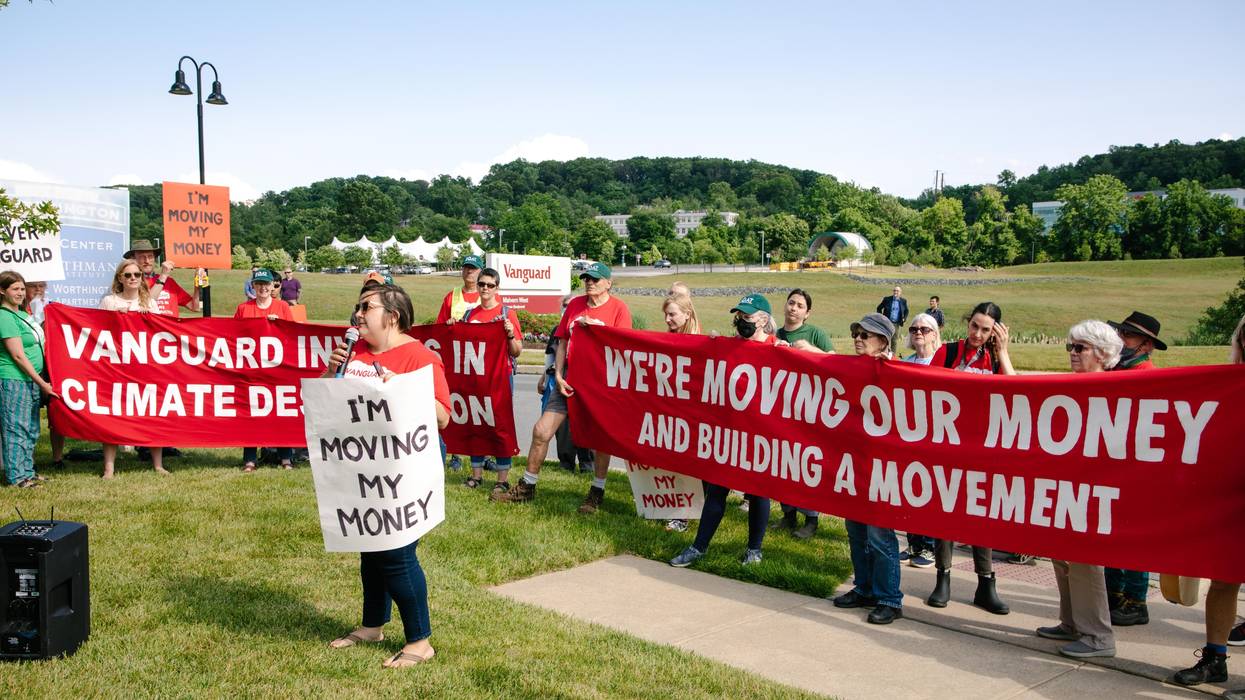
Earth Quaker Action Team has used numerous nonviolent direct actions over the last two years to draw attention to Vanguard’s dangerous investment practices and its failure to incorporate into its business model the existential threat of the climate crisis.
It is easy to feel powerless and overwhelmed by horrifying climate catastrophes seemingly everywhere: Across the U. S. this summer, from Hawaii to Texas and Missouri, intense heat and wildfires are causing injury, illness, and death. Fear and sadness can make us “throw up our hands” and conclude that the problem is too big and that there is nothing we can do to stop the burning of fossil fuels on a scale needed to avert the worst effects of a warming world. However, a group of Quakers in Philadelphia have faith that nonviolent direct action has the potential to interrupt the “business as usual” funding of the fossil fuel industry.
For the last two years, I’ve joined this group of Quakers, Earth Quaker Action Team (EQAT), and an international coalition of activists, in interrupting the pipeline of money that props up the fossil fuel industry. One major source of this money comes from the investment giant, Vanguard Group. Vanguard markets itself as a “leader in low cost investing,” which has helped it become a leader in investment management. People from across the country entrust their savings to Vanguard with the hope of maximizing their return on investment so they can retire or send their children to college. What Vanguard doesn’t advertise is how customers’ money helps drive the fossil fuel industry.
Vanguard is the world’s biggest investor in fossil fuels and has invested $184 billion in fossil fuel infrastructure expansion. (Vanguard is the top investor in Hawaiian Electric, which is currently implicated as a major contributor to the wildfire disaster in Maui.) While Vanguard acknowledges that climate change will have a negative net impact on the global economy, it continues its investment practices, full steam ahead, on a course to climate catastrophe.
We remain hopeful that our message will break through to Vanguard, especially as the reality of climate-related disasters dominates the news, and as more and more investors like many of us refuse to go along with Vanguard’s toxic business practices.
EQAT has used numerous nonviolent direct actions over the last two years to draw attention to Vanguard’s dangerous investment practices and its failure to incorporate into its business model the existential threat of the climate crisis. Luckily, Vanguard’s global headquarters are in EQAT’s “backyard,” Malvern, Pennsylvania, a suburb of Philadelphia, which has allowed us to bring our concerns to their doorstep. Our actions have involved, among other things, distributing fliers to Vanguard employees; co-hosting speakers, including an Indigenous group from Peru asking Vanguard to stop funding oil company Petroperú; and holding a mock news report from the year 2033 in which climate disasters are tied to Vanguard’s failed decision-making in 2023. (We have also prayed at the home of Vanguard CEO, Tim Buckley, in an adjacent suburb.) On the two occasions when we used civil disobedience to get our message across, Vanguard had many of us removed from the campus in handcuffs.
Given the urgency and scope of the crisis, EQAT and its like-minded partners have been urging Vanguard to use the power and influence that it has as a major shareholder in many climate-destroying companies; Vanguard can use its power to insist that fossil fuel companies, and other polluting industries, change their ways. If they refuse, we argue that Vanguard must withdraw its funding from these entities.
We remain hopeful that our message will break through to Vanguard, especially as the reality of climate-related disasters dominates the news, and as more and more investors like many of us refuse to go along with Vanguard’s toxic business practices. In June, a number of EQAT activists who had individual investment accounts with Vanguard decided it was time to remove their funds from “the pipeline.” We came to Vanguard headquarters, in sight of Vanguard employees enjoying their company picnic, and announced that many of us were moving our money elsewhere. Collectively, $17 million has been moved.
While $17 million may not put a big dent in the over $7 trillion that Vanguard manages, it reflects the idea that a caring community can be empowered to take a collective stand against planet-destroying profit taking. Plus, that $17 million is just the beginning. The amount of money being withdrawn from Vanguard is growing as more Quakers and their allies refuse to participate in Vanguard’s reckless way of doing business. One ally Elders Action Network, a national group of thousands, is now joining the effort to move assets out of Vanguard in order to invest with more responsible investment managers.
In addition to removing money from Vanguard, we will continue to challenge Vanguard’s brand. Marketing themselves as a low cost investment manager is misleading as it belies the fact that we all pay a very high price for climate-related disasters. Some of us suffer the health consequences of poor air quality and high heat, while others bear the cost of damaged or destroyed cars and homes in the aftermath of extreme weather and wildfires. As a local television ad targeting Vanguard proclaims, “If it’s bad for the environment, it’s bad for your retirement.”
Remaining hopeful in this work takes discipline and effort. EQAT operates with certain values and practices that help us “stay motivated for the long fights.” One value we embrace is being on our learning edge: We take on tasks and roles that are uncomfortably new, learning as we go. Another value encourages us to create meaningful, supportive connections with our fellow EQAT volunteers. Living these values can be difficult and exhausting, but, for me and others, it offers a much needed alternative to resignation and despair.
A Poetic Nonviolent Victory over War
War is a language of lies. Cold and callous, it emanates from dull, technocratic minds, draining life of color. It is an institutional offense to the human spirit.
The Pentagon speaks the language of war. The President and Congress speak the language of war. Corporations speak the language of war. They sap us of outrage and courage and the appreciation of beauty. They commit carnage of the soul.
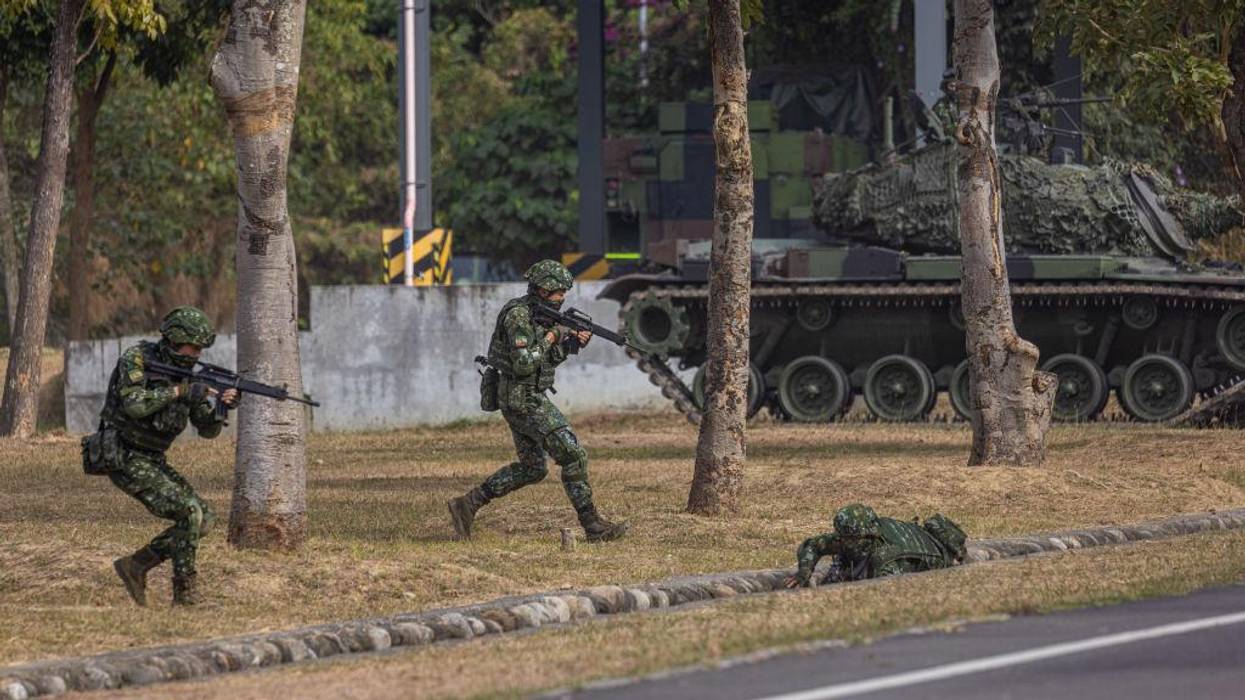
Take for example, the recent report issued by the Center for Strategic & International Studies (CSIS) entitled “The First Battle of the Next War: Wargaming a Chinese Invasion of Taiwan.” This think tank conducted 24 iterations of wargames whereby China invades Taiwan. The U.S. and its allies respond. The result each time: No one wins. Not really.
The report states,
“The United States and Japan lose dozens of ships, hundreds of aircraft, and thousands of servicemembers. Such losses would damage the U.S. global position for many years. While Taiwan’s military is unbroken, it is severely degraded and left to defend a damaged economy on an island without electricity and basic services. China also suffers heavily. Its navy is in shambles, the core of its amphibious forces is broken, and tens of thousands of soldiers are prisoners of war.”
Degraded. A damaged economy. Losses. The report is referring to enormous numbers of men, women, and children slaughtered by bombs and bullets, of economies and livelihoods catastrophically ruined, countries devastated for years. It does not even address the likelihood of a nuclear exchange. Its words are void of the sharp pain and grief of such reality, lifeless, soulless. These zombie-technocrats do not just make war on people, but on reason, on human emotion.
A poet is needed to tell the truth. Poetry recognizes not the ideal but the real. It cuts to the bone. It doesn’t flinch. It doesn’t look away.
They died and were buried in mud but their hands protruded.
So their friends used the hands to hang helmets on.
And the fields? Aren’t the fields changed by what happened?
The dead aren’t like us.
How can the fields continue as simple fields?
Language can free our minds or imprison them. What we say matters. The hard, bare, truthful words of reckoning. Utter the words of truth about war and the military can no longer continue its somnambulant recital of death.
A boy soldier in the bone-hot sun works his knife
to peel the face from a dead man
and hang it from the branch of a tree
flowering with such faces.
War utilizes a philology emptied of humanity. It speaks in an intentionally mind-numbing manner to glaze over the horrid, murderous acts contemplated. The omnicidal wargames report by CSIS continues, “There is no rigorous, open-source analysis of the operational dynamics and outcomes of an invasion despite its critical nature.” It sounds antiseptic, boring, but in reality, it is, well, . . .
It is worse than memory, the open country of death.
We were meant to think and speak poetically. To lay bare the lie. Poetry detests the banal, combs through the detritus to give uncommon testimony. It is to think and speak realistically and transcendentally, to illuminate the works of the world, whether those works be baleful or beautiful. Poetry sees things as they are, looks at life not as an object to be exploited but contemplated, revered.
Why lie? Why not life, as you intended?
If we take our humanity seriously, our response to the warmakers must be rebellion. Peaceful and poetic, forceful and unrelenting. We need to raise the human condition as they seek to degrade it. The Merchants of Death cannot defeat a movement that speaks the language of poetry.
The Corporate State knows what they are doing. They seek to anesthetize our minds first so they can kill our bodies without resistance. They are good at it. They know how to divert us, deplete us. And should we muster enough violent rage, they know how to respond to our violence. But not poetic protest. Their neural pathways do not lead to poetry, to nonviolent potential, to visions of lovingkindness. Their language, their words, and their power, wither before the truthful expression of their deeds.
That is why we feel
it is enough to listen
to the wind jostling lemons,
to dogs ticking across the terraces,
knowing that while birds and warmer weather are forever moving north,
the cries of those who vanish
might take years to get here.
Non-violent revolutionaries speaking the language of poetry can win. It is estimated that it only takes 3.5 percent of a population to bring down the most repressive totalitarian state. And despite our rights, we live in a repressive Corporate-Totalitarian State which imprisons truth-tellers and kills widely and indiscriminately across the globe. Are there 11 million among us in these here United States willing to speak and hear the honest language of poetry?
And so, don’t look away. Speak with unflinching courage and honesty. Words matter. Give witness to life, and to the dirty lie of war. Be a Poet Revolutionary. The truth will kill the Beast.
You tell me you are a poet. If so, our destination is the same.
I find myself now the boatman, driving a taxi at the end of the world.
I will see that you arrive safely, my friend, I will get you there.
(Poetry by Carolyn Forche)
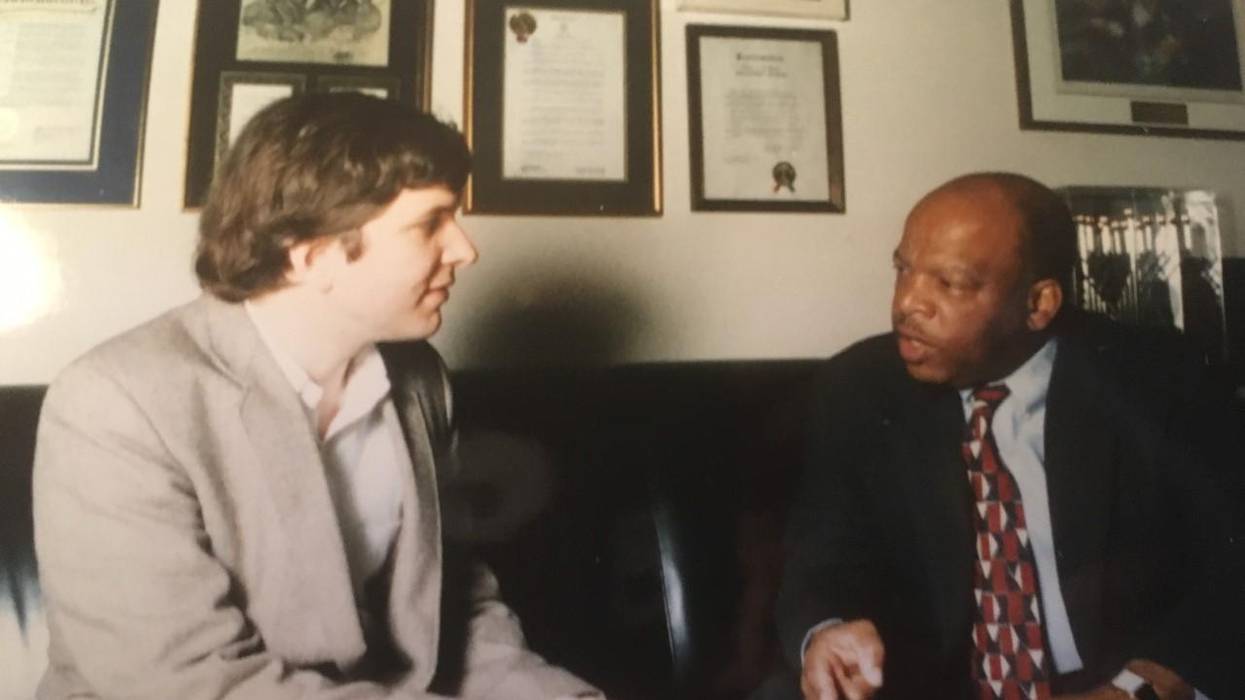
Last summer, after Congressman John Lewis died, I posted a photo on social media of me and John from a memorable afternoon we spent together in his congressional office. It was 26 years ago. We had talked for a while, and then filmed a formal conversation on nonviolence.
Needless to say, it was one of the greatest days of my exciting life.
We stayed in touch over the years, and a few years ago, I ran into him in a parking lot in Washington, D.C. "Why don't you ever come and see me?" he asked. I wanted to respond that he was so famous now, I couldn't get through his staff. Instead, I promised I would. In fact, I tried hard to get him to join our Campaign Nonviolence grassroots project, and speak at our national conference, but it turned out, by then, he was too sick.
Last summer, I was invited to join the national committee of Selma Jubilee--the annual crossing of the Pettus Bridge in Selma, Alabama--to mark the historic 1965 march led by John Lewis where he and hundreds of others were chased by horses and beaten up. The horrific event led to Martin Luther King's March to Montgomery and the Voting Rights Act. It is the oldest ongoing civil right march against racism and for justice in the United States.
"If someone had told me when I was marching from Selma to Montgomery that one day I would be in the Congress, I would have said you're crazy. But you know, it shouldn't be strange."
This weekend, March 5-7, marks the 56th anniversary of the Selma march, and the first totally online commemoration. The organizers and I have worked hard since last summer to put together an astonishing three-day online program that will feature over a hundred speakers and participants, including many national leaders (such as Rev. William Barber, Rev. Jim Lawson and Dr. Bernard Lafayette) as well as original foot soldiers from 1965. All of the events are free, but you have to register for it. We expect thousands of people from around the country and world to watch.
Part of the extensive program includes a film series. We were unable to attain the film rights for the recent John Lewis PBS films, so I went looking in my own collection for a copy of the interview I filmed with the great man all those years ago. After having it digitized, I finally watched it for the first time, and the memories immediately flowed back
It was 1995, I was 35-year-old newly ordained priest fresh out of jail after hammering on a nuclear weapon in a Plowshares disarmament action with Philip Berrigan. Watching John in the interview, you see him at his best--calm, centered, clear, earnest, kind, gentle and wise, full of the wisdom and peace that comes from a lifetime of redemptive nonviolent suffering love, as King would say.
Here below, for the first time in print, is a lightly edited transcript of our conversation. I offer it in the hope that readers will join the massive online commemoration this weekend to celebrate John's life and the ongoing movement. We hope to broadcast the video interview sometime during the online events. In the meantime, may it inspire us to keep on marching, organizing and speaking out against systemic racism, permanent warfare, extreme poverty, nuclear weapons and environmental destruction, and to pursue John Lewis' glorious vision of a new culture of nonviolence.
Let me start right off and ask you what nonviolence means for you and how you got involved and committed to the life of Christian nonviolence?
I must tell you that I grew up in rural Alabama during the '40s and 50s. I grew up in a Christian home where there was a great deal of love. At an early age, I came to appreciate the philosophy and discipline of Christian love. So, I view nonviolence as Christian love in action. It is a part of my faith; it is believing that love is the most powerful force in the universe. And somehow, someway, you have to live it.
Tell me how you got involved in organizing sit-ins against segregation in restaurants and how you formed the Student Nonviolent Coordinating Committee.
I was deeply inspired by Martin Luther King Jr. and Rosa Parks. When I was a young child in Troy, Alabama, about 50 miles south of Montgomery, I would visit Montgomery and I saw signs that said "white men, colored men, white women, colored women, white waiting, colored waiting." Segregation was the order of the day. And I resented the system of segregation, and I wanted to do something about it.
So as a student in Nashville--where I was attending the American Baptist Theological Seminary and later as a student at Fisk University--I started studying the philosophy and the discipline of nonviolence and got involved in a series of what we called sit-ins and I emerged as one of the student leaders. I literally grew up on a lunch counter stool when I was 19 years old in 1959.
Later in 1960, we started sitting in on a regular basis, and I got arrested and went to jail. That was a great triumph because jail sort of became a way out. I grew up at a time in the American South when young Blacks were not supposed to come in contact with the law. You were supposed to stay out of jail. It was a bad thing to go to jail. But there was something redemptive about going through this process. I remember being beaten and a lighted cigarette being put out in my hair and thrown off a lunch counter stool before I was arrested, and I had the power because of my belief in Christian love and nonviolence not to strike back.
How about the first Freedom Ride? What were you trying to do there? What happened?
On the Freedom Ride, we were out to test a decision of the U.S. Supreme Court outlawing segregation in the area of public transportation. So, it was an effort on the part of the 13 of us, seven whites and six Blacks, to ride from Washington, D.C. to Jackson, Mississippi, and on to Louisiana. We were using all of the public facilities, not just the bus, but the waiting rooms, the restrooms and the lunch counters.
I will never forget the night before we left. We had dinner at a local Chinese restaurant in Washington, D.C. I had never had Chinese food before. We were sitting there eating and someone said, "You should eat well tonight because this may be like the Last Supper." Little did we know--as we traveled into Virginia through North Carolina into South Carolina, through Georgia into Alabama--one of our buses would be burned and people beaten and later a group of us was beaten by an angry mob at a Greyhound bus station in Montgomery. I was left lying unconscious, bleeding, at a Greyhound bus station in Montgomery in the year 1961.
Perhaps one of the turning points in our country's history was the famous march from Selma. You were one of the leaders of that on Sunday March 7, 1965, and as you led the march of about 600 people across the Edmund Pettus Bridge, you were met by a whole flank of U.S. police and they beat you severely. Tell me what happened that day and what was the outcome of the Selma march.
Well, the Selma march was an attempt to dramatize to the nation and to the world that people of color not only in Selma but throughout the state of Alabama and throughout the South--11 Southern states really from Virginia to Texas in the old Confederacy--that these people wanted to participate in the democratic process, that they wanted to register and to vote.
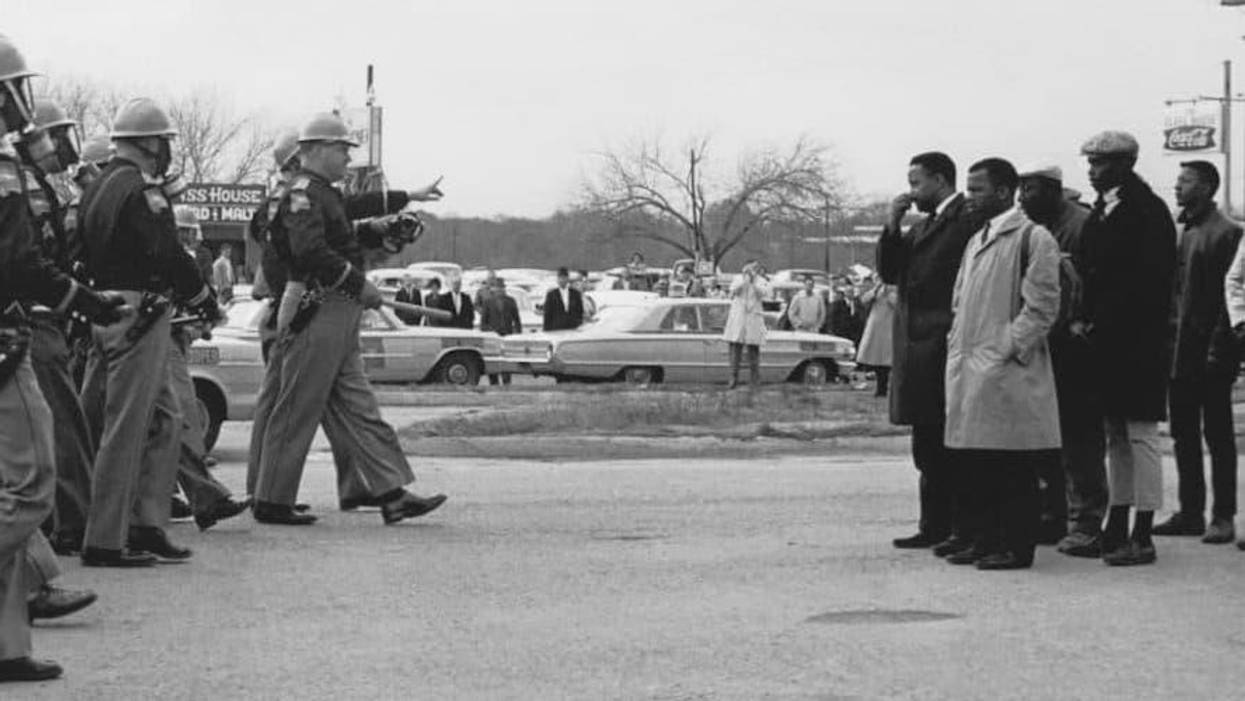
But on that day when 600 of us marched through the streets and came to the apex of the Edmund Pettus Bridge, we saw a sea of blue--Alabama state troopers. They told us in so many words that this was an unlawful march, that we should disperse and go back to the church and less than a minute or so, they said "Troopers advance!" They came toward us, beating us with night sticks, bull whips, tramping us with horses and using tear gas.
I was at the head of the march, as one of the march leaders, and I was hit in the head with a nightstick, and I had a concussion at the bridge. But that was the turning point because there was a sense of righteous indignation when people saw nonviolent people being beaten. We weren't armed with guns or sticks. Some of us had knapsacks with an apple, an orange, some books, the Bible. We were bearing witness to something that we thought was right. We all were committed to the philosophy and discipline of nonviolence. Most of us had just left church that Sunday afternoon. Because of what happened in Selma that day, the day became known as "Bloody Sunday."
As you know so well, part of the challenge of nonviolence is to respond nonviolently to personal assault, but to keep on insisting on the truth of justice and peace. Jesus epitomized this, and Gandhi taught us this. How did you respond personally to these police who were beating you and all the people who threatened you during those years in the struggle? What was it like for you to deal with this violence nonviolently?
Well, I believe in the philosophy and discipline of nonviolence. I accepted it not simply as a technique or as a tactic, but as a way of life, a way of living. You have to arrive at the point as believers in the Christian faith that in every human being there is a spark of divinity. Every human personality is something sacred, something special. We don't have a right as another person, or as a nation, to destroy that spark of divinity, that spark of humanity, that is made and created in the image of God.
I saw Sheriff Clark in Selma or Bull Connor in Birmingham or George Wallace, the governor of Alabama, as victims of the system. We were not out to destroy these men. We were out to destroy a vicious and evil system. So our attack had to be directed against customs, traditions, unjust laws--but not against these individuals.
Unfortunately, most people, most Christians don't see Jesus as nonviolent, or God as a God of nonviolence and our faith calling us to uphold the sanctity of life through nonviolence. How do you understand Jesus and God in light of nonviolence?
There's a verse in the Gospel, I think it's Matthew 10:34, where Jesus says, "Think not that I have come to bring peace but a sword." A lot of people like to interpret that to mean a physical sword and try to say that Jesus was making a justification for violence. But I believe he was talking about a spiritual warfare between what is good and what is evil, between what is right and what is wrong, or as Dr. Martin Luther King Jr. would put, between the forces of light and the forces of darkness.
I happen to believe that God is love, that love is God. Hate is too much of a burden to bear. If you start hating, in the end, how are you going to decide who you are going to hate today and love tomorrow? When you fail to accept the Christian doctrine of love and nonviolence as a way of life, as a way of living, and merely a tactic, it becomes like a faucet that you can turn on and off. Love in action, Christian love, is a better way, a more excellent way, and it's more redemptive. I don't know how to explain it, but I somehow came to that point, as I grew in my faith, that this is the way. This is the way out, and the way out is the way in.
You had the privilege of working with so many people in the civil rights movement, but especially with Martin Luther King Jr. Can you tell me what you learned personally about nonviolence from him?
I learned a great deal from Dr. Martin Luther King Jr. This man in his own way taught me that love in action is the strongest force, that nothing--nothing--is more powerful than love in action. He taught me to have hope, not to give up, not to give in and not to give out. In the philosophy of nonviolence, in the way of Christian love, you have to have an element of hope, an element of faith. He taught us that. He would say from time to time that if you don't have hope, you're already dead, you're really not here.
It's very much in keeping with our Christian faith that if you really believe in love you have to live it. If you believe in the idea of the Beloved Community, then it's a community of believers that is in keeping with the divine. If you believe it, you have to live it. When I was working with Dr. King, after a while, I began to believe that maybe, just maybe, we could create the Beloved Community. That's the other thing: It's possible to create in this life, in this world, a Beloved Society, a Beloved Community, a Beloved World.
King was cut down right in the prime of life. What would you say his greatest legacy, his greatest contribution, is for all of us?
I think his greatest legacy and contribution is that he taught us how to love, how to live, and really, how to die. You live your life by giving, by serving, by sharing and in the process, you don't worry. You are consistent, you are true to your faith, to your belief. I often think about Dr. King, that if it hadn't been for this man, I don't know where our world would be today. I think he influenced so much in American society and society around the world.
Could you say a word about how you see nonviolent civil disobedience specifically as a tool in the struggle for social change.
Nonviolent civil disobedience is a very powerful weapon. It's probably one of the most powerful weapons that we have in the arsenal of nonviolent action because you're literally putting your body on the line. You're saying you're willing to disobey a custom, a tradition, or what you consider to be an unjust law and you're willing to pay the price, you're willing to suffer, you're willing to go to jail if necessary and serve your time.
"For me, nonviolence is one of those immutable principles that you do not deviate from."
I think there's something very redemptive about it. There's something very cleansing about it, to go through all that. In keeping with the philosophy of nonviolent civil disobedience, you come to that point where you have to educate the larger society and you keep trying over and over again, and then some time it's only a core group that's prepared to go the distance with that. I think it's being true to the heart of the faith and philosophy and discipline of nonviolence.
Could you share what it's like for you personally having been arrested and jailed and a leader in civil disobedience, to be here now in the House of Representatives, in the U.S. Congress, which many see as the seat of power in our country and in the world? How do you reconcile all that and still be committed to Christian nonviolence?
Well, if someone had told me when I was sitting in at lunch counters, on the Freedom Ride, marching from Selma to Montgomery, marching on Washington in 1963 with Dr. Martin Luther King Jr., that one day I would be in the Congress, elected by the good people of Georgia, I would have said you're crazy, you're out of your mind, you don't know what you're talking about.
But you know, it shouldn't be strange, in a sense, for me. I really believe if you let the Almighty use your life, if you turn your life over to God Almighty and try to be persistent, consistent, to be committed to certain immutable principles, and you dedicate your life to service--I see all this then as an extension of my commitment to the philosophy of love and nonviolence. Even in the Congress, even in committee meetings, I speak of love, I talk of the philosophy of nonviolence. It's a larger arena and it's still another form of action.
In your opinion how can Christians use nonviolence to help to end war, end poverty, eradicate hunger and abolish nuclear weapons? How can we use nonviolence to attack all these big global issues of injustice?
There are so many things we can do as Christians. We can lead the way, even as a nation. Those of us who believe in the philosophy and discipline of nonviolence, who believe in Christian love, who believe that it's redemptive and powerful, we can say to the leaders of our own country, that there is a better way. We can take the lead.
"I must tell you I have seen a lot of changes in my lifetime. I have witnessed what I like to call 'a nonviolent revolution' in our country."
I've said to the president of the United States, for example, on the whole question of the death penalty, "This is not something that a great nation should be proud of. Putting people to death is barbaric. It represents another period in history. We can do better, we can lead the way."
I've said we can lay down the tools of war, and all the tools of violence. War is an obsolete tool of our foreign policy. I think some place along the way, Christians and all religious leaders and people, we have to say that to our elected officials: "Let's use our resources to end hunger and poverty, to find cures for the diseases that afflict humankind, to improve the standard of living and the quality of life for all people on this little planet." I think we have to take the lead in saying all that.
Can we support the death penalty?
I say to Christians, "If you really believe in love, and that God is a God of love, and if you really believe that we all are created in God's image, and if you really believe that in every human being there is a spark of divinity, a spark of the divine that is so sacred, then how can you kill anyone? We may have the legislative or judicial power to do that, but we don't have the moral authority to do that. That should be left to God Almighty."
We have to say to all Christians that, as believers, we should take the lead and put an end to all violence--the violence that individuals commit against other individuals and the violence that our nation commits against other nations. We should abolish the tools of war and abolish the tools of putting people to death for capital offenses, whether through the gas chamber, injection or electrocution.
As you know all too well, racism is alive and well in our country. What would you suggest to Christians, particularly to white Christians in our country, about turning to nonviolence and using nonviolence to fight the sin of racism?
I think that all of us as Christians must use everything at our disposal to speak out against racism and bigotry. The scars and stains of racism are still deeply embedded in our society. When we acquiesce, when we're silent, we're helping racism to continue to prosper and to grow.
We should say as Christians that we're one family, that we're sisters and brothers, that we're one community, that we're one house.
I work with the homeless in D.C. and many of us in the churches here are working to help disarm our streets and to stop the killings locally. But then a lot of others are working to end war and nuclear weapons. I'm wondering if you could speak about working on both of these. How can we claim to want to disarm our streets when our government is still committed to such global violence?
I understand quite well what you mean. The government tends to send the wrong message to our people. We tend to say to them, "Disarm, stop the killing, get rid of your guns," and yet at the same time, we continue to arm people around the world and we continue to engage in violence and war. How can we preach one thing and practice something else? To say it's ok for the government to engage in military action abroad, but you must not engage in violence here?
In a real sense, I think our foreign policy is a reflection of our domestic policy. That's why we must say to our nation that we must not continue to use the tools of war and violence in our foreign policy.
So you would agree with Dr. King and others about the consistency of nonviolence all across the spectrum--no to violence on the streets and the death penalty and war and nuclear weapons and in our foreign policy.
I do agree with Martin Luther King, Jr. For me, nonviolence is one of those immutable principles that you do not deviate from.
What is your hope for future generations given your life in the movement of Christian nonviolence as we head into a new millennium?
I'm very hopeful, very optimistic, that in the days and years to come, that more and more people not only in America but around the globe will come to accept Christian nonviolence as a way of life, as a way of living, that somehow, someway, humankind will evolve to a higher level where people will accept that violence and hate are too great a burden to bear, that more and more people will lay down the burden of hate and violence, and that we will move to a new period in history where we will be quick to negotiate, to discuss, to solve our problems around a table rather than in the streets, by shooting and bombing.
You have been in so many aspects and parts of the struggle over the years. I see many people who are despairing, who say, "Well, this is very idealistic and wonderful, but there's no evidence of any change happening." What signs of hope have you seen to convince you that there is a lot of hope for the future, that we should carry on the struggle for the Beloved Community?
I must tell you I have seen a lot of changes in my lifetime. I have witnessed what I like to call "a nonviolent revolution" in our country. The signs that I saw growing up, saying "White" and "Colored," are gone and they will not return. There was a tremendous amount of fear in the South, especially in the rural South, and that fear is now gone. At one time, hundreds of thousands of people of color could not register and vote, could not participate in the democratic process. But today, they can register, and they are voting.
"We should all study and read everything we can about the philosophy of nonviolence, of unearned suffering, the power of love in action."
In the South, less than 30 years ago, there were only about 50 Black elected officials. Today [in 1995] there are almost 7,000. We made a lot of progress. We're not there yet, but I think we're on our way to the Beloved Community. There are going to be setbacks and disappointments here and there, along the way, but I think that as a nation and as a people, we're going to move toward the Beloved Community.
Just think, during the '50s and '60s, we were singing the song "We Shall Overcome." It was a theme song, a song of faith and hope, and that song has now spread around the world. People have been singing it all over the world in many protest movements.
So Christian nonviolence did come from Jesus and was spread by Gandhi, but it has been picked up by so many other different peoples and religions around the world. I think it will continue to live as a message. So I'm very hopeful, I'm very optimistic. You have to be hopeful, you have to be optimistic about the future.
What would be your parting message to Christians, in light of your hope, your life, and your commitment to nonviolence, about how they might begin to practice nonviolence in their own lives and join in creating the Beloved Community?
I would say that we should all study and read everything we can about the philosophy of nonviolence, of unearned suffering, the power of love in action. You have to believe, and if you believe that God Almighty is involved in the affairs of humankind, then in a real sense we have to be his agents and we have to help God. And the best way to help, and the most Christian way to help, is to use and live the philosophy of love and nonviolence. That is the way forward, and the way out, and the way out will become the way in.
John Lewis, the Georgia Congressman who led the Student Nonviolent Coordinating Committee (SNCC) and was one of the "Big Six" civil rights leaders who organized the 1963 March on Washington, is being remembered as one of our greatest American heroes, in large part because he was willing to risk his life in non-violent protests against white supremacy.
Lewis was arrested over 40 times in non-violent sit-ins, Freedom Rides, and protests. On March 7, 1965, his skull was fractured, and he was almost murdered, by an Alabama state trooper when he led 600 peaceful civil rights protestors on a march from Selma to Montgomery, Alabama to demand voting rights.
Lewis and the other nonviolent protestors were brutally attacked by mounted police armed with clubs, whips, and rubber tubing wrapped in barbed wire as they peacefully tried to cross the Edmund Pettus Bridge in Selma.
The violent images of this horrendous, unprovoked police brutality against peaceful protestors were broadcast on the national network news that night to over 60 million viewers, and outraged much of the nation. The images, when broadcast worldwide, also publicly shamed the United States on the world stage.
Lewis and the other protestors would have been within their moral rights to have returned the next day armed with rocks, bricks, Molotov cocktails, and even firearms to protect themselves from such police brutality. But whether or not one is a pacifist, to have responded to force with force would have been political disaster for the civil rights movement.
Instead, Rev. Martin Luther King returned to Selma two weeks later to complete the march for voting rights that Lewis had started. On March 25, King led 25,000 nonviolent protestors the steps of the State Capitol in Montgomery, where he delivered his now-famous How Long, Not Long speech:
Once more, the method of nonviolent resistance was unsheathed from its scabbard, and once again an entire community was mobilized to confront the adversary. And again the brutality of a dying order shrieks across the land. Yet, Selma, Alabama, became a shining moment in the conscience of man. If the worst in American life lurked in its dark street, the best of American instincts arose passionately from across the nation.
These images, too, were seen across the country and around the world. Today, the brave sacrifice of Lewis and his fellow nonviolent protestors is largely credited for the passage of the 1965 Voting Rights Act, This landmark legislation, which prohibits racial discrimination in voting, is the cornerstone of defending the right to vote guaranteed by the Fourteenth and Fifteenth Amendments to the Constitution, but has been eroded in recent years by the conservative majority on the U.S. Supreme Court.
Today, Donald Trump has opened a full frontal attack on voting rights, threatening to delay or even suspend elections. In a transparent attempt to scare suburban whites into reelecting him, Trump is doing everything in his power to provoke antiracist protestors in Portland and other cities to forsake nonviolent protest and engage in violent resistance to the heavily armed federal officers in full camouflage uniforms he has ordered into American cities.
Let's be clear: Camouflage uniforms are designed to provide disguise in jungle warfare, not to intimidate protestors on the streets of American cities. But that's exactly what Trump is using them for. Sending in unidentified, camouflage-wearing federal agents to seize peaceful protestors off the streets is straight out of the playbook of Russian President Vladimir Putin, who sent "little green men"--unidentified Russian troops--to invade the Ukraine in 2014.
Sending Federal troops into American streets is Kabuki theater--reality television--by Trump. He wants to create TV images that appear to reflect urban carnage. TV footage of protestors attacking camouflage-wearing police and federal officers with Molotov cocktails, rocks, and bricks is exactly what Trump wants. (It wouldn't even surprise me if Trump has undercover agents provoking protestors to use violence.)
If we want to win, we can't let Trump provoke us into violence. We must honor John Lewis, and his hard-won victories for civil rights, by following his example of nonviolent resistance.
One can have academic arguments about whether violence is ever acceptable to fight injustice. I would personally argue that at least in the cases of the American Revolution, The Civil War, and World War II, violence was necessary. Others may differ.
But right now, violent protests would be the gift to Trump that he's begging for. Don't give it to him.
The street violence of the late 1960s was used by Republican operatives to pave the way for Richard Nixon's election as president in 1968. The implementation of the "Southern Strategy" of stoking irrational fears of Black people among poor and working-class whites to cement them to the Republican Party led right up to Trump's 2016 victory, and is still with us today.
The 1967 riots in major cities like Newark, Detroit, and Milwaukee, the 1968 assassinations of Martin Luther King and Robert F. Kennedy, and the police riots at the 1968 Democratic Convention all contributed to Richard Nixon's narrow victory. Nixon's victory consolidated power in a white supremacist oligarchy for the next half century.
Trump is on the ropes. Don't give him the gift of violent confrontations that he's so blatantly and transparently trying to provoke to rescue his campaign.
Honor John Lewis. Meet police brutality with nonviolent resistance.
In 1965, Martin Luther King, Jr. led marchers to the Dallas County Courthouse in Selma, Alabama to demand their right to vote. When they got there, they were arrested. That arrest, and the police brutality that followed it, galvanized the nation and forced passage of the Voting Rights Act.
Yet in 2018, many of us still do not have our right to vote. More than six million nationwide are disenfranchised because of state laws rooted in white supremacy. Millions more don't vote because someone lied and told us we can't, because we are or were in prison or have a conviction in our past.
So now we've come back to Selma to finish what King started: to recover and restore his movement.
I come to Selma every year on Bloody Sunday. That's the day in March when King's marchers were met by riot police on Edmund Pettis Bridge. Now, this anniversary is a jubilee: we cross the bridge to celebrate how far we've come, with marching bands, banners and choirs.
But there's more work to be done. So we start every year's jubilee with a "Backwards March": Holding hands, I join other pastors and the formerly incarcerated to march backwards across the bridge, at the head of the parade. No one crosses the bridge until we've finished. Then the celebration continues.
Why do we march backwards? To remind us of everyone who's been left behind. We've got to go back and get them, and get things right, so we can move forward.
We march under this banner: "From the back of the bus to the front of the prison, the struggle continues."
I am formerly incarcerated myself. When I was released, I took the state of Alabama to court to regain my vote, then to restore this right to others. Because of these efforts, a quarter of a million in Alabama now have their voting rights restored.
But many still don't know they can vote. So since 2003, with help from the Drug Policy Alliance and Project South, I've gone inside jails to register voters. Because even if you're on the inside in Alabama, if you're not yet convicted, or convicted of a misdemeanor or a nonviolent drug offense, you can vote. No matter what you've been told.
These millions of men and women - the incarcerated and formerly incarcerated - are America's truly forgotten. They're not on anybody's list, or in anybody's poll; they've never been counted. No one ever thought we'd overcome the odds and vote.
Alabama's GOP has fought me every step of the way. Why? Because the last thing they want is for these millions of voters to regain their rights. One of the officials who opposed me most, Mike Hubbard, is now in prison for fraud. He can vote now, too, thanks to our efforts. You can't make this up.
Slavery still exists in the United States. That's because the Thirteenth Amendment to the Constitution, which abolished slavery in 1865, says it can still exist "as a punishment for crime." Prisoners all across this country are forced to work for free, or for pennies on the dollar.
But that's not all the Constitution says. The Eighth Amendment also bans "cruel and unusual punishment." What punishment is more more cruel and unusual than this modern form of slavery?
And in states all across the South, intentionally vague "Moral Turpitude" clauses bar those convicted of crimes from the vote. So in 2008, I sued Alabama and forced the state to allow me to extend voting rights to prisoners. In 2017, Alabama finally passed a law to clearly define crimes of "moral turpitude" which has re-enfranchised most of the 286,000 people with felony convictions in the state. But many of them still don't know they can vote. And hundreds of thousands more across the South - in Florida alone, there are 1.3 million - are waiting for this right to be restored.
So yes, there's work to be done.
Now, we've launched #Free2Vote, a multi-state initiative with the People's Action Mass Liberation Campaign, Project South & the Southern Movement Assembly to register voters inside and outside of prisons and jails.
The only thing that declares your full citizenship is the right to vote. So we'll continue in Alabama, then move on to Florida, Georgia and other states of the South and North where voters have been disenfranchised through mass incarceration. A hundred million Americans are impacted by criminal convictions.
This is an insight I learned in Selma. Non-violence, one of our great lessons from Dr. King, has been misinterpreted by some to mean "non-movement." But the truth is, we need a powerful movement for voting rights, economic and racial justice, just as much today as we did fifty-three years ago.
So it's time to fulfill Dr. King's dream - to restore and revive his movement. We must go back, get what was lost, and move forward to restore the right to vote to America's truly forgotten men and women: the incarcerated, formerly incarcerated, those with criminal convictions as well as those sitting in jail who aren't convicted of anything, just waiting for trial.
It was a joy for me to join eighty people from around the world meeting in Rome from April 11th to the 14th at the "Nonviolence and Just Peace Conference: Contributing to the Catholic Understanding of and Commitment to Nonviolence." Members of the three day event co-hosted by the Pontifical Council for Justice and Peace and the International Catholic Peace Movement Organization, Pax Christi, strongly called on Pope Francis "to share with the world an encyclical on nonviolence and Just Peace," and on the Church to "no longer use or teach 'just war theory' and to continue advocating "for the
It was a joy for me to join eighty people from around the world meeting in Rome from April 11th to the 14th at the "Nonviolence and Just Peace Conference: Contributing to the Catholic Understanding of and Commitment to Nonviolence." Members of the three day event co-hosted by the Pontifical Council for Justice and Peace and the International Catholic Peace Movement Organization, Pax Christi, strongly called on Pope Francis "to share with the world an encyclical on nonviolence and Just Peace," and on the Church to "no longer use or teach 'just war theory' and to continue advocating "for the abolition of war and nuclear weapons."
I believe the misguided age of "blessing wars, militarism and killing" must end.
The statement of appeal to the Pope said clearly: "We believe there is no 'just war.' Too often the 'just war theory' has been used to endorse rather than prevent or limit war. Suggesting that a 'just war' is possible also undermines the moral imperative to develop tools and capacities for nonviolent transformation of conflict."
The gathering in Rome consisted of lay people, theologians, members of religious congregations, and priests and bishops from Africa, the Americas, Asia, Europe, the Middle East, and Oceania. In his opening address, Cardinal Turkson, head of the Pontifical Council for Justice and Peace, read a welcoming statement from Pope Francis.
The final statement, released at the end of the conference, entitled "An Appeal to the Catholic Church to re-commit to the Centrality of Gospel Nonviolence," can be read at the Pax Christi International website.
This was indeed a historic gathering and the participants made a brave and history-making call to Pope Francis and the Church.
I believe we are at an important and hopeful turning point in human history, from violence to nonviolence, war to peace.
We called upon Pope Francis to give strong spiritual leadership to the world's Christians and reject war for peace and nonviolence. We are all conscious of the growing militarization of our societies and countries and the myth being perpetrated that militarism, nuclear weapons and war are acceptable.
I hope that Pope Francis will call upon Catholics not to join the military and remind them that killing cannot be with Christ. I believe the misguided age of "blessing wars, militarism and killing" must end. The responsibility lies with Pope Francis and all religious/spiritual leaders to be true shepherds of peace, nonviolence and nonkilling, to help us follow the command of Jesus to love our enemies and not kill each other.
I also hope also that Pope Francis will unambiguously proclaim that violence is always wrong, that violence is not the way of Jesus, that Catholics cannot take up arms to kill people, and that we are called to become a true peace church.
The Appeal is now in the hands of Pope Francis. We can all now pray, fast and work for a new encyclical on nonviolence and nonkilling. We hope that Pope Francis will continue to show courage, be brave and bold, and be a true Prophet, a loving Shepherd and a bright light in these dark days for the human family. Together, we can herald the coming of a more nonviolent world.
As in the civil rights movement, singing the right song at the fitting moment can involve heart, mind, body, soul
How should music rank among the ever-growing list of time-tested nonviolent methods such as boycotts, marches, strikes, sit-ins, and vigils?
Anthony Shadid of the New York Times reports that a song, "Come on Bashar, Leave," is spreading across Syria, boldly calling on President Bashar al-Assad to step down. The article suggests that a young cement layer who chanted it in demonstrations was pulled from the Orontes River this month, his throat having been cut, and, according to residents of the city of Hama, his vocal chords torn out. Hama is where, in 1982, then-president Hafez al-Assad, father of the current president named in the song, gave orders to the army to massacre more than 10,000 in putting down an Islamist upheaval. Today, boys aged six years and older vocalize their own rendition of the original warbler's song instead. As the song has sped across Syria, demonstrators have adopted it for themselves.

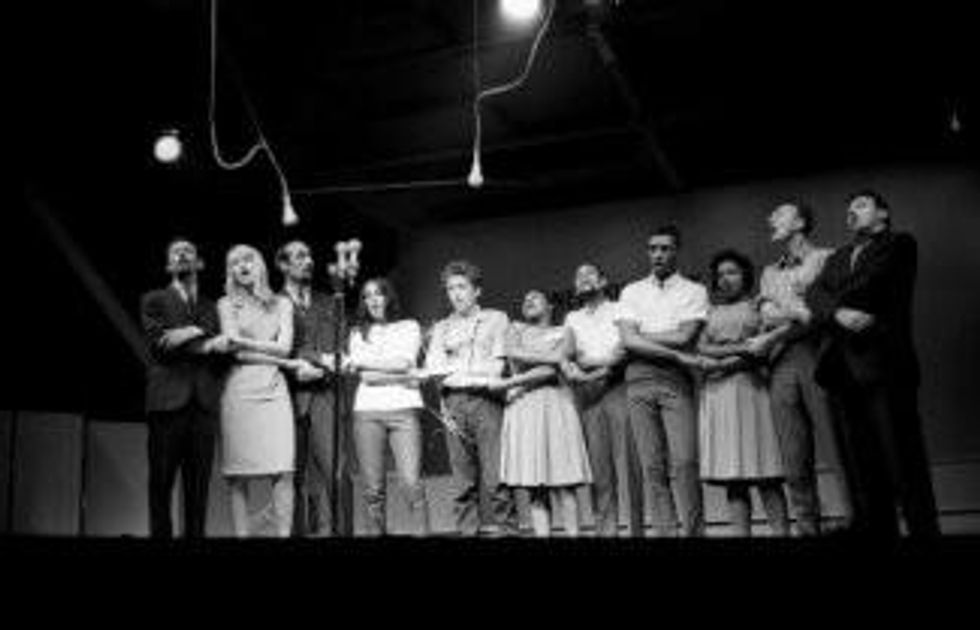
During the U.S. civil rights movement, "freedom songs" raised courage, stated the goals, declared commitment, united separated communities, and sometimes took melodic aim at notorious police chiefs. As a contemporary expression of spirituals, freedom songs derived from the black choral tradition that developed from the African and American experiences, matured in the fires of southern slavery. They addressed frustrations, forged bonds of personal loyalty, assuaged fear and dread, and fortified a people under stress. A strong tradition of composing during performance, in response to need, meant that new phrases would be added or a stanza changed to take up a specific issue, such as deciding whether to go to jail the next day. Song leading became an organizing tool. The civil rights struggle was profoundly rich in song, due to the significance of black congregational singing, nourished as it was by faith and resistance. The movement's signature anthem, "We Shall Overcome," has since become a universal expression of civil resistance movements across the world.
Later, music held a central role in the nonviolent revolutions of the Eastern bloc. On August 23, 1989, hundreds of thousands of Estonians, Latvians, and Lithuanians linked hands in a human chain across 400 miles, "manually" connecting the capital cities of the three Baltic republics. As many as 2 million participants of all ages demanded the right to restore their independent statehood, as they sang folk and nationalist songs. They called their action the Baltic Way. Estonia's struggle that brought independence is specifically known as the Singing Revolution.
During Ukraine's quest for fair elections in 2004-2005, songs sung by rock groups contributed to the Orange Revolution movement. In 17 days in autumn 2004, massive rallies gained staying power from the efforts of musicians who performed around the clock. As approximately 1 million disciplined Ukrainian demonstrators camped out in Kiev's Independence Square to protest rigged election results, their singing and music expressed their purpose. Everyone could participate, and music helped to assure the security personnel that the throng would be stationary. Music ranged from Okean Elzy, the most popular group in Ukraine, to the rock band Grandzioly (Green Jolly), which recorded the official lyrics of the Orange Revolution, "We Are Many, We Cannot Be Defeated." In Ukraine alone, the song had 1.5 million downloads.
Why is music and song important in civil resistance? Several reasons leap to mind. One of the most fundamental requirements for a nonviolent mobilization to coalesce is the need to communicate clearly the nature of the specific grievance. The wrong that has brought people to shed passivity and actively wage the conflict without violence must be clearly grasped, if success is to be achieved. Songs can help in enlisting new recruits. When a group or society has decided to take history into their own hands and wants to act effectively to lift oppression, they must be able to put their point across intelligibly and compellingly. At the most basic level, the desired change can come about more quickly if the target group fully comprehends the basic injustice that has brought an organized challenge to its legitimacy and power. Songs can sometimes transmit the cause of distress more penetratingly than pickets, news releases, or press conferences--which is why the Syrian authorities have reacted to something as intangible as a song.
Music and culture, it must be remembered, are shared by police, security services, and the army, and therefore may help to turn the loyalties of state servants away from repugnant policies or regimes. Lyrics put to a familiar traditional melody can remind the populace and those in the security apparatus that they are one, and that they will together share the benefits of the change being sought.
As in the civil rights movement, singing the right song at the fitting moment can involve heart, mind, body, soul--one's entire being--in making the decision to face fear, stand unflinching in attacking the political power of the adversary, or confronting likely grave retaliation. "This May Be the Last Time We See Each Other," for instance, was a freedom song that we sang in the civil rights movement only when we were afraid that someone would be killed.