

SUBSCRIBE TO OUR FREE NEWSLETTER
Daily news & progressive opinion—funded by the people, not the corporations—delivered straight to your inbox.
5
#000000
#FFFFFF
To donate by check, phone, or other method, see our More Ways to Give page.
Daily news & progressive opinion—funded by the people, not the corporations—delivered straight to your inbox.
As another grand jury has let a cop walk away for gratuitously killing an unarmed black man, a loud silence reverberates through the country, just at it has for many years. It is the silence of the nation's lawyers.
As another grand jury has let a cop walk away for gratuitously killing an unarmed black man, a loud silence reverberates through the country, just at it has for many years. It is the silence of the nation's lawyers.
The fact is, we operate two criminal justice systems in the United States. One is for affluent white people, who when accused of crime are treated as citizens, as people with rights. They get the benefit of the constitutional protections we boast about in textbooks and television shows, protections like due process and trial by jury and proof beyond reasonable doubt. And they are often shown great leniency for very serious crimes, including homicide.
The other system is for poor people and racial minorities, who are treated more like trash to be removed from the streets. They are policed as if they enemy combatants; churned through overcrowded, underfunded courts that traffic in guilty pleas and long prison sentences for minor offenses; and harassed or killed by cops whose brutality would never be tolerated against those whose wealth and skin color entitles them to the privileges and protections of the first system.
Another fact is, the vast majority of the American legal profession maintains steadfast silence about this two-tiered regime. There are vocal civil rights organizations, legal aid groups, lawyer-activists and scholars who tirelessly call attention to, and try to combat, what Michelle Alexander terms "the new Jim Crow" permeating American criminal justice. But these voices, articulate as they are, constitute only a small fraction of the nation's lawyers. The rest of the profession mostly prefers to keep its mouth shut and look the other way.
In this respect, as in others, the new Jim Crow differs little from the old one. A century ago, when swaths of the south were ruled by lynch law, and the rest of the country barely pretended to apply the bill of rights to people other than affluent whites, it was left to civil rights groups and a few conscientious lawyers to press for reform in the courts and other public arenas. Most of the profession, when not denouncing the reformers for stirring up trouble, sat on the sidelines and pretended not to know what everybody what every sentient person knew -- that in the administration of criminal justice, the constitutional promise of "equal protection of the laws" was nothing but a cruel joke.
And fifty years ago, when the Supreme Court finally began to take seriously the idea of equal protection, it did so despite the indifference, if not the active hostility of, much of the legal establishment. As Earl Warren and his colleagues embraced the radical proposition that the bill of rights actually applied to everyone, including racial minorities and poor people -- and that police, prosecutors and courts would have to change their practices accordingly -- the predominant reaction among legal elites was concern about judicial activism, about getting involved in messy social and political matters that did not lend themselves to "legal" resolution, were not the proper province of lawyers, were better left to others to fix.
And today? Most lawyers, if we think about the matter at all, know perfectly well that criminal justice in this country is in disgraceful condition, that it makes indefensible distinctions between white and black, rich and poor, first class and second class. It's just that we prefer not to talk about it. We leave that to the civil rights groups and the the criminal law specialists and the street protesters. Maybe we privately hope they succeed in changing things. But it's really not our problem. There's no money in it, and our well-heeled clients wouldn't be too happy if we criticized the system that treats them so well.
We should consider the possibility, though, that our silence is self-incriminating. Lawyers, after all, are the guardians of the legal process, and we profess allegiance to the ideal of equal justice under law. As we play the part of helpless bystander to America's two-track system, we do more than expose our fellow citizens to discrimination and mistreatment and gasps of "I can't breathe." We expose ourselves to charges of fraud.
Eclipsed by the wake of the final presidential debate between Mitt Romney and President Barack Obama, four third-party candidates took the stage last night in Chicago: Gary Johnson of the Libertarian Party, Jill Stein of the Green Party, Rocky Anderson of the Justice Party and Virgil Goode of the Constitution Party.
In an event sponsored by the Free and Equal Elections Foundation, arguably the most well-known person present was moderator Larry King.
Though they represented the poles of the political spectrum, the four nominees agreed on a number of issues unheard of in the previous debates. The ineffectiveness of the War on Drugs and the imperative to cut defense spending were echoed across the board.
The Commission on Presidential Debates excludes parties with less than 15 percent support nationwide. So far, the only candidate who has met that criteria is billionaire Ross Perot, who debated Bill Clinton and George H W Bush in 1992.
A second third-party debate will be held on October 30. Tuesday's debate was broadcasted by Al Jazeera and Russia Today--which can be viewed below--but largely ignored by all major US cable news networks.
Haven't read Lee Fang's excellent expose on the lobbyists controlling the Presidential Debate Committee? You should. Then imagine what these debates would be like if things were very different. For one thing, there might be more parties' candidates included.
Haven't read Lee Fang's excellent expose on the lobbyists controlling the Presidential Debate Committee? You should. Then imagine what these debates would be like if things were very different. For one thing, there might be more parties' candidates included.
Thanks to Democracy Now, Jill Stein of the Green Party and Rocky Anderson of the Justice Party have been able to take part in three virtually-expanded debates. On no occasion was the contrast greater than in the foreign policy debate Tuesday night. While the word clouds over the Obama/Romney debate screamed "crippling, kill, world leader, Israel," the debate over at Democracy Now kept coming back to international law, climate change, morality and human rights.
Take the first segment. To Bob Schieffer's question about Libya, terrorism and US policy in the Middle East, Mitt Romney applauded the president: "We're going to have to recognize that we have to do as the president has done." The president appreciated the recognition. "I'm glad that you agree that we have been successful in going after al-Qaeda."
Green Party presidential candidate Jill Stein, on the other hand, had this to say:
"It's very clear that there is blowback going on now across the Middle East, not only the unrest directed at the Libyan embassy, likewise at the embassies really across the Middle East, including in Egypt. We are seeing in Afghanistan our soldiers are being shot at by the police forces that they are supposed to be training in Afghanistan. We're seeing in Pakistan that 75 percent of Pakistanis actually identify the United States now as their enemy, not as their supporter or their ally. And, you know, in many ways, we're seeing a very ill-conceived, irresponsible and immoral war policy come back to haunt us, where United States foreign policies have been based, unfortunately, on brute military force and wars for oil."
Rocky Anderson, presidential candidate of the Justice Party added this:
"We're like the bully that never got counseling, and we keep wondering, why don't they like us? We invaded Iraq and occupied that country. It was completely illegal. Two United Nations secretaries-general declared that it was illegal. It was a war of aggression, and it was all done on a pack of lies. Now, we aggravate the situation by keeping bases in so many other nations, including Saudi Arabia, bolstering these tyrants and, at the same time, engaging in direct, unmanned drone strikes in at least four sovereign nations, killing, in the process, hundreds, if not thousands, of innocent men, women and children. That is the policy failure: our belligerence, our efforts to control, to dominate and to make certain that we will always have that control over the resources in these nations. That's what this is all about..."
Libertarian party candidate Gary Johnson declined to take part.
For democracy to flourish, we need not only a corproate-free debate committee, we need a way to break through the monopoly of the two party system. That problem's only gotten harder as the wealth gap has grown and the cost of competing for office in this country has sky-rocketed. What's the number one security threat facing American democracy? If last night's debate is anything to go by, it's the narrow range of policy alternatives on basic issues brought to us by big money in poliitcs.
For more on why our election system needs radical change, check out these commentaries from pro-democracy activists James Rucker co-founder of Color of Change and the New Organizing Institute's Ashindi Maxton. The Why We Care series continues this week with John Nichols & Robert McChesney and Bob Edgar of Common Cause.
You may have noticed that the Green Party presidential candidate, Dr. Jill Stein, was absent from the "town hall" presidential debate at Hofstra University the other night. That's because she was shackled to a chair in a nearby New York police facility, along with her running mate, Green Party vice president nominee Cheri Honkala. Their crime: attempting to get to the debate so Stein could participate in it.
You may have noticed that the Green Party presidential candidate, Dr. Jill Stein, was absent from the "town hall" presidential debate at Hofstra University the other night. That's because she was shackled to a chair in a nearby New York police facility, along with her running mate, Green Party vice president nominee Cheri Honkala. Their crime: attempting to get to the debate so Stein could participate in it. While Mitt Romney uttered the now-famous line that he was given "whole binders full of women" while seeking staff as newly-elected governor of Massachusetts in 2002, the real binders were handcuffs used to shackle these two women, who are mothers, activists and the Green Party's presidential ticket for 2012.
I interviewed Stein the day after the debate, after their imprisonment (which ended, not surprisingly, not long after the debate ended). She told me: "We are on the ballot for 85 percent of voters. Americans deserve to know what their choices are. The police said they were only doing job. I said, 'This is about everyone's jobs, whether we can afford health care, whether students will be indentured.' There are critical issues left out of the debate. Ninety million voters are predicted to stay home and vote with their feet that neither Barack Obama nor Mitt Romney represent them. That's twice as many voters than expected for either of them."
Even if Stein and Honkala hadn't been hauled off a public street and handcuffed to those chairs for eight hours, Stein's exclusion from the debate was certain. The debates are very closely controlled by the Commission on Presidential Debates (CPD), which excludes third-party candidates, among other things. George Farah is the founder and executive director of Open Debates, and author of "No Debate: How the Republican and Democratic Parties Secretly Control the Presidential Debates." Farah told me on the morning of the Hofstra debate about how the CPD gained control over the debates from the nonpartisan League of Women Voters: "We have a private corporation that was created by the Republican and Democratic parties called the Commission on Presidential Debates. It seized control of the presidential debates precisely because the League was independent, precisely because this women's organization had the guts to stand up to the candidates that the major parties had nominated."
The League of Women Voters allowed third-party candidate John B. Anderson to participate in a presidential debate in 1980, and in the decade that followed, the two major parties, Republican and Democrat, sparred with the League. In 1988, the parties tried to force the League into a contract detailing how the debates would be run. Farah explained: "It talked about who could be in the audience and how the format would be structured, but the League found that kind of lack of transparency and that kind of candidate control to be fundamentally outrageous and antithetical to our democratic process. They released the contract and stated they refuse to be an accessory to the hoodwinking of the American people and refuse to implement it."
Farah said that early contract was "tame" compared with the binding contract, leaked to Time magazine this week, that governed the so-called town hall, moderated by CNN's Candy Crowley. The 21-page "Memorandum of Understanding" includes a reference to their standards for candidate eligibility to participate. The CPD requires that a candidate have support from "at least 15 percent of the national electorate as determined by five selected national public opinion polling organizations." This is a classic Catch-22. In order to debate, you must have broad support. In order to earn public support, candidates without huge campaign war chests need the access that the televised debates offer. So the Democrats and Republicans control the debates, and limit the public's access to alternative views.
If the Green Party's nominee, Jill Stein, had been allowed to debate, what might the public have heard? To find out, our "Democracy Now!" news hour went ahead and invited major third-party candidates to participate in the debate, virtually, the morning after. In addition to Stein, we had Rocky Anderson of the Justice Party and Virgil Goode of the Constitution Party (Libertarian Party candidate Gary Johnson declined).
Instead of the Obama/Romney debate, where each attempted to trumpet his superior commitment to fossil-fuel extraction, the public would have heard Jill Stein say, "We support a Green New Deal, which will put everyone back to work, at the same time that it puts a halt to climate change and it makes wars for oil obsolete." Climate change is simply not discussed in these debates.
That's just one example. Imagine if we had a functional electoral system, with genuine, vigorous, representative debates. Jill Stein and Cheri Honkala are on the ballot in 38 states, and available as write-ins for the rest. Rocky Anderson, with his new Justice Party, is on in 15 states. Now that the candidates have been unshackled, it's time to unshackle the debates.
Denis Moynihan contributed research to this column.
A few miles south of the campus arena in the Mile High City where Barack Obama and Mitt Romney met in their first debate, "Democracy Now!" news hour broke the sound barrier by expanding their gated debate to include two third-party presidential candidates. Dr. Jill Stein, of the Green Party, and Rocky Anderson, of the Justice Party, responded to the same questions put to the major-party candidates, in real time, from their own podiums a little ways down the road. The goal was to open the forum, to bring out voices that are ignored or marginalized by the mainstream media. (Libertarian candidate Gary Johnson was also invited to participate, but declined.)
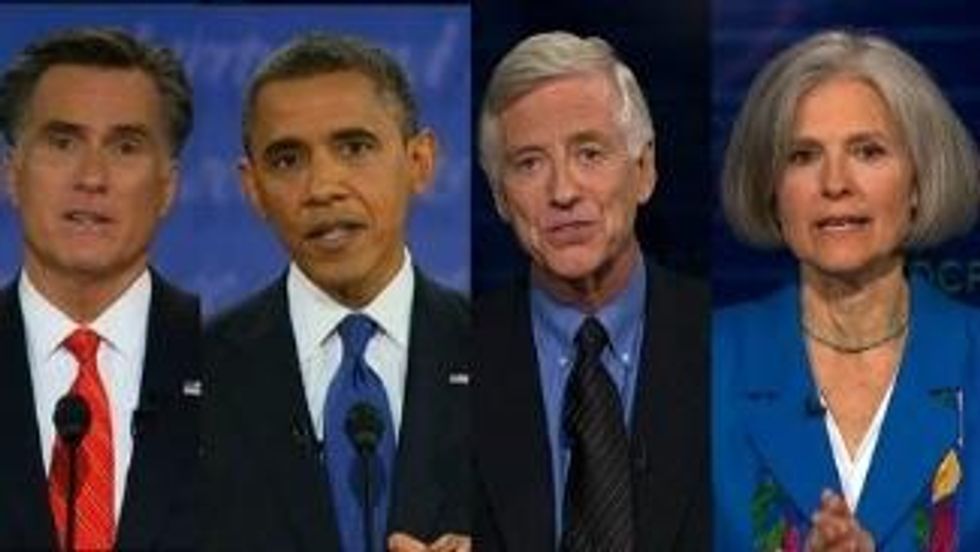
President Obama made a good point in late 2011, when he told "60 Minutes," "Don't judge me against the Almighty; judge me against the alternative." If only the public had a full range of alternatives against which to judge. In fact, most people do. They just don't know it. The reason they don't know it is because the media don't report on third-party politics or campaigns. These campaigns also lack the funds to purchase television airtime, or to compete against the Democratic and Republican campaign fundraising juggernauts. This leads to less diversity of voices, and far fewer alternatives on the ballot.
It hasn't always been this way. In 1980, the League of Women Voters ran the debates, and independent presidential candidate John B. Anderson was allowed to participate (President Jimmy Carter opposed his participation and boycotted the event). In 1992, billionaire Ross Perot used his personal funds to overcome the media blockade of his presidential campaign. His successful debate performance temporarily propelled him ahead of both Bill Clinton and George H.W. Bush in the polls.
Since then, no third-party candidate has been allowed into the presidential debates. The debates are run by the Commission on Presidential Debates, an organization described by George Farah, founder and executive director of Open Debates, as "a private corporation financed by Anheuser-Busch and other major companies, that was created by the Republican and Democratic parties to seize control of the presidential debates from the League of Women Voters."
Farah told me that in 1988, "you have the Michael Dukakis and the George Bush campaigns drafting the first-ever 12-page secret debate contract. They gave it to the League of Women Voters and said please implement this. The league said, Are you kidding me? We are not going to implement a secret contract that dictates the terms of the format. Instead, they release the contract to the public and they held a press conference accusing the candidates of 'perpetrating a fraud on the American people' and refusing to be 'an accessory to the hoodwinking of the American people.' "
The Democratic and Republican parties wrested control of the debates from the League of Women Voters, and have controlled them since.
"Democracy Now!" brought Stein and Anderson to a television studio in Littleton. After each response from President Obama and Mitt Romney to moderator Jim Lehrer's questions, we paused the tape, allowing Stein and Anderson to answer as well. What they said stood in stark contrast to the barbs traded inside the heavily secured debate arena.
For example, on health care, former Salt Lake City Mayor Anderson said: "We're talking here about Obamacare and Romneycare. I would call it insurance companycare because they're the ones who wrote it. They joined up with a very conservative foundation years ago to develop this plan, to make the American people buy this perverse product."
The Green Party's Stein, a medical doctor from Massachusetts, said: "Under the Obama White House, which basically codified the violations of George Bush, the attacks on our privacy rights, on First Amendment rights, the criminalization of the right to protest ... things are not working under Democrats, under Republicans alike. We need a government that is of, by, and for the people, not sponsored and working for big money."
Robust debate on the critical issues of the day only strengthens democracy. As the Democrats and Republicans raise and spend unprecedented sums of campaign cash, "Democracy Now!" will continue to make additional voices heard. This is what democracy sounds like. Open the debates.
The United States does not have presidential debates in any realistic sense of the word.
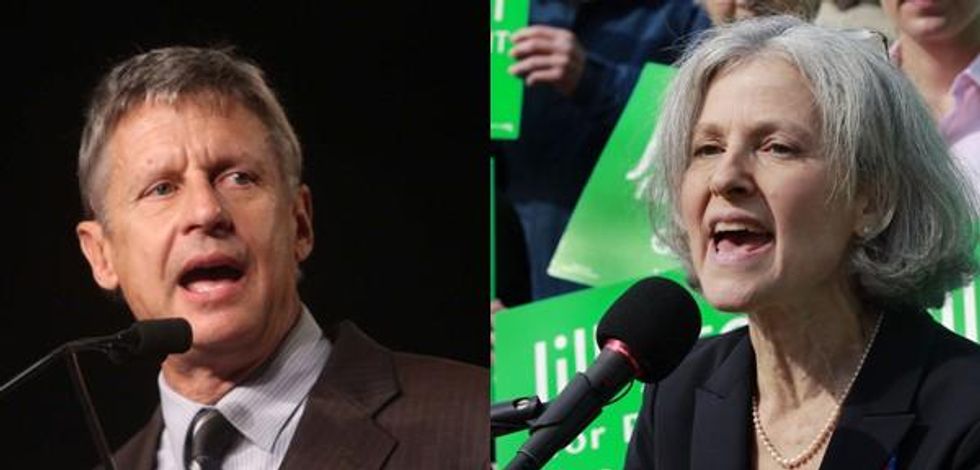
It holds quadrennial joint appearances by major-party candidates who have been schooled in the art of saying little of consequence in the most absurdly aggressive way. And Americans will be served a full helping this evening, as the travesty that the Commission on Presidential Debates foists on the country every four years begins its latest run.
Much will be said on stage, much more by the punditocracy.
But the likelihood that it will matter is slimmer now than ever. That is because presidential debates have become the political equivalent of a classic rock radio station. You'll hear all the hits, and maybe even a few obscure tracks that you'd almost forgotten. But the whole point of the Barack Obama's appearance will be to say nothing that harms himself and everything that harms Mitt Romney, just as the whole point of Romney's appearance will be to say nothing that harms himself and everything that harms Obama.
Neither man will leave his comfort zone. Neither will jump off the narrow track on which this year's campaign has been running. The only theater will be provided by a gaffe, and in fairness Mitt Romney has proven to be more adept than any figure since Chevy Chase (playing Gerald Ford) in that department.
But America deserves better than drinking games built around the wait for Mitt to be Mitt.
What would make the debates better?
More candidates.
In most developed nation--from Canada to Britain to Australia to France--debates are multi-candidate, multi-party affairs. It is not uncommon for five, six, even seven candidates to take the stage. Those countries do not just survive the clashes, they thrive--with higher levels of political engagement than the United States has seen in decades.
Only the most crudely authoritarian states erect the sort of barriers that the United States maintains to entry into the debates by so-called "minor-party" candidates.
And why?
The fool's argument against expanding the number of contenders is that debates involving more than the nominees of the two big parties--which, conveniently, control the access to the debates through their joint Commission on Presidential Debates--is that it would somehow confuse the electorate. As if Americans aren't quite as sharp as the French.
Adding more candidates would not create confusion. It would add clarity.
Imagine if Green Party presidential candidate Jill Stein joined Obama and Romney for this year's debates. Instead of having to listen to a pair of adult men trying to distinguish between Obamacare and Romneycare, we could hear a working physician explain why a "Medicare for All" program would be dramatically more efficient, economical and humane than what either the president or his Republican challenger has proposed.
Imagine if Libertarian Gary Johnson could respond to the predictably empty wrangling about whether America is "broke"--as opposed to suffering from broken budget priorities. Johnson would propose bringing American troops and resources home from policing the world's trouble spots, a wholly sensible fix that would make the United States safer, richer and a more popular.
Imagine if Constitution Party candidate Virgil Goode--who once talked about denying a US House seat to Keith Ellison, the first Muslim elected to Congress, because Ellison clutched a Koran rather than a Bible when he was sworn in--opened up a real discussion about the relationship between church and state. Instead of dancing around the issue, as they both do, Obama and Romney would be forced to get specific about how seriously they take the promise of Thomas Jefferson's "wall of separation." They might even call Goode out, sending a message that America needs to hear. from the leaders of both major parties.
By the standards of most countries, Stein, Johnson and Goode could qualify to join national debates. Johnson and Stein have secured places on enough state ballots to win the electoral votes needed to assume the presidency. Goode is already on twenty-six ballots and could yet use legal challenges (and certified write-in campaigns) to be positioned to get on enough additional ballots to win an Electoral College majority. (Other candidates, including former Salt Lake City Mayor Rocky Anderson, whose mounting an intellectually rich and radical run on the Justice Party line, have struggled to get on enough ballots to get near making the Electoral College cut. Anderson will, however, join Stein in a "Debate Talkback" tonight, which will be moderated by Democracy Now!'s Amy Goodman.)
There's not much chance that any of the three will be elected. But at this point, there's not as much chance as there once was that Romney will be elected. It would be absurd to disqualify Romney on the grounds that he's falling behind in the polls, just as it is absurd to disqualify candidates who are on the ballot but have not gotten the exposure that might run their numbers up.
(Notably, Goode is polling well enough inVirginia to be considered a serious threat by the Romney camp, which spent months trying to keep him off that state's ballot. When he finally got on, Goode said: "Candidate Romney, before he continues campaigning, should read the First Amendment about free speech and the right to petition. They're afraid true conservatives will vote for me.")
The value of adding more candidates to the debates is in the quality and diversity of ideas they bring, and in the prospect that they might force the candidates to address--perhaps even embrace--those ideas. This year, in France, Left Front candidate Jean-Luc Melenchon raised the issue of taxing speculators in that country's presidential race. Melenchon only won about 12 percent of the vote, but by the campaign was done both the sitting president, conservative Nicolas Sarkozy, and the man who beat him, Socialist Francois Hollande, were proposing their own variations on the Robin Hood Tax.
Could Stein, Johnson or Goode add as much to the American debate as an experienced campaigner like France's Melenchon? A credible case can be made for each of them. Johnson's a former Republican governor of New Mexico who debated Romney during last year's Republican nomination fight. Goode was a Virginia legislator and member of Congress, serving initially as a Democrat, then as a Republican. Stein, as the Green nominee for governor of Massachusetts in 2002, debated Romney several times, with major media outlets declaring her the winner.
So why not let them in? Oh, right, the rules. But the rules that have been adopted by the Commission on Presidential Debates are based on a deal cut by Democratic and Republican powerbrokers. Either major-party candidate could today call for opening up the debates, and the other would have a hard time keeping them closed.
Unfortunately, neither will opt for openness. Why? Because neither Barack Obama nor Mitt Romney is all that excited about getting dragged into a real debate. And, thanks to the way in which the big parties have rigged the process, neither Obama nor Romney will have to worry about any interesting questions, unexpected issues or pointed challenges interrupting their joint appearance.
Save
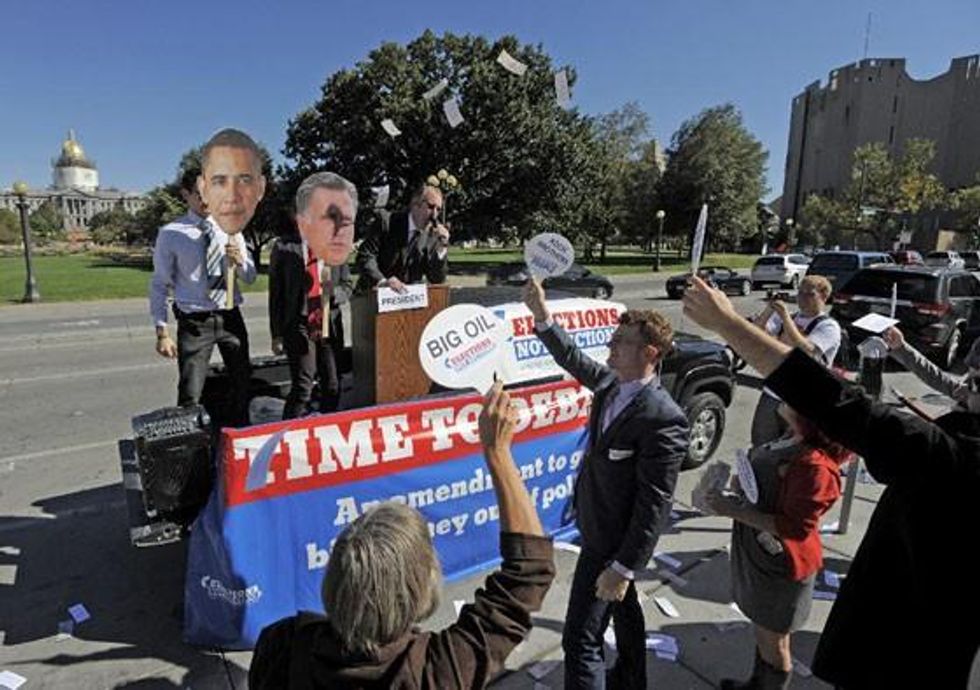
While corporate media will be airing President Barack Obama and Republican nominee Mitt Romney in the first presidential debate in Denver Wednesday night, Democracy Now! will be highlighting presidential contenders whose voices have been shut out: Jill Stein of the Green Party and Rocky Anderson of the Justice Party. Common Dreams will be streaming their live coverage tonight from 8:30 to 11:30 p.m. ET when they will pause after questions to include equal time responses absent from the corporate-sponsored debate.
Tune in to this page at 8:30 p.m. ET...
* * *
* * *
* * *
# # #
In the past week, we have been witness to the spectacle of the Republican and Democratic national conventions, events where both parties leave no stone unturned in their attempts to gain the confidence of voting Americans. Perhaps the biggest and best opportunity during presidential campaigns for the parties to differentiate themselves from each other, but the similarities between the two conventions cannot be overlooked.
In the past week, we have been witness to the spectacle of the Republican and Democratic national conventions, events where both parties leave no stone unturned in their attempts to gain the confidence of voting Americans. Perhaps the biggest and best opportunity during presidential campaigns for the parties to differentiate themselves from each other, but the similarities between the two conventions cannot be overlooked.
Beyond the highly orchestrated ceremony, canned speeches, and attempts to show off their commitments to the grassroots and diversity, both parties have clearly spent huge sums to convince Americans that a vote for the other party's candidates is a vote for the full-blown destruction of our American culture.
Long ago both parties abandoned their grassroots and the attendant disruptions that made conventions exciting and interesting to watch. Today's national delegates, comprised of elected officials and the Party faithful, are tasked with formalizing the selection of nominees for president and vice president, which is already well-decided long before the conventions take place. Non-committed delegates are pressured to vote the "right" way for the sake of party unity, and the Party's platform, which is largely ignored by its elected officials and candidates, is finalized. There is no spontaneity; both are equally boring.
Dissident voices are squelched. Ron Paul and his Libertarian Republican supporters were dissed at their convention where an unscripted moment of actual rebellion (and good TV) broke out on the floor. While many may disagree with their positions, not only do Libertarian Republicans remain true to their political principles, they have remained supporters of the Party. It is easy to understand their reaction at the convention, and the potential for them to abandon Romney for Libertarian Party candidate Gary Johnson.
While there is little controversy within the Democratic Party this year, the party is on the same trajectory with their progressive wing, as demonstrated at their 2004 convention in Boston where party bosses subjected Kucinich delegates to vigorous verbal arm-twisting in an attempt to show unanimous solidarity for Kerry.
By virtue of their wealth, titans of industry have always had more voice in our elections than the average individual.
Unable to secure a presence through the regular Machiavellian channels of party participation, Progressive Democrats of America has sponsored a shadow convention for the past two national conventions, after their organizing convention in Boston during the Democratic convention in 2004. One can only wonder how many progressive Democratic voters will abandon Obama for Green Party candidate Jill Stein or the newly forming Justice Party candidate Rocky Anderson.
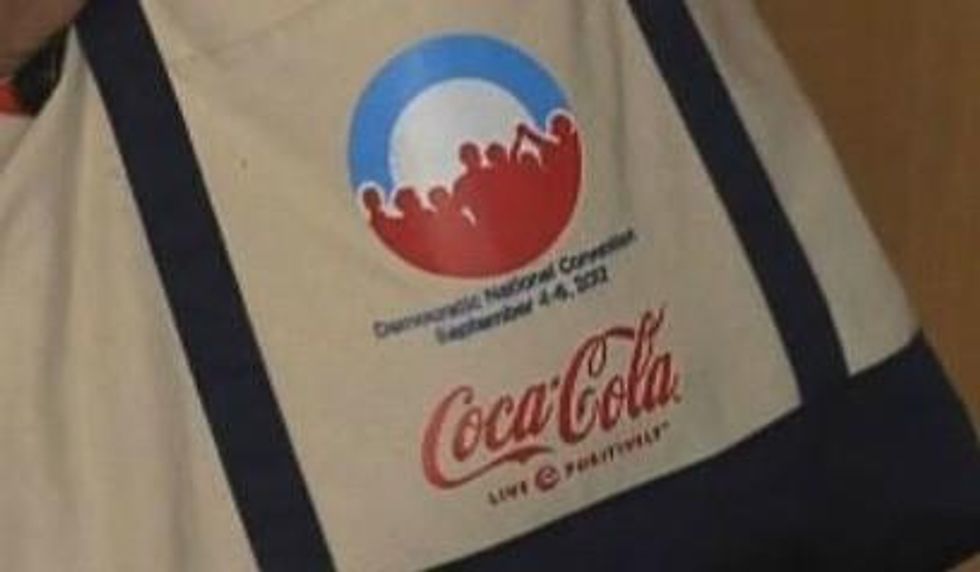
But, the most disturbing similarity between the two is direct corporate sponsorship, and the more obscure soft corporate funding through their respective host committees. While the GOP Convention website proudly boasts their corporate sponsors on their homepage, the Democrats have also accepted corporate funding while trying to maintain the sheen of grassroots funding. Corporate funders for the GOP include Google, Microsoft, Wellcare, Walmart, Chevron and an assortment of energy companies among others. Democratic sponsors include AT&T, Bank of America, Duke Energy, Time Warner Cable, UnitedHealth Group, Piedmont Natural Gas, and US Airways. Coca Cola and Wells Fargo have covered their bets by sponsoring both conventions.
Corporate tentacles are more entwined in our political process than simply making the massive ad buys paid for by undisclosed sources sanctioned by the Citizens United ruling. Corporate sponsorship of the Republican and Democratic conventions has long been policy, despite attempts to curb the practice due to the clear conflict of interest. This year's sponsors come from the healthcare, communications, oil, gas and energy, banking, automotive and housing industries - all of which have benefited from recent legislation under both Democratic and Republican administrations and are likely in line to receive additional benefits in the next administration, whichever party comes to power.
We cannot ignore the connections that wealthy patrons and their corporations have on our political process and who gets elected in this country. By virtue of their wealth, titans of industry have always had more voice in our elections than the average individual. Their influence has led to the election of politicians who support their corporate worldview and appoint judges.
Over time, the doctrine of corporate personhood became a reality as corporations - artificial entities created by government - gained inherent human rights through legislation and the courts. Because the Supreme Court decided in Buckley v. Valeo that money is speech and in prior cases that a corporation is a person, every attempt made by government to control money in politics has resulted in loopholes through which obscene amounts of money pours.
For over a decade, proponents of small "d" democracy have been working to limit the power of corporations. Immediately following the Citizens United decision, they came together to form the Move to Amend Coalition. Recognizing that corporations can and have benefited society in many ways, have an important role in a vibrant economy, and are entitled to privileges to protect themselves, Move to Amend is calling for a Constitutional amendment which clearly states that corporations are not people, are not entitled to unalienable human rights, that money is not speech and can be regulated in campaigns.