SUBSCRIBE TO OUR FREE NEWSLETTER
Daily news & progressive opinion—funded by the people, not the corporations—delivered straight to your inbox.
5
#000000
#FFFFFF
To donate by check, phone, or other method, see our More Ways to Give page.
Daily news & progressive opinion—funded by the people, not the corporations—delivered straight to your inbox.
Earlier this month, on Nov 3rd, the French government opened up applications for $60 million in reparations for American and other non-French Holocaust survivors who were transported by French trains to concentration camps during World War II.
This celebrated "measure of justice" was decades in the making--seven decades to be exact.
France's human rights ambassador Patrizianna Sparacino-Thiella, marked the initial announcement last year as "a further contribution to recognizing France's commitment to facing up to its historic responsibilities." After 70 years, the French foreign ministry admitted that France was responsible and would "assume the consequences."
And here we are, on the road to the Paris Climate Summit--with poor countries on the edge of an unraveling planet, demanding in ever louder voices some kind of reparations for the unavoidable, inevitable destructions that wealthier, carbon-polluting nations have wrought upon the world.
"Loss and damage is part of the climate justice we are asking for. We are at the brink of survival while rich countries continue to pollute and harm us. It needs to stop. We need to make them accountable." --Ayeen Karunungan, Philippines climate activistSpecifically, poor countries are fighting for a powerful agreement on what is called "Loss and Damage."
Loss and Damage refers to the waves and wildfires and other climate wrecking balls we can't stop anymore, largely because we've dragged our feet as a planet for over twenty years on climate action. It's about getting poor countries, who've contributed very little to the climate crisis some measures of justice for the climate impacts for which no level of preemptive "adaptation" can account.
Given its central importance among the world's most vulnerable countries, ActionAid's Harjeet Singh says a lack of progress on Loss and Damage could "absolutely" trigger a breakdown of the upcoming talks in Paris.
Ambassador Nozipho Mxakato-Diseko of South Africa, who leads the G77 + China bloc (134 developing nations), said "Loss and damage is not optional. We experience in our hearts the broad spectrum of climate change impacts. We are trying to see loss and damage have a role in this agreement."
Meanwhile, Ambassador Amjad Abdulla of the Maldives, who leads the 37-country Small Island Bloc, AOSIS, said Loss and Damage is a must have. "There has to be a home for loss-and-damage in the agreement."
The US, on the other hand, is not pleased about potentially paying up.
Todd Stern, the US climate envoy, told the press in late October that he supports Loss and Damage "as an idea" but said the United States, simply put, "is not going to accept compensation and liability being in the agreement."
Stern's words echo his message at the last iconic climate summit in Copenhagen in 2009, saying the U.S. would acknowledge responsibility, but not culpability. "We absolutely recognize our historical role in putting emissions in the atmosphere that are there now. But the sense of guilt or culpability or reparations, I categorically reject that."
If the U.S. and other wealthy allies like Australia and surprisingly Switzerland continue to insist on cleaving compensation from Loss and Damage, which seems very likely, the fight will be to salvage something that still gives the whole issue enough momentum to carry forward in the years ahead.
One battlefront involves getting rich countries to admit their historical responsibility for the glut of carbon emissions. Another front involves getting Loss and Damage out from under the "Adaptation" category in the UN framework, where it stands to be confused with preparing for the worst, instead of compensating for the unimaginable.
As the Angolan diplomat Giza Gaspar Martins, who leads the 48 least developed countries bloc, recently told Reuters: "(Loss and damage) is when you can no longer adapt to any potential change - that reality is deserving of special consideration."
A more tangible fight in the the Loss and Damage negotiations involves fighting for a UN climate refugee program--called "displacement coordination facility" in the UNFCCC lexicon--which could assist with emergency relief, migration support, and planned relocations for populations who are literally washed away, or whose crops just don't cut it anymore. (Something like this, one could aruge, may have been handy for the current Syrian refugee crisis.)
Negotiations will surely get heated, but all the negotiating in the world tends to overlook how very real the need for a Loss and Damage program already is.
Ayeen Karunungan, a Philippines climate justice advocate, felt Loss and Damage up close in late 2013.
Karunungan witnessed how Typhoon Haiyan, which claimed over 6,300 lives, devastated her home country of the Philippines. "I have met people who lost their whole family to Haiyan, who lost their whole agricultural lands, who were left with nothing," she said.
For Karunungan, the concept of Loss and Damage is a matter of justice, not for some later date, but for the here and now.
"If climate change is human induced, and it is, someone has to be responsible for all this damage," she continued. "Loss and damage is part of the climate justice we are asking for. We are at the brink of survival while rich countries continue to pollute and harm us. It needs to stop. We need to make them accountable."
When Yeb Sano, the Philippines negotiator took the stage at the climate talks in 2013, his words came in tears. After describing the "hellstorm"" of Haiyan that had just unleashed devastation upon his island home, he declared that it was "time to confront the issue of loss and damage."
"It is now too late, too late to talk about the world being able to rely on developed countries to solve the climate crisis," Sano declared. "We have entered a new era that demands global solidarity."
The same year Haiyan took 6,300 lives in the Philippines, the US spewed 6,673 million metric tons of carbon dioxide equivalents into the atmosphere, and while they were at it, showered $21.6 billion in subsidies on the fossil fuel industry.
Because of the bullish insistence by the U.S. and other wealthy nations against paying for the damage of historic pollution, the current Paris draft makes no mention of actual reparations or clear compensation language. As it stands, the G77 plus China bloc was able to squeeze different scenarios on Loss and Damage into brackets in the latest draft for future debate in Paris.
Almost all of the bracketed ideas on Loss and Damage are building blocks to further mechanisms and frameworks that may one day be able to deliver real support and perhaps real compensation. In other words, even if the G77 is able to move forward on their already weakened positions, it would take years or far more likely many painfully long decades to even build a working framework for doling out "measures of justice" for those who've lost everything.
It took well over half a century for one country to take responsibility and "assume the consequences" for something that was a very obvious evil--one not nearly as complex as getting the world's nations to match their historical carbon emissions with hunks of responsibility for a broken world, and then figure out shares of reparations and so on from there.
Unfortunately, we don't have 70 years for the survivors of a climate nightmare-made world. Knowing how long it took France to realize its latest reparations means Paris needs to find some equivalent to Godspeed on Loss and Damage.
The final round of preliminary climate negotiations in Bonn, Germany came to a close Friday without much consensus on some of the most pressing issues, including cementing wealthy nations' financial commitments to guarantee assistance for developing nations grappling with the impacts of global warming.
The talks in Bonn represented the last chance for United Nations (UN) member states to settle on a draft climate treaty ahead of the upcoming COP21 talks in Paris, where leaders will finalize a global agreement on curbing global warming.
Without substantial progress, climate advocacy groups said Friday, frontline communities around the globe face imminent threats.
"The deplorable inaction at the climate negotiations is a calamity for people across the world," said Dipti Bhatnagar, Friends of the Earth International's climate justice and energy coordinator. "We are facing a planetary emergency with floods, storms, droughts and rising seas causing devastation. The risk of irreversible climate change draws ever closer, and hundreds of thousands of people have already paid with their lives."
As the talks concluded, delegates expressed ongoing concerns that wealthy nations were still attempting to foist their aid obligations onto independent financiers like the World Bank and International Monetary Fund (IMF), which the Group of 77 (G77) plus China coalition of developing nations said was an underhanded attempt to evade financial responsibilities at any cost--even if it meant derailing the entire treaty process.
Mattias Soderberg, chair of the ACT Alliance climate change advisory group, told Deutsche Welle the pace of the talks was frustrating and disappointing.
"From our perspective, where we work with those who are affected by climate change, the progress is far from enough," Soderberg said. "Parties need to leave their comfort zones, to look for common understanding. Now they stay in their corners, sticking to old positions."
Susann Scherbarth, climate justice and energy campaigner at Friends of the Earth Europe, added, "We need a fair agreement, a fair process and fair shares of climate action. What we have on the negotiation table now is increased effort by more than 140 developing countries but it won't avoid catastrophic climate change unless rich countries have a dramatic change of heart. We need rich countries to urgently commit to do their fair share."
The draft agreement that came out of Bonn was still riddled with "technical disagreements" and was unlikely to provide much guidance to minsters during the Paris talks, Soderberg said.
"An example is on loss and damage [where adaptation to climate change is no longer possible]. Some rich countries want to cut it out, while developing countries, led by LDCs [least developed countries] and small islands, want to include ambitious text. There is no middle ground," he said.
Harjeet Singh, climate policy manager for ActionAid, said the week's events showed "there is still a mountain to climb before a deal emerges on the horizon at the Paris summit in December."
"It seems that the [European Union] forgot its claim of standing together with the world's poor and vulnerable," Singh added. "For months it has remained undecided on how the Paris deal will help poor communities already being battered by climate change. The EU hangs at the threshold dithering on whether and how it should go out and help the people in the storm."
G77 delegates have asserted that the rift was not simply a disagreement between ministers--it was a matter of life and death. "It is not a photo opportunity; it is not an instagram or selfie moment. It is a reality we have to deal with on a day-to-day basis," said G77 chair and South African climate envoy Nozipho Mxakato-Diseko.
"Whether Paris succeeds or not will depend on what we have as part of the core agreement on finance," she said during a press conference Thursday.
Jamie Henn, strategy and communications director for climate advocacy group 350.org, reported from Bonn on Friday that the week had been "frustrating" for climate ministers and that many disagreements remained over the "level of ambition" by world leaders to move away from fossil fuels and financial support for developing countries.
He also said there were "huge preparations under way" for direct actions outside of the COP21 summit, including marches and other demonstrations around the world.
"No matter where you are, you can play a huge role in this movement by continuing to keep pressure up for strong action in Paris and beyond.... The only way we're going to see progress is with a strong grassroots movement that can take on the power of the fossil fuel industry," he said.
Scherbarth added, "People will have the last word in Paris. But the demonstrations in Paris will not be the end. The struggle will continue, as it must, because the job will not be done in Paris."
Watch Henn's video below:
A bloc of developing nations said Thursday that rich nations are blocking efforts to reach a consensus on financial climate pledges in Bonn, Germany, this week as the upcoming United Nations climate talks approach. This move could derail the entire process.
The Group of 77 (G77) and China, a coalition of nations and alliances that represent more than 80 percent of the world's population, said wealthy UN member states were shirking their financial responsibilities to help developing nations stave off the impacts of climate change and attempting to shift those obligations onto institutions like the World Bank and International Monetary Fund (IMF).
According to AllAfrica, the latest blueprint of climate pledges reportedly omits key mechanisms included in previous drafts, such as financing for poorer countries and accountability for wealthier ones.
"When you take out the issues of others, you disenfranchise them and disempower those who suffer the most," said G77 chair and South Africa climate envoy Nozipho Mxakato-Diseko.
Mxakato-Diseko said that with the COP21 talks approaching quickly and no more chances to negotiate after the Bonn session ends this week, those roadblocks could mean the difference between life and death for frontline nations.
"It's a matter of life or death...and we are deadly serious," Mxakato-Diseko told journalists in a media briefing on Thursday. While the G77 had agreed on financial positions, she said, "developed countries have not negotiated, in the hope that it will be sorted [out] external to the agreement, where we are weakest."
Mxakato-Diseko continued, " Legally binding financial mandates for wealthy nations must be included in the agreement to guarantee that frontline countries receive funds to address the impacts of climate change. Otherwise, we are left to the whim of charity, the whim of individual countries to decide if and when [to pay], depending on the circumstances."
According to a recent report by the Paris-based Organization for Economic Cooperation and Development (OECD), several sources, including government funds, private institutions, and development banks, raised $62.8 billion in 2014 to stock up the climate war chest. Developed nations previously swore to mobilize $100 billion by 2020 to help frontline countries adapt to the impacts of global warming, such as sea level rise.
But on Thursday, the G77 said those figures were not accounted for and that the fine print included 'development aid' as a form of financial contribution, which raises "serious and valid concerns over the way that $62 billion figure was arrived at," said Angolan diplomat Giza Gaspar Martins. "It accounts for credit guarantees, loans that must be repaid."
Because the World Bank and IMF are private institutions not bound by the COP21 climate agreement, delegates say there is no way to guarantee that those funds will ever reach developing nations.
The World Bank is "a competitor with developing countries for finance to give to us on unregulated conditions," while the IMF "has no status in the agreement," Mxakato-Diseko said. "Beneath the darkness, where there is no scrutiny from civil society, the hope is that our will be bent so much that we are tired, we give up, and then the issue is resolved by external announcements" to the UN climate process.
Gurdial Singh Nijar, a spokesperson for the Like-Minded Developing Countries (LMDC) coalition--which includes Argentina, China, India, Iran, and Vietnam, among others--told journalists that the new draft "completely ignored the submissions of G77 on finance."
"We demand that the text be balanced for negotiations to commence," Nijar said.
Harjeet Singh, policy manager for ActionAid's humanitarian organization, explained the G77's position: "If your house goes up in flames, you first put the fire out. Developing countries are already fighting climate change fires and demanding strategies and money to deal with its impact. For rich nations with the money, technology, and skills, the devastation of climate change is not a pressing issue."
"The current climate talks reflect the contrasting order of priority of issues between developed and developing nations," Singh said. "Rich nations need to recognize the crisis is here and now. The money to prepare for and deal with climate impacts must be at the center of the deal in Paris."
The G77's call follows a report released Monday that found the U.S. and other wealthy nations' climate pledges to limit greenhouse gas emissions were not enough to prevent an average surface temperature warming of 2degC, the agreed threshold to prevent irreparable global warming and extreme weather events.
The success of COP21, said Mxakato-Diseko, will be judged by "what will be contained inside" the final accord.
As the U.N. Conference of the Parties (COP20) talks enter their last scheduled day in Lima, Peru on Friday, remarks delivered by U.S. Secretary of State late Thursday to climate negotiators from around the world, though welcomed by some, seemed to do very little in terms of moving the talks closer to the kind of agreement experts say are necessary to adequately tackle the crisis of human-caused global warming.
Kerry sounded notes of urgency and shared purpose in his remarks to the delegates as he stated, "Rest assured, if we fail, future generations will not and should not forgive those who ignore this moment, no matter their reasoning. Future generations will judge our effort not just as a policy failure, but as a massive, collective moral failure of historic consequence, particularly if we're just bogged down in abstract debates. They will want to know how we together could possibly have been so blind, so ideological, so dysfunctional, and frankly, so stubborn that we failed to act on knowledge that was confirmed by so many scientists in so many studies over such a long period of time and documented by so much evidence."
"Secretary Kerry should ask his boss to use every tool he can to fight the climate catastrophe we are facing - including the cessation of the sale of publicly-owned fossil fuels and a significant strengthening of EPA climate policy. The US should increase their 2025 climate pollution reduction target from 28 to 40% and commit to it in an internationally legally binding agreement next year. Our transition to 100% renewable energy by 2050 depends on it."
--Kyle Ash, Greenpeace
Meanwhile, as the Guardian's Suzanne Goldenberg reported, with talks scheduled to conclude Friday, delegates had agreed "on just one paragraph of a deal" and she quoted the Union of Concerned Scientist expert Alden Meyer who said negotiators were "going backward," not forward on a quality agreement.
Though some U.S.-based climate action groups welcomed Kerry's arrival at the talks and his lofty rhetoric on climate, none seemed convinced that the U.S. contributions at the summit or its standing positions on climate action are nearly adequate to the task.
"We appreciate [Sec. Kerry's] comments on the urgency of creating a clean energy economy," said Kyle Ash, Greenpeace's top legislative advisor. "His record as a climate champion, however, contrasts with many of the US positions in the Lima COP negotiations."
350.org's Jamie Henn, also attending the summit in Lima, said Kerry "sure sounded like someone who was gearing up" for strong action on climate change, but argued Kerry's calls for others to act would mean little if the U.S. approves new dirty energy projects like the Keystone XL pipeline; refuses to make stronger emissions cuts; or continues to ramp up oil and gas exploration and fossil fuel exports.
"Fancy words are worth nothing if they aren't backed up with action," Henn said.
According to Karen Orenstein, senior climate analyst with Friends of the Earth US, the gap between Kerry's rhetoric and U.S. commitments is more like a chasm.
"It is past time to put words into action," Orenstein said. "The emissions cuts the US has put forward put us on a path for a global temperature increase well beyond the already dangerous 2C level. Secretary Kerry said, 'If you're a big developed nation and you are not helping to lead, then you're part of the problem.' Regrettably, the US is a tremendous part of the problem, and as the hundreds of thousands of people on the streets of Lima and New York have demanded, this must change immediately."
"It is past time to put words into action." --Karen Orenstein, Friends of the EarthOrenstein was referencing the People's Climate March in New York City earlier this year and a large march in Lima outside the talks on Wednesday where civil society organizations, Indigenous groups, and climate justice advocates rallied for a far-reaching draft agreement at this summit which would be finalized at the next round of talks scheduled for Paris in 2015.
In a policy paper released at the talks, Greenpeace argues that the U.S. approach to its own commitments and negotiating stance are in direct contrast with Kerry's stated desire to forge a strong agreement. The Obama administration has argued that making carbon emission reduction targets and other climate mitigation commitments legally binding is not necessary, but Greenpeace is among those who strongly disagree. Without "binding" targets and enforcement mechanisms, goes the argument, the necessary reductions will simply not be made in time. Ash, who authored the report on behalf of the group, explains:
President Obama's team continues to insist that presidential authority is insufficient to sign onto legally binding obligations to reduce climate pollution. At the same time, they claim that making pollution targets binding will reduce ambition. Neither is correct. Rather than portray US presidential legal powers as weak in the face of a politically stunted, soon-to-be climate denier controlled Congress, Secretary Kerry should ask his boss to use every tool he can to fight the climate catastrophe we are facing - including the cessation of the sale of publicly-owned fossil fuels and a significant strengthening of EPA climate policy. The US should increase their 2025 climate pollution reduction target from 28 to 40% and commit to it in an internationally legally binding agreement next year. Our transition to 100% renewable energy by 2050 depends on it.
Familiar sticking points at the talk continue to center around the divide between rich and poor nations. Whereas the U.S. argues that so-called "developing nations" must make the same kinds of sacrifices that larger and wealthier nations are prepared to make, critics of that view say that because those most-developed nations are also the largest historic greenhouse gas emitters they have a special responsibility to do more--a concept known as "common but differentiated responsibilities."
Advocates of climate justice argue that big polluters, like the U.S., Canada, Australia, and the nations of Europe have should play a more significant role in financing the mitigation and transition efforts of those countries which did much less to create the climate crisis but are much more threatened by the increasing impacts of higher temperatures, rising seas, longer droughts, and more extreme weather.
As the BBC reports:
Some countries are suspicious that the text being developed here in Lima is an attempt to get round the concept of differentiation, which is embedded in 1992's UN framework convention on climate change.
The issue has become critical as the chairs of the talks introduced a new draft text that many felt watered down the original commitment.
A large group of developing nations known as the G77 objected.
"This whole exercise is not meant to rewrite the convention, this is a firm basic position of the G77," said Antonio Marcondes, Brazil's representative at the talks.
"We stand behind the differentiation, we stand behind 'common but differentiated responsibilities', these are issues we hold very strong and these are definite red lines."
The COP 19 international climate negotiations in Warsaw, which have been labelled "the dirtiest climate conference on record," finally came to a close overnight, barely scraping by with a partial deal aimed at future talks and limited "concrete" actions in the interim.
"This summit has been shrouded in farce - dominated by rich, industrial nations who have put the interests of big polluters first," said Friends of the Earth's International Climate Campaigner Asad Rehman from the summit. "They leave Warsaw with an agreement that will allow them to do as they please."
After two weeks of negotiating, virtually the only agreement reached requires countries to publish their greenhouse gas reducing plans for the period after 2020 by the first quarter of 2015 ahead of the next round of talks in Paris.
"Warsaw has set a pathway for governments to work on a draft text of a new universal climate agreement, an essential step to reach a final agreement in Paris, in 2015," said Marcin Korolec, the Polish host of the conference.
Negotiators did manage to agree that all countries should be required to reduce their emissions, including large developing countries such as China and India--a shift from the Kyoto Protocol, which only required the most developed countries to do so.
However, as Reuters reports, during the two week negotiations, "no major nation offered tougher action to slow rising world greenhouse gas emissions and Japan backtracked from its carbon goals for 2020, after shuttering its nuclear industry after the Fukushima disaster."
Only one "concrete measure" came of the talks, reports Reuters: an agreement on new rules to protect tropical forests.
"World leaders better get their act together quickly. If they show up empty-handed in 2015 and don't secure a strong international agreement, they'll be known as the generation that clearly saw the growing threat of global climate change, and failed to try to stop it," stated Jake Schmidt, International Climate Policy Director at the Natural Resources Defense Council, who attended the Warsaw conference.
FOE's Rehman added, "With the planet careening towards catastrophic climate change, the international community has done nothing in Warsaw to take its foot off the accelerator."
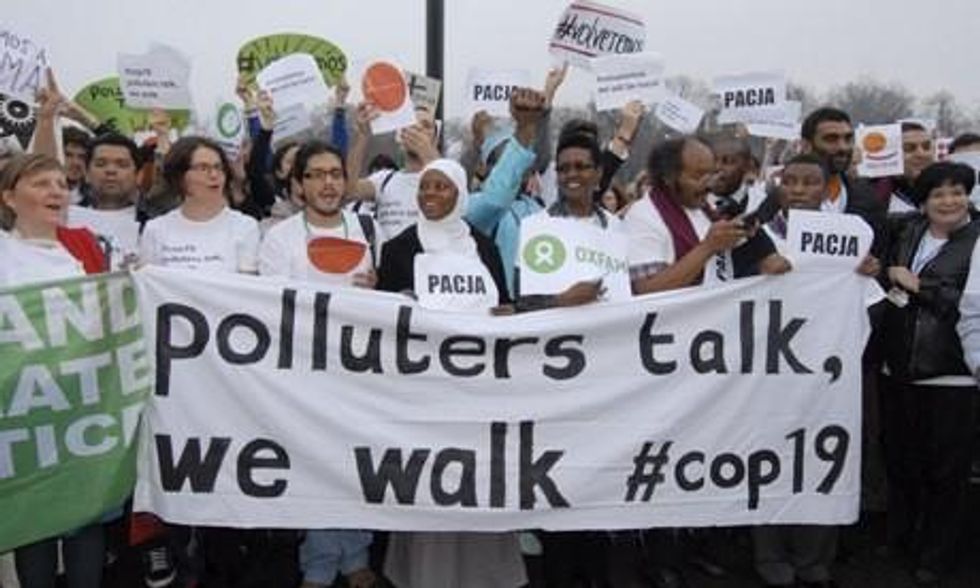
The only "ray of hope" Rehman saw at the conference was a mass walk-out by the world's leading green, anti-poverty, youth and faith groups, denouncing the summit as putting corporate profits above people and being "on track to deliver virtually nothing."
One hundred and thirty two of the world's poorest and less-developed nations, including the G77 nations and China, also staged their own walk-out at one point, accusing the wealthiest nations, such as the U.S., Canada, Australia, and the EU states of sabotaging any hope for progress.
_______________________
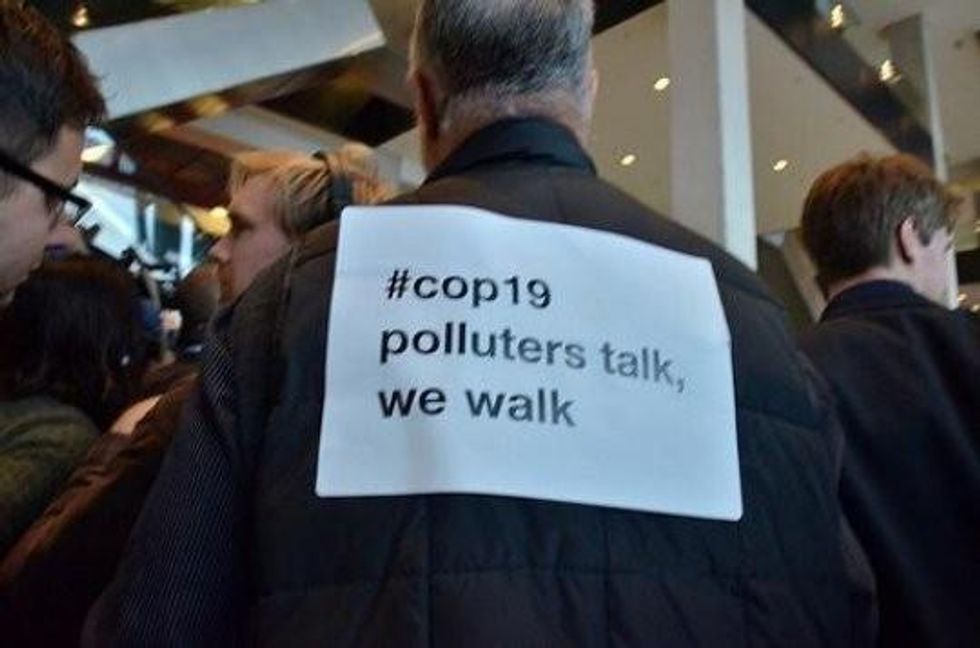
"By walking out of COP19, we're walking into a fight with the real enemies to progress: the coal, oil and gas companies that have a stranglehold over our governments and economy."
-Jamie Henn, 350.org
Among the civil society groups represented in the walkout are Oxfam International, Greenpeace, ActionAid, Friends of the Earth International, the International Trade Union Confederation and 350.org.
"Polluters and corporations dominated this conference with their empty talk, so we walked out in protest. Polluters talk, we walk," stated Jagoda Munic, Chairperson of Friends of the Earth International.
"By walking out of COP19," added 350's Jamie Henn, "we're walking into a fight with the real enemies to progress: the coal, oil and gas companies that have a stranglehold over our governments and economy."
"While people around the world are paying with their lives and livelihoods, and the risk of runaway climate change draws closer, we simply could not sit by this egregious inaction. Corporate profits should not come before peoples' lives," stated Munic.
Various Twitter users captured the walkout in pictures:
The walkout is the second to hit the conference in as many days. On Wednesday, over 130 of the world's developing nations, including the G77 nations and China, walked out, accusing the wealthiest nations, such as the U.S., Canada, Australia, and the EU states of derailing deals on reparations owed from their massive fossil fuel emissions.
In a joint statement issued Thursday, the environmental groups and allies charged that COP19 "is on track to deliver virtually nothing" and "has put the interests of dirty energy industries over that of global citizens." They continue:
We as civil society are ready to engage with ministers and delegations who actually come to negotiate in good faith. But at the Warsaw Conference, rich country governments have come with nothing to offer. Many developing country governments are also struggling and failing to stand up for the needs and rights of their people. It is clear that if countries continue acting in this way, the next two days of negotiations will not deliver the climate action the world so desperately needs.
"We as civil society are ready to engage with ministers and delegations who actually come to negotiate in good faith. But at the Warsaw Conference, rich country governments have come with nothing to offer." - from the joint statement
Therefore, organizations and movements representing people from every corner of the Earth have decided that the best use of our time is to voluntarily withdraw from the Warsaw climate talks. Instead, we are now focusing on mobilizing people to push our governments to take leadership for serious climate action. We will work to transform our food and energy systems at a national and global level and rebuild a broken economic system to create a sustainable and low-carbon economy with decent jobs and livelihoods for all. And we will put pressure on everyone to do more to realize this vision.
Youth climate activist Anjali Appadurai, who made headlines at the COP17 climate conference in Durban with a moving speech demanding urgent action, spoke to Democracy Now! on the sidelines of the conference.
"The message is about social movements," Appadurai said. "We're going back, we're building our power, we're building up our networks and our movements and we're coming back much stronger in Peru [for the next COP] ready to reengage in the political process."
"We have this message: volveremos--we will be back."
"We're going to bring back social movements as an essential part of this process so that COP20 next year in Lima can be stronger because of the social movements lighting a fire underneath it," Appadurai said.
"We are calling on developed countries to go back home and listen to their own people," urged Dipti Bhatnagar, Friends of the Earth International Climate Justice and Energy coordinator. "People all over the world demand urgent steps to agree an ambitious, binding and equitable international agreement on climate change.
The people that took part in the walkout were right to do so to "raise the profile" of the urgency of the climate problem--something that's not happening at sessions within the summit, said Kevin Anderson and Alice Bows-Larkin of the Tyndall Centre for Climate Change Research, two scientists calling for "radical and immediate de-growth strategies in the U.S., EU and other wealthy nations."
Speaking to Democracy Now!, Bows-Larkin said, "I think that it's important that if the scientists and the science is not being adhered to or listened to, and that there is frustration, I think those people who are in those civil society organizations need to make a stand and to raise the profile."
"Civil society are trying to raise the profile, the fact that, you know, this is a huge and an urgent problem," she continued. "And actually, you would not get that sort of message from the negotiations, that it's urgent at all. You know, you get the sense that really we can, you know, wait a while, and at some point we will sort some targets out. Well, it's, frankly, going to be too late. And it's--you know, not setting any targets before 2015 means it will be too late to avoid a two-degree target, because emissions are supposed to have globally reached a peak by then. Well, of course, they can't reach a peak if we don't have a target."
At the conference last week, Philippines lead negotiator Yeb Sano wondered if he must put forth the same questions he asked at last year's COP in Doha: "If not us, then who? If not now, then when? If not here, then where?"
For the green groups calling who walked out in protest, the answer couldn't be more clear.
"Now is the time to break free from our fossil fuel addiction and start a transformation towards sustainable and just societies," said Bhatnagar.
________________________
Harjeet Singh, a spokesman for ActionAid Internatonal, called the continued willingness of the wealthiest (and most polluting) nations to sacrifice the low-lying islands nations and poor countries that are the least responsible for but most vulnerable to climate change an insult to the spirit of the UN talks.
"The US, EU, Australia and Norway remain blind to the climate reality that's hitting us all, and poor people and countries much harder," Singh said. "They continue to derail negotiations in Warsaw that can create a new system to deal with new types of loss and damage such as sea-level rise, loss of territory, biodiversity and other non-economic losses more systematically."
As Sophie Yeo writes for the RTCC Blog, Australia was the target of specific ire for what was interpreted as disrespectful and unserious behavior during the latest conversations at the summit which focused on the development and mechanisms for an international climate relief fund.
According to Yeo:
The Australian delegation turned up in casual attire and "gorged on snacks" during negotiations on whether developed states should make reparations to vulnerable countries as the impacts of climate change become more severe, according to Saleemul Huq, an expert on loss and damage at the International Institute for Environment and Development.
Their behaviour caused over 130 developing nations to abandon discussions on the controversial issue of climate compensation at 4am last night.
Representatives from developed countries also appear less than impressed. EU negotiator Paul Watkinson tweeted: "It is one thing to be tired in a negotiation meeting, another to turn up in pyjamas - respect matters".
According to reports, the negotiators blocked any progress on a new 'loss and damage mechanism', which many developing countries are pushing as a non-negotiable element of the climate talks which are gathering pace in Warsaw.
The late night talks were developing constructively, sources say, until the Australian delegation blocked progress on the new document currently being thrashed out behind closed doors.
And the Guardian's John Vidal reports:
Developing countries have demanded that a new UN institution be set up to oversee compensation but rich countries have been dismissive, blocking calls for a full debate in the climate talks.
"The EU understands that the issue is incredibly important for developing countries. But they should be careful about ... creating a new institution. This is not [what] this process needs," said Connie Hedegaard, EU climate commissioner.
She ruled out their most important demand, insisting: "We cannot have a system where we have automatic compensation when severe events happen around the world. That is not feasible."
The G77 and China group, which is due to give a press conference on Wednesday to explain the walkout, has made progress on loss and damage, which it says is a "red line" issue. It claims to be unified with similar blocs including the Least Developed Countries, Alliance of Small Island States and the Africa Group of negotiators.
Hedegaard poured cold water on last week's related proposal by Brazil, that the Intergovernmental Panel on Climate Change be asked to find a way to quantify each country's historical emissions of greenhouse gases in order to help countries establish the level of future emission cuts.
Debate on the issue has been rejected by rich countries, which fear it could lead to unacceptable costs.
Those countries that walked out, including a coalition of low-lying island countries, African nations, and others were holding a press conference later in the day to explain their frustrations and articulate a possible path forward.
_______________________________
Hunger allows no choice
To the citizen or the police;
We must love one another or die.
Hunger allows no choice
To the citizen or the police;
We must love one another or die.
W.H. Auden wrote that, sitting in a dive on 52nd Street nearly three-quarters of a century ago, as the world plunged into darkness on September 1, 1939. I've been thinking of those words a lot lately. Because it feels to me, and many others I know, like we're poised at the edge of another darkness.
It's a darkness already visible, right now, in the Philippines, where thousands are dead and many hundreds of thousands made refugees by the force of a storm like none had ever seen.
And it's a darkness visible in the bright corporate halls of a conference center in Warsaw, where delegates to the nineteenth annual U.N. negotiations on climate change are divided and dithering, even as the window to prevent civilizational catastrophe rapidly closes.
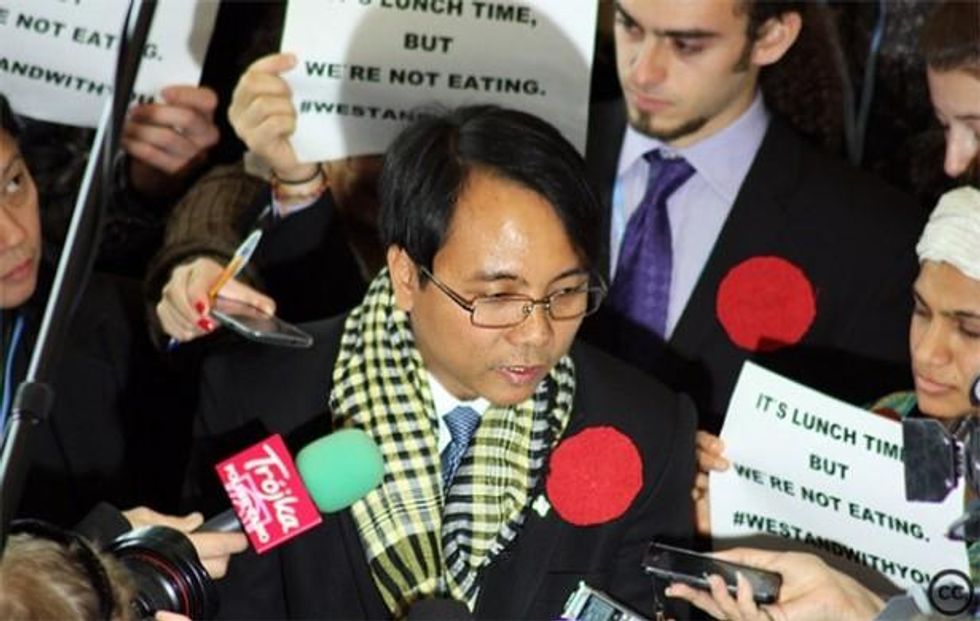
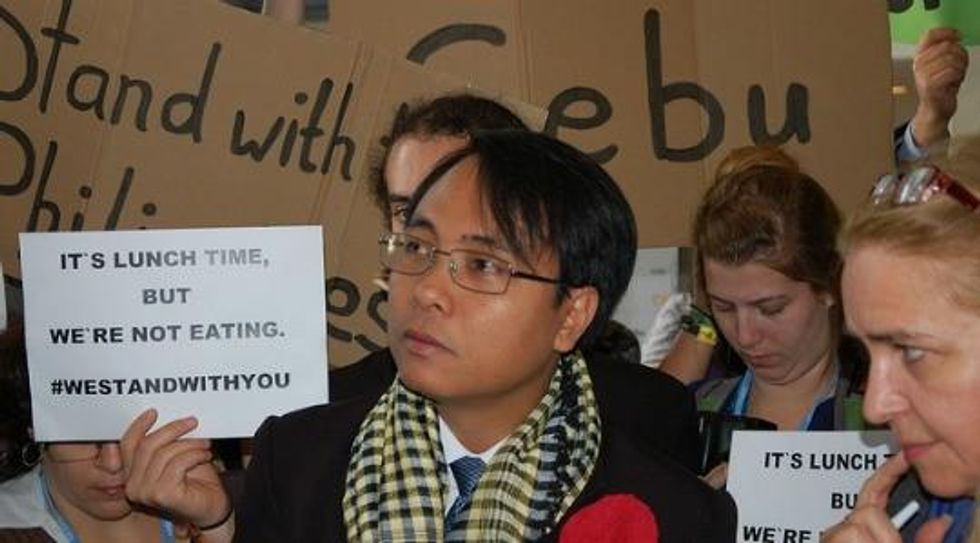
In those same bright halls last Monday, during the opening session, the Philippines' lead negotiator, Naderev Yeb Sano, announced in a powerful and emotional speech that he would eat no food for the duration of the twelve-day conference, or until meaningful action was taken to address the global crisis, and sparked an international outpouring of solidarity.
It so happens that two young friends of mine, Adam Greenberg and Collin Rees, recent Boston-area college grads, are in Warsaw as youth delegates to the U.N. conference with SustainUS, and they and other young people there immediately joined Sano in his hunger strike--and have now been fasting for more than a week. (Adam and Collin are allowing themselves some liquid nutrients so they can keep up the grueling conference schedule.)
By coincidence, it also happens that I spent this past weekend with a core group of about fifty committed student climate organizers from Students For a Just and Stable Future (SJSF) at their fall convergence in Worcester, Massachusetts, as they spent two full days in trainings and strategy meetings to strengthen their network and support the fast-growing grassroots climate movement in New England and beyond. And yesterday, the SJSF groups at Tufts and Brandeis launched a weeklong fast in solidarity with Sano and the people of the Philippines (as well as their friends Adam and Collin), and held a candlelight vigil in Cambridge. They're joined by people throughout Boston and the region, and coordinated fasts and vigils are being planned around the U.S. and the world for Thursday and Friday, the final days of the Warsaw conference.
These students (many of whom I've come to know personally as we've worked side by side in the 350 Massachusetts network) understand full well what's happening to the climate, and are acutely conscious of the fact that time is running out for their generation--and, especially, those that will follow. They know that we simply cannot wait until 2020, or even 2015, to turn things around decisively. It has to be now. And they're prepared to engage in the kind of hard work and struggle that building their movement will require.
In an email last week, Adam Greenberg told me:
I'm fasting because we need to, as Yeb said, stop this madness. I refuse to accept that we can't. I refuse to accept that we won't. I refuse to let the fossil fuel companies win. This is about justice, this is about taking action, and this is about preventing harm both now and in the future. We know what needs to happen. The science and the deadly simple math could not be more clear. Walking away from these talks each year without making progress is morally unacceptable.
I followed up with some questions for the two of them, and Collin Rees was able to respond last night. Noting that expectations for what the UN process can achieve are exceedingly low, I asked if he could describe what the atmosphere at the Warsaw conference was like coming in, and how the devastation in the Philippines and the action by Yeb Sano has changed it.
Collin Rees: Expectations from the UNFCCC are traditionally very low; this has been even more true in Warsaw. There was not a lot of hope for real action coming into the talks; there was some fairly vague talk about a loss and damage mechanism and some small hopes for moving on finance. Ever since Copenhagen expectations have been kept exceedingly low to avoid disappointment--I think they've actually been kept artificially low through this method, and this week has shown us there's still a lot of hope.
People are now talking about real advances in the loss and damage arena, and tangible movement on finance. Discussions on REDD+ has been surprisingly hopeful, and sessions have run late into the night as countries continue debate. It hasn't changed everything and expectations are still low, but I think we're seeing real movement and that's something we can continue to push for as we move into the second week.
I also asked what the goals of SustainUS were for Warsaw, and whether they had changed, and what the US delegation's reaction has been, if any.
CR: SustainUS's goals for Warsaw were largely related to two campaigns--inserting intergenerational equity into the negotiating text for 2015's agreement and sparking a climate conversation in the U.S. about this June's upcoming Clean Air Act Section 111(d) EPA standards for existing-source power plants. Both campaigns have been going well, but the domestic efforts especially have been augmented by Haiyan's devastation and Sano's courageous stand. The media is connecting climate change to real impacts, and the need for climate action is clear. The upcoming EPA regulations are a simple, easy way the U.S. can instantly become a leader on climate action, by implementing aggressive standards that force the worst energy sources out of the equation. These regs will be issued; the only question is how much of an impact they will have. They're a chance to avoid a completely dysfunctional Congress and take real action with immediate impacts.
The large majority of the U.S. delegation didn't show up until this week, so they've been largely absent from the dialogue thus far. We're planning to bring it to their attention, but we're also cognizant of the fact that they've essentially been given their marching orders from Washington and have very little flexibility in their actions here in Warsaw. What we need in the U.S. is aggressive domestic action, so that in the next two years we can come to these negotiations and be a real leader in the international sphere. This fast is about solidarity with climate change victims worldwide, but it's also about getting action back at home (in every country, not just the U.S.).
I asked Collin, as someone in his early twenties, what he wanted people to understand about what's happening there in Warsaw right now--not just in terms of the negotiations, but in terms of what's truly at stake.
CR: We want people to understand that negotiators are coming to the table with full knowledge of the science of climate change and its devastating impacts. They're coming with knowledge of what needs to be done, and the steps that need to occur to get to that point.
They're coming with all of this knowledge, they're waving their arms and giving windy, empty speeches for two weeks, and they're walking away WITHOUT DOING ANYTHING. This is not a process that's subtly flawed, it's a process that's being hijacked by a small group of countries who refuse to commit to action. That's morally unacceptable.
If we don't take action on climate change, we're condemning the entire world to an unlivable future. We're condemning those currently living in vulnerable regions disproportionately affected by the ravages of climate change, and we're condemning all future generations to a world incompatible with life. That's what's at stake here, and that's why inaction is so unacceptable.
[Update, 11/20/13: The Guardian reports that a bloc of 132 poor and developing countries (the G77 and China) have walked out of the Warsaw negotiations in an "orchestrated move," protesting wealthy nations' refusal to discuss "loss and damage" compensation until after 2015.]
* * *
A personal note: As I post this, I'm nearing twenty-four hours without food myself, as I fast in solidarity with Yeb Sano, the people of the Philippines, people suffering the effects of climate change everywhere--and with these young friends of mine in Warsaw and at home. It's a small thing, not eating for a day or two, by choice. A very small thing. And yet, fasting last week and again now, it has been a profound reminder of my physical connection to, well, everyone and everything.
"No one exists alone," Auden wrote in that same poem, "September 1, 1939," just before the lines about hunger and love I quoted at the outset. It's also worth noting how Auden ended that poem. After telling us that "we must love one another or die," he leaves us in the final stanza with an image that, the more I repeat it to myself, retains an uncanny staying power:
Defenceless under the night
Our world in stupor lies;
Yet, dotted everywhere,
Ironic points of light
Flash out wherever the Just
Exchange their messages:
May I, composed like them
Of Eros and of dust,
Beleaguered by the same
Negation and despair,
Show an affirming flame.
"Poetry makes nothing happen," Auden wrote in another famous poem (his elegy for Yeats) earlier that same year, 1939. And yes, I know, my temporary self-imposed hunger doesn't either.
But as all those fasting this week must feel in their guts and bones, it's not really about the fast itself. It's about the flame that started it--and keeps us going.
Sano, the Philippine Climate Change Commissioner, delivered his address during the opening session of the 12-day climate talks in Warsaw, Poland three days after Typhoon Haiyan made landfall, wreaking havoc across his island nation.
"What my country is going through as a result of this extreme climate event is madness. The climate crisis is madness," Sano told the assembly, describing the massive devastation and thousands feared dead following Typhoon Haiyan, the "strongest in modern recorded history."
"We can stop this madness. Right here in Warsaw," he added, appealing to the representatives of nearly 200 countries who assembled in a bid to reach a new agreement to replace the Kyoto protocol that expired last year. Many anticipate the talks will only amount to a 2015 agreement for new limits on greenhouse gas emissions.
"Typhoons such as Haiyan and its impacts represent a sobering reminder to the international community that we cannot afford to delay climate action," Sano continued.
His comments Monday echoed those made during last year's UN climate conference in Doha, Qatar when Sano--pointing to both Hurricane Sandy and Typhoon Bopha as "clear examples" of climate change--demanded a call for urgency in the climate debate.
"We need not engage in the perpetual debate on whether climate change is happening or not," he said at the time.
The Doha climate talks amounted to little more than a "sham of a deal"--as described by Friends of the Earth International spokesperson Asad Rehman--as rich nations failed to take responsibility for their outsized carbon footprints or increase their financial commitments to developing nations.
To climate change deniers, or those countries who are less impacted by the effects of global warming and therefore are less motivated to enact meaningful change, Sano challenged them before the Warsaw assembly, saying, "I dare them, I dare them to get off their ivory towers and away from the comfort of their armchairs."
He continued:
I dare them to go to the islands of the Pacific, the Caribbean, the Indian ocean and see the impacts of rising sea levels; to the mountainous regions of the Himalayas and the Andes to see communities confronting glacial floods, to the Arctic where communities grapple with the fast dwindling sea ice caps, to the large deltas of the Mekong, the Ganges, the Amazon, the Nile where lives and livelihoods are drowned, to the hills of Central America that confronts similar monstrous hurricanes, to the vast savannas of Africa where climate change has likewise become a matter of life and death as food and water become scarce.
Not to forget the monster hurricanes in the Gulf of Mexico and the eastern seaboard of North America as well as the fires that razed Down Under. And if that is not enough, you may want to pay a visit to the Philippines right now.
Even with developed nations establishing dramatic emissions reduction targets, he said, it is "too late" and that we are "locked-in" to climate change and now need to look forward to the issue of loss and damage.
"We have entered a new era that demands global solidarity in order to fight climate change and ensure that the pursuit of sustainable human development remains at the fore of the global community's efforts," he said, adding, "We cannot sit and stay helpless staring at this international climate stalemate. It is now time to raise ambition and take action. We need an emergency climate pathway."
Sano concluded his speech by acknowledging the personal toll of the storm, saying that his family hails from the devastated town of Tacloban where Haiyan made landfall on Friday.
Further impressing the severity of his commitment and the urgency of a climate agreement, Sano pledged to go on hunger strike until "clear progress is made," saying, "In solidarity with my countrymen who are struggling to find food back home and with my brother who has not had food for the last three days... I will now commence a voluntary fasting."
* * *
The complete transcript of Sano's speech is below:
Mr President, I have the honor to speak on behalf of the resilient people of the Republic of the Philippines.
At the onset, allow me to fully associate my delegation with the statement made by the distinguished Ambassador of the Republic of Fiji, on behalf of G77 and China. We likewise join others in congratulating you for your election of COP19.
The people of the Philippines, and our delegation here in Warsaw, from the bottom of our hearts, thank you for your expression of sympathy and solidarity to my country in the face of this national difficulty. The white flowers that you have bestowed upon my delegation that symbolize Poland's sympathy with the Philippines are deeply and profoundly cherished so thank you for this very heartwarming gesture.
In the midst of this tragedy, one which you correctly referred to as a painful awakening, my delegation finds comfort in the warm hospitality of Poland, for welcoming us to this very beautiful and charming city of Warsaw, with your people offering us warm smiles everywhere we go: in the hotels, around the streets, with the stewards and personnel in this National Stadium. So, thank you again. Thank you, Poland.
The arrangements you and the secretariat have made for this COP is also most excellent and we highly appreciate the tremendous effort you have put into the preparations for this important meeting.
We also thank all of you, friends and colleagues gathered in this hall and from all corners of the world as you stand beside us in this trying time. I thank all countries and governments who have extended your solidarity and for offering assistance to the Philippines. We thank the youth present here and the billions of young people all over the world who stand steadfast with the Philippines, and who are carefully watching us as we craft their future.
I thank civil society, both who are working on the ground as we race against time in the hardest hit areas, and those who are here in Warsaw prodding us to have a sense of urgency. We thank the media as well for helping us communicate the reality of climate change. We are deeply moved by this manifestation of human solidarity and we likewise stand in solidarity with all countries that face and confront the adverse impact of climate change. This outpouring of support proves to us that as a human race, we can unite and we can all rise above adversity; that as a species, we care.
It was barely 11 months ago in Doha when my delegation made an appeal, an appeal to the world to open our eyes to the stark reality that we face. As then we confronted a catastrophic storm that resulted in the costliest disaster in Philippine history. Less than a year hence, we cannot imagine that a disaster much bigger would come.
With an apparent cruel twist of fate, my country is being tested by this hellstorm called Super Typhoon Haiyan. It was so strong that if there was a Category 6, it would have fallen squarely in that box. Up to this hour, we remain uncertain as to the full extent of the damage and devastation, as information trickles in in an agonizingly slow manner because power lines and communication lines have been cut off and may take a while before these are restored.
The initial assessment show that Haiyan left a wake of massive devastation that is unprecedented, unthinkable and horrific. According to the Joint Typhoon Warning Center estimated Haiyan to have attained one-minute sustained winds of 315 km/h (195 mph) and gusts up to 378 km/h (235 mph) making it the strongest typhoon in modern recorded history.
Despite the massive efforts that my country had exerted in preparing for the onslaught of this monster of a storm, it was just a force too powerful and even as a nation familiar with storms, Haiyan was nothing we have ever experienced before, or perhaps nothing that any country has every experienced before.
The picture in the aftermath is ever slowly coming into clearer focus. The devastation is colossal. And as if this is not enough, another storm is brewing again in the warm waters of the western Pacific. I shudder at the thought of another typhoon hitting the same places where people have not yet even managed to begin standing up.
To anyone outside who continues to deny the reality that is climate change, I dare them, I dare them to get off their ivory towers and away from the comfort of their armchairs. I dare them to go to the islands of the Pacific, the Caribbean, the Indian ocean and see the impacts of rising sea levels; to the mountainous regions of the Himalayas and the Andes to see communities confronting glacial floods, to the Arctic where communities grapple with the fast dwindling sea ice caps, to the large deltas of the Mekong, the Ganges, the Amazon, the Nile where lives and livelihoods are drowned, to the hills of Central America that confronts similar monstrous hurricanes, to the vast savannas of Africa where climate change has likewise become a matter of life and death as food and water become scarce.
Not to forget the monster hurricanes in the Gulf of Mexico and the eastern seaboard of North America as well as the fires that razed Down Under. And if that is not enough, you may want to pay a visit to the Philippines right now.
Climate change will mean increased potential for more intense tropical storms and this will have profound implications on many communities, especially who struggle against the twin challenges of the development crisis and the climate change crisis. Typhoons such as Haiyan and its impacts represent a sobering reminder to the international community that we cannot afford to delay climate action.
Warsaw must deliver on enhancing ambition and should muster the political will to address climate change and build that important bridge towards Peru and Paris. It might be said that it must be poetic justice that Typhoon Haiyan was so big that its diameter spanned a distance between Warsaw and Paris.
In Doha, we asked "If not us then who? If not now, then when? If not here, then where?" but here in Warsaw, we may very well ask these same forthright questions.
What my country is going through as a result of this extreme climate event is madness. The climate crisis is madness.
We can stop this madness. Right here in Warsaw.
It is the 19th COP, but we might as well stop counting, because my country refuses to accept that a COP30 or a COP40 will be needed to solve climate change. And because it seems that despite the significant gains we have had since the UNFCCC (Editor's Note: the UNFCCC stands for UN Framework Convention on Climate Change) was born, 20 years hence we continue to fall short in fulfilling the ultimate objective of the Convention.
Now, we find ourselves in a situation where we have to ask ourselves - can we ever attain the ultimate objective of the Convention - which is to prevent dangerous anthropogenic interference with the climate system? By failing to meet the objective of the Convention, we may have ratified our own doom.
And if we have failed to meet the objective of the Convention, we have to confront the issue of loss and damage. Loss and damage is a reality today across the world.
Developed country emissions reductions targets are dangerously low and must be raised immediately, but even if these were in line with the demand of reducing 40-50% below 1990 levels, we will still have locked-in climate change and would still need to address the issue of loss and damage.
We find ourselves at a critical juncture and the situation is that even the most ambitious emissions reductions by developed countries, who should have been taking the lead in the last two decades, will not be enough to avert the crisis. It is now too late, too late to talk about the world being able to rely on Annex I countries to solve the climate crisis.
We have entered a new era that demands global solidarity in order to fight climate change and ensure that the pursuit of sustainable human development remains at the fore of the global community's efforts. This is why the means of implementation for developing countries becomes ever so crucial.
We cannot sit and stay helpless staring at this international climate stalemate. It is now time to raise ambition and take action. We need an emergency climate pathway.
'We refuse to accept typhoons as way of life'
I speak for my delegation. But I speak for the countless people who will no longer be able to speak for themselves after perishing from the storm. I speak also for those who have been orphaned by the storm. I speak for the people now racing against time to save survivors and alleviate the suffering of the people affected.
We can take drastic action now to ensure that we prevent a future where super typhoons become a way of life. Because we refuse, as a nation, to accept a future where super typhoons like Haiyan become a way of life. We refuse to accept that running away from storms, evacuating our families, suffering the devastation and misery, counting our dead, become a way of life. We simply refuse to.
Even in the context of the obvious imperative for adaptation, my country does not come with empty hands. The Philippines had enacted a Renewable Energy Law, which mandates the establishment of feed-in tariffs for renewable energy with the aspiration of doubling our renewable energy capacity by 2020 and tripling it by 2030 pursuant to our national renewable energy program. Now as has become very clear, the Philippines grapples with serious challenges in the face of climate impacts.
I challenge our friends, our partners from developed countries to finance this incremental cost of the portion of the Philippine feed-in tariff that would otherwise be paid for by the impoverished electricity consumer and only until renewables reach grid parity with fossil fuels or conventional fuels. We call this our socialized feed-in tariff.
By our estimate, it is only in the neighborhood of $500 million. We estimate also that renewables will reach grid parity by 2020. If developed countries would finance this cost, we can triple our renewable energy capacity by 2013. If developed countries will gladly come forward to provide the resources for this, we will be ready to inscribe this as our nationally appropriate mitigation action because we believe in renewables. We believe in sustainable development. And because we believe that solving climate change is our moral duty. This moral duty is applicable to all parties.
'Fasting pending a meaningful outcome'
Now, if you will allow me, I wish to speak on a more personal note.
Super Typhoon Haiyan perhaps unknown to many here made landfall in my own family's hometown and the devastation is staggering. I struggle to find words even for the images that we see on the news coverage. And I struggle to find words to describe how I feel about the losses.
Up to this hour, I agonize while waiting for word as to the fate of my very own relatives. What gives me renewed strength and great relief is that my own brother succeeded in communicating with us that he has survived the onslaught. In the last two days, he has been gathering bodies of the dead with his own two hands. He is very hungry and weary as food supplies find it difficult to arrive in that hardest hit area.
These last two days, there are moments when I feel I should rally behind climate advocates who peacefully confront those historically responsible for the current state of our climate. These selfless people who fight coal, expose themselves to freezing temperatures or block oil pipelines. In fact, we are seeing increasing frustration and thus more increased civil disobedience. The next two weeks, these people and many around the world who serve as our conscience will again remind us of this enormous responsibility. The youth here who constantly remind us that their future is in peril. We stand with them.
We cannot solve climate change when we seek to spew more emissions. I express this with all due sincerity. In solidarity with my countrymen who are struggling to find food back home and with my brother who has not had food for the last 3 days, with all due respect and I mean no disrespect for your kind hospitality, I will now commence a voluntary fasting for the climate.
This means I will voluntarily refrain from eating food during this COP (Conferences of the Parties to the UNFCCC) until a meaningful outcome is in sight, until concrete pledges have been made to ensure mobilization of resources for the Green Climate Fund (GFC). We cannot afford a COP with an empty GCF, until the promise of the operationalization of a loss and damage mechanism has been fulfilled, until there is assurance on finance for adaptation, until we see real ambition on climate action in accordance with the principles we have so upheld.
This process under the UNFCCC has been called many names. It has been called a farce. It has been called an annual carbon-intensive gathering of useless frequent flyers. It has been called many names. And this hurts. But we can prove them wrong. The UNFCCC can also be called the project to save the planet. It has also been called "saving tomorrow today" a couple of years ago. And today, we say, "I care." We can fix this. We can stop this madness. Right now. Right here, in the middle of this football field. And stop moving the goalposts.
My delegation calls on you to lead us and let Poland and Warsaw be remembered forever as the place where we truly cared to stop this madness. If this is our imperative here in Warsaw, you can rely on my delegation. Can humanity rise to the occasion? I still believe we can.
_____________________
RIO DE JANEIRO - When a reluctant George H.W. Bush, Sr., then U.S. president, changed his mind and decided at the eleventh hour to address the 1992 Earth Summit in Rio, he sounded defensive in his strong response to charges that the United States was one of the major powers responsible for the some of the world's worst environmental ills - from greenhouse gases to conspicuous consumption.
RIO DE JANEIRO - When a reluctant George H.W. Bush, Sr., then U.S. president, changed his mind and decided at the eleventh hour to address the 1992 Earth Summit in Rio, he sounded defensive in his strong response to charges that the United States was one of the major powers responsible for the some of the world's worst environmental ills - from greenhouse gases to conspicuous consumption.
"I didn't come here to apologize," Bush told world leaders in a defiant seven-minute speech, even as the IPS daily conference newspaper Terra Viva led off with the story in an arresting headline: "U.S. President Snubs His Nose at Rest of the World."
Before he left Washington DC for the Earth Summit, Bush had told reporters, "The day of the open checkbook is over" - indicating that the financing scheme for the biodiversity convention will not work.
"Sometimes leadership means standing alone," he said.
In that U.S. presidential election year, Bush was virtually forced to attend the summit under political pressure from his Democratic rival Bill Clinton, who went on to win the presidency and beat Bush at the polls.
At a press conference in Washington DC, Clinton criticized Bush's stance at the Earth Summit and accused him of "delaying world progress towards a more prosperous and healthy planet".
Twenty years later, President Barack Obama, who like Bush is running for re-election, has disappointed the United Nations by deciding to skip the Rio+20 summit, also known as the U.N. Conference on Sustainable Development.
The three-day summit, which begins Jun. 20, is to be attended by over 100 world leaders.
A U.N. source told IPS the list of participating world leaders is likely to be finalized next week because it is being updated almost on a daily basis.
But according to the White House, the U.S. delegation to the summit will be led not by Obama but by Secretary of State Hillary Clinton.
Meena Raman of the Malaysia-based Third World Network told IPS, "Given the stance of the United States thus far in the Rio+20 negotiations and the position they have taken in the climate change negotiations in Durban, it may perhaps be a blessing that President Obama is not coming to Rio."
Just as George Bush Sr. refused to show leadership in committing to changing production systems and consumption patterns by saying that U.S. lifestyles are not up for negotiation, officials in the Rio plus 20 process are refusing to even reaffirm the Rio principles, in particular that of common but differentiated responsibility, she pointed out.
"They are also backtracking on technology transfer, where they do not even want the word 'transfer' referred to," Raman said.
Funding remains a contentious issue. On Thursday, delegates from the G77 bloc of developing countries walked out of negotiations on a green economy until commitments on "means of implementation" were made.
At the 2002 World Summit on Sustainable Development in Durban, South Africa, the U.S. refused to acknowledge its historic responsibility as the biggest emitter of greenhouse gases, said Raman.
"It is not making real ambitious and gravely needed emission cuts. It did not want any reference to equity and CBDR (common but differentiated responsibility) in Durban and wants to shift most of the responsibility for emission reductions to developing countries.
"Given the U.S. stance, we do not want President Obama or any U.S. leader to come to Rio to bury what was agreed in 1992 in Rio. We cannot expect the U.S. to show any leadership in truly wanting to save the planet and the poor. So it is better for President Obama to stay at home," she said.
Phil Kline, senior campaigner at Greenpeace USA, told IPS, "We are disappointed President Obama did not show leadership by coming to Rio, but much worse than that is the U.S. standing in the way of ending the plunder of the High Seas at Rio+20."
He said the majority of countries want to move forward and kickstart a High Seas Biodiversity Agreement at Rio. "If President Obama wants to prove he cares about sustainable development, he should instruct his negotiators to finally protect the High Seas," Kline said.
Tricia O' Rourke of Oxfam International told IPS, "What is important is that the U.S. negotiators arrive in Rio ready and willing to show real leadership with substantive commitments to establish a new set of global development goals that address both poverty and environmental sustainability."
At the 1992 summit, Bush also came under fire at the hands of activists and non-governmental organizations (NGOs).
Greenpeace described Bush as "an environmental degenerate" whose speech at the summit gave no hope for averting the historic failure of that summit.
"President Bush has played the role of a highway robber on the road to the Earth Summit's conclusion by insisting on undermining key initiatives to protect the planet," said Greenpeace lobbyist Clifton Curtis.
He said U.S. negotiators had brazenly adopted the tactic of holding the consensus-dependent summit hostage until other nations capitulated to U.S. demands.
The question lingering in the minds of some NGOs in Rio this week was will history repeat itself, considering the fact that the Preparatory Committee of 193 countries negotiating the final document remains deadlocked because of the intransigent stand taken by the United States and other Western nations.