

SUBSCRIBE TO OUR FREE NEWSLETTER
Daily news & progressive opinion—funded by the people, not the corporations—delivered straight to your inbox.
5
#000000
#FFFFFF
To donate by check, phone, or other method, see our More Ways to Give page.


"This misguided directive is a huge step back to a time when sexual assault was a secret that was swept under the rug."
--Fatima Goss Graves, National Women's Law Center
"It will discourage students from reporting assaults, create uncertainty for schools on how to follow the law, and make campuses less safe," said Fatima Goss Graves, president and CEO of the National Women's Law Center.
"This misguided directive is a huge step back to a time when sexual assault was a secret that was swept under the rug," she said. "Hundreds of thousands of parents, students, alumnae, and school officials know what's at risk and have strongly urged the department to keep the guidance in place. It's reckless to ignore these voices."
DeVos said in a statement Friday that the move "will help schools as they work to combat sexual misconduct, and will treat all students fairly."
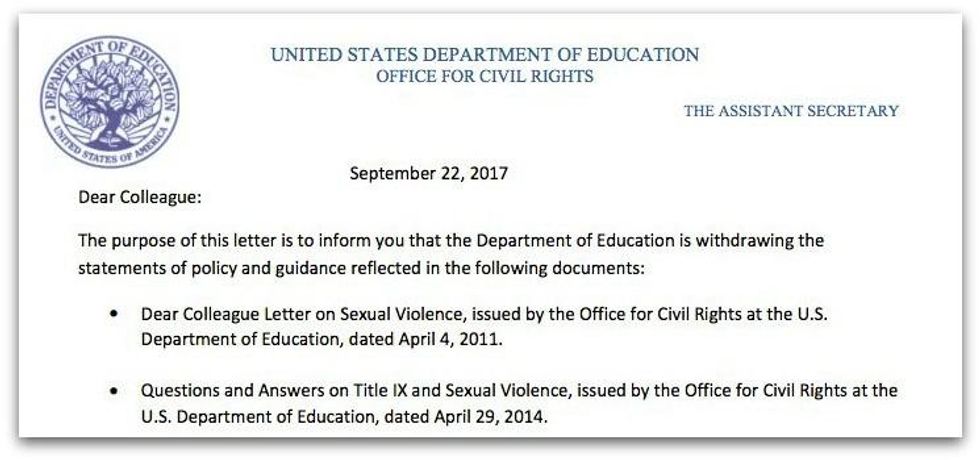
The interim guidance withdraws a 2011 Dear Colleague letter (pdf) that advised schools adjudicating sexual assault cases to apply a preponderance-of-the-evidence standard, which requires more than 50 percent of evidence to support accusations. Now, schools may instead opt to use a clear-and-convincing-evidence standard, a more rigorous standard that's harder to prove, which critics warn will allow those who commit crimes to avoid punishment.
It also rescinds a Title IX and sexual violence Q&A document (pdf) issued by the Department of Education in 2014, and replaces it with a new one (pdf). The guidance is a temporary precursor to new rules that are in development, but require public notice and comment.
Lawyers and leaders of advocacy groups immediately expressed concern that under the interim guidance, and whichever permanent policies that follow, student survivors will be less inclined to report assaults, and perpetrators won't be held accountable.
"Today, Betsy DeVos and the Trump administration chose to tip the scales in favor of rapists and perpetrators," said Sofie Karasek, co-founder of End Rape on Campus.
"DeVos has tried to silence survivors by keeping us out of this process," Karasek continued. "With this recision, she is giving schools the go-ahead to deny survivors the right to appeal cases, drag cases on until assailants graduate, let rapists have a 'mediation' with the person they violated, and use a different evidentiary standard that gives a default advantage to perpetrators."
"Weakening guidance about and enforcement of campus sexual assaults is a horrific step back for crime victims' rights and for public safety more broadly."
--Michael Dolce, attorney
Michael Dolce, a Florida-based attorney who represents sexual assault victims, called the decision "reckless, unjustified, and completely unnecessary," and told The Hill he believes the guidance will discourage victims from reporting sex crimes.
"Weakening guidance about and enforcement of campus sexual assaults is a horrific step back for crime victims' rights and for public safety more broadly," Dolce said. "The move will also encourage colleges and universities to reduce, rather than increase, efforts to combat sex crimes--efforts that are already substandard and ineffective on numerous campuses across the country."
Brenda Shum, director of the Educational Opportunities Project at the Lawyers' Committee for Civil Rights Under Law said that "with her decision to pull the guidelines, Secretary DeVos has created a culture of confusion across the country that puts the civil rights of students in jeopardy."
Vowing to take legal action "if the Department of Education issues regulations inconsistent with Title IX," Shum added that "if Secretary DeVos genuinely listens to public comments and input, it will further demonstrate the need for rigorous enforcement of the protections against sex discrimination."
The announcement on Friday triggered a deluge of condemnation on Twitter, with many using the #StopBetsy hashtag.

The ACLU caught up with Meg Stern, one of the Louisville Clinic Escorts, earlier this week to talk about her work. She is a Louisville native and works for the Kentucky Health Justice Network. This interview has been edited for clarity and length.
I started escorting in 1999 with a group of friends because I had learned that the protests were taking place and that the escorts were a thing. At the time, it was a very small group of folks, and I wanted to show up and do what I could because I didn't think that that type of harassment was an okay thing for people to have to endure.
There have been a number of things that have affected what's gone on on the sidewalk. There have been new regulations on abortion access in addition to the closing of the satellite clinics that EMW had open until this past January in Lexington, at which point the Louisville clinic became the only one in the state. In general, we've seen an increase in attendance at this clinic because it's the only one. The protesters are aware that Gov. Matt Bevin is interested in trying to close this clinic as well. They see our clinic as low-hanging fruit in their mission to create a state with no clinics.
Our website has a page called "points of unity." They talk about things like focusing on de-escalation, not making assumptions. We always ask for consent from our clients every time. And that includes, "Do you want me to walk with you?" to, just based on body language, "If you want to grab my arm, you may." We never make assumptions, and we focus a lot on consent from the clients and their companions.

Yeah, some people say no. Sometimes they change their minds pretty quickly. Escorts are stationed throughout the entire area surrounding the clinic, so it's a pretty busy downtown road, especially on weekdays. And there's no onsite parking for the clients, so they have to park either at a street meter or in a parking garage nearby. They have no option but to walk up the public sidewalk through a literal gauntlet, occasionally it looks more like an obstacle course, of people with signs. Often there are small children playing in the middle of the sidewalk. They create blockades. We have photos of all of the above, including protesters doing things like pressing signs into the faces of the escorts as the escort practices non-engagement.
If a patient declines an escort, absolutely we will respect that, and if they start walking on their own sometimes they will sort of realize that they're getting swarmed by people that aren't asking consent from them, and inevitably they will have gotten to a point in the sidewalk where there are more escorts, and those escorts will also check in and ask, "Do you want me to walk with you?"
The clinic lets people know that there are protesters and escorts. They don't go really deeply into what it's going to look like because they have so much other information that they're having to deliver about the medical care. Some people do find our blog or our Facebook page. We get messages from people either asking questions before they accompany someone in or thanking us for being there.
So we start to arrive close to 7 a.m., sometimes a little bit earlier if we're expecting a big crowd. Escorts arrive, park, and just immediately report to their post. Sometimes people line up along the property line to hold space to allow people to pass from the sidewalk to the private property without being obstructed. Some people station themselves at a corner or at a parking lot. And then we hang around, the clinic opens at 8, so we have some downtime, during which time the protesters take advantage of the fact that we are a captive audience for them, and that's when there's plenty of preaching, or they try to goad us into a debate, especially if they notice new escorts or they are new protesters.
Sometimes that can turn into aggression. So we do our best to not engage during that amount of time, and we make sure that we are holding space in such a way that clients will be able to see us and let them know, "Hey, I'm a volunteer, there's other people that are in orange vests that are happy to walk with you."
I escort on Saturdays for the most part. On an average Saturday, we will see between 50 and 70 protesters, somewhere around 20 or 25 escorts, and the number of clients varies, but usually between 15 to 25.
I sometimes feel intimidated. I've definitely been grabbed out there. I'm 5'3. There are people that are much, much bigger than me that use their bodies and that can be really scary.
So, fear, on occasion, but that's not the prominent feeling that I have. Honestly, they make me angry. I have years and years of experience, and also training, so I'm not going to act on that anger in any way. If anything it helps me practice de-escalation for myself because that's one of the skills that we have to practice outwardly. I've had people ask me if they should bring their guns out of the car. We have to practice de-escalation, so it starts with me.
We have clients that run their mouths to the protesters the entire time, which is their right as well. Sometimes they'll get to the property line and say their piece and get it off their chest and turn around triumphantly and walk inside. We have people who just want to put on their sunglasses and their hood and keep their head down, so it really runs the gamut as far as reactions go.
Sometimes people have to bring their kids with them, and those are particularly hard walks because the protesters get really vicious in those situations. We do have ways around that, and we'll give options, like we'll offer to sit in cars with the kids. It's all about asking consent, providing options, letting the client make the decision that feels best for them.
My first experience with them was in winter when they came and were really aggressive. It was one of their leadership convenings, so I already had an idea of how nasty they and their tactics are.
We're used to signs. Our regular protesters use big signs that are 2 feet wide and 4 feet tall, and they use those to create blockades or raise them up in the air and take up a lot of visual space. Operation Save America had a 12-foot wide sign that 3 people had to hold, and it had swastikas and lynching pictures on it. They also set up a baby coffin on the sidewalk.
It was the day before Mother's Day. We've seen as many as 500 protesters on that holiday. We were aware that OSA was in town and that it was going to be a big day. I do not tend to station myself near the door. I'm good at talking with clients and walking with them. I'm not so good at being around a bunch of bullies. So I was not near the area when the sit-in happened. However, I did walk up to it with a client. We had gotten the signal that the doors were open. I was the only escort with this individual, and she was nervous. We were walking in the street because the sidewalk was congested. We sometimes find that to be the path of least resistance.
So when we got to the clinic, I noticed that there were about 50 people crowded on the door area. And I noticed that people had their arms up, cameras filming, and so instead of going onto the sidewalk from the other side of the line of parked cars, I was like, "Okay, so it looks to me like there's some trespassing going on, so we're just going to keep walking past here and circle back to your car until the police can get this situation under control."
We've been working very closely with EMW staff as well as local and federal law enforcement. The National Abortion Federation and Feminist Majority Foundation have been engaged for a long time helping support security at the clinic. Clinic Escorts' volunteers have also received special training. We're doing a little bit more intensive points of unity and practice reinforcement than usual.
Probably about 60.
Over the last 12 months, 2,658 patients opted to complete a survey moments after walking past the protesters. Over 87 percent were disturbed by the protesters in some way. Patients described being blocked, intimidated, touched, and shoved. Nearly half of them said they felt scared, threatened, or unsafe, and more than a third of the respondents considered confronting the protesters.
It is nice that people are starting to pay attention to what has been going on and how it's been getting worse. We are all volunteers, so it's been really challenging to juggle the amount of media requests we're getting and offers of support from people who truly are our allies, but we specifically ask that people do not come and counter protest because that would just make the situation more chaotic and possibly escalate things.
We are running a fundraiser right now called "pledge a picketer" where people can fill out a Google form and pledge to give a certain amount either per protester or per arrest. Or they can make a flat contribution that benefits our legal defense fund. And also we have our legal committee in place and a legal defense fund in the event that an escort ends up having to face criminal or civil charges because of these protesters.
If people want to support us, the fundraiser is the best way as well as just reading and sharing our blog everysaturdaymorning.net blog, which features our three-part series, "Where Would They Go?". Those are the best ways to support us.

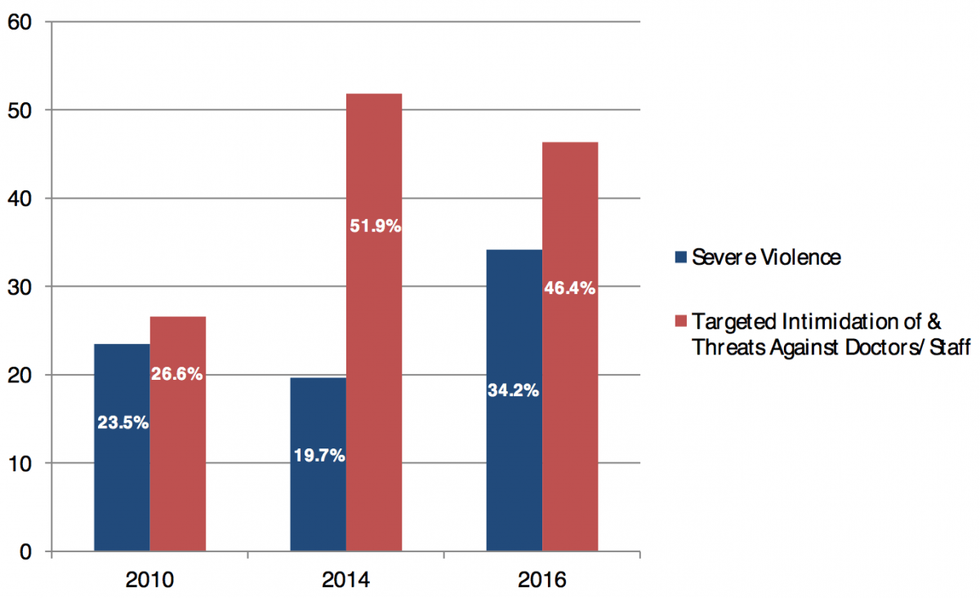
The foundation's report found that the number of clinics that experienced the most severe types of threats and violence, including death threats, stalking, and blocking clinic access, dramatically increased from 19.7 percent of providers in the first half of 2014 to 34.2 percent of providers in the first half of 2016.
It was in 2015 that anti-abortion activists produced a series of heavily edited (and since debunked) videos that ostensibly showed Planned Parenthood workers negotiating the sale of fetal body parts. That smear campaign has been used as the basis for a national effort to defund the healthcare organization.
"This is just not tolerable behavior in a democracy," Smeal told the Huffington Post. "This would never happen to men walking into a medical clinic."
In some locations, women's health advocates are planning rallies to counter Saturday's actions, as in Kalamazoo, Michigan.
But Huffington Post associate women's editor Jenavieve Hatch reported earlier this week on how for some clinics, "showing up to counter protest isn't actually helpful."
"Our goal is making sure our patients are comfortable," Adrienne Verrilli, associate vice president of communications at Planned Parenthood of New York City, told Hatch. "The quieter it is outside, and the less people are engaging with each other, the better it is for our patients."
A separate pro-Planned Parenthood rally has been organized to take place elsewhere in New York City on Saturday.
The Feminist Majority Foundation produced this video to accompany its report: