SUBSCRIBE TO OUR FREE NEWSLETTER
Daily news & progressive opinion—funded by the people, not the corporations—delivered straight to your inbox.
5
#000000
#FFFFFF
To donate by check, phone, or other method, see our More Ways to Give page.
Daily news & progressive opinion—funded by the people, not the corporations—delivered straight to your inbox.
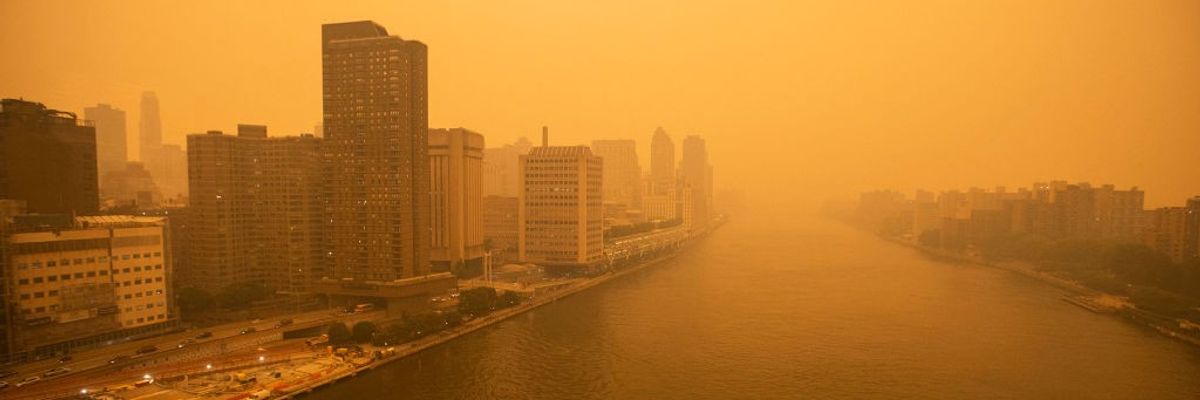
The tramway to Roosevelt Island crosses the East River as smoke from Canadian wildfires casts a haze over the area on June 7, 2023 in New York City. Air pollution alerts were issued across the United States due to smoke from wildfires that have been burning in Canada for weeks.
If humanity’s two choices are to transform or collapse, the only rational, moral choice is to become a part of the transformation.
The smoke emergency faced by NYC and much of the Eastern Seaboard should be our “Pearl Harbor” moment. It should stir a collective awakening to the existential threat of climate change, and a shared understanding that our entire economy and society must be mobilized in response.
And yet, as the air quality improves, I fear we will immediately return to our “normal lives,” rather than awaken to climate reality. Our politicians and institutions will move on, the press will get bored, and individuals will retreat into their busy days and personal priorities. The trance of normalcy will overtake us once again. We will put the painful knowledge of smoke out of our minds and pretend that the climate crisis isn’t accelerating.
It is insane to ignore such a massive and mounting threat. But, humans aren’t rational creatures — indeed much of what we do is driven by our unconscious mind. In 1901, Freud argued in The Psychopathology of Everyday Life, that the unconscious permeates all aspects of our lives, from slips of the tongue to forgetting and making mistakes. Freud believed that, until we make the unconscious conscious through psychoanalysis, we will be strongly driven by forces outside of our direct control.
What you do now will either help seal our apocalyptic fate or help put humanity on a different course.
Climate denial is similarly all-permeating. As I write in Facing the Climate Emergency: How to Transform Yourself with Climate Truth (2023) the vast majority of Americans have relegated the emotional reality of the climate emergency to their unconscious. We know, intellectually, that the climate crisis is real, but have not integrated reality into our feelings, identity, or future plans. We are still living normal lives as though the climate crisis is not happening. We are pursuing our careers, starting families, and saving for retirement. We cannot act responsibly or in accordance with reality while stuck pretending that our hoped-for future can still happen.
Climate activism, like psychoanalysis, is a method of making the unconscious conscious. It’s a large-scale psychological intervention; climate activists are shaking people who are sleepwalking off a cliff. That’s why they throw soup on paintings and sit on roads—they are shaking us, trying to get society to wake up! Of course, it doesn’t feel good to be shaken awake, which is why climate activists are so unpopular! Disparaging climate activists is what Freud called “resistance”—the mind’s last-ditch attempt to avoid reckoning with a painful reality that is becoming conscious.
It’s time for each of us to realize that we are in terrible danger and treat the climate like the emergency that it is. More people are doing so every day, inspired by climate activists or the accelerating climate disasters. But it’s not enough to “know”—climate reality must be processed emotionally. After you acknowledge the apocalyptic scale and speed of the climate emergency, you must feel the painful truth. You have to acknowledge and explore your terror, rage, guilt, grief, and other painful feelings.
Climate activism, like psychoanalysis, is a method of making the unconscious conscious.
There are so many losses to grieve: the people and species already lost, your sense of safety and normalcy. We also must grieve for our own futures—the futures we had planned, hoped for, and thought we were building. This can be the most devastating loss of all. Realizing that so many of your future hopes and plans are not going to happen. The climate crisis threatens to set back thousands of years of human development. Maybe you can string out a few more years of privileged “normal life,” but all around you crops will be failing, smoke billowing, and entire regions becoming unlivable. I doubt living in this future will feel safe or rewarding.
Once you realize that the future you planned is not going to happen; you can begin to think differently; seeing yourself as an agent of change. What you do now will either help seal our apocalyptic fate or help put humanity on a different course.
If humanity’s two choices are to transform or collapse, the only rational, moral choice is to become a part of the transformation. Once the truth of the climate emergency has been made conscious and integrated emotionally, we can join with climate activists to wake the public up and demand rapid WWII-scale mobilization to restore a safe climate. What other future is worth fighting for?
Dear Common Dreams reader, It’s been nearly 30 years since I co-founded Common Dreams with my late wife, Lina Newhouser. We had the radical notion that journalism should serve the public good, not corporate profits. It was clear to us from the outset what it would take to build such a project. No paid advertisements. No corporate sponsors. No millionaire publisher telling us what to think or do. Many people said we wouldn't last a year, but we proved those doubters wrong. Together with a tremendous team of journalists and dedicated staff, we built an independent media outlet free from the constraints of profits and corporate control. Our mission has always been simple: To inform. To inspire. To ignite change for the common good. Building Common Dreams was not easy. Our survival was never guaranteed. When you take on the most powerful forces—Wall Street greed, fossil fuel industry destruction, Big Tech lobbyists, and uber-rich oligarchs who have spent billions upon billions rigging the economy and democracy in their favor—the only bulwark you have is supporters who believe in your work. But here’s the urgent message from me today. It's never been this bad out there. And it's never been this hard to keep us going. At the very moment Common Dreams is most needed, the threats we face are intensifying. We need your support now more than ever. We don't accept corporate advertising and never will. We don't have a paywall because we don't think people should be blocked from critical news based on their ability to pay. Everything we do is funded by the donations of readers like you. When everyone does the little they can afford, we are strong. But if that support retreats or dries up, so do we. Will you donate now to make sure Common Dreams not only survives but thrives? —Craig Brown, Co-founder |
Margaret Klein Salamon, PhD, is a clinical psychologist turned climate activist and thought leader. Her work helps people face the frightening, painful truths of the climate emergency and empowers all of us to transform despair into effective "emergency mode" action. Her book, Facing the Climate Emergency: How to Transform Yourself with Climate Truth (2023), is a radical self-help guide.
As the Executive Director of the Climate Emergency Fund, Margaret fundraises for and strategically deploys financial resources to high-impact disruptive protest campaigns. Her project Climate Awakening allows people to call into a video chatfrom all over the world and share their climate emotions.
The smoke emergency faced by NYC and much of the Eastern Seaboard should be our “Pearl Harbor” moment. It should stir a collective awakening to the existential threat of climate change, and a shared understanding that our entire economy and society must be mobilized in response.
And yet, as the air quality improves, I fear we will immediately return to our “normal lives,” rather than awaken to climate reality. Our politicians and institutions will move on, the press will get bored, and individuals will retreat into their busy days and personal priorities. The trance of normalcy will overtake us once again. We will put the painful knowledge of smoke out of our minds and pretend that the climate crisis isn’t accelerating.
It is insane to ignore such a massive and mounting threat. But, humans aren’t rational creatures — indeed much of what we do is driven by our unconscious mind. In 1901, Freud argued in The Psychopathology of Everyday Life, that the unconscious permeates all aspects of our lives, from slips of the tongue to forgetting and making mistakes. Freud believed that, until we make the unconscious conscious through psychoanalysis, we will be strongly driven by forces outside of our direct control.
What you do now will either help seal our apocalyptic fate or help put humanity on a different course.
Climate denial is similarly all-permeating. As I write in Facing the Climate Emergency: How to Transform Yourself with Climate Truth (2023) the vast majority of Americans have relegated the emotional reality of the climate emergency to their unconscious. We know, intellectually, that the climate crisis is real, but have not integrated reality into our feelings, identity, or future plans. We are still living normal lives as though the climate crisis is not happening. We are pursuing our careers, starting families, and saving for retirement. We cannot act responsibly or in accordance with reality while stuck pretending that our hoped-for future can still happen.
Climate activism, like psychoanalysis, is a method of making the unconscious conscious. It’s a large-scale psychological intervention; climate activists are shaking people who are sleepwalking off a cliff. That’s why they throw soup on paintings and sit on roads—they are shaking us, trying to get society to wake up! Of course, it doesn’t feel good to be shaken awake, which is why climate activists are so unpopular! Disparaging climate activists is what Freud called “resistance”—the mind’s last-ditch attempt to avoid reckoning with a painful reality that is becoming conscious.
It’s time for each of us to realize that we are in terrible danger and treat the climate like the emergency that it is. More people are doing so every day, inspired by climate activists or the accelerating climate disasters. But it’s not enough to “know”—climate reality must be processed emotionally. After you acknowledge the apocalyptic scale and speed of the climate emergency, you must feel the painful truth. You have to acknowledge and explore your terror, rage, guilt, grief, and other painful feelings.
Climate activism, like psychoanalysis, is a method of making the unconscious conscious.
There are so many losses to grieve: the people and species already lost, your sense of safety and normalcy. We also must grieve for our own futures—the futures we had planned, hoped for, and thought we were building. This can be the most devastating loss of all. Realizing that so many of your future hopes and plans are not going to happen. The climate crisis threatens to set back thousands of years of human development. Maybe you can string out a few more years of privileged “normal life,” but all around you crops will be failing, smoke billowing, and entire regions becoming unlivable. I doubt living in this future will feel safe or rewarding.
Once you realize that the future you planned is not going to happen; you can begin to think differently; seeing yourself as an agent of change. What you do now will either help seal our apocalyptic fate or help put humanity on a different course.
If humanity’s two choices are to transform or collapse, the only rational, moral choice is to become a part of the transformation. Once the truth of the climate emergency has been made conscious and integrated emotionally, we can join with climate activists to wake the public up and demand rapid WWII-scale mobilization to restore a safe climate. What other future is worth fighting for?
Margaret Klein Salamon, PhD, is a clinical psychologist turned climate activist and thought leader. Her work helps people face the frightening, painful truths of the climate emergency and empowers all of us to transform despair into effective "emergency mode" action. Her book, Facing the Climate Emergency: How to Transform Yourself with Climate Truth (2023), is a radical self-help guide.
As the Executive Director of the Climate Emergency Fund, Margaret fundraises for and strategically deploys financial resources to high-impact disruptive protest campaigns. Her project Climate Awakening allows people to call into a video chatfrom all over the world and share their climate emotions.
The smoke emergency faced by NYC and much of the Eastern Seaboard should be our “Pearl Harbor” moment. It should stir a collective awakening to the existential threat of climate change, and a shared understanding that our entire economy and society must be mobilized in response.
And yet, as the air quality improves, I fear we will immediately return to our “normal lives,” rather than awaken to climate reality. Our politicians and institutions will move on, the press will get bored, and individuals will retreat into their busy days and personal priorities. The trance of normalcy will overtake us once again. We will put the painful knowledge of smoke out of our minds and pretend that the climate crisis isn’t accelerating.
It is insane to ignore such a massive and mounting threat. But, humans aren’t rational creatures — indeed much of what we do is driven by our unconscious mind. In 1901, Freud argued in The Psychopathology of Everyday Life, that the unconscious permeates all aspects of our lives, from slips of the tongue to forgetting and making mistakes. Freud believed that, until we make the unconscious conscious through psychoanalysis, we will be strongly driven by forces outside of our direct control.
What you do now will either help seal our apocalyptic fate or help put humanity on a different course.
Climate denial is similarly all-permeating. As I write in Facing the Climate Emergency: How to Transform Yourself with Climate Truth (2023) the vast majority of Americans have relegated the emotional reality of the climate emergency to their unconscious. We know, intellectually, that the climate crisis is real, but have not integrated reality into our feelings, identity, or future plans. We are still living normal lives as though the climate crisis is not happening. We are pursuing our careers, starting families, and saving for retirement. We cannot act responsibly or in accordance with reality while stuck pretending that our hoped-for future can still happen.
Climate activism, like psychoanalysis, is a method of making the unconscious conscious. It’s a large-scale psychological intervention; climate activists are shaking people who are sleepwalking off a cliff. That’s why they throw soup on paintings and sit on roads—they are shaking us, trying to get society to wake up! Of course, it doesn’t feel good to be shaken awake, which is why climate activists are so unpopular! Disparaging climate activists is what Freud called “resistance”—the mind’s last-ditch attempt to avoid reckoning with a painful reality that is becoming conscious.
It’s time for each of us to realize that we are in terrible danger and treat the climate like the emergency that it is. More people are doing so every day, inspired by climate activists or the accelerating climate disasters. But it’s not enough to “know”—climate reality must be processed emotionally. After you acknowledge the apocalyptic scale and speed of the climate emergency, you must feel the painful truth. You have to acknowledge and explore your terror, rage, guilt, grief, and other painful feelings.
Climate activism, like psychoanalysis, is a method of making the unconscious conscious.
There are so many losses to grieve: the people and species already lost, your sense of safety and normalcy. We also must grieve for our own futures—the futures we had planned, hoped for, and thought we were building. This can be the most devastating loss of all. Realizing that so many of your future hopes and plans are not going to happen. The climate crisis threatens to set back thousands of years of human development. Maybe you can string out a few more years of privileged “normal life,” but all around you crops will be failing, smoke billowing, and entire regions becoming unlivable. I doubt living in this future will feel safe or rewarding.
Once you realize that the future you planned is not going to happen; you can begin to think differently; seeing yourself as an agent of change. What you do now will either help seal our apocalyptic fate or help put humanity on a different course.
If humanity’s two choices are to transform or collapse, the only rational, moral choice is to become a part of the transformation. Once the truth of the climate emergency has been made conscious and integrated emotionally, we can join with climate activists to wake the public up and demand rapid WWII-scale mobilization to restore a safe climate. What other future is worth fighting for?