SUBSCRIBE TO OUR FREE NEWSLETTER
Daily news & progressive opinion—funded by the people, not the corporations—delivered straight to your inbox.
5
#000000
#FFFFFF
To donate by check, phone, or other method, see our More Ways to Give page.
Daily news & progressive opinion—funded by the people, not the corporations—delivered straight to your inbox.
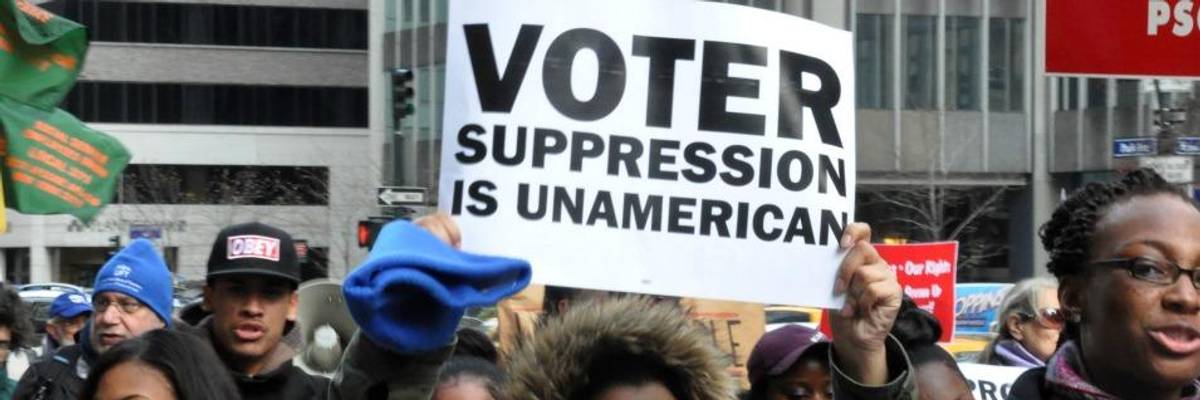
New York City residents marching in the name of voting rights in 2011. A newly-introduced proposal would enshrine the right to vote in a Constitutional amendment.
What happens in November at the ballot box is crucial because of what must be accomplished in 2025 in Congress.
The freedom to vote had a big moment last week. It was not about how citizens should vote in 2024, but what might happen in 2025. It was a rousing affirmation that could lead to sweeping reform — and may signal a momentous fight ahead.
The Freedom to Vote Act would guarantee early voting and vote by mail, establish automatic registration, ban gerrymandering, bring disclosure to dark money in elections, and strengthen public campaign financing and safeguards against election subversion. The John R. Lewis Voting Rights Advancement Act would restore the strength of the Voting Rights Act after it was gutted by the Supreme Court.
This package would be the most significant democracy reform in two generations. It would strike a blow for racial justice. It would strengthen our system of self-government to better represent the people of a changing, growing country. H.R. 1 and H.R. 4 came within two votes of enactment in 2022. Now it is clear that bold democracy reform is at the center of the public agenda going forward.
As policy — and politics — this is a big deal.
Last Wednesday in Chicago, the Brennan Center and Democracy SENTRY held a conversation on voting rights in 2025. Hundreds filled two rooms. We heard from Rep. Joe Morelle, the ranking member of the House Administration Committee, and Rep. Delia Ramirez of Illinois. We heard from Michigan Secretary of State Jocelyn Benson, one of the country’s foremost election officials. And we heard from top civil rights leaders Maya Wiley of the Leadership Conference on Civil and Human Rights, Damon Hewitt of the Lawyers’ Committee for Civil Rights Under Law, and Marc Morial of the National Urban League.
Senate Majority Leader Chuck Schumer keynoted. He made clear that the bills are a priority and that he hoped to pass them by February 2025, even if doing so requires changing the rules to allow their passage with a simple-majority vote. “This is vital to democracy,” he told reporters. “This is not just another extraneous issue. This is the wellspring of it all.”
Sen. Amy Klobuchar, chair of the Rules Committee, closed the event. She movingly described stepping over broken glass in the Capitol on the evening of January 6, 2021, to ensure that the electoral votes were counted. She explained that the fight over the bills, including frustration with outdated Senate rules, galvanized senators to prepare to act when they have the chance.
The Washington Post saw the significance of lawmakers’ focus on these bills, with a lead story on its website.
And the next night, Vice President Harris promised to sign the two bills.
As policy — and politics — this is a big deal.
Voters and democracy face rising attacks as Election Day approaches. We’ve seen moves to make it easier to block the verdict of voters in Georgia and other states. Defying half a century of precedent, a federal court ruled that voters can’t sue under the Voting Rights Act. Hundreds of millions of dollars from secret donors have flooded elections. As a recent Brennan Center study noted, the racial turnout gap between white and nonwhite voters in states once covered by the Voting Rights Act has grown twice as fast as in the rest of the country. This package would stop this wave of voter suppression in its tracks.
It’s also important politically.
The health of American democracy has ranked among the top issues this year in polls. We must protect against authoritarianism and a repeat of January 6. But what matters most is not what we’re against, but what we’re for: a democracy in which every eligible citizen can vote, have their vote counted, and trust the results.
Amid partisanship and polarization, we should not let obstruction block vital legislation.
Another important audience should take note of the cheers for reform: political insiders who sometimes discount public enthusiasm for democracy reform. As I told the attendees at the Brennan Center’s event, “This is not a messaging bill. It’s for real.” Remember: voting rights failed in 1957, 1960, and 1964 before being enacted in 1965.
How will this play out? We hope leaders from all parties will work to protect the freedom to vote. The last time the Voting Rights Act was considered, in 2006, it passed the Senate unanimously. In 2022, on the other hand, only one Republican senator was even willing to consider supporting the John Lewis Voting Rights Act. Sen. Ted Cruz, recognizing the broad popularity of these measures, last time called for an “under-the-dome strategy,” a euphemism for a no-holds-barred filibuster. Amid partisanship and polarization, we should not let obstruction block vital legislation.
At the Brennan Center, we’re proud that so many of the policies in these bills draw on our research and work over two decades. Here’s our commitment: if there is a chance to enact this legislation in 2025, we will do everything we can to make it happen.
As I said in Chicago, over recent years we’ve all been unnerved by the rise of the election deniers. But now there is a democracy movement — deep, diverse, and strong. If we all do our part and do it right, we can make that democracy movement the story of the coming years.
Dear Common Dreams reader, It’s been nearly 30 years since I co-founded Common Dreams with my late wife, Lina Newhouser. We had the radical notion that journalism should serve the public good, not corporate profits. It was clear to us from the outset what it would take to build such a project. No paid advertisements. No corporate sponsors. No millionaire publisher telling us what to think or do. Many people said we wouldn't last a year, but we proved those doubters wrong. Together with a tremendous team of journalists and dedicated staff, we built an independent media outlet free from the constraints of profits and corporate control. Our mission has always been simple: To inform. To inspire. To ignite change for the common good. Building Common Dreams was not easy. Our survival was never guaranteed. When you take on the most powerful forces—Wall Street greed, fossil fuel industry destruction, Big Tech lobbyists, and uber-rich oligarchs who have spent billions upon billions rigging the economy and democracy in their favor—the only bulwark you have is supporters who believe in your work. But here’s the urgent message from me today. It's never been this bad out there. And it's never been this hard to keep us going. At the very moment Common Dreams is most needed, the threats we face are intensifying. We need your support now more than ever. We don't accept corporate advertising and never will. We don't have a paywall because we don't think people should be blocked from critical news based on their ability to pay. Everything we do is funded by the donations of readers like you. When everyone does the little they can afford, we are strong. But if that support retreats or dries up, so do we. Will you donate now to make sure Common Dreams not only survives but thrives? —Craig Brown, Co-founder |
The freedom to vote had a big moment last week. It was not about how citizens should vote in 2024, but what might happen in 2025. It was a rousing affirmation that could lead to sweeping reform — and may signal a momentous fight ahead.
The Freedom to Vote Act would guarantee early voting and vote by mail, establish automatic registration, ban gerrymandering, bring disclosure to dark money in elections, and strengthen public campaign financing and safeguards against election subversion. The John R. Lewis Voting Rights Advancement Act would restore the strength of the Voting Rights Act after it was gutted by the Supreme Court.
This package would be the most significant democracy reform in two generations. It would strike a blow for racial justice. It would strengthen our system of self-government to better represent the people of a changing, growing country. H.R. 1 and H.R. 4 came within two votes of enactment in 2022. Now it is clear that bold democracy reform is at the center of the public agenda going forward.
As policy — and politics — this is a big deal.
Last Wednesday in Chicago, the Brennan Center and Democracy SENTRY held a conversation on voting rights in 2025. Hundreds filled two rooms. We heard from Rep. Joe Morelle, the ranking member of the House Administration Committee, and Rep. Delia Ramirez of Illinois. We heard from Michigan Secretary of State Jocelyn Benson, one of the country’s foremost election officials. And we heard from top civil rights leaders Maya Wiley of the Leadership Conference on Civil and Human Rights, Damon Hewitt of the Lawyers’ Committee for Civil Rights Under Law, and Marc Morial of the National Urban League.
Senate Majority Leader Chuck Schumer keynoted. He made clear that the bills are a priority and that he hoped to pass them by February 2025, even if doing so requires changing the rules to allow their passage with a simple-majority vote. “This is vital to democracy,” he told reporters. “This is not just another extraneous issue. This is the wellspring of it all.”
Sen. Amy Klobuchar, chair of the Rules Committee, closed the event. She movingly described stepping over broken glass in the Capitol on the evening of January 6, 2021, to ensure that the electoral votes were counted. She explained that the fight over the bills, including frustration with outdated Senate rules, galvanized senators to prepare to act when they have the chance.
The Washington Post saw the significance of lawmakers’ focus on these bills, with a lead story on its website.
And the next night, Vice President Harris promised to sign the two bills.
As policy — and politics — this is a big deal.
Voters and democracy face rising attacks as Election Day approaches. We’ve seen moves to make it easier to block the verdict of voters in Georgia and other states. Defying half a century of precedent, a federal court ruled that voters can’t sue under the Voting Rights Act. Hundreds of millions of dollars from secret donors have flooded elections. As a recent Brennan Center study noted, the racial turnout gap between white and nonwhite voters in states once covered by the Voting Rights Act has grown twice as fast as in the rest of the country. This package would stop this wave of voter suppression in its tracks.
It’s also important politically.
The health of American democracy has ranked among the top issues this year in polls. We must protect against authoritarianism and a repeat of January 6. But what matters most is not what we’re against, but what we’re for: a democracy in which every eligible citizen can vote, have their vote counted, and trust the results.
Amid partisanship and polarization, we should not let obstruction block vital legislation.
Another important audience should take note of the cheers for reform: political insiders who sometimes discount public enthusiasm for democracy reform. As I told the attendees at the Brennan Center’s event, “This is not a messaging bill. It’s for real.” Remember: voting rights failed in 1957, 1960, and 1964 before being enacted in 1965.
How will this play out? We hope leaders from all parties will work to protect the freedom to vote. The last time the Voting Rights Act was considered, in 2006, it passed the Senate unanimously. In 2022, on the other hand, only one Republican senator was even willing to consider supporting the John Lewis Voting Rights Act. Sen. Ted Cruz, recognizing the broad popularity of these measures, last time called for an “under-the-dome strategy,” a euphemism for a no-holds-barred filibuster. Amid partisanship and polarization, we should not let obstruction block vital legislation.
At the Brennan Center, we’re proud that so many of the policies in these bills draw on our research and work over two decades. Here’s our commitment: if there is a chance to enact this legislation in 2025, we will do everything we can to make it happen.
As I said in Chicago, over recent years we’ve all been unnerved by the rise of the election deniers. But now there is a democracy movement — deep, diverse, and strong. If we all do our part and do it right, we can make that democracy movement the story of the coming years.
The freedom to vote had a big moment last week. It was not about how citizens should vote in 2024, but what might happen in 2025. It was a rousing affirmation that could lead to sweeping reform — and may signal a momentous fight ahead.
The Freedom to Vote Act would guarantee early voting and vote by mail, establish automatic registration, ban gerrymandering, bring disclosure to dark money in elections, and strengthen public campaign financing and safeguards against election subversion. The John R. Lewis Voting Rights Advancement Act would restore the strength of the Voting Rights Act after it was gutted by the Supreme Court.
This package would be the most significant democracy reform in two generations. It would strike a blow for racial justice. It would strengthen our system of self-government to better represent the people of a changing, growing country. H.R. 1 and H.R. 4 came within two votes of enactment in 2022. Now it is clear that bold democracy reform is at the center of the public agenda going forward.
As policy — and politics — this is a big deal.
Last Wednesday in Chicago, the Brennan Center and Democracy SENTRY held a conversation on voting rights in 2025. Hundreds filled two rooms. We heard from Rep. Joe Morelle, the ranking member of the House Administration Committee, and Rep. Delia Ramirez of Illinois. We heard from Michigan Secretary of State Jocelyn Benson, one of the country’s foremost election officials. And we heard from top civil rights leaders Maya Wiley of the Leadership Conference on Civil and Human Rights, Damon Hewitt of the Lawyers’ Committee for Civil Rights Under Law, and Marc Morial of the National Urban League.
Senate Majority Leader Chuck Schumer keynoted. He made clear that the bills are a priority and that he hoped to pass them by February 2025, even if doing so requires changing the rules to allow their passage with a simple-majority vote. “This is vital to democracy,” he told reporters. “This is not just another extraneous issue. This is the wellspring of it all.”
Sen. Amy Klobuchar, chair of the Rules Committee, closed the event. She movingly described stepping over broken glass in the Capitol on the evening of January 6, 2021, to ensure that the electoral votes were counted. She explained that the fight over the bills, including frustration with outdated Senate rules, galvanized senators to prepare to act when they have the chance.
The Washington Post saw the significance of lawmakers’ focus on these bills, with a lead story on its website.
And the next night, Vice President Harris promised to sign the two bills.
As policy — and politics — this is a big deal.
Voters and democracy face rising attacks as Election Day approaches. We’ve seen moves to make it easier to block the verdict of voters in Georgia and other states. Defying half a century of precedent, a federal court ruled that voters can’t sue under the Voting Rights Act. Hundreds of millions of dollars from secret donors have flooded elections. As a recent Brennan Center study noted, the racial turnout gap between white and nonwhite voters in states once covered by the Voting Rights Act has grown twice as fast as in the rest of the country. This package would stop this wave of voter suppression in its tracks.
It’s also important politically.
The health of American democracy has ranked among the top issues this year in polls. We must protect against authoritarianism and a repeat of January 6. But what matters most is not what we’re against, but what we’re for: a democracy in which every eligible citizen can vote, have their vote counted, and trust the results.
Amid partisanship and polarization, we should not let obstruction block vital legislation.
Another important audience should take note of the cheers for reform: political insiders who sometimes discount public enthusiasm for democracy reform. As I told the attendees at the Brennan Center’s event, “This is not a messaging bill. It’s for real.” Remember: voting rights failed in 1957, 1960, and 1964 before being enacted in 1965.
How will this play out? We hope leaders from all parties will work to protect the freedom to vote. The last time the Voting Rights Act was considered, in 2006, it passed the Senate unanimously. In 2022, on the other hand, only one Republican senator was even willing to consider supporting the John Lewis Voting Rights Act. Sen. Ted Cruz, recognizing the broad popularity of these measures, last time called for an “under-the-dome strategy,” a euphemism for a no-holds-barred filibuster. Amid partisanship and polarization, we should not let obstruction block vital legislation.
At the Brennan Center, we’re proud that so many of the policies in these bills draw on our research and work over two decades. Here’s our commitment: if there is a chance to enact this legislation in 2025, we will do everything we can to make it happen.
As I said in Chicago, over recent years we’ve all been unnerved by the rise of the election deniers. But now there is a democracy movement — deep, diverse, and strong. If we all do our part and do it right, we can make that democracy movement the story of the coming years.