SUBSCRIBE TO OUR FREE NEWSLETTER
Daily news & progressive opinion—funded by the people, not the corporations—delivered straight to your inbox.
5
#000000
#FFFFFF
To donate by check, phone, or other method, see our More Ways to Give page.
Daily news & progressive opinion—funded by the people, not the corporations—delivered straight to your inbox.
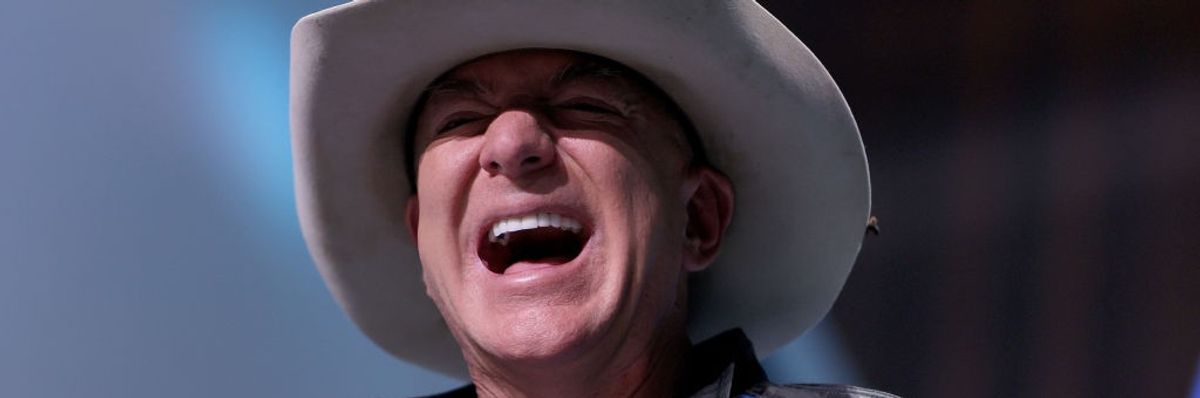
Jeff Bezos laughs as he speaks about his flight on Blue Origin’s New Shepard into space during a press conference on July 20, 2021 in Van Horn, Texas.
Republicans know full well that saying you don't think billionaires should have to pay any tax at all, ever, doesn't make for good messaging.
Under America's current loophole-ridden tax law, rich people — even billionaires — can pass unlimited investment gains to their descendants without paying a dollar in income tax. These rich don't even have to do any fancy planning. All they have to do is die, a step everyone, of course, takes eventually.
This particularly lush loophole comes from a tax law provision known as the "stepped-up basis rule," and it works like this: Say Jeff Bezos died and left his Amazon shares, currently worth over $100 billion, to his kids. The Bezos kids would be treated under our income tax law as if they bought the shares for their value on the date of dad's death. They could sell the shares at that value and pay no income tax.
But that doesn't mean those kids would pay no tax at all. Dad's estate would face an estate tax liability equal to 40 percent of the excess of the value of his estate, including the Amazon shares, over $13 million. Estate tax avoidance planners could, to be sure, help Mr. Bezos avoid much of that estate tax, possibly even all of it. But doing so likely would mean the kids couldn't avoid income tax on his investment gains.
This can all get super-complicated. The tricks tax avoidance planners play to shelter wealth from estate tax can make it difficult to avoid income tax. Not impossible, mind you, just really difficult. But not if 41 — and counting — Republican U.S. senators have their way.
Under legislation these 41 Republicans have just re-introduced, billionaires like Mr. Bezos won't need to choose between avoiding income tax and avoiding estate tax. They'll be able to avoid both. Entirely. And without a lot of effort. They won't even have to hire high-priced tax avoidance planners.
The new Republican bill, formally entitled the "Death Tax Repeal Act," completely repeals the estate tax. Those strategies billionaires use to avoid estate tax — strategies that typically expose their investment gains to income tax sometime after their deaths — would no longer be needed.
In fact, those strategies would become counterproductive. All billionaires would have to do to avoid both income and estate tax on their investment gains would be to not sell their investment assets during their lifetimes.
But wait? What if our tax-averse billionaires need some cash? Not a problem. As ProPublica has reported, billionaires have a handy, tax-skipping strategy for getting cash known as Buy-Borrow-Die. This video explains how this whole process works:
Buy, Borrow, Die: How America's Ultrawealthy Stay That Wayyoutu.be
The sponsors of the new Billionaires Pay Zero Tax Act don't mention, of course, their billionaire patrons in their advocacy. They refer instead to all the "family-run farms, ranches, and businesses" upon which the estate tax would "wreak havoc." What they don't say: Only 50 farms and businesses in the entire country likely would have been subject to estate tax in 2017, according to Center on Budget and Policy Priorities research. And the Center did that research before lawmakers in Congress doubled the exemption from estate tax in the 2018 Tax Cuts and Jobs Act.
The Billionaires Pay Zero Tax Act sponsors also don't mention that our U.S. tax code already has provisions that protect the very few families with farms and businesses subject to estate tax. If the bill sponsors truly cared about family farms, ranches, and businesses, they could have proposed legislation to expand these protections but leave the estate tax intact.
These lawmakers might have proposed, for instance, a lengthening of the 15-year period the inheritors of family farms, ranches, and businesses currently have to pay their estate tax due. Or they might have proposed an expansion in the "special use" provisions that allow estates to value farm property according to its use as a farm, rather than at its market value. A bill taking that approach likely would have drawn bipartisan support and actually had a chance of becoming law in this Congress.
Why have Republicans purporting to be concerned about family farms, ranches, and businesses rejected this extending-protections approach and instead introduced a bill whose benefits will flow overwhelmingly to the ultra-rich?
Here's my guess: The actual intended beneficiaries of the bill don't happen to be family-owned farms, ranches, and businesses. But GOP lawmakers know full well that saying you don't think billionaires should have to pay any tax at all, ever, doesn't make for good messaging.
Saying that would be like naming your bill the "Billionaires Pay Zero Tax Act."
Dear Common Dreams reader, It’s been nearly 30 years since I co-founded Common Dreams with my late wife, Lina Newhouser. We had the radical notion that journalism should serve the public good, not corporate profits. It was clear to us from the outset what it would take to build such a project. No paid advertisements. No corporate sponsors. No millionaire publisher telling us what to think or do. Many people said we wouldn't last a year, but we proved those doubters wrong. Together with a tremendous team of journalists and dedicated staff, we built an independent media outlet free from the constraints of profits and corporate control. Our mission has always been simple: To inform. To inspire. To ignite change for the common good. Building Common Dreams was not easy. Our survival was never guaranteed. When you take on the most powerful forces—Wall Street greed, fossil fuel industry destruction, Big Tech lobbyists, and uber-rich oligarchs who have spent billions upon billions rigging the economy and democracy in their favor—the only bulwark you have is supporters who believe in your work. But here’s the urgent message from me today. It's never been this bad out there. And it's never been this hard to keep us going. At the very moment Common Dreams is most needed, the threats we face are intensifying. We need your support now more than ever. We don't accept corporate advertising and never will. We don't have a paywall because we don't think people should be blocked from critical news based on their ability to pay. Everything we do is funded by the donations of readers like you. When everyone does the little they can afford, we are strong. But if that support retreats or dries up, so do we. Will you donate now to make sure Common Dreams not only survives but thrives? —Craig Brown, Co-founder |
Under America's current loophole-ridden tax law, rich people — even billionaires — can pass unlimited investment gains to their descendants without paying a dollar in income tax. These rich don't even have to do any fancy planning. All they have to do is die, a step everyone, of course, takes eventually.
This particularly lush loophole comes from a tax law provision known as the "stepped-up basis rule," and it works like this: Say Jeff Bezos died and left his Amazon shares, currently worth over $100 billion, to his kids. The Bezos kids would be treated under our income tax law as if they bought the shares for their value on the date of dad's death. They could sell the shares at that value and pay no income tax.
But that doesn't mean those kids would pay no tax at all. Dad's estate would face an estate tax liability equal to 40 percent of the excess of the value of his estate, including the Amazon shares, over $13 million. Estate tax avoidance planners could, to be sure, help Mr. Bezos avoid much of that estate tax, possibly even all of it. But doing so likely would mean the kids couldn't avoid income tax on his investment gains.
This can all get super-complicated. The tricks tax avoidance planners play to shelter wealth from estate tax can make it difficult to avoid income tax. Not impossible, mind you, just really difficult. But not if 41 — and counting — Republican U.S. senators have their way.
Under legislation these 41 Republicans have just re-introduced, billionaires like Mr. Bezos won't need to choose between avoiding income tax and avoiding estate tax. They'll be able to avoid both. Entirely. And without a lot of effort. They won't even have to hire high-priced tax avoidance planners.
The new Republican bill, formally entitled the "Death Tax Repeal Act," completely repeals the estate tax. Those strategies billionaires use to avoid estate tax — strategies that typically expose their investment gains to income tax sometime after their deaths — would no longer be needed.
In fact, those strategies would become counterproductive. All billionaires would have to do to avoid both income and estate tax on their investment gains would be to not sell their investment assets during their lifetimes.
But wait? What if our tax-averse billionaires need some cash? Not a problem. As ProPublica has reported, billionaires have a handy, tax-skipping strategy for getting cash known as Buy-Borrow-Die. This video explains how this whole process works:
Buy, Borrow, Die: How America's Ultrawealthy Stay That Wayyoutu.be
The sponsors of the new Billionaires Pay Zero Tax Act don't mention, of course, their billionaire patrons in their advocacy. They refer instead to all the "family-run farms, ranches, and businesses" upon which the estate tax would "wreak havoc." What they don't say: Only 50 farms and businesses in the entire country likely would have been subject to estate tax in 2017, according to Center on Budget and Policy Priorities research. And the Center did that research before lawmakers in Congress doubled the exemption from estate tax in the 2018 Tax Cuts and Jobs Act.
The Billionaires Pay Zero Tax Act sponsors also don't mention that our U.S. tax code already has provisions that protect the very few families with farms and businesses subject to estate tax. If the bill sponsors truly cared about family farms, ranches, and businesses, they could have proposed legislation to expand these protections but leave the estate tax intact.
These lawmakers might have proposed, for instance, a lengthening of the 15-year period the inheritors of family farms, ranches, and businesses currently have to pay their estate tax due. Or they might have proposed an expansion in the "special use" provisions that allow estates to value farm property according to its use as a farm, rather than at its market value. A bill taking that approach likely would have drawn bipartisan support and actually had a chance of becoming law in this Congress.
Why have Republicans purporting to be concerned about family farms, ranches, and businesses rejected this extending-protections approach and instead introduced a bill whose benefits will flow overwhelmingly to the ultra-rich?
Here's my guess: The actual intended beneficiaries of the bill don't happen to be family-owned farms, ranches, and businesses. But GOP lawmakers know full well that saying you don't think billionaires should have to pay any tax at all, ever, doesn't make for good messaging.
Saying that would be like naming your bill the "Billionaires Pay Zero Tax Act."
Under America's current loophole-ridden tax law, rich people — even billionaires — can pass unlimited investment gains to their descendants without paying a dollar in income tax. These rich don't even have to do any fancy planning. All they have to do is die, a step everyone, of course, takes eventually.
This particularly lush loophole comes from a tax law provision known as the "stepped-up basis rule," and it works like this: Say Jeff Bezos died and left his Amazon shares, currently worth over $100 billion, to his kids. The Bezos kids would be treated under our income tax law as if they bought the shares for their value on the date of dad's death. They could sell the shares at that value and pay no income tax.
But that doesn't mean those kids would pay no tax at all. Dad's estate would face an estate tax liability equal to 40 percent of the excess of the value of his estate, including the Amazon shares, over $13 million. Estate tax avoidance planners could, to be sure, help Mr. Bezos avoid much of that estate tax, possibly even all of it. But doing so likely would mean the kids couldn't avoid income tax on his investment gains.
This can all get super-complicated. The tricks tax avoidance planners play to shelter wealth from estate tax can make it difficult to avoid income tax. Not impossible, mind you, just really difficult. But not if 41 — and counting — Republican U.S. senators have their way.
Under legislation these 41 Republicans have just re-introduced, billionaires like Mr. Bezos won't need to choose between avoiding income tax and avoiding estate tax. They'll be able to avoid both. Entirely. And without a lot of effort. They won't even have to hire high-priced tax avoidance planners.
The new Republican bill, formally entitled the "Death Tax Repeal Act," completely repeals the estate tax. Those strategies billionaires use to avoid estate tax — strategies that typically expose their investment gains to income tax sometime after their deaths — would no longer be needed.
In fact, those strategies would become counterproductive. All billionaires would have to do to avoid both income and estate tax on their investment gains would be to not sell their investment assets during their lifetimes.
But wait? What if our tax-averse billionaires need some cash? Not a problem. As ProPublica has reported, billionaires have a handy, tax-skipping strategy for getting cash known as Buy-Borrow-Die. This video explains how this whole process works:
Buy, Borrow, Die: How America's Ultrawealthy Stay That Wayyoutu.be
The sponsors of the new Billionaires Pay Zero Tax Act don't mention, of course, their billionaire patrons in their advocacy. They refer instead to all the "family-run farms, ranches, and businesses" upon which the estate tax would "wreak havoc." What they don't say: Only 50 farms and businesses in the entire country likely would have been subject to estate tax in 2017, according to Center on Budget and Policy Priorities research. And the Center did that research before lawmakers in Congress doubled the exemption from estate tax in the 2018 Tax Cuts and Jobs Act.
The Billionaires Pay Zero Tax Act sponsors also don't mention that our U.S. tax code already has provisions that protect the very few families with farms and businesses subject to estate tax. If the bill sponsors truly cared about family farms, ranches, and businesses, they could have proposed legislation to expand these protections but leave the estate tax intact.
These lawmakers might have proposed, for instance, a lengthening of the 15-year period the inheritors of family farms, ranches, and businesses currently have to pay their estate tax due. Or they might have proposed an expansion in the "special use" provisions that allow estates to value farm property according to its use as a farm, rather than at its market value. A bill taking that approach likely would have drawn bipartisan support and actually had a chance of becoming law in this Congress.
Why have Republicans purporting to be concerned about family farms, ranches, and businesses rejected this extending-protections approach and instead introduced a bill whose benefits will flow overwhelmingly to the ultra-rich?
Here's my guess: The actual intended beneficiaries of the bill don't happen to be family-owned farms, ranches, and businesses. But GOP lawmakers know full well that saying you don't think billionaires should have to pay any tax at all, ever, doesn't make for good messaging.
Saying that would be like naming your bill the "Billionaires Pay Zero Tax Act."