SUBSCRIBE TO OUR FREE NEWSLETTER
Daily news & progressive opinion—funded by the people, not the corporations—delivered straight to your inbox.
5
#000000
#FFFFFF
To donate by check, phone, or other method, see our More Ways to Give page.
Daily news & progressive opinion—funded by the people, not the corporations—delivered straight to your inbox.
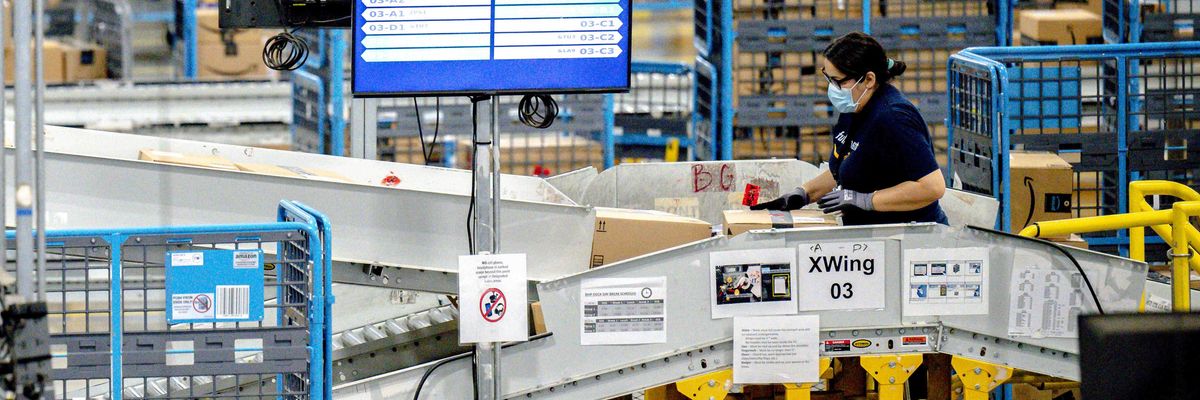
Stories like mine are a part of a larger problem at Amazon, where workers are pushed to our physical limits only to be disregarded, ignored, and neglected by a billion-dollar company that makes its profits off our backs.
Amazon is notorious for having one of highest injury rates in the warehouse industry.
What’s less well known is that Amazon will ignore, overcomplicate, or outright deny workers their right to disability accommodations, forcing them to perform physically impossible and excruciating work or risk giving up their income entirely.
I should know — it happened to me several times.
That’s why, alongside United for Respect, I’m demanding that Amazon abide by the Americans with Disabilities Act and reform its accommodations system to ensure that workers don’t have to sacrifice their health to keep their jobs.
I spend about 10 hours a day moving and sorting products that can weigh up to 49 pounds each. After four years of physically intense labor with minimal breaks, my shoulder finally gave out during one especially busy day last summer.
The price of Amazon’s “prime” business model is our bodies and well-being.
Like other workers who’d been injured before me, I was dissuaded from visiting my own doctor and encouraged to consult AmCare, Amazon’s on-site first aid clinic, instead. For a month, they gave me ice packs or heat treatments meant to help me endure the pain as I continued working through my injury.
But as the pain became unbearable, I escalated my case and consulted a doctor from the company’s list of approved providers.
I learned that I had damaged my rotator cuff. In order to fully recover, I was put on lifting restrictions with gradually increasing increments, from 5 to 20 pounds. The gradual increase was meant to help my healing process.
At first, I was allowed to return to work on light duty. But just a few weeks later, as we prepared for the holiday shopping season, Amazon expected me to go against my doctor’s orders. When I told management that I was physically unable, I was placed on indefinite leave and escorted out of the building.
During that time, I underwent surgery for my shoulder. When I was cleared to go back to work in February, again with restrictions on what I could lift, Amazon stonewalled me. Even as I sent in medical documentation proving my steady recovery, Amazon never answered whether I could continue working with my disability.
Instead, they kept extending my indefinite leave. With a mortgage to pay and a retirement to plan for, I was left with two bad options: Work my regular duty job or lose my house. With no other choice, I was back on the warehouse floor lifting 49 pounds for 40-60 hours a week.
Unsurprisingly, my injury is only getting worse.
Stories like mine are a part of a larger problem at Amazon, where workers are pushed to our physical limits only to be disregarded, ignored, and neglected by a billion-dollar company that makes its profits off our backs.
I know many co-workers who’ve been victims of Amazon’s careless, and at times illegal, accommodations practices. Some are military veterans who came to Amazon with physical disabilities only to be pressured to take on work that exacerbates their pain. Others have been terminated after trying to request accommodations for panic-inducing anxiety disorders.
These practices are unreasonable and inhumane. That’s why our worker-led campaign is sharing a petition calling on Amazon to implement immediate changes to the accommodations process. You can sign on in support here.
No one should be kept in the dark about their employment when they have families to feed and roofs to keep over their heads. And no one should be discriminated against or harassed because of their disabilities.
The price of Amazon’s “prime” business model is our bodies and well-being. I’m speaking up with Amazon workers nationwide to say we won’t stand for it anymore.
Dear Common Dreams reader, It’s been nearly 30 years since I co-founded Common Dreams with my late wife, Lina Newhouser. We had the radical notion that journalism should serve the public good, not corporate profits. It was clear to us from the outset what it would take to build such a project. No paid advertisements. No corporate sponsors. No millionaire publisher telling us what to think or do. Many people said we wouldn't last a year, but we proved those doubters wrong. Together with a tremendous team of journalists and dedicated staff, we built an independent media outlet free from the constraints of profits and corporate control. Our mission has always been simple: To inform. To inspire. To ignite change for the common good. Building Common Dreams was not easy. Our survival was never guaranteed. When you take on the most powerful forces—Wall Street greed, fossil fuel industry destruction, Big Tech lobbyists, and uber-rich oligarchs who have spent billions upon billions rigging the economy and democracy in their favor—the only bulwark you have is supporters who believe in your work. But here’s the urgent message from me today. It's never been this bad out there. And it's never been this hard to keep us going. At the very moment Common Dreams is most needed, the threats we face are intensifying. We need your support now more than ever. We don't accept corporate advertising and never will. We don't have a paywall because we don't think people should be blocked from critical news based on their ability to pay. Everything we do is funded by the donations of readers like you. When everyone does the little they can afford, we are strong. But if that support retreats or dries up, so do we. Will you donate now to make sure Common Dreams not only survives but thrives? —Craig Brown, Co-founder |
Amazon is notorious for having one of highest injury rates in the warehouse industry.
What’s less well known is that Amazon will ignore, overcomplicate, or outright deny workers their right to disability accommodations, forcing them to perform physically impossible and excruciating work or risk giving up their income entirely.
I should know — it happened to me several times.
That’s why, alongside United for Respect, I’m demanding that Amazon abide by the Americans with Disabilities Act and reform its accommodations system to ensure that workers don’t have to sacrifice their health to keep their jobs.
I spend about 10 hours a day moving and sorting products that can weigh up to 49 pounds each. After four years of physically intense labor with minimal breaks, my shoulder finally gave out during one especially busy day last summer.
The price of Amazon’s “prime” business model is our bodies and well-being.
Like other workers who’d been injured before me, I was dissuaded from visiting my own doctor and encouraged to consult AmCare, Amazon’s on-site first aid clinic, instead. For a month, they gave me ice packs or heat treatments meant to help me endure the pain as I continued working through my injury.
But as the pain became unbearable, I escalated my case and consulted a doctor from the company’s list of approved providers.
I learned that I had damaged my rotator cuff. In order to fully recover, I was put on lifting restrictions with gradually increasing increments, from 5 to 20 pounds. The gradual increase was meant to help my healing process.
At first, I was allowed to return to work on light duty. But just a few weeks later, as we prepared for the holiday shopping season, Amazon expected me to go against my doctor’s orders. When I told management that I was physically unable, I was placed on indefinite leave and escorted out of the building.
During that time, I underwent surgery for my shoulder. When I was cleared to go back to work in February, again with restrictions on what I could lift, Amazon stonewalled me. Even as I sent in medical documentation proving my steady recovery, Amazon never answered whether I could continue working with my disability.
Instead, they kept extending my indefinite leave. With a mortgage to pay and a retirement to plan for, I was left with two bad options: Work my regular duty job or lose my house. With no other choice, I was back on the warehouse floor lifting 49 pounds for 40-60 hours a week.
Unsurprisingly, my injury is only getting worse.
Stories like mine are a part of a larger problem at Amazon, where workers are pushed to our physical limits only to be disregarded, ignored, and neglected by a billion-dollar company that makes its profits off our backs.
I know many co-workers who’ve been victims of Amazon’s careless, and at times illegal, accommodations practices. Some are military veterans who came to Amazon with physical disabilities only to be pressured to take on work that exacerbates their pain. Others have been terminated after trying to request accommodations for panic-inducing anxiety disorders.
These practices are unreasonable and inhumane. That’s why our worker-led campaign is sharing a petition calling on Amazon to implement immediate changes to the accommodations process. You can sign on in support here.
No one should be kept in the dark about their employment when they have families to feed and roofs to keep over their heads. And no one should be discriminated against or harassed because of their disabilities.
The price of Amazon’s “prime” business model is our bodies and well-being. I’m speaking up with Amazon workers nationwide to say we won’t stand for it anymore.
Amazon is notorious for having one of highest injury rates in the warehouse industry.
What’s less well known is that Amazon will ignore, overcomplicate, or outright deny workers their right to disability accommodations, forcing them to perform physically impossible and excruciating work or risk giving up their income entirely.
I should know — it happened to me several times.
That’s why, alongside United for Respect, I’m demanding that Amazon abide by the Americans with Disabilities Act and reform its accommodations system to ensure that workers don’t have to sacrifice their health to keep their jobs.
I spend about 10 hours a day moving and sorting products that can weigh up to 49 pounds each. After four years of physically intense labor with minimal breaks, my shoulder finally gave out during one especially busy day last summer.
The price of Amazon’s “prime” business model is our bodies and well-being.
Like other workers who’d been injured before me, I was dissuaded from visiting my own doctor and encouraged to consult AmCare, Amazon’s on-site first aid clinic, instead. For a month, they gave me ice packs or heat treatments meant to help me endure the pain as I continued working through my injury.
But as the pain became unbearable, I escalated my case and consulted a doctor from the company’s list of approved providers.
I learned that I had damaged my rotator cuff. In order to fully recover, I was put on lifting restrictions with gradually increasing increments, from 5 to 20 pounds. The gradual increase was meant to help my healing process.
At first, I was allowed to return to work on light duty. But just a few weeks later, as we prepared for the holiday shopping season, Amazon expected me to go against my doctor’s orders. When I told management that I was physically unable, I was placed on indefinite leave and escorted out of the building.
During that time, I underwent surgery for my shoulder. When I was cleared to go back to work in February, again with restrictions on what I could lift, Amazon stonewalled me. Even as I sent in medical documentation proving my steady recovery, Amazon never answered whether I could continue working with my disability.
Instead, they kept extending my indefinite leave. With a mortgage to pay and a retirement to plan for, I was left with two bad options: Work my regular duty job or lose my house. With no other choice, I was back on the warehouse floor lifting 49 pounds for 40-60 hours a week.
Unsurprisingly, my injury is only getting worse.
Stories like mine are a part of a larger problem at Amazon, where workers are pushed to our physical limits only to be disregarded, ignored, and neglected by a billion-dollar company that makes its profits off our backs.
I know many co-workers who’ve been victims of Amazon’s careless, and at times illegal, accommodations practices. Some are military veterans who came to Amazon with physical disabilities only to be pressured to take on work that exacerbates their pain. Others have been terminated after trying to request accommodations for panic-inducing anxiety disorders.
These practices are unreasonable and inhumane. That’s why our worker-led campaign is sharing a petition calling on Amazon to implement immediate changes to the accommodations process. You can sign on in support here.
No one should be kept in the dark about their employment when they have families to feed and roofs to keep over their heads. And no one should be discriminated against or harassed because of their disabilities.
The price of Amazon’s “prime” business model is our bodies and well-being. I’m speaking up with Amazon workers nationwide to say we won’t stand for it anymore.