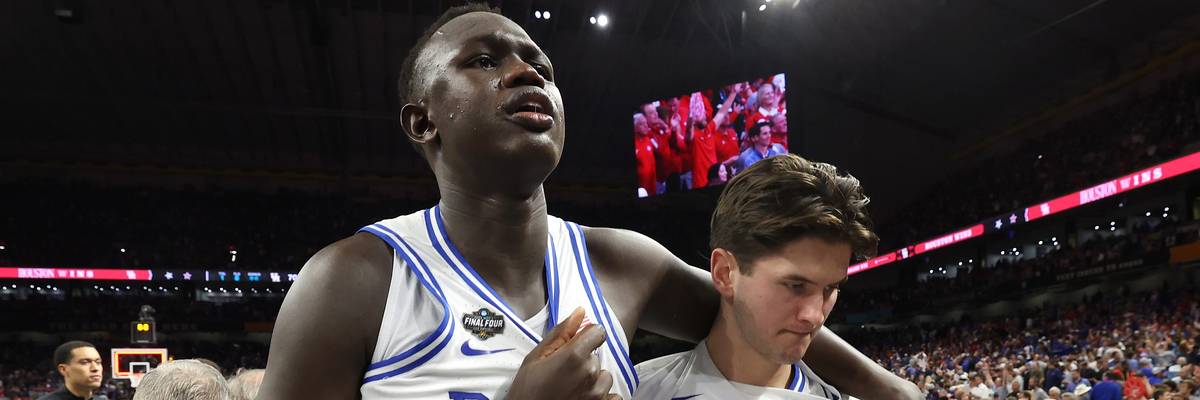
Khaman Maluach, who was born in the South Sudanese city of Rumbek and now plays for the Duke Blue Devils, reacts with teammate after the second half in the Final Four game of the NCAA Men's Basketball Tournament against the Houston Cougars at the Alamodome on April 5, 2025 in San Antonio, Texas.
'Wrongheaded Cruelty': Observers Bash Rubio Decision to Revoke All Visas Held by South Sudanese
"South Sudan is about to blow up into potentially another country-wide civil war, putting civilians at risk. But yea let's force people to go back now," wrote one professor.
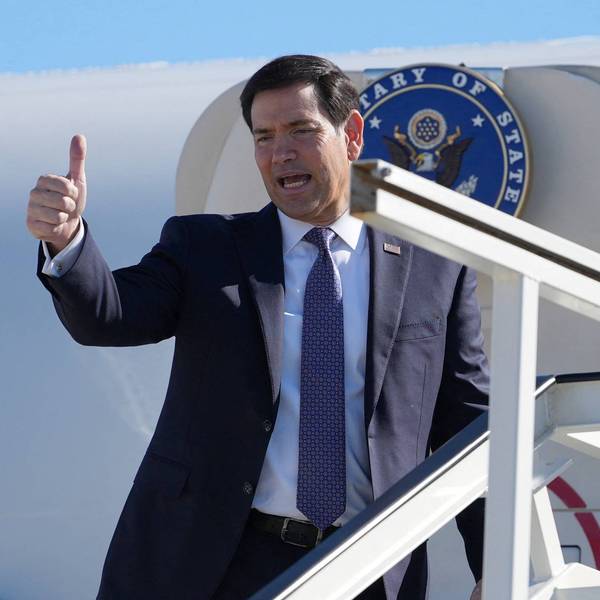
U.S. Secretary of State Marco Rubio on Saturday announced that the United States is revoking visas for all South Sudanese passport holders, "effective immediately"—sparking criticism from several observers, including those who pointed out that the country could soon tip into another civil war.
Rubio announced on X that the move, which includes restricting any "further issuance" of visas, comes in response to the South Sudanese government's failure to return "its repatriated citizens in a timely manner."
"This is wrongheaded cruelty," wrote Rebecca Hamilton, a professor at American University Washington College of Law and executive editor at the digital law and policy journal Just Security, on X on Saturday. "The vast majority of South Sudanese in this country (or, frankly inside South Sudan, right now) have no say in what their government does. They are here working, studying, building skills essential for their nascent country."
Mike Brand, an adjunct professor at the University of Connecticut and Georgetown University who focuses on human rights and atrocities prevention, wrote on Saturday: "South Sudan is about to blow up into potentially another country-wide civil war, putting civilians at risk. But yea let's force people to go back now."
South Sudan is the world's youngest country, having only declared independence from Sudan in 2011 following two lengthy civil wars.
The young nation was once again plunged into civil war in 2013 due to violence between warring factions backing President Salva Kiir and his deputy, Riek Machar. A peace deal was brokered in 2018, though the country has still not held a long-delayed presidential election and Kiir remains in power today, according to Time.
Fears of full-on civil war returned when, last month, Machar was arrested and his allies in government were also detained. Machar's opposition political party declared the country's peace deal effectively over, per Time.
Shortly after Rubio's announcement on Saturday, Deputy Secretary of State Christopher Landau wrote on X that the government of South Sudan had refused to accept a South Sudanese national who was "certified by their own embassy in Washington" and then repatriated. "Our efforts to engage diplomatically with the South Sudanese government have been rebuffed," Landau wrote.
On Monday, the government of South Sudan released a statement saying that the deportee who was not permitted entry is a citizen of the Democratic Republic of the Congo, not South Sudan. The government also said it has maintained consistent communication and cooperation with the U.S. government regarding "immigration and deportation matters."
In the early 2000s, thousands of "lost boys" stemming from a civil war in Sudan that began in the 1980s and eventually led to South Sudan's independence were resettled in the United States.
John Skiles Skinner, a software engineer based in California, reacted to Rubio's announcement by writing on Bluesky: "I taught a U.S. citizenship class to South Sudanese refugees in Nebraska, 2006-2007. Fleeing civil war, they worked arduous jobs at a meat packing plant. Many had no literacy in any language. But they studied hard for a citizenship exam which many native-born Americans would not be able to pass."
In 2011, the Obama administration granted South Sudan nationals in the United States "temporary protected status" (TPS)—a designation that shields foreign-born people from deportation because they cannot return home safely due to war, natural disasters, or other "extraordinary" circumstances. The Biden administration extended it, but the designation is set to expire early next month.
As of September 2024, the U.S. provides TPS protections to 155 people from South Sudan.
In a Monday post for Just Security, Hamilton of American University and a co-author wrote that "while there has been no public determination by the secretary of homeland security regarding an extension of TPS for South Sudanese, Rubio's announcement presumably means [U.S. Department of Homeland Security] Secretary Kristi Noem is planning to terminate their TPS."
Observers online also highlighted that Duke University star basketball player Khaman Maluach, whose family left South Sudan for Uganda when he was a child, could be impacted by the State Department's ruling.
We are at a crossroads
This country and this world are at a monumental crossroads. In a few short weeks, US voters will have an opportunity to beat back the forces of fascism and confront the billionaires who are rigging the economy, our media system, and our democracy, making it increasingly impossible for ordinary people to get by. We’re not just talking about the election. We’re talking about what must be done once these fascist elements are vanquished from power. We need a bolder set of solutions than what either major party has so far been willing to offer and a working-class movement ready to fight like hell for it. Trump didn't emerge from nowhere. The conditions that fueled MAGA authoritarianism were created by decades of radical neoliberal economic policies and a corrupt political system dominated by corporate interests. They slashed taxes on the super-rich, promising that the benefits would trickle down. They said giveaways to the corporate titans would make life more affordable for the rest of us. It was all bullshit. And when a bitter, betrayed populace searches for someone to blame, right-wing demagogues have little trouble finding scapegoats. People know when they're being lied to, but you won't hear any of this from the corporate media. Only independent journalism—powered and funded by people who believe in building a better world—can deliver truly trustworthy daily news. Our Fall Campaign is underway, and we need your help. To power our newsroom through the rest of the year, we need to raise $125,000 by midnight on October 31. So if you share our vision, please contribute whatever you can to sustain our work. |
U.S. Secretary of State Marco Rubio on Saturday announced that the United States is revoking visas for all South Sudanese passport holders, "effective immediately"—sparking criticism from several observers, including those who pointed out that the country could soon tip into another civil war.
Rubio announced on X that the move, which includes restricting any "further issuance" of visas, comes in response to the South Sudanese government's failure to return "its repatriated citizens in a timely manner."
"This is wrongheaded cruelty," wrote Rebecca Hamilton, a professor at American University Washington College of Law and executive editor at the digital law and policy journal Just Security, on X on Saturday. "The vast majority of South Sudanese in this country (or, frankly inside South Sudan, right now) have no say in what their government does. They are here working, studying, building skills essential for their nascent country."
Mike Brand, an adjunct professor at the University of Connecticut and Georgetown University who focuses on human rights and atrocities prevention, wrote on Saturday: "South Sudan is about to blow up into potentially another country-wide civil war, putting civilians at risk. But yea let's force people to go back now."
South Sudan is the world's youngest country, having only declared independence from Sudan in 2011 following two lengthy civil wars.
The young nation was once again plunged into civil war in 2013 due to violence between warring factions backing President Salva Kiir and his deputy, Riek Machar. A peace deal was brokered in 2018, though the country has still not held a long-delayed presidential election and Kiir remains in power today, according to Time.
Fears of full-on civil war returned when, last month, Machar was arrested and his allies in government were also detained. Machar's opposition political party declared the country's peace deal effectively over, per Time.
Shortly after Rubio's announcement on Saturday, Deputy Secretary of State Christopher Landau wrote on X that the government of South Sudan had refused to accept a South Sudanese national who was "certified by their own embassy in Washington" and then repatriated. "Our efforts to engage diplomatically with the South Sudanese government have been rebuffed," Landau wrote.
On Monday, the government of South Sudan released a statement saying that the deportee who was not permitted entry is a citizen of the Democratic Republic of the Congo, not South Sudan. The government also said it has maintained consistent communication and cooperation with the U.S. government regarding "immigration and deportation matters."
In the early 2000s, thousands of "lost boys" stemming from a civil war in Sudan that began in the 1980s and eventually led to South Sudan's independence were resettled in the United States.
John Skiles Skinner, a software engineer based in California, reacted to Rubio's announcement by writing on Bluesky: "I taught a U.S. citizenship class to South Sudanese refugees in Nebraska, 2006-2007. Fleeing civil war, they worked arduous jobs at a meat packing plant. Many had no literacy in any language. But they studied hard for a citizenship exam which many native-born Americans would not be able to pass."
In 2011, the Obama administration granted South Sudan nationals in the United States "temporary protected status" (TPS)—a designation that shields foreign-born people from deportation because they cannot return home safely due to war, natural disasters, or other "extraordinary" circumstances. The Biden administration extended it, but the designation is set to expire early next month.
As of September 2024, the U.S. provides TPS protections to 155 people from South Sudan.
In a Monday post for Just Security, Hamilton of American University and a co-author wrote that "while there has been no public determination by the secretary of homeland security regarding an extension of TPS for South Sudanese, Rubio's announcement presumably means [U.S. Department of Homeland Security] Secretary Kristi Noem is planning to terminate their TPS."
Observers online also highlighted that Duke University star basketball player Khaman Maluach, whose family left South Sudan for Uganda when he was a child, could be impacted by the State Department's ruling.
U.S. Secretary of State Marco Rubio on Saturday announced that the United States is revoking visas for all South Sudanese passport holders, "effective immediately"—sparking criticism from several observers, including those who pointed out that the country could soon tip into another civil war.
Rubio announced on X that the move, which includes restricting any "further issuance" of visas, comes in response to the South Sudanese government's failure to return "its repatriated citizens in a timely manner."
"This is wrongheaded cruelty," wrote Rebecca Hamilton, a professor at American University Washington College of Law and executive editor at the digital law and policy journal Just Security, on X on Saturday. "The vast majority of South Sudanese in this country (or, frankly inside South Sudan, right now) have no say in what their government does. They are here working, studying, building skills essential for their nascent country."
Mike Brand, an adjunct professor at the University of Connecticut and Georgetown University who focuses on human rights and atrocities prevention, wrote on Saturday: "South Sudan is about to blow up into potentially another country-wide civil war, putting civilians at risk. But yea let's force people to go back now."
South Sudan is the world's youngest country, having only declared independence from Sudan in 2011 following two lengthy civil wars.
The young nation was once again plunged into civil war in 2013 due to violence between warring factions backing President Salva Kiir and his deputy, Riek Machar. A peace deal was brokered in 2018, though the country has still not held a long-delayed presidential election and Kiir remains in power today, according to Time.
Fears of full-on civil war returned when, last month, Machar was arrested and his allies in government were also detained. Machar's opposition political party declared the country's peace deal effectively over, per Time.
Shortly after Rubio's announcement on Saturday, Deputy Secretary of State Christopher Landau wrote on X that the government of South Sudan had refused to accept a South Sudanese national who was "certified by their own embassy in Washington" and then repatriated. "Our efforts to engage diplomatically with the South Sudanese government have been rebuffed," Landau wrote.
On Monday, the government of South Sudan released a statement saying that the deportee who was not permitted entry is a citizen of the Democratic Republic of the Congo, not South Sudan. The government also said it has maintained consistent communication and cooperation with the U.S. government regarding "immigration and deportation matters."
In the early 2000s, thousands of "lost boys" stemming from a civil war in Sudan that began in the 1980s and eventually led to South Sudan's independence were resettled in the United States.
John Skiles Skinner, a software engineer based in California, reacted to Rubio's announcement by writing on Bluesky: "I taught a U.S. citizenship class to South Sudanese refugees in Nebraska, 2006-2007. Fleeing civil war, they worked arduous jobs at a meat packing plant. Many had no literacy in any language. But they studied hard for a citizenship exam which many native-born Americans would not be able to pass."
In 2011, the Obama administration granted South Sudan nationals in the United States "temporary protected status" (TPS)—a designation that shields foreign-born people from deportation because they cannot return home safely due to war, natural disasters, or other "extraordinary" circumstances. The Biden administration extended it, but the designation is set to expire early next month.
As of September 2024, the U.S. provides TPS protections to 155 people from South Sudan.
In a Monday post for Just Security, Hamilton of American University and a co-author wrote that "while there has been no public determination by the secretary of homeland security regarding an extension of TPS for South Sudanese, Rubio's announcement presumably means [U.S. Department of Homeland Security] Secretary Kristi Noem is planning to terminate their TPS."
Observers online also highlighted that Duke University star basketball player Khaman Maluach, whose family left South Sudan for Uganda when he was a child, could be impacted by the State Department's ruling.