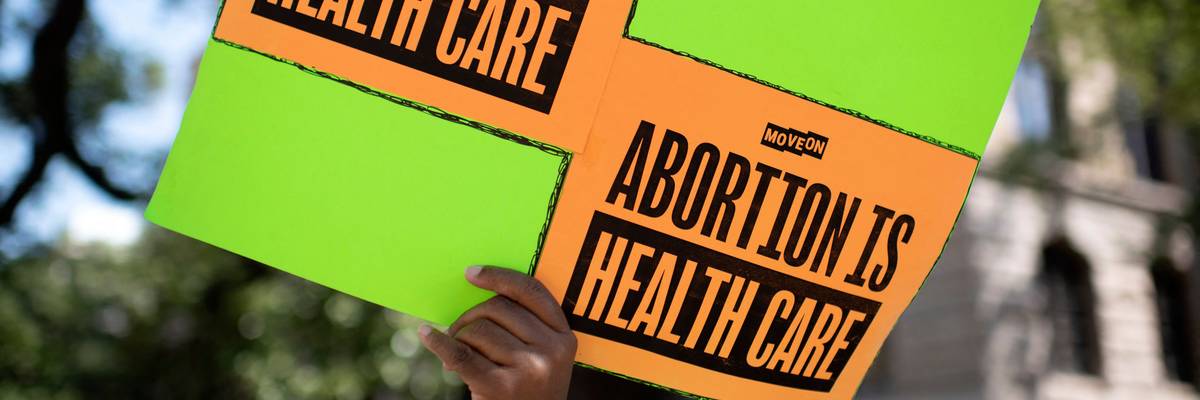
An abortion rights demonstrator holds a sign outside of the Harris County Courthouse during the Women's Wave march in Houston, Texas, on October 8, 2022.
'All Power to the People': Nebraskans to Vote on Dueling Abortion Ballot Measures
Anti-abortion politicians, said one campaigner, "know Nebraskans want to end the harmful abortion ban and stop government overreach in their personal and private healthcare decisions."
A ruling by the Nebraska Supreme Court on Friday sets the stage for two separate abortion rights initiatives being on the state ballot this November.
The court ruled that two competing questions focused on abortion care can appear on voters' ballots: one that would enshrine the state's current 12-week ban and another that would affirm Nebraskans have the right to obtain abortion care until "fetal viability," around 24 weeks.
Campaigns for each of the ballot initiatives gathered more than 200,000 signatures in favor of the questions remaining on the ballot.
The Supreme Court decided that a constitutional amendment proposed by the reproductive rights group Protect Our Rights, allowing "all persons the fundamental right to an abortion without interference from the state" until fetal viability, did not violate the state's single-subject rule.
"The first right in our state constitution is for the people to engage in initiatives."
Opponents of the measure had claimed the wording was too vague and that it should not be permitted on ballots because it addressed abortion rights before and after viability as well as how the state should regulate abortion care.
The court said the question "has a singleness of subject" and noted that its ruling aligns with a decision made by the Florida Supreme Court this year.
Lawsuits were brought by an Omaha resident and an neonatologist, both of whom oppose abortion rights.
The state's 12-week abortion ban was passed by the Nebraska Legislature in 2023.
A recent poll by Pew Research found that 50% of adults in Nebraska believe abortion care should be legal in all or most cases, while 46% said it should be illegal.
State Sen. Megan Hunt (I-8) said she was "eager to see the outcome in November, when we will protect the right to abortion in Nebraska."
"All power to the people," said Hunt. "The first right in our state constitution is for the people to engage in initiatives."
Allie Berry, campaign manager for Protect Our Rights, told the Associated Press that "anti-abortion politicians forced an abortion ban into law and then coordinated with activists to launch desperate lawsuits to silence over 200,000 Nebraskans by preventing them from voting on what happens to their bodies."
"They know Nebraskans want to end the harmful abortion ban and stop government overreach in their personal and private healthcare decisions," said Berry. "Today, their plans failed."
We are at a crossroads
This country and this world are at a monumental crossroads. In a few short weeks, US voters will have an opportunity to beat back the forces of fascism and confront the billionaires who are rigging the economy, our media system, and our democracy, making it increasingly impossible for ordinary people to get by. We’re not just talking about the election. We’re talking about what must be done once these fascist elements are vanquished from power. We need a bolder set of solutions than what either major party has so far been willing to offer and a working-class movement ready to fight like hell for it. Trump didn't emerge from nowhere. The conditions that fueled MAGA authoritarianism were created by decades of radical neoliberal economic policies and a corrupt political system dominated by corporate interests. They slashed taxes on the super-rich, promising that the benefits would trickle down. They said giveaways to the corporate titans would make life more affordable for the rest of us. It was all bullshit. And when a bitter, betrayed populace searches for someone to blame, right-wing demagogues have little trouble finding scapegoats. People know when they're being lied to, but you won't hear any of this from the corporate media. Only independent journalism—powered and funded by people who believe in building a better world—can deliver truly trustworthy daily news. Our Fall Campaign is underway, and we need your help. To power our newsroom through the rest of the year, we need to raise $125,000 by midnight on October 31. So if you share our vision, please contribute whatever you can to sustain our work. |
A ruling by the Nebraska Supreme Court on Friday sets the stage for two separate abortion rights initiatives being on the state ballot this November.
The court ruled that two competing questions focused on abortion care can appear on voters' ballots: one that would enshrine the state's current 12-week ban and another that would affirm Nebraskans have the right to obtain abortion care until "fetal viability," around 24 weeks.
Campaigns for each of the ballot initiatives gathered more than 200,000 signatures in favor of the questions remaining on the ballot.
The Supreme Court decided that a constitutional amendment proposed by the reproductive rights group Protect Our Rights, allowing "all persons the fundamental right to an abortion without interference from the state" until fetal viability, did not violate the state's single-subject rule.
"The first right in our state constitution is for the people to engage in initiatives."
Opponents of the measure had claimed the wording was too vague and that it should not be permitted on ballots because it addressed abortion rights before and after viability as well as how the state should regulate abortion care.
The court said the question "has a singleness of subject" and noted that its ruling aligns with a decision made by the Florida Supreme Court this year.
Lawsuits were brought by an Omaha resident and an neonatologist, both of whom oppose abortion rights.
The state's 12-week abortion ban was passed by the Nebraska Legislature in 2023.
A recent poll by Pew Research found that 50% of adults in Nebraska believe abortion care should be legal in all or most cases, while 46% said it should be illegal.
State Sen. Megan Hunt (I-8) said she was "eager to see the outcome in November, when we will protect the right to abortion in Nebraska."
"All power to the people," said Hunt. "The first right in our state constitution is for the people to engage in initiatives."
Allie Berry, campaign manager for Protect Our Rights, told the Associated Press that "anti-abortion politicians forced an abortion ban into law and then coordinated with activists to launch desperate lawsuits to silence over 200,000 Nebraskans by preventing them from voting on what happens to their bodies."
"They know Nebraskans want to end the harmful abortion ban and stop government overreach in their personal and private healthcare decisions," said Berry. "Today, their plans failed."
- 'Can't Win, So They Cheat': GOP Tries to Keep Abortion Rights Off Ballot After Big Losses ›
- Chants of 'Shame!' After Nebraska GOP Bans Abortion, Trans Youth Healthcare ›
- Nebraska Woman Gets Two Years in Prison After Giving Abortion Pills to Teen Daughter ›
- Emulating Dan Osborne, Nebraska Independent Targets Corporate Greed in US House Run | Common Dreams ›
A ruling by the Nebraska Supreme Court on Friday sets the stage for two separate abortion rights initiatives being on the state ballot this November.
The court ruled that two competing questions focused on abortion care can appear on voters' ballots: one that would enshrine the state's current 12-week ban and another that would affirm Nebraskans have the right to obtain abortion care until "fetal viability," around 24 weeks.
Campaigns for each of the ballot initiatives gathered more than 200,000 signatures in favor of the questions remaining on the ballot.
The Supreme Court decided that a constitutional amendment proposed by the reproductive rights group Protect Our Rights, allowing "all persons the fundamental right to an abortion without interference from the state" until fetal viability, did not violate the state's single-subject rule.
"The first right in our state constitution is for the people to engage in initiatives."
Opponents of the measure had claimed the wording was too vague and that it should not be permitted on ballots because it addressed abortion rights before and after viability as well as how the state should regulate abortion care.
The court said the question "has a singleness of subject" and noted that its ruling aligns with a decision made by the Florida Supreme Court this year.
Lawsuits were brought by an Omaha resident and an neonatologist, both of whom oppose abortion rights.
The state's 12-week abortion ban was passed by the Nebraska Legislature in 2023.
A recent poll by Pew Research found that 50% of adults in Nebraska believe abortion care should be legal in all or most cases, while 46% said it should be illegal.
State Sen. Megan Hunt (I-8) said she was "eager to see the outcome in November, when we will protect the right to abortion in Nebraska."
"All power to the people," said Hunt. "The first right in our state constitution is for the people to engage in initiatives."
Allie Berry, campaign manager for Protect Our Rights, told the Associated Press that "anti-abortion politicians forced an abortion ban into law and then coordinated with activists to launch desperate lawsuits to silence over 200,000 Nebraskans by preventing them from voting on what happens to their bodies."
"They know Nebraskans want to end the harmful abortion ban and stop government overreach in their personal and private healthcare decisions," said Berry. "Today, their plans failed."
- 'Can't Win, So They Cheat': GOP Tries to Keep Abortion Rights Off Ballot After Big Losses ›
- Chants of 'Shame!' After Nebraska GOP Bans Abortion, Trans Youth Healthcare ›
- Nebraska Woman Gets Two Years in Prison After Giving Abortion Pills to Teen Daughter ›
- Emulating Dan Osborne, Nebraska Independent Targets Corporate Greed in US House Run | Common Dreams ›