SUBSCRIBE TO OUR FREE NEWSLETTER
Daily news & progressive opinion—funded by the people, not the corporations—delivered straight to your inbox.
5
#000000
#FFFFFF
To donate by check, phone, or other method, see our More Ways to Give page.
Daily news & progressive opinion—funded by the people, not the corporations—delivered straight to your inbox.
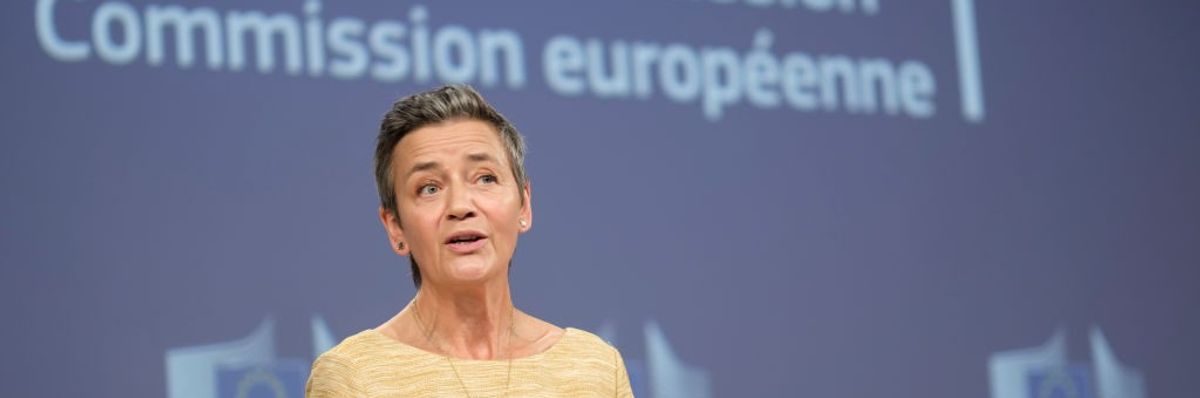
European Commission antitrust official Margrethe Vestager speaks at a press conference on September 10, 2024 in Brussels following a court ruling that upheld the commission's decision to force Apple to pay 13 billion euros in back taxes.
"This ruling exposes E.U. tax havens' love affair with multinationals."
The European Union's highest court on Tuesday ruled that Apple must pay €13 billion in back taxes to Ireland, determining that the country gave the company illegal tax benefits in the past, in what campaigners called a victory for tax justice.
The E.U. Court of Justice ruling brought to a close a landmark case that began in 2016 when the European Commission ordered Apple to pay the €13 billion ($14.4 billion) based on an unfair tax arrangement the company had with Ireland from 1991 until 2014. A lower court overturned the commission's order in 2020, but Tuesday's ruling, which is final, restores it.
Observers viewed the case as among the most important brought by E.U. Competition Commissioner Margrethe Vestager, an antitrust official who's been in office since 2014.
"It's important to show European taxpayers that once in a while, tax justice can be done," Vestager, who leaves office in two weeks, said following Tuesday's ruling.
Chiara Putaturo, a tax policy adviser at Oxfam EU, said in a statement that "this ruling exposes E.U. tax havens' love affair with multinationals. It delivers long-overdue justice after over a decade of Ireland standing by and allowing Apple to dodge taxes."
Today is a huge win for European citizens and tax justice.
👉In its final judgment, @EUCourtPress confirms @EU_Commission 2016 decision: Ireland granted illegal aid to @Apple.
Ireland now has to release up to 13 billion euros of unpaid taxes.
— Margrethe Vestager (@vestager) September 10, 2024
The European Commission argued that the selective tax benefits that Ireland had offered to two Apple subsidiaries amounted to illegal state aid that hindered competition. The company's tax burden in Ireland, where its European operations have been based since 1980, was as low as 0.005% of its profits in 2014.
In November of last year, Giovanni Pitruzzella, the advocate general of the E.U. Court of Justice, issued an opinion in favor of the commission's position and against the lower court ruling, in a setback for the tech giant. The high court, which is based in Luxembourg, generally agrees with its advocate general following such recommendations, as it ultimately did on Tuesday.
The €13 billion, plus interest, has been held in an escrow account since 2018 and will be released to Ireland, even though the country fought against the commission's order. Ireland said it would respect the court ruling.
Ireland is often characterized a tax haven within the E.U. and hosts the European headquarters for many multinational firms, with critics charging that its tax system drives up inequality.
Tax justice campaigners said Tuesday's ruling should just be a start and that more fundamental reforms are needed at the international and E.U. level.
"Our tax problem is more than just one rotten apple," Tove Maria Ryding, a policy manager at the European Network on Debt and Development, said in a statement.
"The international system for taxing multinational corporations continues to be deeply complex, unpredictable and unfair," she added, arguing that a company's economic activity across many countries, including in the Global South, shouldn't mean tax revenues only for one country such as Ireland.
Ryding praised the United Nations' efforts to establish a global tax convention, calling the proposal a "beacon of hope for a fairer future."
Putaturo of Oxfam likewise called for a fairer tax system in Europe.
"While this ruling will force the tech giant to pay its debt, the root of the issue is far from solved," she said. "E.U. tax havens can still make sweetheart tax deals with big multinationals. The duty to stop this rests on the shoulders of E.U. policymakers. Yet, they have turned a blind eye to tax havens within their borders and the harmful race to the bottom that countries like Ireland are instigating."
Oxfam EU also called for the closing of tax loopholes and the establishment of a wealth tax.
The Apple case was not the only victory for Vestager, the antitrust chief, on Tuesday: The E.U. Court of Justice also ruled that Google had illegally used its search engine dominance to favor its own shopping service, fining the company €2.4 billion ($2.65 billion).
Bloomberg on Tuesday called it a "double boost to the European Union’s crackdown on Big Tech," and said that Vestager's past work had "paved the way" for the U.S. and the U.K. to take action against Google.
Dear Common Dreams reader, It’s been nearly 30 years since I co-founded Common Dreams with my late wife, Lina Newhouser. We had the radical notion that journalism should serve the public good, not corporate profits. It was clear to us from the outset what it would take to build such a project. No paid advertisements. No corporate sponsors. No millionaire publisher telling us what to think or do. Many people said we wouldn't last a year, but we proved those doubters wrong. Together with a tremendous team of journalists and dedicated staff, we built an independent media outlet free from the constraints of profits and corporate control. Our mission has always been simple: To inform. To inspire. To ignite change for the common good. Building Common Dreams was not easy. Our survival was never guaranteed. When you take on the most powerful forces—Wall Street greed, fossil fuel industry destruction, Big Tech lobbyists, and uber-rich oligarchs who have spent billions upon billions rigging the economy and democracy in their favor—the only bulwark you have is supporters who believe in your work. But here’s the urgent message from me today. It's never been this bad out there. And it's never been this hard to keep us going. At the very moment Common Dreams is most needed, the threats we face are intensifying. We need your support now more than ever. We don't accept corporate advertising and never will. We don't have a paywall because we don't think people should be blocked from critical news based on their ability to pay. Everything we do is funded by the donations of readers like you. When everyone does the little they can afford, we are strong. But if that support retreats or dries up, so do we. Will you donate now to make sure Common Dreams not only survives but thrives? —Craig Brown, Co-founder |
The European Union's highest court on Tuesday ruled that Apple must pay €13 billion in back taxes to Ireland, determining that the country gave the company illegal tax benefits in the past, in what campaigners called a victory for tax justice.
The E.U. Court of Justice ruling brought to a close a landmark case that began in 2016 when the European Commission ordered Apple to pay the €13 billion ($14.4 billion) based on an unfair tax arrangement the company had with Ireland from 1991 until 2014. A lower court overturned the commission's order in 2020, but Tuesday's ruling, which is final, restores it.
Observers viewed the case as among the most important brought by E.U. Competition Commissioner Margrethe Vestager, an antitrust official who's been in office since 2014.
"It's important to show European taxpayers that once in a while, tax justice can be done," Vestager, who leaves office in two weeks, said following Tuesday's ruling.
Chiara Putaturo, a tax policy adviser at Oxfam EU, said in a statement that "this ruling exposes E.U. tax havens' love affair with multinationals. It delivers long-overdue justice after over a decade of Ireland standing by and allowing Apple to dodge taxes."
Today is a huge win for European citizens and tax justice.
👉In its final judgment, @EUCourtPress confirms @EU_Commission 2016 decision: Ireland granted illegal aid to @Apple.
Ireland now has to release up to 13 billion euros of unpaid taxes.
— Margrethe Vestager (@vestager) September 10, 2024
The European Commission argued that the selective tax benefits that Ireland had offered to two Apple subsidiaries amounted to illegal state aid that hindered competition. The company's tax burden in Ireland, where its European operations have been based since 1980, was as low as 0.005% of its profits in 2014.
In November of last year, Giovanni Pitruzzella, the advocate general of the E.U. Court of Justice, issued an opinion in favor of the commission's position and against the lower court ruling, in a setback for the tech giant. The high court, which is based in Luxembourg, generally agrees with its advocate general following such recommendations, as it ultimately did on Tuesday.
The €13 billion, plus interest, has been held in an escrow account since 2018 and will be released to Ireland, even though the country fought against the commission's order. Ireland said it would respect the court ruling.
Ireland is often characterized a tax haven within the E.U. and hosts the European headquarters for many multinational firms, with critics charging that its tax system drives up inequality.
Tax justice campaigners said Tuesday's ruling should just be a start and that more fundamental reforms are needed at the international and E.U. level.
"Our tax problem is more than just one rotten apple," Tove Maria Ryding, a policy manager at the European Network on Debt and Development, said in a statement.
"The international system for taxing multinational corporations continues to be deeply complex, unpredictable and unfair," she added, arguing that a company's economic activity across many countries, including in the Global South, shouldn't mean tax revenues only for one country such as Ireland.
Ryding praised the United Nations' efforts to establish a global tax convention, calling the proposal a "beacon of hope for a fairer future."
Putaturo of Oxfam likewise called for a fairer tax system in Europe.
"While this ruling will force the tech giant to pay its debt, the root of the issue is far from solved," she said. "E.U. tax havens can still make sweetheart tax deals with big multinationals. The duty to stop this rests on the shoulders of E.U. policymakers. Yet, they have turned a blind eye to tax havens within their borders and the harmful race to the bottom that countries like Ireland are instigating."
Oxfam EU also called for the closing of tax loopholes and the establishment of a wealth tax.
The Apple case was not the only victory for Vestager, the antitrust chief, on Tuesday: The E.U. Court of Justice also ruled that Google had illegally used its search engine dominance to favor its own shopping service, fining the company €2.4 billion ($2.65 billion).
Bloomberg on Tuesday called it a "double boost to the European Union’s crackdown on Big Tech," and said that Vestager's past work had "paved the way" for the U.S. and the U.K. to take action against Google.
The European Union's highest court on Tuesday ruled that Apple must pay €13 billion in back taxes to Ireland, determining that the country gave the company illegal tax benefits in the past, in what campaigners called a victory for tax justice.
The E.U. Court of Justice ruling brought to a close a landmark case that began in 2016 when the European Commission ordered Apple to pay the €13 billion ($14.4 billion) based on an unfair tax arrangement the company had with Ireland from 1991 until 2014. A lower court overturned the commission's order in 2020, but Tuesday's ruling, which is final, restores it.
Observers viewed the case as among the most important brought by E.U. Competition Commissioner Margrethe Vestager, an antitrust official who's been in office since 2014.
"It's important to show European taxpayers that once in a while, tax justice can be done," Vestager, who leaves office in two weeks, said following Tuesday's ruling.
Chiara Putaturo, a tax policy adviser at Oxfam EU, said in a statement that "this ruling exposes E.U. tax havens' love affair with multinationals. It delivers long-overdue justice after over a decade of Ireland standing by and allowing Apple to dodge taxes."
Today is a huge win for European citizens and tax justice.
👉In its final judgment, @EUCourtPress confirms @EU_Commission 2016 decision: Ireland granted illegal aid to @Apple.
Ireland now has to release up to 13 billion euros of unpaid taxes.
— Margrethe Vestager (@vestager) September 10, 2024
The European Commission argued that the selective tax benefits that Ireland had offered to two Apple subsidiaries amounted to illegal state aid that hindered competition. The company's tax burden in Ireland, where its European operations have been based since 1980, was as low as 0.005% of its profits in 2014.
In November of last year, Giovanni Pitruzzella, the advocate general of the E.U. Court of Justice, issued an opinion in favor of the commission's position and against the lower court ruling, in a setback for the tech giant. The high court, which is based in Luxembourg, generally agrees with its advocate general following such recommendations, as it ultimately did on Tuesday.
The €13 billion, plus interest, has been held in an escrow account since 2018 and will be released to Ireland, even though the country fought against the commission's order. Ireland said it would respect the court ruling.
Ireland is often characterized a tax haven within the E.U. and hosts the European headquarters for many multinational firms, with critics charging that its tax system drives up inequality.
Tax justice campaigners said Tuesday's ruling should just be a start and that more fundamental reforms are needed at the international and E.U. level.
"Our tax problem is more than just one rotten apple," Tove Maria Ryding, a policy manager at the European Network on Debt and Development, said in a statement.
"The international system for taxing multinational corporations continues to be deeply complex, unpredictable and unfair," she added, arguing that a company's economic activity across many countries, including in the Global South, shouldn't mean tax revenues only for one country such as Ireland.
Ryding praised the United Nations' efforts to establish a global tax convention, calling the proposal a "beacon of hope for a fairer future."
Putaturo of Oxfam likewise called for a fairer tax system in Europe.
"While this ruling will force the tech giant to pay its debt, the root of the issue is far from solved," she said. "E.U. tax havens can still make sweetheart tax deals with big multinationals. The duty to stop this rests on the shoulders of E.U. policymakers. Yet, they have turned a blind eye to tax havens within their borders and the harmful race to the bottom that countries like Ireland are instigating."
Oxfam EU also called for the closing of tax loopholes and the establishment of a wealth tax.
The Apple case was not the only victory for Vestager, the antitrust chief, on Tuesday: The E.U. Court of Justice also ruled that Google had illegally used its search engine dominance to favor its own shopping service, fining the company €2.4 billion ($2.65 billion).
Bloomberg on Tuesday called it a "double boost to the European Union’s crackdown on Big Tech," and said that Vestager's past work had "paved the way" for the U.S. and the U.K. to take action against Google.