SUBSCRIBE TO OUR FREE NEWSLETTER
Daily news & progressive opinion—funded by the people, not the corporations—delivered straight to your inbox.
5
#000000
#FFFFFF
To donate by check, phone, or other method, see our More Ways to Give page.
Daily news & progressive opinion—funded by the people, not the corporations—delivered straight to your inbox.
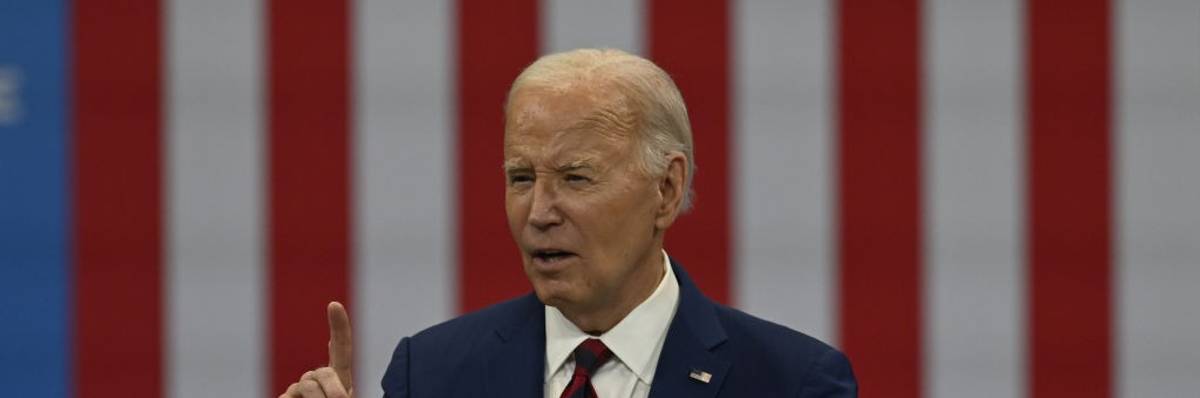
President Joe Biden delivers remarks about healthcare in Raleigh, North Carolina on March 26, 2024.
New polling finds a majority of Americans across party lines support raising taxes on billionaires.
During his State of the Union address, U.S. President Joe Biden declared that he wants to raise taxes on the rich, and polling results published Tuesday show that both Democratic and Republican voters in important swing states support doing so.
The polling firm Morning Consult reports that 69% of registered voters in seven swing states say they support raising taxes on billionaires. That includes states like Michigan, Wisconsin, and Pennsylvania.
One of the most consistently popular policy proposals, across parties, is raising taxes on the rich. https://t.co/1fwJK5z0EN
— David Roberts (@drvolts) March 26, 2024
The poll found 58% of Republicans, 83% of Democrats, and 66% of independents support raising taxes on billionaires. The poll also found similar numbers of voters support raising taxes on people who make more than $400,000 per year.
Biden's 2025 budget plan includes a hike in taxes on the rich that would generate significant revenue for the federal government.
"Biden proposes to raise $503 billion over the next decade by imposing a 25% tax on people who claim more than $100 million in assets—a source of wealth that has long been beyond the reach of the [Internal Revenue Service]," The Washington Post reports.
In a New York Times opinion piece that was published on Wednesday, Felicia Wong, president and chief executive of the progressive advocacy organization Roosevelt Forward, outlined how opinions have changed about how much wealth is too much and if it should be more heavily taxed.
"Should we have trillionaires? Should we even have billionaires? According to at least one recent analysis, the economy is on track to mint its first trillionaire—that is 1,000 billion—within a decade. Such staggering accumulations of wealth are made possible in large part by the fact that America's federal tax burden is so comparatively light," Wong wrote. "After a long period of seeming to venerate the 1 %, or the 1% of 1% of 1%, American sentiment is swinging hard against this imbalance."
Dear Common Dreams reader, It’s been nearly 30 years since I co-founded Common Dreams with my late wife, Lina Newhouser. We had the radical notion that journalism should serve the public good, not corporate profits. It was clear to us from the outset what it would take to build such a project. No paid advertisements. No corporate sponsors. No millionaire publisher telling us what to think or do. Many people said we wouldn't last a year, but we proved those doubters wrong. Together with a tremendous team of journalists and dedicated staff, we built an independent media outlet free from the constraints of profits and corporate control. Our mission has always been simple: To inform. To inspire. To ignite change for the common good. Building Common Dreams was not easy. Our survival was never guaranteed. When you take on the most powerful forces—Wall Street greed, fossil fuel industry destruction, Big Tech lobbyists, and uber-rich oligarchs who have spent billions upon billions rigging the economy and democracy in their favor—the only bulwark you have is supporters who believe in your work. But here’s the urgent message from me today. It's never been this bad out there. And it's never been this hard to keep us going. At the very moment Common Dreams is most needed, the threats we face are intensifying. We need your support now more than ever. We don't accept corporate advertising and never will. We don't have a paywall because we don't think people should be blocked from critical news based on their ability to pay. Everything we do is funded by the donations of readers like you. When everyone does the little they can afford, we are strong. But if that support retreats or dries up, so do we. Will you donate now to make sure Common Dreams not only survives but thrives? —Craig Brown, Co-founder |
During his State of the Union address, U.S. President Joe Biden declared that he wants to raise taxes on the rich, and polling results published Tuesday show that both Democratic and Republican voters in important swing states support doing so.
The polling firm Morning Consult reports that 69% of registered voters in seven swing states say they support raising taxes on billionaires. That includes states like Michigan, Wisconsin, and Pennsylvania.
One of the most consistently popular policy proposals, across parties, is raising taxes on the rich. https://t.co/1fwJK5z0EN
— David Roberts (@drvolts) March 26, 2024
The poll found 58% of Republicans, 83% of Democrats, and 66% of independents support raising taxes on billionaires. The poll also found similar numbers of voters support raising taxes on people who make more than $400,000 per year.
Biden's 2025 budget plan includes a hike in taxes on the rich that would generate significant revenue for the federal government.
"Biden proposes to raise $503 billion over the next decade by imposing a 25% tax on people who claim more than $100 million in assets—a source of wealth that has long been beyond the reach of the [Internal Revenue Service]," The Washington Post reports.
In a New York Times opinion piece that was published on Wednesday, Felicia Wong, president and chief executive of the progressive advocacy organization Roosevelt Forward, outlined how opinions have changed about how much wealth is too much and if it should be more heavily taxed.
"Should we have trillionaires? Should we even have billionaires? According to at least one recent analysis, the economy is on track to mint its first trillionaire—that is 1,000 billion—within a decade. Such staggering accumulations of wealth are made possible in large part by the fact that America's federal tax burden is so comparatively light," Wong wrote. "After a long period of seeming to venerate the 1 %, or the 1% of 1% of 1%, American sentiment is swinging hard against this imbalance."
During his State of the Union address, U.S. President Joe Biden declared that he wants to raise taxes on the rich, and polling results published Tuesday show that both Democratic and Republican voters in important swing states support doing so.
The polling firm Morning Consult reports that 69% of registered voters in seven swing states say they support raising taxes on billionaires. That includes states like Michigan, Wisconsin, and Pennsylvania.
One of the most consistently popular policy proposals, across parties, is raising taxes on the rich. https://t.co/1fwJK5z0EN
— David Roberts (@drvolts) March 26, 2024
The poll found 58% of Republicans, 83% of Democrats, and 66% of independents support raising taxes on billionaires. The poll also found similar numbers of voters support raising taxes on people who make more than $400,000 per year.
Biden's 2025 budget plan includes a hike in taxes on the rich that would generate significant revenue for the federal government.
"Biden proposes to raise $503 billion over the next decade by imposing a 25% tax on people who claim more than $100 million in assets—a source of wealth that has long been beyond the reach of the [Internal Revenue Service]," The Washington Post reports.
In a New York Times opinion piece that was published on Wednesday, Felicia Wong, president and chief executive of the progressive advocacy organization Roosevelt Forward, outlined how opinions have changed about how much wealth is too much and if it should be more heavily taxed.
"Should we have trillionaires? Should we even have billionaires? According to at least one recent analysis, the economy is on track to mint its first trillionaire—that is 1,000 billion—within a decade. Such staggering accumulations of wealth are made possible in large part by the fact that America's federal tax burden is so comparatively light," Wong wrote. "After a long period of seeming to venerate the 1 %, or the 1% of 1% of 1%, American sentiment is swinging hard against this imbalance."