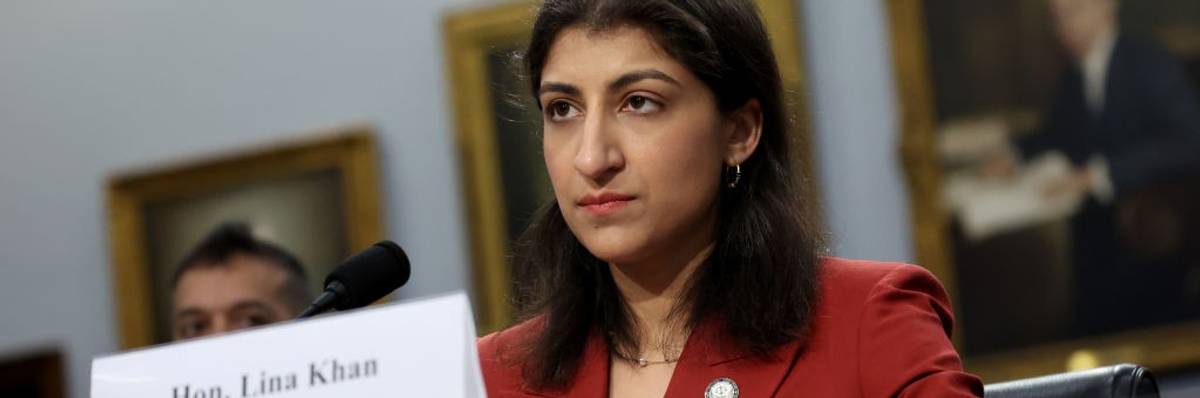
Lina Khan, chair of the Federal Trade Commission, voted in favor of the agency's inquiry into surveillance pricing, which was announced on July 23, 2024.
'Woah!': FTC Applauded for Launching Inquiry Into Surveillance Pricing
"Firms that harvest Americans' personal data can put people's privacy at risk," FTC Chair Lina Khan said. "Now firms could be exploiting this vast trove of personal information to charge people higher prices."
The U.S. Federal Trade Commission on Tuesday launched an investigation into surveillance pricing and requested information from eight companies on the practice.
The FTC inquiry will look at the effect of surveillance pricing—using data on consumers' behavior or characteristics to manipulate the price for them as individuals—on privacy, competition, and consumer protection.
The agency asked Mastercard, JPMorgan Chase, Accenture, and McKinsey for information on the practice, as well as four less well-known companies that service major corporations.
"Firms that harvest Americans' personal data can put people's privacy at risk," FTC Chair Lina Khan said in a statement. "Now firms could be exploiting this vast trove of personal information to charge people higher prices."
"Americans deserve to know whether businesses are using detailed consumer data to deploy surveillance pricing, and the FTC's inquiry will shed light on this shadowy ecosystem of pricing middlemen," she added.
1. Firms harvest a trove of Americans’ personal data, from your browsing history to your biometrics. Now firms could be using this data to target you with an individualized price.
Today @FTC launched an inquiry into these surveillance pricing tactics. https://t.co/G4uc8lHWOV
— Lina Khan (@linakhanFTC) July 23, 2024
Progressive advocacy groups, which have long considered Khan to be one of their strongest allies in the Biden administration, and which argue that discriminatory pricing is unfair, celebrated the FTC's announcement.
"We're thrilled to see the FTC crack down on the dystopian practice of surveillance pricing," Lee Hepner, legal counsel at the American Economic Liberties Project, said in a statement. "It's chilling to think that companies have so much control over our lives that they can leverage personal data they've harvested—including your location, demographic, and shopping history—to turn our habits against us and hike up prices on essential goods. But it's already happening."
Groundwork Collaborative executive director Lindsay Owens also praised the FTC move, warning that "a personalized price might sound nice, but it is actually a three-part corporate strategy to spy on you, isolate you, and overcharge you."
"Today's investigation is an important step in cracking down on the methods big corporations use to spy on consumers to rip them off," Owens said in a statement.
Emily Peterson-Cassin, a director at Demand Progress Education Fund, said in a statement that Tuesday's announcement was "another strong sign that the FTC is fighting for consumer power over corporate power."
Zephyr Teachout, a law professor at Fordham University who has helped lead the opposition to surveillance pricing, reacted with excitement on Tuesday.
"Woah!" she wrote on social media. "The FTC is going there! So excited to see the FTC launching a full study into how companies use data to serve different prices to different people. We know the incentive and capacity is there, but the reality of surveillance pricing has been a triple-locked black box!"
Advocates of surveillance pricing sometimes call it personalized pricing and argue that it efficiently allocates resources. Such pricing questions are the subject of great interest among business school academics, especially at elite institutions such as the Massachusetts Institute of Technology and Harvard University, according to a detailed article in The American Prospect last month.
A crackdown on the practice could conceivably have support across the political spectrum. Stock guru Jim Cramer of CNBC—a frequent and vociferous critic of Khan—praised the FTC's announcement on air on Tuesday, while expressing disbelief that he was doing so.
7/ Even @jimcramer agrees that surveillance pricing is not an honest or ethical way to treat customers.
“How could you live with yourself?” if you’re a business that uses this strategy, he asked this morning.
“That is a great report. I agree with [@FTC].” pic.twitter.com/23HEDk8Yqf
— American Economic Liberties Project (@econliberties) July 23, 2024
All five FTC commissioners, including two Republicans, voted to move forward with the investigation, which will focus on intermediary firms—"the middlemen enabling firms to algorithmically tweak and target their prices," according to a blog post the FTC also published Tuesday.
The requests for information don't indicate that the eight firms engaged in wrongdoing, but rather that they can be useful sources of information, an unnamed FTC official told The Hill.
We are at a crossroads
This country and this world are at a monumental crossroads. In a few short weeks, US voters will have an opportunity to beat back the forces of fascism and confront the billionaires who are rigging the economy, our media system, and our democracy, making it increasingly impossible for ordinary people to get by. We’re not just talking about the election. We’re talking about what must be done once these fascist elements are vanquished from power. We need a bolder set of solutions than what either major party has so far been willing to offer and a working-class movement ready to fight like hell for it. Trump didn't emerge from nowhere. The conditions that fueled MAGA authoritarianism were created by decades of radical neoliberal economic policies and a corrupt political system dominated by corporate interests. They slashed taxes on the super-rich, promising that the benefits would trickle down. They said giveaways to the corporate titans would make life more affordable for the rest of us. It was all bullshit. And when a bitter, betrayed populace searches for someone to blame, right-wing demagogues have little trouble finding scapegoats. People know when they're being lied to, but you won't hear any of this from the corporate media. Only independent journalism—powered and funded by people who believe in building a better world—can deliver truly trustworthy daily news. Our Fall Campaign is underway, and we need your help. To power our newsroom through the rest of the year, we need to raise $125,000 by midnight on October 31. So if you share our vision, please contribute whatever you can to sustain our work. |
The U.S. Federal Trade Commission on Tuesday launched an investigation into surveillance pricing and requested information from eight companies on the practice.
The FTC inquiry will look at the effect of surveillance pricing—using data on consumers' behavior or characteristics to manipulate the price for them as individuals—on privacy, competition, and consumer protection.
The agency asked Mastercard, JPMorgan Chase, Accenture, and McKinsey for information on the practice, as well as four less well-known companies that service major corporations.
"Firms that harvest Americans' personal data can put people's privacy at risk," FTC Chair Lina Khan said in a statement. "Now firms could be exploiting this vast trove of personal information to charge people higher prices."
"Americans deserve to know whether businesses are using detailed consumer data to deploy surveillance pricing, and the FTC's inquiry will shed light on this shadowy ecosystem of pricing middlemen," she added.
1. Firms harvest a trove of Americans’ personal data, from your browsing history to your biometrics. Now firms could be using this data to target you with an individualized price.
Today @FTC launched an inquiry into these surveillance pricing tactics. https://t.co/G4uc8lHWOV
— Lina Khan (@linakhanFTC) July 23, 2024
Progressive advocacy groups, which have long considered Khan to be one of their strongest allies in the Biden administration, and which argue that discriminatory pricing is unfair, celebrated the FTC's announcement.
"We're thrilled to see the FTC crack down on the dystopian practice of surveillance pricing," Lee Hepner, legal counsel at the American Economic Liberties Project, said in a statement. "It's chilling to think that companies have so much control over our lives that they can leverage personal data they've harvested—including your location, demographic, and shopping history—to turn our habits against us and hike up prices on essential goods. But it's already happening."
Groundwork Collaborative executive director Lindsay Owens also praised the FTC move, warning that "a personalized price might sound nice, but it is actually a three-part corporate strategy to spy on you, isolate you, and overcharge you."
"Today's investigation is an important step in cracking down on the methods big corporations use to spy on consumers to rip them off," Owens said in a statement.
Emily Peterson-Cassin, a director at Demand Progress Education Fund, said in a statement that Tuesday's announcement was "another strong sign that the FTC is fighting for consumer power over corporate power."
Zephyr Teachout, a law professor at Fordham University who has helped lead the opposition to surveillance pricing, reacted with excitement on Tuesday.
"Woah!" she wrote on social media. "The FTC is going there! So excited to see the FTC launching a full study into how companies use data to serve different prices to different people. We know the incentive and capacity is there, but the reality of surveillance pricing has been a triple-locked black box!"
Advocates of surveillance pricing sometimes call it personalized pricing and argue that it efficiently allocates resources. Such pricing questions are the subject of great interest among business school academics, especially at elite institutions such as the Massachusetts Institute of Technology and Harvard University, according to a detailed article in The American Prospect last month.
A crackdown on the practice could conceivably have support across the political spectrum. Stock guru Jim Cramer of CNBC—a frequent and vociferous critic of Khan—praised the FTC's announcement on air on Tuesday, while expressing disbelief that he was doing so.
7/ Even @jimcramer agrees that surveillance pricing is not an honest or ethical way to treat customers.
“How could you live with yourself?” if you’re a business that uses this strategy, he asked this morning.
“That is a great report. I agree with [@FTC].” pic.twitter.com/23HEDk8Yqf
— American Economic Liberties Project (@econliberties) July 23, 2024
All five FTC commissioners, including two Republicans, voted to move forward with the investigation, which will focus on intermediary firms—"the middlemen enabling firms to algorithmically tweak and target their prices," according to a blog post the FTC also published Tuesday.
The requests for information don't indicate that the eight firms engaged in wrongdoing, but rather that they can be useful sources of information, an unnamed FTC official told The Hill.
The U.S. Federal Trade Commission on Tuesday launched an investigation into surveillance pricing and requested information from eight companies on the practice.
The FTC inquiry will look at the effect of surveillance pricing—using data on consumers' behavior or characteristics to manipulate the price for them as individuals—on privacy, competition, and consumer protection.
The agency asked Mastercard, JPMorgan Chase, Accenture, and McKinsey for information on the practice, as well as four less well-known companies that service major corporations.
"Firms that harvest Americans' personal data can put people's privacy at risk," FTC Chair Lina Khan said in a statement. "Now firms could be exploiting this vast trove of personal information to charge people higher prices."
"Americans deserve to know whether businesses are using detailed consumer data to deploy surveillance pricing, and the FTC's inquiry will shed light on this shadowy ecosystem of pricing middlemen," she added.
1. Firms harvest a trove of Americans’ personal data, from your browsing history to your biometrics. Now firms could be using this data to target you with an individualized price.
Today @FTC launched an inquiry into these surveillance pricing tactics. https://t.co/G4uc8lHWOV
— Lina Khan (@linakhanFTC) July 23, 2024
Progressive advocacy groups, which have long considered Khan to be one of their strongest allies in the Biden administration, and which argue that discriminatory pricing is unfair, celebrated the FTC's announcement.
"We're thrilled to see the FTC crack down on the dystopian practice of surveillance pricing," Lee Hepner, legal counsel at the American Economic Liberties Project, said in a statement. "It's chilling to think that companies have so much control over our lives that they can leverage personal data they've harvested—including your location, demographic, and shopping history—to turn our habits against us and hike up prices on essential goods. But it's already happening."
Groundwork Collaborative executive director Lindsay Owens also praised the FTC move, warning that "a personalized price might sound nice, but it is actually a three-part corporate strategy to spy on you, isolate you, and overcharge you."
"Today's investigation is an important step in cracking down on the methods big corporations use to spy on consumers to rip them off," Owens said in a statement.
Emily Peterson-Cassin, a director at Demand Progress Education Fund, said in a statement that Tuesday's announcement was "another strong sign that the FTC is fighting for consumer power over corporate power."
Zephyr Teachout, a law professor at Fordham University who has helped lead the opposition to surveillance pricing, reacted with excitement on Tuesday.
"Woah!" she wrote on social media. "The FTC is going there! So excited to see the FTC launching a full study into how companies use data to serve different prices to different people. We know the incentive and capacity is there, but the reality of surveillance pricing has been a triple-locked black box!"
Advocates of surveillance pricing sometimes call it personalized pricing and argue that it efficiently allocates resources. Such pricing questions are the subject of great interest among business school academics, especially at elite institutions such as the Massachusetts Institute of Technology and Harvard University, according to a detailed article in The American Prospect last month.
A crackdown on the practice could conceivably have support across the political spectrum. Stock guru Jim Cramer of CNBC—a frequent and vociferous critic of Khan—praised the FTC's announcement on air on Tuesday, while expressing disbelief that he was doing so.
7/ Even @jimcramer agrees that surveillance pricing is not an honest or ethical way to treat customers.
“How could you live with yourself?” if you’re a business that uses this strategy, he asked this morning.
“That is a great report. I agree with [@FTC].” pic.twitter.com/23HEDk8Yqf
— American Economic Liberties Project (@econliberties) July 23, 2024
All five FTC commissioners, including two Republicans, voted to move forward with the investigation, which will focus on intermediary firms—"the middlemen enabling firms to algorithmically tweak and target their prices," according to a blog post the FTC also published Tuesday.
The requests for information don't indicate that the eight firms engaged in wrongdoing, but rather that they can be useful sources of information, an unnamed FTC official told The Hill.