

SUBSCRIBE TO OUR FREE NEWSLETTER
Daily news & progressive opinion—funded by the people, not the corporations—delivered straight to your inbox.
5
#000000
#FFFFFF
To donate by check, phone, or other method, see our More Ways to Give page.
Daily news & progressive opinion—funded by the people, not the corporations—delivered straight to your inbox.
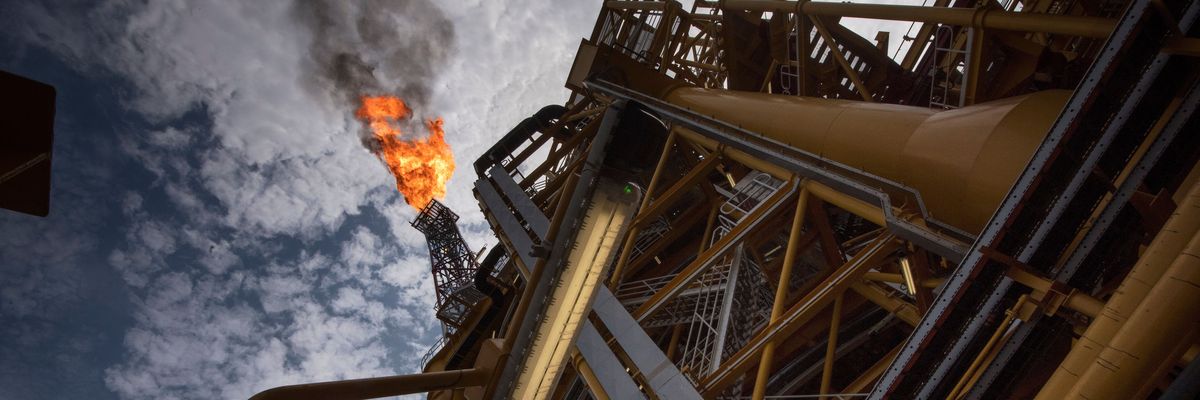
A flare is pictured at an oil and gas operation by the French company TotalEnergies off the coast of Angola on November 8, 2018.
"This support perpetuates the world's reliance on fossil fuels, paving the way for yet more energy crises due to market volatility and geopolitical security risks."
An analysis released this week by the International Institute for Sustainable Development shows that G20 countries spent at least $1 trillion on fossil fuel subsidies in 2022, running afoul of recent pledges to curb financial support for the sector most responsible for the global climate emergency.
IISD's report estimates that G20 governments provided a record $1.4 trillion in support for fossil fuels last year, including subsidies and loans from public financial institutions.
"This support perpetuates the world's reliance on fossil fuels, paving the way for yet more energy crises due to market volatility and geopolitical security risks," researchers with IISD and other organizations wrote in a detailed analysis of the new findings.
"It also severely limits the possibilities of achieving climate objectives set by the Paris Agreement by incentivizing greenhouse gas (GHG) emissions while undermining the cost-competitiveness of clean energy," they added. "G20 governments need to shift their financial resources away from fossil fuels to instead provide targeted, sustainable support for social protection and the scaling-up of clean energy. Maintaining fossil fuel prices that reflect the cost these fuels impose on society will be necessary to reduce fossil fuel use."
The researchers noted that the surge in fossil fuel subsidies—which quadrupled in 2022 compared to the previous year—was "largely due to a dramatic expansion in consumer support in response to peaking fossil fuel prices."
"Helping households and businesses during an energy crisis is understandable and necessary, but there are better ways to do it than subsidizing fossil fuels, which keeps consumers locked into emissions-intensive, polluting, and price-volatile energy sources," the researchers wrote. "Shifting support from fuels to people is fundamental for the sustainable implementation of G20 governments' pledges to phase out fossil fuel subsidies."
G20 governments also provided financial support for fossil fuel production.
As the researchers explained, "these subsidies are problematic because they influence larger private investment flows, lock in higher fossil fuel production and emissions, and take up scarce fiscal resources that are needed to catalyze investments in clean energy transition solutions."
Global investment in renewable energy reached a record high last year, according to IISD, but it still amounted to just half the total worldwide investment in fossil fuels.
The analysis calls on G20 nations to establish a firm deadline for completely eliminating fossil fuel subsidies, which disproportionately benefit wealthy households that contribute far more to the climate crisis than lower-income households.
At the 2021 COP26 summit in Glasgow, 197 countries agreed to phase out "inefficient" fossil fuel subsidies—but they did not agree on a timeframe for action, nor did they clearly define "inefficient."
The IISD analysis notes that "more than half of the signatories with significant international financing have implemented their Glasgow commitment with integrity, including Canada, France, and the United Kingdom."
"However, several developed G20 countries have not yet delivered on implementation: Italy's policy is not aligned with the Glasgow statement, nor is Germany's draft policy, and the United States has not published its regulation," the analysis says. "These countries are among the most responsible for historical CO2 emissions and should take greater responsibility for preventing further emissions by shifting financing from fossil fuels to clean energy."
Dear Common Dreams reader, It’s been nearly 30 years since I co-founded Common Dreams with my late wife, Lina Newhouser. We had the radical notion that journalism should serve the public good, not corporate profits. It was clear to us from the outset what it would take to build such a project. No paid advertisements. No corporate sponsors. No millionaire publisher telling us what to think or do. Many people said we wouldn't last a year, but we proved those doubters wrong. Together with a tremendous team of journalists and dedicated staff, we built an independent media outlet free from the constraints of profits and corporate control. Our mission has always been simple: To inform. To inspire. To ignite change for the common good. Building Common Dreams was not easy. Our survival was never guaranteed. When you take on the most powerful forces—Wall Street greed, fossil fuel industry destruction, Big Tech lobbyists, and uber-rich oligarchs who have spent billions upon billions rigging the economy and democracy in their favor—the only bulwark you have is supporters who believe in your work. But here’s the urgent message from me today. It's never been this bad out there. And it's never been this hard to keep us going. At the very moment Common Dreams is most needed, the threats we face are intensifying. We need your support now more than ever. We don't accept corporate advertising and never will. We don't have a paywall because we don't think people should be blocked from critical news based on their ability to pay. Everything we do is funded by the donations of readers like you. When everyone does the little they can afford, we are strong. But if that support retreats or dries up, so do we. Will you donate now to make sure Common Dreams not only survives but thrives? —Craig Brown, Co-founder |
An analysis released this week by the International Institute for Sustainable Development shows that G20 countries spent at least $1 trillion on fossil fuel subsidies in 2022, running afoul of recent pledges to curb financial support for the sector most responsible for the global climate emergency.
IISD's report estimates that G20 governments provided a record $1.4 trillion in support for fossil fuels last year, including subsidies and loans from public financial institutions.
"This support perpetuates the world's reliance on fossil fuels, paving the way for yet more energy crises due to market volatility and geopolitical security risks," researchers with IISD and other organizations wrote in a detailed analysis of the new findings.
"It also severely limits the possibilities of achieving climate objectives set by the Paris Agreement by incentivizing greenhouse gas (GHG) emissions while undermining the cost-competitiveness of clean energy," they added. "G20 governments need to shift their financial resources away from fossil fuels to instead provide targeted, sustainable support for social protection and the scaling-up of clean energy. Maintaining fossil fuel prices that reflect the cost these fuels impose on society will be necessary to reduce fossil fuel use."
The researchers noted that the surge in fossil fuel subsidies—which quadrupled in 2022 compared to the previous year—was "largely due to a dramatic expansion in consumer support in response to peaking fossil fuel prices."
"Helping households and businesses during an energy crisis is understandable and necessary, but there are better ways to do it than subsidizing fossil fuels, which keeps consumers locked into emissions-intensive, polluting, and price-volatile energy sources," the researchers wrote. "Shifting support from fuels to people is fundamental for the sustainable implementation of G20 governments' pledges to phase out fossil fuel subsidies."
G20 governments also provided financial support for fossil fuel production.
As the researchers explained, "these subsidies are problematic because they influence larger private investment flows, lock in higher fossil fuel production and emissions, and take up scarce fiscal resources that are needed to catalyze investments in clean energy transition solutions."
Global investment in renewable energy reached a record high last year, according to IISD, but it still amounted to just half the total worldwide investment in fossil fuels.
The analysis calls on G20 nations to establish a firm deadline for completely eliminating fossil fuel subsidies, which disproportionately benefit wealthy households that contribute far more to the climate crisis than lower-income households.
At the 2021 COP26 summit in Glasgow, 197 countries agreed to phase out "inefficient" fossil fuel subsidies—but they did not agree on a timeframe for action, nor did they clearly define "inefficient."
The IISD analysis notes that "more than half of the signatories with significant international financing have implemented their Glasgow commitment with integrity, including Canada, France, and the United Kingdom."
"However, several developed G20 countries have not yet delivered on implementation: Italy's policy is not aligned with the Glasgow statement, nor is Germany's draft policy, and the United States has not published its regulation," the analysis says. "These countries are among the most responsible for historical CO2 emissions and should take greater responsibility for preventing further emissions by shifting financing from fossil fuels to clean energy."
An analysis released this week by the International Institute for Sustainable Development shows that G20 countries spent at least $1 trillion on fossil fuel subsidies in 2022, running afoul of recent pledges to curb financial support for the sector most responsible for the global climate emergency.
IISD's report estimates that G20 governments provided a record $1.4 trillion in support for fossil fuels last year, including subsidies and loans from public financial institutions.
"This support perpetuates the world's reliance on fossil fuels, paving the way for yet more energy crises due to market volatility and geopolitical security risks," researchers with IISD and other organizations wrote in a detailed analysis of the new findings.
"It also severely limits the possibilities of achieving climate objectives set by the Paris Agreement by incentivizing greenhouse gas (GHG) emissions while undermining the cost-competitiveness of clean energy," they added. "G20 governments need to shift their financial resources away from fossil fuels to instead provide targeted, sustainable support for social protection and the scaling-up of clean energy. Maintaining fossil fuel prices that reflect the cost these fuels impose on society will be necessary to reduce fossil fuel use."
The researchers noted that the surge in fossil fuel subsidies—which quadrupled in 2022 compared to the previous year—was "largely due to a dramatic expansion in consumer support in response to peaking fossil fuel prices."
"Helping households and businesses during an energy crisis is understandable and necessary, but there are better ways to do it than subsidizing fossil fuels, which keeps consumers locked into emissions-intensive, polluting, and price-volatile energy sources," the researchers wrote. "Shifting support from fuels to people is fundamental for the sustainable implementation of G20 governments' pledges to phase out fossil fuel subsidies."
G20 governments also provided financial support for fossil fuel production.
As the researchers explained, "these subsidies are problematic because they influence larger private investment flows, lock in higher fossil fuel production and emissions, and take up scarce fiscal resources that are needed to catalyze investments in clean energy transition solutions."
Global investment in renewable energy reached a record high last year, according to IISD, but it still amounted to just half the total worldwide investment in fossil fuels.
The analysis calls on G20 nations to establish a firm deadline for completely eliminating fossil fuel subsidies, which disproportionately benefit wealthy households that contribute far more to the climate crisis than lower-income households.
At the 2021 COP26 summit in Glasgow, 197 countries agreed to phase out "inefficient" fossil fuel subsidies—but they did not agree on a timeframe for action, nor did they clearly define "inefficient."
The IISD analysis notes that "more than half of the signatories with significant international financing have implemented their Glasgow commitment with integrity, including Canada, France, and the United Kingdom."
"However, several developed G20 countries have not yet delivered on implementation: Italy's policy is not aligned with the Glasgow statement, nor is Germany's draft policy, and the United States has not published its regulation," the analysis says. "These countries are among the most responsible for historical CO2 emissions and should take greater responsibility for preventing further emissions by shifting financing from fossil fuels to clean energy."

