SUBSCRIBE TO OUR FREE NEWSLETTER
Daily news & progressive opinion—funded by the people, not the corporations—delivered straight to your inbox.
5
#000000
#FFFFFF
To donate by check, phone, or other method, see our More Ways to Give page.
Daily news & progressive opinion—funded by the people, not the corporations—delivered straight to your inbox.
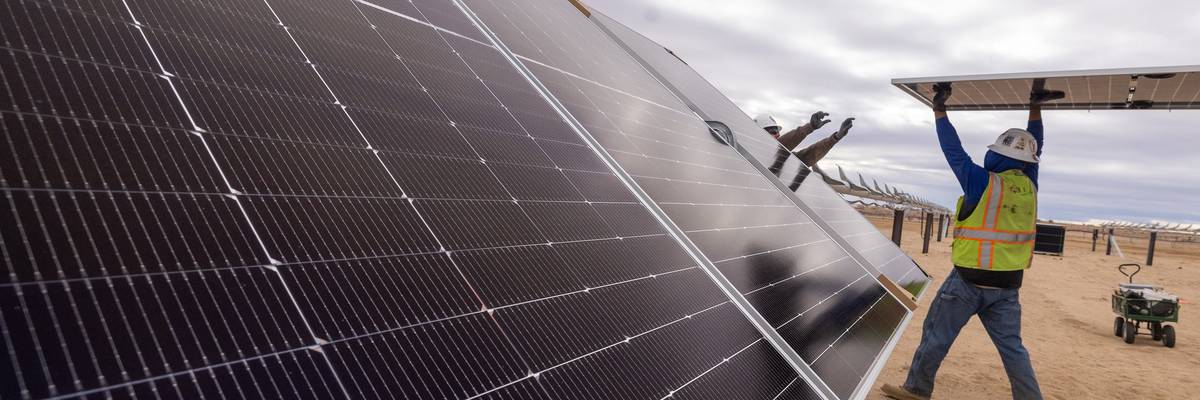
Workers install solar panels for the Los Angeles Department of Water and Power's biggest solar and battery storage plant on November 25, 2024 near California City, California.
"This program was designed to save money for hard-working Americans who are struggling to pay for groceries and keep the lights on," said the head of a climate group that had been awarded funds to finance green energy expansion.
The need for a federal lawsuit filed Monday presents "more evidence of a constitutional crisis," according to one campaigner, as plaintiffs pushed back against the Trump administration's unlawful freezing of funds appropriated by Congress to help fuel a green energy transition in marginalized communities nationwide.
The lawsuit was announced Saturday by Climate United Fund, a nonprofit green investment fund, and was received Monday by U.S. District Judge Tanya Chutkan, who previously presided over President Donald Trump's criminal trial regarding his alleged attempts to overturn the 2020 election.
The group is accusing the Environmental Protection Agency and Citibank of "illegally withholding" $7 billion that had been awarded to Climate United through the Inflation Reduction Act (IRA), which set up a $20 billion Greenhouse Gas Reduction Fund, also known as the Green Bank.
The Green Bank was established to fund solar power, energy-efficient housing projects, and electric vehicles. Climate United has reported that it used funds to begin pre-construction on a solar energy project across the University of Arkansas system, invest in electric trucks at the ports of Los Angeles and Long Beach with plans for nationwide expansion, and launch a grant program for low-income communities to start clean energy projects.
For the last two weeks, The New York Times reported, Climate United and seven other nonprofits that were awarded funding through the Green Bank have been unable to withdraw the money from their accounts at Citibank.
"They have essentially acted as if they control the power of the purse, but very clearly written into the Constitution is the separation of powers that grants Congress and Congress alone the power of making funding decisions."
The Times reported that the EPA appeared to have frozen the funds after EPA Administrator Lee Zeldin called for a "termination" of the agreement the Biden administration made with Citibank when the money was allocated to the nonprofits.
Zeldin made that demand last month after the right-wing group Project Veritas, released a hidden-camera video in which it had surreptitiously recorded an EPA employee saying before Trump took office that the agency was attempting to spend federal money on climate programs before the Republican president was inaugurated.
Zeldin suggested the comments signaled the Green Bank was "designed to obligate all of the money in a rush job with reduced oversight" and was "irresponsibly shoveling boat loads of cash to far-left, activist groups in the name of environmental justice and climate equity."
Climate United and the other groups impacted by the funding freeze have been struggling to pay their staff, the Times reported.
"This isn't about politics; it's about economics," said Beth Bafford, CEO of Climate United. "This program was designed to save money for hard-working Americans who are struggling to pay for groceries and keep the lights on. We're going to court for the communities we serve—not because we want to, but because we have to."
In his statement about the Green Bank funding last month, Zeldin said he was referring the matter to the Office of the Inspector General, suggesting an accusation of potential fraud.
Days after Zeldin's directive, federal prosecutor Denise Cheung resigned after declining to freeze an unidentified bank's accounts for a government contractor, saying she had not found "sufficient evidence" of criminal activity. Cheung's resignation is believed to have stemmed from Zeldin's accusations regarding the Greenhouse Gas Reduction Fund.
In an interview with "Living on Earth" on Public Radio Exchange last month, Jillian Blanchard, vice president of climate change and environmental justice at Lawyers for Good Government, said Zeldin's push to claw back $20 billion that was awarded last year through legislation passed by Congress suggests that "this executive [branch] seems to believe that they have and should have more power than both Congress and the courts."
"They have essentially acted as if they control the power of the purse, but very clearly written into the Constitution is the separation of powers that grants Congress and Congress alone the power of making funding decisions," said Blanchard.
The Trump administration has already been blocked from freezing funds that were were appropriated by Congress. In January the president moved to block federal grants and loans in an order that was swiftly blocked by federal courts, with one judge saying the funding freeze was "likely unconstitutional."
Dear Common Dreams reader, It’s been nearly 30 years since I co-founded Common Dreams with my late wife, Lina Newhouser. We had the radical notion that journalism should serve the public good, not corporate profits. It was clear to us from the outset what it would take to build such a project. No paid advertisements. No corporate sponsors. No millionaire publisher telling us what to think or do. Many people said we wouldn't last a year, but we proved those doubters wrong. Together with a tremendous team of journalists and dedicated staff, we built an independent media outlet free from the constraints of profits and corporate control. Our mission has always been simple: To inform. To inspire. To ignite change for the common good. Building Common Dreams was not easy. Our survival was never guaranteed. When you take on the most powerful forces—Wall Street greed, fossil fuel industry destruction, Big Tech lobbyists, and uber-rich oligarchs who have spent billions upon billions rigging the economy and democracy in their favor—the only bulwark you have is supporters who believe in your work. But here’s the urgent message from me today. It's never been this bad out there. And it's never been this hard to keep us going. At the very moment Common Dreams is most needed, the threats we face are intensifying. We need your support now more than ever. We don't accept corporate advertising and never will. We don't have a paywall because we don't think people should be blocked from critical news based on their ability to pay. Everything we do is funded by the donations of readers like you. When everyone does the little they can afford, we are strong. But if that support retreats or dries up, so do we. Will you donate now to make sure Common Dreams not only survives but thrives? —Craig Brown, Co-founder |
The need for a federal lawsuit filed Monday presents "more evidence of a constitutional crisis," according to one campaigner, as plaintiffs pushed back against the Trump administration's unlawful freezing of funds appropriated by Congress to help fuel a green energy transition in marginalized communities nationwide.
The lawsuit was announced Saturday by Climate United Fund, a nonprofit green investment fund, and was received Monday by U.S. District Judge Tanya Chutkan, who previously presided over President Donald Trump's criminal trial regarding his alleged attempts to overturn the 2020 election.
The group is accusing the Environmental Protection Agency and Citibank of "illegally withholding" $7 billion that had been awarded to Climate United through the Inflation Reduction Act (IRA), which set up a $20 billion Greenhouse Gas Reduction Fund, also known as the Green Bank.
The Green Bank was established to fund solar power, energy-efficient housing projects, and electric vehicles. Climate United has reported that it used funds to begin pre-construction on a solar energy project across the University of Arkansas system, invest in electric trucks at the ports of Los Angeles and Long Beach with plans for nationwide expansion, and launch a grant program for low-income communities to start clean energy projects.
For the last two weeks, The New York Times reported, Climate United and seven other nonprofits that were awarded funding through the Green Bank have been unable to withdraw the money from their accounts at Citibank.
"They have essentially acted as if they control the power of the purse, but very clearly written into the Constitution is the separation of powers that grants Congress and Congress alone the power of making funding decisions."
The Times reported that the EPA appeared to have frozen the funds after EPA Administrator Lee Zeldin called for a "termination" of the agreement the Biden administration made with Citibank when the money was allocated to the nonprofits.
Zeldin made that demand last month after the right-wing group Project Veritas, released a hidden-camera video in which it had surreptitiously recorded an EPA employee saying before Trump took office that the agency was attempting to spend federal money on climate programs before the Republican president was inaugurated.
Zeldin suggested the comments signaled the Green Bank was "designed to obligate all of the money in a rush job with reduced oversight" and was "irresponsibly shoveling boat loads of cash to far-left, activist groups in the name of environmental justice and climate equity."
Climate United and the other groups impacted by the funding freeze have been struggling to pay their staff, the Times reported.
"This isn't about politics; it's about economics," said Beth Bafford, CEO of Climate United. "This program was designed to save money for hard-working Americans who are struggling to pay for groceries and keep the lights on. We're going to court for the communities we serve—not because we want to, but because we have to."
In his statement about the Green Bank funding last month, Zeldin said he was referring the matter to the Office of the Inspector General, suggesting an accusation of potential fraud.
Days after Zeldin's directive, federal prosecutor Denise Cheung resigned after declining to freeze an unidentified bank's accounts for a government contractor, saying she had not found "sufficient evidence" of criminal activity. Cheung's resignation is believed to have stemmed from Zeldin's accusations regarding the Greenhouse Gas Reduction Fund.
In an interview with "Living on Earth" on Public Radio Exchange last month, Jillian Blanchard, vice president of climate change and environmental justice at Lawyers for Good Government, said Zeldin's push to claw back $20 billion that was awarded last year through legislation passed by Congress suggests that "this executive [branch] seems to believe that they have and should have more power than both Congress and the courts."
"They have essentially acted as if they control the power of the purse, but very clearly written into the Constitution is the separation of powers that grants Congress and Congress alone the power of making funding decisions," said Blanchard.
The Trump administration has already been blocked from freezing funds that were were appropriated by Congress. In January the president moved to block federal grants and loans in an order that was swiftly blocked by federal courts, with one judge saying the funding freeze was "likely unconstitutional."
The need for a federal lawsuit filed Monday presents "more evidence of a constitutional crisis," according to one campaigner, as plaintiffs pushed back against the Trump administration's unlawful freezing of funds appropriated by Congress to help fuel a green energy transition in marginalized communities nationwide.
The lawsuit was announced Saturday by Climate United Fund, a nonprofit green investment fund, and was received Monday by U.S. District Judge Tanya Chutkan, who previously presided over President Donald Trump's criminal trial regarding his alleged attempts to overturn the 2020 election.
The group is accusing the Environmental Protection Agency and Citibank of "illegally withholding" $7 billion that had been awarded to Climate United through the Inflation Reduction Act (IRA), which set up a $20 billion Greenhouse Gas Reduction Fund, also known as the Green Bank.
The Green Bank was established to fund solar power, energy-efficient housing projects, and electric vehicles. Climate United has reported that it used funds to begin pre-construction on a solar energy project across the University of Arkansas system, invest in electric trucks at the ports of Los Angeles and Long Beach with plans for nationwide expansion, and launch a grant program for low-income communities to start clean energy projects.
For the last two weeks, The New York Times reported, Climate United and seven other nonprofits that were awarded funding through the Green Bank have been unable to withdraw the money from their accounts at Citibank.
"They have essentially acted as if they control the power of the purse, but very clearly written into the Constitution is the separation of powers that grants Congress and Congress alone the power of making funding decisions."
The Times reported that the EPA appeared to have frozen the funds after EPA Administrator Lee Zeldin called for a "termination" of the agreement the Biden administration made with Citibank when the money was allocated to the nonprofits.
Zeldin made that demand last month after the right-wing group Project Veritas, released a hidden-camera video in which it had surreptitiously recorded an EPA employee saying before Trump took office that the agency was attempting to spend federal money on climate programs before the Republican president was inaugurated.
Zeldin suggested the comments signaled the Green Bank was "designed to obligate all of the money in a rush job with reduced oversight" and was "irresponsibly shoveling boat loads of cash to far-left, activist groups in the name of environmental justice and climate equity."
Climate United and the other groups impacted by the funding freeze have been struggling to pay their staff, the Times reported.
"This isn't about politics; it's about economics," said Beth Bafford, CEO of Climate United. "This program was designed to save money for hard-working Americans who are struggling to pay for groceries and keep the lights on. We're going to court for the communities we serve—not because we want to, but because we have to."
In his statement about the Green Bank funding last month, Zeldin said he was referring the matter to the Office of the Inspector General, suggesting an accusation of potential fraud.
Days after Zeldin's directive, federal prosecutor Denise Cheung resigned after declining to freeze an unidentified bank's accounts for a government contractor, saying she had not found "sufficient evidence" of criminal activity. Cheung's resignation is believed to have stemmed from Zeldin's accusations regarding the Greenhouse Gas Reduction Fund.
In an interview with "Living on Earth" on Public Radio Exchange last month, Jillian Blanchard, vice president of climate change and environmental justice at Lawyers for Good Government, said Zeldin's push to claw back $20 billion that was awarded last year through legislation passed by Congress suggests that "this executive [branch] seems to believe that they have and should have more power than both Congress and the courts."
"They have essentially acted as if they control the power of the purse, but very clearly written into the Constitution is the separation of powers that grants Congress and Congress alone the power of making funding decisions," said Blanchard.
The Trump administration has already been blocked from freezing funds that were were appropriated by Congress. In January the president moved to block federal grants and loans in an order that was swiftly blocked by federal courts, with one judge saying the funding freeze was "likely unconstitutional."