
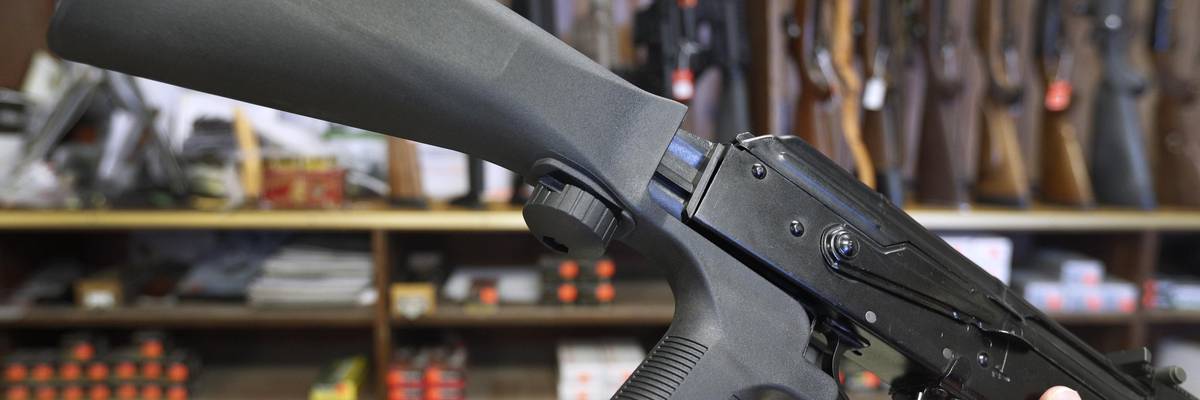
A bump stock device that fits on a semi-automatic rifle to increase the firing speed making it similar to a fully automatic on October 5, 2017 in Salt Lake City, Utah.
Rejecting Bump Stock Ban, Federal Court Legalizes 'Instrument of Mass Murder'
Bump stocks were used to modify firearms used in the deadliest mass shooting in U.S. history, which killed 60 people in Las Vegas in 2017.
Despite acknowledging "tremendous" public pressure to impose a ban on bump stocks, a firearm attachment used in the deadliest mass shooting in U.S. history, a federal appeals court on Friday rejected a 2019 Trump administration rule barring people from owning the instruments.
In a 13-3 ruling, the 5th U.S. Circuit Court of Appeals in New Orleans ruled that the ban violated the Administrative Procedure Act and that the U.S. Congress must act to ban bump stocks rather than the executive branch.
The majority, made up mostly of judges appointed by Republican presidents, said that the Bureau of Alcohol, Tobacco, and Firearms (ATF) at the U.S. Department of Justice wrongly interpreted a law banning machine guns when they extended that ban to bump stocks in 2019, two years after a gunman killed 60 people and injured hundreds of others in a shooting at a concert in Las Vegas.
"A plain reading of the statutory language, paired with close consideration of the mechanics of a semi-automatic firearm, reveals that a bump stock is excluded from the technical definition of 'machine gun' set forth in the Gun Control Act and National Firearms Act," Judge Jennifer Walker Elrod wrote in the majority opinion.
The gunman used bump stocks to modify 12 firearms he used when he shot at the crowd from a hotel room. Bump stocks can be used to replace a rifle's stock, which is held against the shooter's shoulder, and allows the weapon to fire multiple rounds of ammunition more rapidly.
The three judges who dissented in Friday's ruling were appointed by Democratic presidents. One, Judge Stephen Higginson, wrote in an opinion that the majority employed technical legal reasoning "to legalize an instrument of mass murder," after three other federal appeals courts rejected challenges to the bump stock ban and the Supreme Court declined to hear appeals to two of those rulings last year.
"Under the majority's rule, the defendant wins by default whenever the government fails to prove that a statute unambiguously criminalizes the defendant's conduct," wrote Higginson.
Following Friday's decision, the Supreme Court could ultimately rule on the legality of bump stocks in the future.
We are at a crossroads
This country and this world are at a monumental crossroads. In a few short weeks, US voters will have an opportunity to beat back the forces of fascism and confront the billionaires who are rigging the economy, our media system, and our democracy, making it increasingly impossible for ordinary people to get by. We’re not just talking about the election. We’re talking about what must be done once these fascist elements are vanquished from power. We need a bolder set of solutions than what either major party has so far been willing to offer and a working-class movement ready to fight like hell for it. Trump didn't emerge from nowhere. The conditions that fueled MAGA authoritarianism were created by decades of radical neoliberal economic policies and a corrupt political system dominated by corporate interests. They slashed taxes on the super-rich, promising that the benefits would trickle down. They said giveaways to the corporate titans would make life more affordable for the rest of us. It was all bullshit. And when a bitter, betrayed populace searches for someone to blame, right-wing demagogues have little trouble finding scapegoats. People know when they're being lied to, but you won't hear any of this from the corporate media. Only independent journalism—powered and funded by people who believe in building a better world—can deliver truly trustworthy daily news. Our Fall Campaign is underway, and we need your help. To power our newsroom through the rest of the year, we need to raise $125,000 by midnight on October 31. So if you share our vision, please contribute whatever you can to sustain our work. |
Despite acknowledging "tremendous" public pressure to impose a ban on bump stocks, a firearm attachment used in the deadliest mass shooting in U.S. history, a federal appeals court on Friday rejected a 2019 Trump administration rule barring people from owning the instruments.
In a 13-3 ruling, the 5th U.S. Circuit Court of Appeals in New Orleans ruled that the ban violated the Administrative Procedure Act and that the U.S. Congress must act to ban bump stocks rather than the executive branch.
The majority, made up mostly of judges appointed by Republican presidents, said that the Bureau of Alcohol, Tobacco, and Firearms (ATF) at the U.S. Department of Justice wrongly interpreted a law banning machine guns when they extended that ban to bump stocks in 2019, two years after a gunman killed 60 people and injured hundreds of others in a shooting at a concert in Las Vegas.
"A plain reading of the statutory language, paired with close consideration of the mechanics of a semi-automatic firearm, reveals that a bump stock is excluded from the technical definition of 'machine gun' set forth in the Gun Control Act and National Firearms Act," Judge Jennifer Walker Elrod wrote in the majority opinion.
The gunman used bump stocks to modify 12 firearms he used when he shot at the crowd from a hotel room. Bump stocks can be used to replace a rifle's stock, which is held against the shooter's shoulder, and allows the weapon to fire multiple rounds of ammunition more rapidly.
The three judges who dissented in Friday's ruling were appointed by Democratic presidents. One, Judge Stephen Higginson, wrote in an opinion that the majority employed technical legal reasoning "to legalize an instrument of mass murder," after three other federal appeals courts rejected challenges to the bump stock ban and the Supreme Court declined to hear appeals to two of those rulings last year.
"Under the majority's rule, the defendant wins by default whenever the government fails to prove that a statute unambiguously criminalizes the defendant's conduct," wrote Higginson.
Following Friday's decision, the Supreme Court could ultimately rule on the legality of bump stocks in the future.
- Critics Call Out House Democrats for Excluding Assault Weapons Ban From Gun Proposal ›
- Supreme Court Puts 'Countless Lives in Danger' by Striking Down Bump Stock Ban | Common Dreams ›
Despite acknowledging "tremendous" public pressure to impose a ban on bump stocks, a firearm attachment used in the deadliest mass shooting in U.S. history, a federal appeals court on Friday rejected a 2019 Trump administration rule barring people from owning the instruments.
In a 13-3 ruling, the 5th U.S. Circuit Court of Appeals in New Orleans ruled that the ban violated the Administrative Procedure Act and that the U.S. Congress must act to ban bump stocks rather than the executive branch.
The majority, made up mostly of judges appointed by Republican presidents, said that the Bureau of Alcohol, Tobacco, and Firearms (ATF) at the U.S. Department of Justice wrongly interpreted a law banning machine guns when they extended that ban to bump stocks in 2019, two years after a gunman killed 60 people and injured hundreds of others in a shooting at a concert in Las Vegas.
"A plain reading of the statutory language, paired with close consideration of the mechanics of a semi-automatic firearm, reveals that a bump stock is excluded from the technical definition of 'machine gun' set forth in the Gun Control Act and National Firearms Act," Judge Jennifer Walker Elrod wrote in the majority opinion.
The gunman used bump stocks to modify 12 firearms he used when he shot at the crowd from a hotel room. Bump stocks can be used to replace a rifle's stock, which is held against the shooter's shoulder, and allows the weapon to fire multiple rounds of ammunition more rapidly.
The three judges who dissented in Friday's ruling were appointed by Democratic presidents. One, Judge Stephen Higginson, wrote in an opinion that the majority employed technical legal reasoning "to legalize an instrument of mass murder," after three other federal appeals courts rejected challenges to the bump stock ban and the Supreme Court declined to hear appeals to two of those rulings last year.
"Under the majority's rule, the defendant wins by default whenever the government fails to prove that a statute unambiguously criminalizes the defendant's conduct," wrote Higginson.
Following Friday's decision, the Supreme Court could ultimately rule on the legality of bump stocks in the future.
- Critics Call Out House Democrats for Excluding Assault Weapons Ban From Gun Proposal ›
- Supreme Court Puts 'Countless Lives in Danger' by Striking Down Bump Stock Ban | Common Dreams ›