

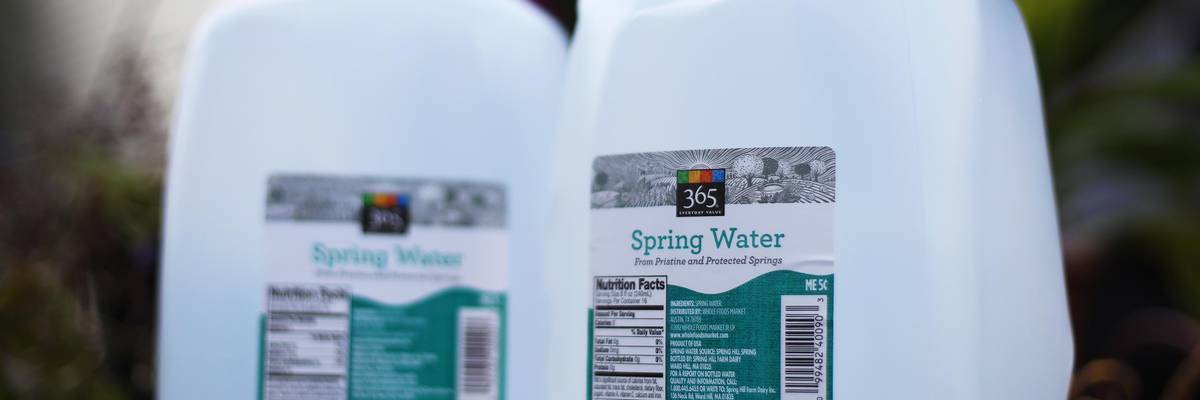
Jugs of 365-branded water are pictured in Haverhill, Massachusetts on July 26, 2019. The previous month, testing from the Center for Environmental Health found PFAS in bottled water brands sourced from Spring Hill Dairy Farm in the city.
Groups Call On EPA to Close Loopholes and Revoke Approval of 600 'Forever Chemicals'
"If EPA is serious about addressing the PFAS crisis, it must immediately take off the market all PFAS that were approved through misused exemptions."
A coalition of more than a dozen environmental groups filed a petition on Thursday with the U.S. Environmental Protection Agency, demanding the EPA rescind approval for 600 per- and polyfluoroalkyl substances and immediately remove the products containing the chemicals from the market.
" PFAS cause cancers and birth defects, yet EPA approved hundreds of them through loopholes."
Per- and polyfluoroalkyl substances (PFAS), commonly referred to as "forever chemicals," are a large family of human-made toxic chemicals used in various products and industrial processes--including airplane jet engines, firefighting foam, waterproof jackets, nonstick pans, shampoo, food packaging, paints, and other household items--and can persist in humans and the environment for decades, sometimes taking up to 1,700 years to degrade.
According to the environmental groups, the EPA allowed PFAS to be approved for market by unlawfully exploiting exemptions in the Toxic Substances Control Act (TSCA), which allowed the agency to approve these chemicals through "lax safety reviews."
"PFAS cause cancers and birth defects, yet EPA approved hundreds of them through loopholes," said Eve Gartner, Earthjustice's managing attorney. "If EPA is serious about addressing the PFAS crisis, it must immediately take off the market all PFAS that were approved through misused exemptions. PFAS manufacturers must follow the most stringent approval process. In fact, we believe no PFAS would be approved if full safety reviews were conducted."
Under TSCA guidelines section five, a pre-manufacture notice (PMN) is required for the safety review of new chemicals to determine what kind of risk they pose. However, if PMN exemptions are granted--as they were for hundreds of PFAS--it allows the EPA to forgo full section five safety reviews for certain chemical substances. Under this exemption, chemicals are approved through the EPA's own determination that the chemical "will not present an unreasonable risk" to humans or the environment.
PFAS are linked to numerous adverse health effects and scientific evidence has found that even low levels of exposure can cause various cancers, immune system suppression, cardiovascular diseases, developmental harms, and liver disease in children.
A 2016 study found that 16.5 million Americans across 33 states and three American territories were exposed to drinking water with detectable levels of PFAS and a more recent study found that tens of thousands of sites across the United States--including restaurants, car washes, and textile cleaners--are believed to be contaminated by PFAS.
Forever chemicals are also considered environmental contaminants, affecting fish populations, plants, and aquatic ecosystems.
"PFAS are pervasive in the environment and present in the bodies of virtually every person in the U.S.," the environmental groups said. "People are exposed to PFAS through various sources, including the products we use, the food we eat, the air we breathe, and the water we drink."
Due to the overwhelming scientific evidence detailing the harm caused by PFAS, the environmental groups say the EPA cannot conclude that PFAS meet the "will not present an unreasonable risk" designation and demand that the EPA revoke all PMN exemptions previously granted for PFAS, as they do not meet the legal standards.
"By continuing to allow the manufacture and use of PFAS that have not undergone the full PMN review process, while simultaneously relying on ineffective voluntary programs that fail to meaningfully limit manufacture, processing, use, and disposal of PFAS LVEs and LoREXs, EPA is violating TSCA, its own regulations, and the Administrative Procedure Act," the groups said.
The petition aims to prohibit the use of four EPA-created exemptions--the byproducts exemption, the low volume exemption (LVE), the low release and exposure exemption (LoREX), and the polymer exemption--for PFAS approval.
Along with advocating for an approval process rooted in science and law, the petition explains "how EPA's increasingly frequent practice of approving PFAS via PMN exemptions rather than via the PMN review process has put communities and the environment at risk and deprived the public of information about proposed new PFAS that it would be entitled to during the PMN process."
The petition adds that "nothing in these arguments should be read to suggest that petitioners believe EPA could lawfully find that any proposed new PFAS 'is not likely to present an unreasonable risk of injury to health or the environment,' the legal standard that must be met for manufacture to commence after submission of a PMN."
An Urgent Message From Our Co-Founder
Dear Common Dreams reader, It’s been nearly 30 years since I co-founded Common Dreams with my late wife, Lina Newhouser. We had the radical notion that journalism should serve the public good, not corporate profits. It was clear to us from the outset what it would take to build such a project. No paid advertisements. No corporate sponsors. No millionaire publisher telling us what to think or do. Many people said we wouldn't last a year, but we proved those doubters wrong. Together with a tremendous team of journalists and dedicated staff, we built an independent media outlet free from the constraints of profits and corporate control. Our mission has always been simple: To inform. To inspire. To ignite change for the common good. Building Common Dreams was not easy. Our survival was never guaranteed. When you take on the most powerful forces—Wall Street greed, fossil fuel industry destruction, Big Tech lobbyists, and uber-rich oligarchs who have spent billions upon billions rigging the economy and democracy in their favor—the only bulwark you have is supporters who believe in your work. But here’s the urgent message from me today. It's never been this bad out there. And it's never been this hard to keep us going. At the very moment Common Dreams is most needed, the threats we face are intensifying. We need your support now more than ever. We don't accept corporate advertising and never will. We don't have a paywall because we don't think people should be blocked from critical news based on their ability to pay. Everything we do is funded by the donations of readers like you. When everyone does the little they can afford, we are strong. But if that support retreats or dries up, so do we. Will you donate now to make sure Common Dreams not only survives but thrives? —Craig Brown, Co-founder |
A coalition of more than a dozen environmental groups filed a petition on Thursday with the U.S. Environmental Protection Agency, demanding the EPA rescind approval for 600 per- and polyfluoroalkyl substances and immediately remove the products containing the chemicals from the market.
" PFAS cause cancers and birth defects, yet EPA approved hundreds of them through loopholes."
Per- and polyfluoroalkyl substances (PFAS), commonly referred to as "forever chemicals," are a large family of human-made toxic chemicals used in various products and industrial processes--including airplane jet engines, firefighting foam, waterproof jackets, nonstick pans, shampoo, food packaging, paints, and other household items--and can persist in humans and the environment for decades, sometimes taking up to 1,700 years to degrade.
According to the environmental groups, the EPA allowed PFAS to be approved for market by unlawfully exploiting exemptions in the Toxic Substances Control Act (TSCA), which allowed the agency to approve these chemicals through "lax safety reviews."
"PFAS cause cancers and birth defects, yet EPA approved hundreds of them through loopholes," said Eve Gartner, Earthjustice's managing attorney. "If EPA is serious about addressing the PFAS crisis, it must immediately take off the market all PFAS that were approved through misused exemptions. PFAS manufacturers must follow the most stringent approval process. In fact, we believe no PFAS would be approved if full safety reviews were conducted."
Under TSCA guidelines section five, a pre-manufacture notice (PMN) is required for the safety review of new chemicals to determine what kind of risk they pose. However, if PMN exemptions are granted--as they were for hundreds of PFAS--it allows the EPA to forgo full section five safety reviews for certain chemical substances. Under this exemption, chemicals are approved through the EPA's own determination that the chemical "will not present an unreasonable risk" to humans or the environment.
PFAS are linked to numerous adverse health effects and scientific evidence has found that even low levels of exposure can cause various cancers, immune system suppression, cardiovascular diseases, developmental harms, and liver disease in children.
A 2016 study found that 16.5 million Americans across 33 states and three American territories were exposed to drinking water with detectable levels of PFAS and a more recent study found that tens of thousands of sites across the United States--including restaurants, car washes, and textile cleaners--are believed to be contaminated by PFAS.
Forever chemicals are also considered environmental contaminants, affecting fish populations, plants, and aquatic ecosystems.
"PFAS are pervasive in the environment and present in the bodies of virtually every person in the U.S.," the environmental groups said. "People are exposed to PFAS through various sources, including the products we use, the food we eat, the air we breathe, and the water we drink."
Due to the overwhelming scientific evidence detailing the harm caused by PFAS, the environmental groups say the EPA cannot conclude that PFAS meet the "will not present an unreasonable risk" designation and demand that the EPA revoke all PMN exemptions previously granted for PFAS, as they do not meet the legal standards.
"By continuing to allow the manufacture and use of PFAS that have not undergone the full PMN review process, while simultaneously relying on ineffective voluntary programs that fail to meaningfully limit manufacture, processing, use, and disposal of PFAS LVEs and LoREXs, EPA is violating TSCA, its own regulations, and the Administrative Procedure Act," the groups said.
The petition aims to prohibit the use of four EPA-created exemptions--the byproducts exemption, the low volume exemption (LVE), the low release and exposure exemption (LoREX), and the polymer exemption--for PFAS approval.
Along with advocating for an approval process rooted in science and law, the petition explains "how EPA's increasingly frequent practice of approving PFAS via PMN exemptions rather than via the PMN review process has put communities and the environment at risk and deprived the public of information about proposed new PFAS that it would be entitled to during the PMN process."
The petition adds that "nothing in these arguments should be read to suggest that petitioners believe EPA could lawfully find that any proposed new PFAS 'is not likely to present an unreasonable risk of injury to health or the environment,' the legal standard that must be met for manufacture to commence after submission of a PMN."
A coalition of more than a dozen environmental groups filed a petition on Thursday with the U.S. Environmental Protection Agency, demanding the EPA rescind approval for 600 per- and polyfluoroalkyl substances and immediately remove the products containing the chemicals from the market.
" PFAS cause cancers and birth defects, yet EPA approved hundreds of them through loopholes."
Per- and polyfluoroalkyl substances (PFAS), commonly referred to as "forever chemicals," are a large family of human-made toxic chemicals used in various products and industrial processes--including airplane jet engines, firefighting foam, waterproof jackets, nonstick pans, shampoo, food packaging, paints, and other household items--and can persist in humans and the environment for decades, sometimes taking up to 1,700 years to degrade.
According to the environmental groups, the EPA allowed PFAS to be approved for market by unlawfully exploiting exemptions in the Toxic Substances Control Act (TSCA), which allowed the agency to approve these chemicals through "lax safety reviews."
"PFAS cause cancers and birth defects, yet EPA approved hundreds of them through loopholes," said Eve Gartner, Earthjustice's managing attorney. "If EPA is serious about addressing the PFAS crisis, it must immediately take off the market all PFAS that were approved through misused exemptions. PFAS manufacturers must follow the most stringent approval process. In fact, we believe no PFAS would be approved if full safety reviews were conducted."
Under TSCA guidelines section five, a pre-manufacture notice (PMN) is required for the safety review of new chemicals to determine what kind of risk they pose. However, if PMN exemptions are granted--as they were for hundreds of PFAS--it allows the EPA to forgo full section five safety reviews for certain chemical substances. Under this exemption, chemicals are approved through the EPA's own determination that the chemical "will not present an unreasonable risk" to humans or the environment.
PFAS are linked to numerous adverse health effects and scientific evidence has found that even low levels of exposure can cause various cancers, immune system suppression, cardiovascular diseases, developmental harms, and liver disease in children.
A 2016 study found that 16.5 million Americans across 33 states and three American territories were exposed to drinking water with detectable levels of PFAS and a more recent study found that tens of thousands of sites across the United States--including restaurants, car washes, and textile cleaners--are believed to be contaminated by PFAS.
Forever chemicals are also considered environmental contaminants, affecting fish populations, plants, and aquatic ecosystems.
"PFAS are pervasive in the environment and present in the bodies of virtually every person in the U.S.," the environmental groups said. "People are exposed to PFAS through various sources, including the products we use, the food we eat, the air we breathe, and the water we drink."
Due to the overwhelming scientific evidence detailing the harm caused by PFAS, the environmental groups say the EPA cannot conclude that PFAS meet the "will not present an unreasonable risk" designation and demand that the EPA revoke all PMN exemptions previously granted for PFAS, as they do not meet the legal standards.
"By continuing to allow the manufacture and use of PFAS that have not undergone the full PMN review process, while simultaneously relying on ineffective voluntary programs that fail to meaningfully limit manufacture, processing, use, and disposal of PFAS LVEs and LoREXs, EPA is violating TSCA, its own regulations, and the Administrative Procedure Act," the groups said.
The petition aims to prohibit the use of four EPA-created exemptions--the byproducts exemption, the low volume exemption (LVE), the low release and exposure exemption (LoREX), and the polymer exemption--for PFAS approval.
Along with advocating for an approval process rooted in science and law, the petition explains "how EPA's increasingly frequent practice of approving PFAS via PMN exemptions rather than via the PMN review process has put communities and the environment at risk and deprived the public of information about proposed new PFAS that it would be entitled to during the PMN process."
The petition adds that "nothing in these arguments should be read to suggest that petitioners believe EPA could lawfully find that any proposed new PFAS 'is not likely to present an unreasonable risk of injury to health or the environment,' the legal standard that must be met for manufacture to commence after submission of a PMN."