SUBSCRIBE TO OUR FREE NEWSLETTER
Daily news & progressive opinion—funded by the people, not the corporations—delivered straight to your inbox.
5
#000000
#FFFFFF
To donate by check, phone, or other method, see our More Ways to Give page.
Daily news & progressive opinion—funded by the people, not the corporations—delivered straight to your inbox.
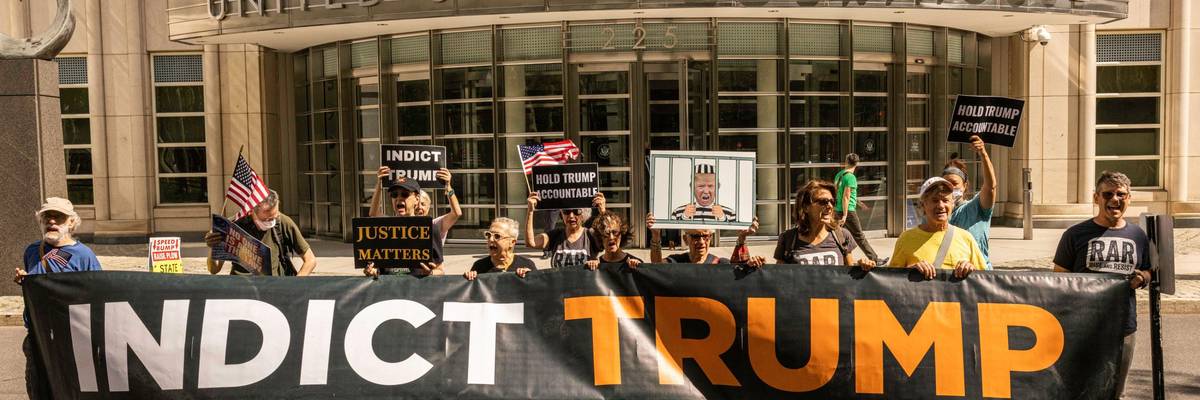
Protestors held a sign outside a federal courthouse in Brooklyn, the site of Special Master Raymond Dearie's hearing about classified documents on September 20, 2022. (Photo: Alex Kent/Getty Images)
The "special master" assigned to review materials seized from Donald Trump's Mar-a-Lago estate pushed back against attempts by the former president's legal team to avoid officially addressing his declassification claims in court on Tuesday.
The exchange came during Judge Raymond Dearie's first meeting with Trump's lawyers and U.S. Department of Justice (DOJ) prosecutors at a federal courthouse in Brooklyn.
The ex-president's attorneys had sought a special master and Trump-appointed, Florida-based U.S. District Judge Aileen Cannon granted that request--tasking Dearie with vetting the materials that federal agents took from the Florida estate last month while executing a search warrant.
While about 100 of the 11,000 records are marked as classified, Trump has publicly claimed--without providing any evidence--that he declassified all of those documents.
Summarizing the key takeaway from the hearing, the watchdog Citizens for Responsibility and Ethics in Washington (CREW) tweeted that the special master "just said if Trump's lawyers don't officially counter whether the documents Trump took are classified, then Dearie will side with the DOJ."
Citing separate court filings by his attorneys Monday night and Tuesday, The New York Times explained that Trump "wants it both ways: He is arguing that he and his legal team should not have to state in a legal proceeding, where they could become subject to perjury charges or other penalties, that he declassified the documents, while also telling the courts that they should not accept the Justice Department's word that they remain classified."
Trump's attorneys wrote Monday that they didn't want Dearie to force their client to "fully and specifically disclose a defense to the merits of any subsequent indictment without such a requirement being evident in the district court's order."
The Washington Post noted that line from the Monday filing was "a remarkable statement that acknowledges at least the possibility that the former president or his aides could be criminally charged."
During Tuesday's hearing, Dearie pressed "Trump's lawyers on what he's supposed to do," noting that "the government provided 'prima facie evidence' of classification, i.e., the markings," reported Law & Crime managing editor Adam Klasfeld.
Dearie told Trump attorney James Trusty, "As far as I'm concerned, that's the end of it."
Trusty argued to the judge that his team should not have to disclose declassification defenses at this time.
According to Klasfeld and Politico senior legal affairs reporter Josh Gerstein, Dearie responded that "you can't have your cake and eat it."
The hearing occurred despite the DOJ's ongoing appeal of Cannon's ruling--specifically, her decision about what materials Dearie should examine and her determination that the department can't use classified materials for its criminal investigation of Trump until the review is complete.
The Daily Beast highlighted that "whether any of the records seized from Trump's home are classified may ultimately be a side issue. The Justice Department has emphasized that the three potential crimes it is investigating don't hinge on whether the material held at Mar-a-Lago was classified."
Dear Common Dreams reader, It’s been nearly 30 years since I co-founded Common Dreams with my late wife, Lina Newhouser. We had the radical notion that journalism should serve the public good, not corporate profits. It was clear to us from the outset what it would take to build such a project. No paid advertisements. No corporate sponsors. No millionaire publisher telling us what to think or do. Many people said we wouldn't last a year, but we proved those doubters wrong. Together with a tremendous team of journalists and dedicated staff, we built an independent media outlet free from the constraints of profits and corporate control. Our mission has always been simple: To inform. To inspire. To ignite change for the common good. Building Common Dreams was not easy. Our survival was never guaranteed. When you take on the most powerful forces—Wall Street greed, fossil fuel industry destruction, Big Tech lobbyists, and uber-rich oligarchs who have spent billions upon billions rigging the economy and democracy in their favor—the only bulwark you have is supporters who believe in your work. But here’s the urgent message from me today. It's never been this bad out there. And it's never been this hard to keep us going. At the very moment Common Dreams is most needed, the threats we face are intensifying. We need your support now more than ever. We don't accept corporate advertising and never will. We don't have a paywall because we don't think people should be blocked from critical news based on their ability to pay. Everything we do is funded by the donations of readers like you. When everyone does the little they can afford, we are strong. But if that support retreats or dries up, so do we. Will you donate now to make sure Common Dreams not only survives but thrives? —Craig Brown, Co-founder |
The "special master" assigned to review materials seized from Donald Trump's Mar-a-Lago estate pushed back against attempts by the former president's legal team to avoid officially addressing his declassification claims in court on Tuesday.
The exchange came during Judge Raymond Dearie's first meeting with Trump's lawyers and U.S. Department of Justice (DOJ) prosecutors at a federal courthouse in Brooklyn.
The ex-president's attorneys had sought a special master and Trump-appointed, Florida-based U.S. District Judge Aileen Cannon granted that request--tasking Dearie with vetting the materials that federal agents took from the Florida estate last month while executing a search warrant.
While about 100 of the 11,000 records are marked as classified, Trump has publicly claimed--without providing any evidence--that he declassified all of those documents.
Summarizing the key takeaway from the hearing, the watchdog Citizens for Responsibility and Ethics in Washington (CREW) tweeted that the special master "just said if Trump's lawyers don't officially counter whether the documents Trump took are classified, then Dearie will side with the DOJ."
Citing separate court filings by his attorneys Monday night and Tuesday, The New York Times explained that Trump "wants it both ways: He is arguing that he and his legal team should not have to state in a legal proceeding, where they could become subject to perjury charges or other penalties, that he declassified the documents, while also telling the courts that they should not accept the Justice Department's word that they remain classified."
Trump's attorneys wrote Monday that they didn't want Dearie to force their client to "fully and specifically disclose a defense to the merits of any subsequent indictment without such a requirement being evident in the district court's order."
The Washington Post noted that line from the Monday filing was "a remarkable statement that acknowledges at least the possibility that the former president or his aides could be criminally charged."
During Tuesday's hearing, Dearie pressed "Trump's lawyers on what he's supposed to do," noting that "the government provided 'prima facie evidence' of classification, i.e., the markings," reported Law & Crime managing editor Adam Klasfeld.
Dearie told Trump attorney James Trusty, "As far as I'm concerned, that's the end of it."
Trusty argued to the judge that his team should not have to disclose declassification defenses at this time.
According to Klasfeld and Politico senior legal affairs reporter Josh Gerstein, Dearie responded that "you can't have your cake and eat it."
The hearing occurred despite the DOJ's ongoing appeal of Cannon's ruling--specifically, her decision about what materials Dearie should examine and her determination that the department can't use classified materials for its criminal investigation of Trump until the review is complete.
The Daily Beast highlighted that "whether any of the records seized from Trump's home are classified may ultimately be a side issue. The Justice Department has emphasized that the three potential crimes it is investigating don't hinge on whether the material held at Mar-a-Lago was classified."
The "special master" assigned to review materials seized from Donald Trump's Mar-a-Lago estate pushed back against attempts by the former president's legal team to avoid officially addressing his declassification claims in court on Tuesday.
The exchange came during Judge Raymond Dearie's first meeting with Trump's lawyers and U.S. Department of Justice (DOJ) prosecutors at a federal courthouse in Brooklyn.
The ex-president's attorneys had sought a special master and Trump-appointed, Florida-based U.S. District Judge Aileen Cannon granted that request--tasking Dearie with vetting the materials that federal agents took from the Florida estate last month while executing a search warrant.
While about 100 of the 11,000 records are marked as classified, Trump has publicly claimed--without providing any evidence--that he declassified all of those documents.
Summarizing the key takeaway from the hearing, the watchdog Citizens for Responsibility and Ethics in Washington (CREW) tweeted that the special master "just said if Trump's lawyers don't officially counter whether the documents Trump took are classified, then Dearie will side with the DOJ."
Citing separate court filings by his attorneys Monday night and Tuesday, The New York Times explained that Trump "wants it both ways: He is arguing that he and his legal team should not have to state in a legal proceeding, where they could become subject to perjury charges or other penalties, that he declassified the documents, while also telling the courts that they should not accept the Justice Department's word that they remain classified."
Trump's attorneys wrote Monday that they didn't want Dearie to force their client to "fully and specifically disclose a defense to the merits of any subsequent indictment without such a requirement being evident in the district court's order."
The Washington Post noted that line from the Monday filing was "a remarkable statement that acknowledges at least the possibility that the former president or his aides could be criminally charged."
During Tuesday's hearing, Dearie pressed "Trump's lawyers on what he's supposed to do," noting that "the government provided 'prima facie evidence' of classification, i.e., the markings," reported Law & Crime managing editor Adam Klasfeld.
Dearie told Trump attorney James Trusty, "As far as I'm concerned, that's the end of it."
Trusty argued to the judge that his team should not have to disclose declassification defenses at this time.
According to Klasfeld and Politico senior legal affairs reporter Josh Gerstein, Dearie responded that "you can't have your cake and eat it."
The hearing occurred despite the DOJ's ongoing appeal of Cannon's ruling--specifically, her decision about what materials Dearie should examine and her determination that the department can't use classified materials for its criminal investigation of Trump until the review is complete.
The Daily Beast highlighted that "whether any of the records seized from Trump's home are classified may ultimately be a side issue. The Justice Department has emphasized that the three potential crimes it is investigating don't hinge on whether the material held at Mar-a-Lago was classified."