SUBSCRIBE TO OUR FREE NEWSLETTER
Daily news & progressive opinion—funded by the people, not the corporations—delivered straight to your inbox.
5
#000000
#FFFFFF
To donate by check, phone, or other method, see our More Ways to Give page.
Daily news & progressive opinion—funded by the people, not the corporations—delivered straight to your inbox.
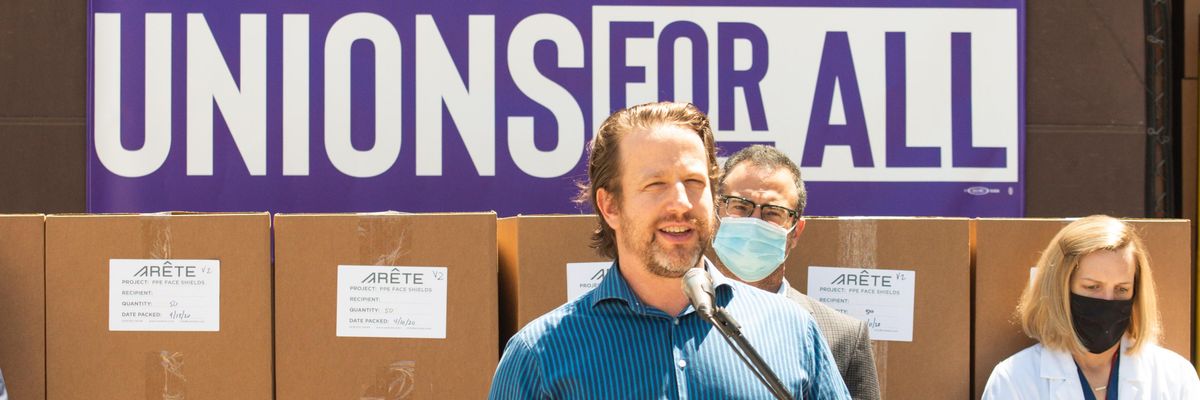
Joe Sanberg speaks at a press conference on April 14, 2020 in Los Angeles, California. (Photo: Presley Ann/Getty Images for Emergency Supply Donor Group)
The signature-gathering process for an initiative to raise the California minimum wage to $18 an hour by 2025 officially began Wednesday, the latest step toward getting the proposal on the state ballot in November.
"There is not one California worker who is making a good living on $15 an hour. Not one."
The current minimum wage in California is $15 per hour for businesses with 26 or more employees. While that's more than double the federal wage floor of $7.25, campaigners say it's still far from enough in a state with one of the highest costs of living in the U.S.
According to the Massachusetts Institute of Technology's Living Wage Calculator, a single parent of two kids would need to make $50 an hour to fully cover essential expenses in California.
"There is not one California worker who is making a good living on $15 an hour. Not one," Joe Sanberg, the investor and progressive anti-poverty activist sponsoring the proposed ballot measure, said in a statement Wednesday. "Many of the heroic essential workers--who have put their lives on the line to go to work during the pandemic--are paid wages so low they can't afford to pay for even their most basic needs."
"And because of the systemic inequity that governs this country, workers of color are much more likely to be paid poverty-level wages," Sanberg added. "That has to change. Raising the minimum wage in the Golden State is a moral imperative."
Titled the Living Wage Act of 2022, the measure would require businesses with 26 or more employees to raise their base pay by a dollar each year until it hits $18 an hour by January 1, 2025. Smaller businesses would be given an additional year to reach the $18-an-hour level.
Thereafter, California's minimum wage would be adjusted for inflation.
For their proposal to make it onto California voters' ballots in November, the campaign for the Living Wage Act must collect at least 623,212 valid signatures in the coming months ahead of an early-summer deadline.
Art Pulaski, executive secretary-treasurer of the California Labor Federation, said Wednesday that "raising the minimum wage is one of the strongest anti-poverty measures we have as a state."
"For low-wage workers, a higher minimum wage is life-changing," Pulaski added. "Better wages for workers also means they have more to spend at local businesses in our communities. If we're serious about combating poverty and reducing inequality, raising the minimum wage is an absolute necessity."
Dear Common Dreams reader, It’s been nearly 30 years since I co-founded Common Dreams with my late wife, Lina Newhouser. We had the radical notion that journalism should serve the public good, not corporate profits. It was clear to us from the outset what it would take to build such a project. No paid advertisements. No corporate sponsors. No millionaire publisher telling us what to think or do. Many people said we wouldn't last a year, but we proved those doubters wrong. Together with a tremendous team of journalists and dedicated staff, we built an independent media outlet free from the constraints of profits and corporate control. Our mission has always been simple: To inform. To inspire. To ignite change for the common good. Building Common Dreams was not easy. Our survival was never guaranteed. When you take on the most powerful forces—Wall Street greed, fossil fuel industry destruction, Big Tech lobbyists, and uber-rich oligarchs who have spent billions upon billions rigging the economy and democracy in their favor—the only bulwark you have is supporters who believe in your work. But here’s the urgent message from me today. It's never been this bad out there. And it's never been this hard to keep us going. At the very moment Common Dreams is most needed, the threats we face are intensifying. We need your support now more than ever. We don't accept corporate advertising and never will. We don't have a paywall because we don't think people should be blocked from critical news based on their ability to pay. Everything we do is funded by the donations of readers like you. When everyone does the little they can afford, we are strong. But if that support retreats or dries up, so do we. Will you donate now to make sure Common Dreams not only survives but thrives? —Craig Brown, Co-founder |
The signature-gathering process for an initiative to raise the California minimum wage to $18 an hour by 2025 officially began Wednesday, the latest step toward getting the proposal on the state ballot in November.
"There is not one California worker who is making a good living on $15 an hour. Not one."
The current minimum wage in California is $15 per hour for businesses with 26 or more employees. While that's more than double the federal wage floor of $7.25, campaigners say it's still far from enough in a state with one of the highest costs of living in the U.S.
According to the Massachusetts Institute of Technology's Living Wage Calculator, a single parent of two kids would need to make $50 an hour to fully cover essential expenses in California.
"There is not one California worker who is making a good living on $15 an hour. Not one," Joe Sanberg, the investor and progressive anti-poverty activist sponsoring the proposed ballot measure, said in a statement Wednesday. "Many of the heroic essential workers--who have put their lives on the line to go to work during the pandemic--are paid wages so low they can't afford to pay for even their most basic needs."
"And because of the systemic inequity that governs this country, workers of color are much more likely to be paid poverty-level wages," Sanberg added. "That has to change. Raising the minimum wage in the Golden State is a moral imperative."
Titled the Living Wage Act of 2022, the measure would require businesses with 26 or more employees to raise their base pay by a dollar each year until it hits $18 an hour by January 1, 2025. Smaller businesses would be given an additional year to reach the $18-an-hour level.
Thereafter, California's minimum wage would be adjusted for inflation.
For their proposal to make it onto California voters' ballots in November, the campaign for the Living Wage Act must collect at least 623,212 valid signatures in the coming months ahead of an early-summer deadline.
Art Pulaski, executive secretary-treasurer of the California Labor Federation, said Wednesday that "raising the minimum wage is one of the strongest anti-poverty measures we have as a state."
"For low-wage workers, a higher minimum wage is life-changing," Pulaski added. "Better wages for workers also means they have more to spend at local businesses in our communities. If we're serious about combating poverty and reducing inequality, raising the minimum wage is an absolute necessity."
The signature-gathering process for an initiative to raise the California minimum wage to $18 an hour by 2025 officially began Wednesday, the latest step toward getting the proposal on the state ballot in November.
"There is not one California worker who is making a good living on $15 an hour. Not one."
The current minimum wage in California is $15 per hour for businesses with 26 or more employees. While that's more than double the federal wage floor of $7.25, campaigners say it's still far from enough in a state with one of the highest costs of living in the U.S.
According to the Massachusetts Institute of Technology's Living Wage Calculator, a single parent of two kids would need to make $50 an hour to fully cover essential expenses in California.
"There is not one California worker who is making a good living on $15 an hour. Not one," Joe Sanberg, the investor and progressive anti-poverty activist sponsoring the proposed ballot measure, said in a statement Wednesday. "Many of the heroic essential workers--who have put their lives on the line to go to work during the pandemic--are paid wages so low they can't afford to pay for even their most basic needs."
"And because of the systemic inequity that governs this country, workers of color are much more likely to be paid poverty-level wages," Sanberg added. "That has to change. Raising the minimum wage in the Golden State is a moral imperative."
Titled the Living Wage Act of 2022, the measure would require businesses with 26 or more employees to raise their base pay by a dollar each year until it hits $18 an hour by January 1, 2025. Smaller businesses would be given an additional year to reach the $18-an-hour level.
Thereafter, California's minimum wage would be adjusted for inflation.
For their proposal to make it onto California voters' ballots in November, the campaign for the Living Wage Act must collect at least 623,212 valid signatures in the coming months ahead of an early-summer deadline.
Art Pulaski, executive secretary-treasurer of the California Labor Federation, said Wednesday that "raising the minimum wage is one of the strongest anti-poverty measures we have as a state."
"For low-wage workers, a higher minimum wage is life-changing," Pulaski added. "Better wages for workers also means they have more to spend at local businesses in our communities. If we're serious about combating poverty and reducing inequality, raising the minimum wage is an absolute necessity."