

SUBSCRIBE TO OUR FREE NEWSLETTER
Daily news & progressive opinion—funded by the people, not the corporations—delivered straight to your inbox.
5
#000000
#FFFFFF
To donate by check, phone, or other method, see our More Ways to Give page.
Daily news & progressive opinion—funded by the people, not the corporations—delivered straight to your inbox.
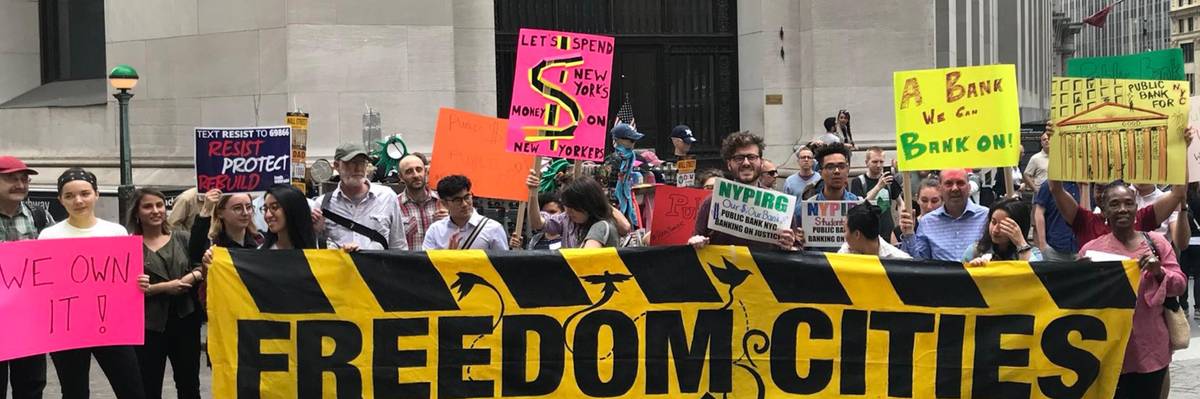
Demonstrators rally in support of public banking in New York City on June 5, 2018. (Photo: Dave Colon/Twitter)
Over 150 advocacy groups from across the Empire State Tuesday sent a letter to New York legislative leaders urging them to follow in the footsteps of places like North Dakota, Germany, and Costa Rica and pass legislation allowing the creation of public banks that would help "advance racial equity and ensure a just recovery for all New Yorkers."
"We need to divest from destructive Wall Street banks and invest in our communities!"
"Our organizations are fighting for public banks that have a clear mission to advance racial, economic, and environmental justice," the letter supporting the New York Public Banking Act states. "With these principles at their core, public banks would reinvest in New York's low-income and immigrant neighborhoods and neighborhoods of color, meeting critical community needs and strengthening our ability to withstand future crises."
"Wall Street banks have for decades blocked low-income people, immigrants, and people of color from mainstream banking," the letter continues, "relegating them to high-cost, predatory financial services that extract massive amounts of wealth from communities and perpetuate poverty and inequality."
"Public banks would partner with our state's numerous community-based lenders to deliver responsible financing and emergency funding to small and worker-owned businesses--including MWBEs--hardest hit by Covid-19," the authors write, referring to New York state's Minority- and Women- Owned Business Enterprise Program.
"They would invest in economic development initiatives that build, rather than extract, wealth, such as permanently affordable housing, community-controlled renewable energy, and more," they argue. "And they would expand access to high-quality, affordable banking services in New York's historically-redlined communities of color."
The letter continues:
Public banking is a proven model; it is common throughout the world, from Costa Rica to Germany. In the U.S., the Bank of North Dakota has successfully financed public projects and made responsible loans to small businesses, farmers, and others for more than a century. Recently, California enacted legislation to facilitate public banking at the local level. It's time for New York to take action and usher in democratic financial institutions that meet the needs of New York's communities, during the Covid-19 crisis and beyond.
Voicing support for the proposed legislation, Democratic New York City Councilwoman Tiffany Caban said in a statement that "it is time our city and state declared independence from Wall Street."
"As long as we bank with massive for-profit financial firms, we will be helping the rich get richer and the poor poorer, creating financial insecurity for unbanked and underbanked working-class New Yorkers, and reinforcing racist inequalities," she continued. "It is high time we adopted a public bank, to allow us to invest in key pillars of safe, stable families and neighborhoods, such as permanently affordable housing, community-controlled clean energy, vital infrastructure, worker-owned businesses, community-development credit unions, and more."
State Assemblymember Amanda Septimo (D-84) added that "as New York prepares to rebuild from the Covid-19 pandemic, we have an opportunity to make way for financial infrastructure that will empower all New Yorkers across the state."
"Passing the New York Public Banking Act will open pathways for economic growth in everything from business to homeownership, and put underserved communities on the path to prosperity," she asserted. "From the South Bronx to Buffalo, New Yorkers will benefit from public financing services that will prioritize access, affordability, and growth, all while putting local dollars to work."
Dear Common Dreams reader, It’s been nearly 30 years since I co-founded Common Dreams with my late wife, Lina Newhouser. We had the radical notion that journalism should serve the public good, not corporate profits. It was clear to us from the outset what it would take to build such a project. No paid advertisements. No corporate sponsors. No millionaire publisher telling us what to think or do. Many people said we wouldn't last a year, but we proved those doubters wrong. Together with a tremendous team of journalists and dedicated staff, we built an independent media outlet free from the constraints of profits and corporate control. Our mission has always been simple: To inform. To inspire. To ignite change for the common good. Building Common Dreams was not easy. Our survival was never guaranteed. When you take on the most powerful forces—Wall Street greed, fossil fuel industry destruction, Big Tech lobbyists, and uber-rich oligarchs who have spent billions upon billions rigging the economy and democracy in their favor—the only bulwark you have is supporters who believe in your work. But here’s the urgent message from me today. It's never been this bad out there. And it's never been this hard to keep us going. At the very moment Common Dreams is most needed, the threats we face are intensifying. We need your support now more than ever. We don't accept corporate advertising and never will. We don't have a paywall because we don't think people should be blocked from critical news based on their ability to pay. Everything we do is funded by the donations of readers like you. When everyone does the little they can afford, we are strong. But if that support retreats or dries up, so do we. Will you donate now to make sure Common Dreams not only survives but thrives? —Craig Brown, Co-founder |
Over 150 advocacy groups from across the Empire State Tuesday sent a letter to New York legislative leaders urging them to follow in the footsteps of places like North Dakota, Germany, and Costa Rica and pass legislation allowing the creation of public banks that would help "advance racial equity and ensure a just recovery for all New Yorkers."
"We need to divest from destructive Wall Street banks and invest in our communities!"
"Our organizations are fighting for public banks that have a clear mission to advance racial, economic, and environmental justice," the letter supporting the New York Public Banking Act states. "With these principles at their core, public banks would reinvest in New York's low-income and immigrant neighborhoods and neighborhoods of color, meeting critical community needs and strengthening our ability to withstand future crises."
"Wall Street banks have for decades blocked low-income people, immigrants, and people of color from mainstream banking," the letter continues, "relegating them to high-cost, predatory financial services that extract massive amounts of wealth from communities and perpetuate poverty and inequality."
"Public banks would partner with our state's numerous community-based lenders to deliver responsible financing and emergency funding to small and worker-owned businesses--including MWBEs--hardest hit by Covid-19," the authors write, referring to New York state's Minority- and Women- Owned Business Enterprise Program.
"They would invest in economic development initiatives that build, rather than extract, wealth, such as permanently affordable housing, community-controlled renewable energy, and more," they argue. "And they would expand access to high-quality, affordable banking services in New York's historically-redlined communities of color."
The letter continues:
Public banking is a proven model; it is common throughout the world, from Costa Rica to Germany. In the U.S., the Bank of North Dakota has successfully financed public projects and made responsible loans to small businesses, farmers, and others for more than a century. Recently, California enacted legislation to facilitate public banking at the local level. It's time for New York to take action and usher in democratic financial institutions that meet the needs of New York's communities, during the Covid-19 crisis and beyond.
Voicing support for the proposed legislation, Democratic New York City Councilwoman Tiffany Caban said in a statement that "it is time our city and state declared independence from Wall Street."
"As long as we bank with massive for-profit financial firms, we will be helping the rich get richer and the poor poorer, creating financial insecurity for unbanked and underbanked working-class New Yorkers, and reinforcing racist inequalities," she continued. "It is high time we adopted a public bank, to allow us to invest in key pillars of safe, stable families and neighborhoods, such as permanently affordable housing, community-controlled clean energy, vital infrastructure, worker-owned businesses, community-development credit unions, and more."
State Assemblymember Amanda Septimo (D-84) added that "as New York prepares to rebuild from the Covid-19 pandemic, we have an opportunity to make way for financial infrastructure that will empower all New Yorkers across the state."
"Passing the New York Public Banking Act will open pathways for economic growth in everything from business to homeownership, and put underserved communities on the path to prosperity," she asserted. "From the South Bronx to Buffalo, New Yorkers will benefit from public financing services that will prioritize access, affordability, and growth, all while putting local dollars to work."
Over 150 advocacy groups from across the Empire State Tuesday sent a letter to New York legislative leaders urging them to follow in the footsteps of places like North Dakota, Germany, and Costa Rica and pass legislation allowing the creation of public banks that would help "advance racial equity and ensure a just recovery for all New Yorkers."
"We need to divest from destructive Wall Street banks and invest in our communities!"
"Our organizations are fighting for public banks that have a clear mission to advance racial, economic, and environmental justice," the letter supporting the New York Public Banking Act states. "With these principles at their core, public banks would reinvest in New York's low-income and immigrant neighborhoods and neighborhoods of color, meeting critical community needs and strengthening our ability to withstand future crises."
"Wall Street banks have for decades blocked low-income people, immigrants, and people of color from mainstream banking," the letter continues, "relegating them to high-cost, predatory financial services that extract massive amounts of wealth from communities and perpetuate poverty and inequality."
"Public banks would partner with our state's numerous community-based lenders to deliver responsible financing and emergency funding to small and worker-owned businesses--including MWBEs--hardest hit by Covid-19," the authors write, referring to New York state's Minority- and Women- Owned Business Enterprise Program.
"They would invest in economic development initiatives that build, rather than extract, wealth, such as permanently affordable housing, community-controlled renewable energy, and more," they argue. "And they would expand access to high-quality, affordable banking services in New York's historically-redlined communities of color."
The letter continues:
Public banking is a proven model; it is common throughout the world, from Costa Rica to Germany. In the U.S., the Bank of North Dakota has successfully financed public projects and made responsible loans to small businesses, farmers, and others for more than a century. Recently, California enacted legislation to facilitate public banking at the local level. It's time for New York to take action and usher in democratic financial institutions that meet the needs of New York's communities, during the Covid-19 crisis and beyond.
Voicing support for the proposed legislation, Democratic New York City Councilwoman Tiffany Caban said in a statement that "it is time our city and state declared independence from Wall Street."
"As long as we bank with massive for-profit financial firms, we will be helping the rich get richer and the poor poorer, creating financial insecurity for unbanked and underbanked working-class New Yorkers, and reinforcing racist inequalities," she continued. "It is high time we adopted a public bank, to allow us to invest in key pillars of safe, stable families and neighborhoods, such as permanently affordable housing, community-controlled clean energy, vital infrastructure, worker-owned businesses, community-development credit unions, and more."
State Assemblymember Amanda Septimo (D-84) added that "as New York prepares to rebuild from the Covid-19 pandemic, we have an opportunity to make way for financial infrastructure that will empower all New Yorkers across the state."
"Passing the New York Public Banking Act will open pathways for economic growth in everything from business to homeownership, and put underserved communities on the path to prosperity," she asserted. "From the South Bronx to Buffalo, New Yorkers will benefit from public financing services that will prioritize access, affordability, and growth, all while putting local dollars to work."

