

SUBSCRIBE TO OUR FREE NEWSLETTER
Daily news & progressive opinion—funded by the people, not the corporations—delivered straight to your inbox.
5
#000000
#FFFFFF
To donate by check, phone, or other method, see our More Ways to Give page.
Daily news & progressive opinion—funded by the people, not the corporations—delivered straight to your inbox.
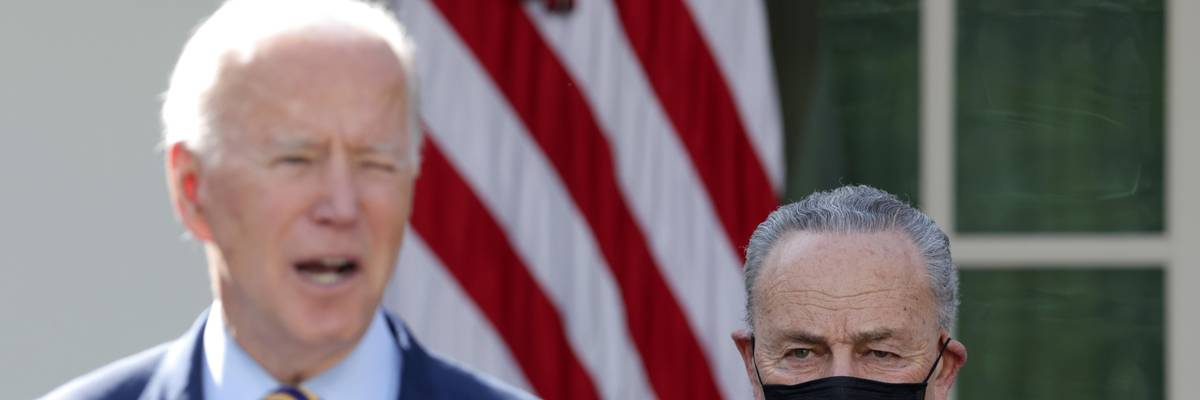
Senate Majority Leader Sen. Chuck Schumer (D-N.Y.) (R) listens as President Joe Biden speaks during an event on the American Rescue Plan in the Rose Garden of the White House on March 12, 2021 in Washington, D.C. (Photo: Alex Wong/Getty Images)
Just ahead of Senate Majority Leader Chuck Schumer announcing a vote on repealing the Iraq war authorization later this year, the White House this week declared its support for legislation to end the 2002 measure--a development welcomed by Democratic lawmakers and progressive groups that have demanded an end to "endless wars."
At issue is Rep. Barbara Lee's (D-Calif.) H.R. 256, which would repeal the Authorization for Use of Military Force (AUMF) Against Iraq Resolution of 2002 that passed in the wake of the September 11 attacks. The repeal measure--whose supporters now include even right-wing groups like Americans for Prosperity--has 134 bipartisan co-sponsors. The House is set to vote on the bill Thursday.
In a statement of administrative policy released (pdf) Monday announcing support for H.R. 256, the Biden administration said that "the United States has no ongoing military activities that rely solely on the 2002 AUMF as a domestic legal basis, and repeal of the 2002 AUMF would likely have minimal impact on current military operations." The statement also declares President Joe Biden's commitment to working "with the Congress on repealing and replacing other existing authorizations of military force."
Lee called it "great news" that Biden "is on board with my legislation to repeal the 2002 AUMF, which Congress will vote on this week."
"This is a long overdue step toward ending our forever wars," she tweeted.
The Friends Committee on National Legislation (FCNL) also welcomed the development as "big news."
"This marks the first time in memory that a president has called for the repeal of a war authorization, a significant step towards ending the forever wars," said Diana Ohlbaum, FCNL's senior strategist and legislative director for foreign policy, in a statement.
"The 2002 Iraq AUMF authorized war against the Saddam Hussein regime. That war ended years ago, but the war authorization remains on the books, leaving it susceptible to abuse by any president," Ohlbaum said. She cited as one example then-President Donald Trump's use of it in January 2020 to justify the U.S. assassination of Iranian Major Gen. Qassem Soleimani.
On Wednesday, Schumer (D-N.Y.) announced support for repealing the 2002 authorization, saying on the Senate floor that it "no longer serves a vital purpose in our fight against violent extremists."
"I strongly and fully support repealing the 2002 authorization for the use of military force in Iraq," he said. "It is my intention as majority leader to bring this matter to a floor vote this year."
Schumer said that the Senate Foreign Relations Committee would next week mark up legislation from Sens. Tim Kaine (D-Va.) and Todd Young (R-Ind.) to repeal the 1991 and 2002 AUMFs.
Kaine said in a statement that he was "grateful" to see the legislation moving forward.
"So much has changed since 1991 and 2002: Saddam Hussein's regime is gone; the Gulf and Iraq Wars are over; and Iraq is now a close security partner who should not be labeled an enemy state. Foreign Relations Committee action on our AUMF repeal bill represents a bipartisan recognition of these truths," added Kaine, "and a widespread desire to not keep old war authorizations on the books."
According to FCNL, the legislative movement comes down to dogged activism from the grassroots.
The "2002 Iraq AUMF repeal wasn't on the radar of Congress for years," the group tweeted. "Now, we've got a full House vote this week and a Senate committee markup next week. Advocates made this happen!"
Dear Common Dreams reader, It’s been nearly 30 years since I co-founded Common Dreams with my late wife, Lina Newhouser. We had the radical notion that journalism should serve the public good, not corporate profits. It was clear to us from the outset what it would take to build such a project. No paid advertisements. No corporate sponsors. No millionaire publisher telling us what to think or do. Many people said we wouldn't last a year, but we proved those doubters wrong. Together with a tremendous team of journalists and dedicated staff, we built an independent media outlet free from the constraints of profits and corporate control. Our mission has always been simple: To inform. To inspire. To ignite change for the common good. Building Common Dreams was not easy. Our survival was never guaranteed. When you take on the most powerful forces—Wall Street greed, fossil fuel industry destruction, Big Tech lobbyists, and uber-rich oligarchs who have spent billions upon billions rigging the economy and democracy in their favor—the only bulwark you have is supporters who believe in your work. But here’s the urgent message from me today. It's never been this bad out there. And it's never been this hard to keep us going. At the very moment Common Dreams is most needed, the threats we face are intensifying. We need your support now more than ever. We don't accept corporate advertising and never will. We don't have a paywall because we don't think people should be blocked from critical news based on their ability to pay. Everything we do is funded by the donations of readers like you. When everyone does the little they can afford, we are strong. But if that support retreats or dries up, so do we. Will you donate now to make sure Common Dreams not only survives but thrives? —Craig Brown, Co-founder |
Just ahead of Senate Majority Leader Chuck Schumer announcing a vote on repealing the Iraq war authorization later this year, the White House this week declared its support for legislation to end the 2002 measure--a development welcomed by Democratic lawmakers and progressive groups that have demanded an end to "endless wars."
At issue is Rep. Barbara Lee's (D-Calif.) H.R. 256, which would repeal the Authorization for Use of Military Force (AUMF) Against Iraq Resolution of 2002 that passed in the wake of the September 11 attacks. The repeal measure--whose supporters now include even right-wing groups like Americans for Prosperity--has 134 bipartisan co-sponsors. The House is set to vote on the bill Thursday.
In a statement of administrative policy released (pdf) Monday announcing support for H.R. 256, the Biden administration said that "the United States has no ongoing military activities that rely solely on the 2002 AUMF as a domestic legal basis, and repeal of the 2002 AUMF would likely have minimal impact on current military operations." The statement also declares President Joe Biden's commitment to working "with the Congress on repealing and replacing other existing authorizations of military force."
Lee called it "great news" that Biden "is on board with my legislation to repeal the 2002 AUMF, which Congress will vote on this week."
"This is a long overdue step toward ending our forever wars," she tweeted.
The Friends Committee on National Legislation (FCNL) also welcomed the development as "big news."
"This marks the first time in memory that a president has called for the repeal of a war authorization, a significant step towards ending the forever wars," said Diana Ohlbaum, FCNL's senior strategist and legislative director for foreign policy, in a statement.
"The 2002 Iraq AUMF authorized war against the Saddam Hussein regime. That war ended years ago, but the war authorization remains on the books, leaving it susceptible to abuse by any president," Ohlbaum said. She cited as one example then-President Donald Trump's use of it in January 2020 to justify the U.S. assassination of Iranian Major Gen. Qassem Soleimani.
On Wednesday, Schumer (D-N.Y.) announced support for repealing the 2002 authorization, saying on the Senate floor that it "no longer serves a vital purpose in our fight against violent extremists."
"I strongly and fully support repealing the 2002 authorization for the use of military force in Iraq," he said. "It is my intention as majority leader to bring this matter to a floor vote this year."
Schumer said that the Senate Foreign Relations Committee would next week mark up legislation from Sens. Tim Kaine (D-Va.) and Todd Young (R-Ind.) to repeal the 1991 and 2002 AUMFs.
Kaine said in a statement that he was "grateful" to see the legislation moving forward.
"So much has changed since 1991 and 2002: Saddam Hussein's regime is gone; the Gulf and Iraq Wars are over; and Iraq is now a close security partner who should not be labeled an enemy state. Foreign Relations Committee action on our AUMF repeal bill represents a bipartisan recognition of these truths," added Kaine, "and a widespread desire to not keep old war authorizations on the books."
According to FCNL, the legislative movement comes down to dogged activism from the grassroots.
The "2002 Iraq AUMF repeal wasn't on the radar of Congress for years," the group tweeted. "Now, we've got a full House vote this week and a Senate committee markup next week. Advocates made this happen!"
Just ahead of Senate Majority Leader Chuck Schumer announcing a vote on repealing the Iraq war authorization later this year, the White House this week declared its support for legislation to end the 2002 measure--a development welcomed by Democratic lawmakers and progressive groups that have demanded an end to "endless wars."
At issue is Rep. Barbara Lee's (D-Calif.) H.R. 256, which would repeal the Authorization for Use of Military Force (AUMF) Against Iraq Resolution of 2002 that passed in the wake of the September 11 attacks. The repeal measure--whose supporters now include even right-wing groups like Americans for Prosperity--has 134 bipartisan co-sponsors. The House is set to vote on the bill Thursday.
In a statement of administrative policy released (pdf) Monday announcing support for H.R. 256, the Biden administration said that "the United States has no ongoing military activities that rely solely on the 2002 AUMF as a domestic legal basis, and repeal of the 2002 AUMF would likely have minimal impact on current military operations." The statement also declares President Joe Biden's commitment to working "with the Congress on repealing and replacing other existing authorizations of military force."
Lee called it "great news" that Biden "is on board with my legislation to repeal the 2002 AUMF, which Congress will vote on this week."
"This is a long overdue step toward ending our forever wars," she tweeted.
The Friends Committee on National Legislation (FCNL) also welcomed the development as "big news."
"This marks the first time in memory that a president has called for the repeal of a war authorization, a significant step towards ending the forever wars," said Diana Ohlbaum, FCNL's senior strategist and legislative director for foreign policy, in a statement.
"The 2002 Iraq AUMF authorized war against the Saddam Hussein regime. That war ended years ago, but the war authorization remains on the books, leaving it susceptible to abuse by any president," Ohlbaum said. She cited as one example then-President Donald Trump's use of it in January 2020 to justify the U.S. assassination of Iranian Major Gen. Qassem Soleimani.
On Wednesday, Schumer (D-N.Y.) announced support for repealing the 2002 authorization, saying on the Senate floor that it "no longer serves a vital purpose in our fight against violent extremists."
"I strongly and fully support repealing the 2002 authorization for the use of military force in Iraq," he said. "It is my intention as majority leader to bring this matter to a floor vote this year."
Schumer said that the Senate Foreign Relations Committee would next week mark up legislation from Sens. Tim Kaine (D-Va.) and Todd Young (R-Ind.) to repeal the 1991 and 2002 AUMFs.
Kaine said in a statement that he was "grateful" to see the legislation moving forward.
"So much has changed since 1991 and 2002: Saddam Hussein's regime is gone; the Gulf and Iraq Wars are over; and Iraq is now a close security partner who should not be labeled an enemy state. Foreign Relations Committee action on our AUMF repeal bill represents a bipartisan recognition of these truths," added Kaine, "and a widespread desire to not keep old war authorizations on the books."
According to FCNL, the legislative movement comes down to dogged activism from the grassroots.
The "2002 Iraq AUMF repeal wasn't on the radar of Congress for years," the group tweeted. "Now, we've got a full House vote this week and a Senate committee markup next week. Advocates made this happen!"

