SUBSCRIBE TO OUR FREE NEWSLETTER
Daily news & progressive opinion—funded by the people, not the corporations—delivered straight to your inbox.
5
#000000
#FFFFFF
To donate by check, phone, or other method, see our More Ways to Give page.
Daily news & progressive opinion—funded by the people, not the corporations—delivered straight to your inbox.
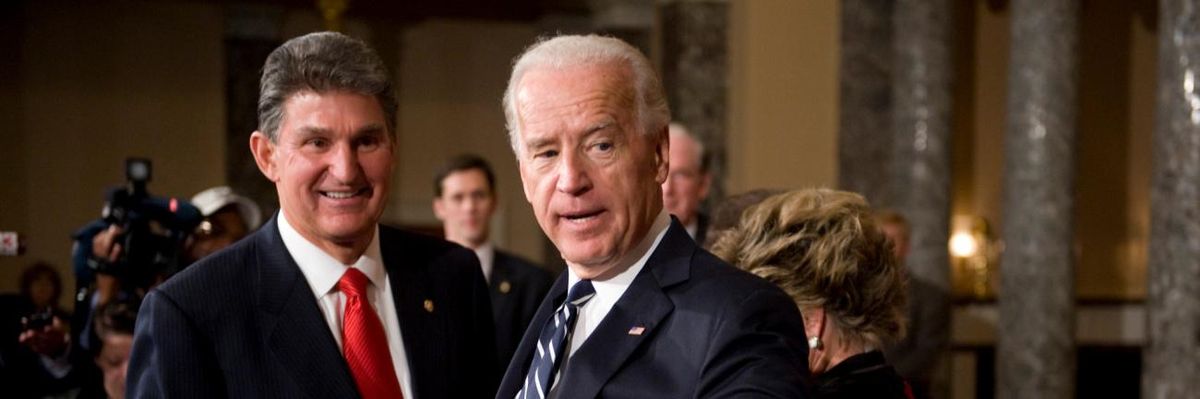
Sen. Joe Manchin (D-W.V.) talks with then-Vice President Joe Biden in the Old Senate Chamber. (Photo: Tom Williams/Roll Call)
Monday brought fresh outrage among climate campaigners after the G7 Summit ended without a commitment to ending coal extraction in some of the world's richest countries.
Five of the seven delegations--all but the U.S. and Japan--supported phasing out coal by 2040, but as Politico reported, the Biden administration forced the group to steer clear of language in its final statement that would point to the end of coal.
"The long arm of Joe Manchin reaches across the Atlantic," tweeted Politico editor Blake Hounsell.
The G7's final communique committed only to accelerating "the transition away from unabated coal capacity," with no end date, in an apparent bid to appease Democratic Sen. Joe Manchin of West Virginia--the nation's second largest coal producer--as President Joe Biden pushes the Senate to approve his infrastructure package.
Manchin has sparked fury among progressives in recent weeks by refusing to back the For the People Act, claiming the voting rights legislation is not sufficiently bipartisan despite its broad support among voters across the political spectrum.
"Once again Joe Manchin is casting a heavy shadow," Alden Meyer, a senior associate at European environmental think tank E3G, told the New York Times.
Artist Price Garrison added angrily on social media, "We don't have any time left for this bullshit."
The International Energy Agency (IEA) said recently that global coal use must be cut in half during this decade in order to limit global heating to 1.5 degrees Celsius and reach net zero carbon emissions by 2050. The G7 said in its final statement that it supports those goals--without backing the steps needed to achieve them due to the Biden administration's and Japan's refusal.
"It's very disappointing," Jennifer Morgan, executive director of Greenpeace International, told the Times. "This was a moment when the G7 could have shown historic leadership, and instead they left a massive void."
In the U.S., evidence has emerged in recent years that Manchin's allegiance to coal is unpopular among a growing number of voters. A 2018 survey by the University of Michigan found that 46% of voters in states with coal mines supported phasing out coal-fired power plants, compared to 36% who opposed the plan.
More recently, as Common Dreams reported in April, the largest union representing coal miners said it would support a transition to renewable energy in the U.S. provided policymakers ensure there is a just transition with green jobs provided for workers and income support for those who go through periods of unemployment.
At the weekend summit, the U.S. did support a $2 billion fund to support new energy industries and a just transition in developing countries and a global infrastructure plan called Build Back Better World--but the Americans did not pledge any new funding to help poor countries mitigate the climate crisis and it was unclear how the infrastructure plan would be fully funded.
"In the face of the perfect storm of planetary crises--climate, Covid, injustice, and ecosystem collapse--the world's richest democracies have responded with a plan to make a plan," Laurence Tubiana, CEO of the European Climate Foundation, told Politico.
The Biden administration seemed intent on contrasting its approach to the climate crisis with that of the previous administration, in which former President Donald Trump failed to even accept the scientific consensus that the Earth is growing warmer due to human activity.
"While the previous administration ignored the science and consequences of climate change, our administration has taken unprecedented actions to prioritize this on the global stage," Daleep Singh, deputy national security adviser, told the Times.
But U.S. progressives as well as leaders in the Global South were unimpressed with the results of the summit, with Pakistani climate minister Malik Amin Aslam calling the final statement a "huge disappointment."
"At the least, countries responsible for this inescapable crisis need to live up to their stated commitments, otherwise the climate negotiations could well end in futility," Aslam told the Times.
Dear Common Dreams reader, It’s been nearly 30 years since I co-founded Common Dreams with my late wife, Lina Newhouser. We had the radical notion that journalism should serve the public good, not corporate profits. It was clear to us from the outset what it would take to build such a project. No paid advertisements. No corporate sponsors. No millionaire publisher telling us what to think or do. Many people said we wouldn't last a year, but we proved those doubters wrong. Together with a tremendous team of journalists and dedicated staff, we built an independent media outlet free from the constraints of profits and corporate control. Our mission has always been simple: To inform. To inspire. To ignite change for the common good. Building Common Dreams was not easy. Our survival was never guaranteed. When you take on the most powerful forces—Wall Street greed, fossil fuel industry destruction, Big Tech lobbyists, and uber-rich oligarchs who have spent billions upon billions rigging the economy and democracy in their favor—the only bulwark you have is supporters who believe in your work. But here’s the urgent message from me today. It's never been this bad out there. And it's never been this hard to keep us going. At the very moment Common Dreams is most needed, the threats we face are intensifying. We need your support now more than ever. We don't accept corporate advertising and never will. We don't have a paywall because we don't think people should be blocked from critical news based on their ability to pay. Everything we do is funded by the donations of readers like you. When everyone does the little they can afford, we are strong. But if that support retreats or dries up, so do we. Will you donate now to make sure Common Dreams not only survives but thrives? —Craig Brown, Co-founder |
Monday brought fresh outrage among climate campaigners after the G7 Summit ended without a commitment to ending coal extraction in some of the world's richest countries.
Five of the seven delegations--all but the U.S. and Japan--supported phasing out coal by 2040, but as Politico reported, the Biden administration forced the group to steer clear of language in its final statement that would point to the end of coal.
"The long arm of Joe Manchin reaches across the Atlantic," tweeted Politico editor Blake Hounsell.
The G7's final communique committed only to accelerating "the transition away from unabated coal capacity," with no end date, in an apparent bid to appease Democratic Sen. Joe Manchin of West Virginia--the nation's second largest coal producer--as President Joe Biden pushes the Senate to approve his infrastructure package.
Manchin has sparked fury among progressives in recent weeks by refusing to back the For the People Act, claiming the voting rights legislation is not sufficiently bipartisan despite its broad support among voters across the political spectrum.
"Once again Joe Manchin is casting a heavy shadow," Alden Meyer, a senior associate at European environmental think tank E3G, told the New York Times.
Artist Price Garrison added angrily on social media, "We don't have any time left for this bullshit."
The International Energy Agency (IEA) said recently that global coal use must be cut in half during this decade in order to limit global heating to 1.5 degrees Celsius and reach net zero carbon emissions by 2050. The G7 said in its final statement that it supports those goals--without backing the steps needed to achieve them due to the Biden administration's and Japan's refusal.
"It's very disappointing," Jennifer Morgan, executive director of Greenpeace International, told the Times. "This was a moment when the G7 could have shown historic leadership, and instead they left a massive void."
In the U.S., evidence has emerged in recent years that Manchin's allegiance to coal is unpopular among a growing number of voters. A 2018 survey by the University of Michigan found that 46% of voters in states with coal mines supported phasing out coal-fired power plants, compared to 36% who opposed the plan.
More recently, as Common Dreams reported in April, the largest union representing coal miners said it would support a transition to renewable energy in the U.S. provided policymakers ensure there is a just transition with green jobs provided for workers and income support for those who go through periods of unemployment.
At the weekend summit, the U.S. did support a $2 billion fund to support new energy industries and a just transition in developing countries and a global infrastructure plan called Build Back Better World--but the Americans did not pledge any new funding to help poor countries mitigate the climate crisis and it was unclear how the infrastructure plan would be fully funded.
"In the face of the perfect storm of planetary crises--climate, Covid, injustice, and ecosystem collapse--the world's richest democracies have responded with a plan to make a plan," Laurence Tubiana, CEO of the European Climate Foundation, told Politico.
The Biden administration seemed intent on contrasting its approach to the climate crisis with that of the previous administration, in which former President Donald Trump failed to even accept the scientific consensus that the Earth is growing warmer due to human activity.
"While the previous administration ignored the science and consequences of climate change, our administration has taken unprecedented actions to prioritize this on the global stage," Daleep Singh, deputy national security adviser, told the Times.
But U.S. progressives as well as leaders in the Global South were unimpressed with the results of the summit, with Pakistani climate minister Malik Amin Aslam calling the final statement a "huge disappointment."
"At the least, countries responsible for this inescapable crisis need to live up to their stated commitments, otherwise the climate negotiations could well end in futility," Aslam told the Times.
Monday brought fresh outrage among climate campaigners after the G7 Summit ended without a commitment to ending coal extraction in some of the world's richest countries.
Five of the seven delegations--all but the U.S. and Japan--supported phasing out coal by 2040, but as Politico reported, the Biden administration forced the group to steer clear of language in its final statement that would point to the end of coal.
"The long arm of Joe Manchin reaches across the Atlantic," tweeted Politico editor Blake Hounsell.
The G7's final communique committed only to accelerating "the transition away from unabated coal capacity," with no end date, in an apparent bid to appease Democratic Sen. Joe Manchin of West Virginia--the nation's second largest coal producer--as President Joe Biden pushes the Senate to approve his infrastructure package.
Manchin has sparked fury among progressives in recent weeks by refusing to back the For the People Act, claiming the voting rights legislation is not sufficiently bipartisan despite its broad support among voters across the political spectrum.
"Once again Joe Manchin is casting a heavy shadow," Alden Meyer, a senior associate at European environmental think tank E3G, told the New York Times.
Artist Price Garrison added angrily on social media, "We don't have any time left for this bullshit."
The International Energy Agency (IEA) said recently that global coal use must be cut in half during this decade in order to limit global heating to 1.5 degrees Celsius and reach net zero carbon emissions by 2050. The G7 said in its final statement that it supports those goals--without backing the steps needed to achieve them due to the Biden administration's and Japan's refusal.
"It's very disappointing," Jennifer Morgan, executive director of Greenpeace International, told the Times. "This was a moment when the G7 could have shown historic leadership, and instead they left a massive void."
In the U.S., evidence has emerged in recent years that Manchin's allegiance to coal is unpopular among a growing number of voters. A 2018 survey by the University of Michigan found that 46% of voters in states with coal mines supported phasing out coal-fired power plants, compared to 36% who opposed the plan.
More recently, as Common Dreams reported in April, the largest union representing coal miners said it would support a transition to renewable energy in the U.S. provided policymakers ensure there is a just transition with green jobs provided for workers and income support for those who go through periods of unemployment.
At the weekend summit, the U.S. did support a $2 billion fund to support new energy industries and a just transition in developing countries and a global infrastructure plan called Build Back Better World--but the Americans did not pledge any new funding to help poor countries mitigate the climate crisis and it was unclear how the infrastructure plan would be fully funded.
"In the face of the perfect storm of planetary crises--climate, Covid, injustice, and ecosystem collapse--the world's richest democracies have responded with a plan to make a plan," Laurence Tubiana, CEO of the European Climate Foundation, told Politico.
The Biden administration seemed intent on contrasting its approach to the climate crisis with that of the previous administration, in which former President Donald Trump failed to even accept the scientific consensus that the Earth is growing warmer due to human activity.
"While the previous administration ignored the science and consequences of climate change, our administration has taken unprecedented actions to prioritize this on the global stage," Daleep Singh, deputy national security adviser, told the Times.
But U.S. progressives as well as leaders in the Global South were unimpressed with the results of the summit, with Pakistani climate minister Malik Amin Aslam calling the final statement a "huge disappointment."
"At the least, countries responsible for this inescapable crisis need to live up to their stated commitments, otherwise the climate negotiations could well end in futility," Aslam told the Times.