SUBSCRIBE TO OUR FREE NEWSLETTER
Daily news & progressive opinion—funded by the people, not the corporations—delivered straight to your inbox.
5
#000000
#FFFFFF
To donate by check, phone, or other method, see our More Ways to Give page.
Daily news & progressive opinion—funded by the people, not the corporations—delivered straight to your inbox.
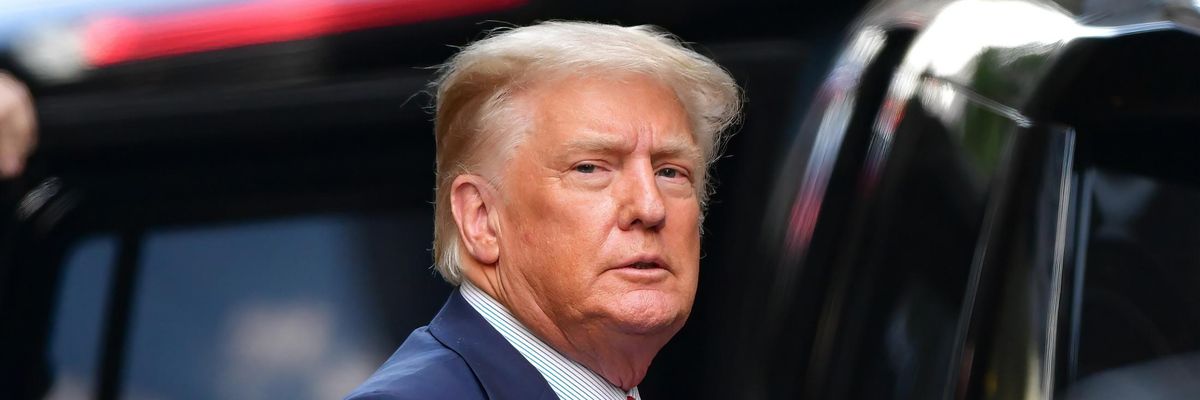
Former U.S. President Donald Trump leaves Trump Tower in Manhattan on May 18, 2021. (Photo: James Devaney/GC Images)
In a major step toward holding former President Donald Trump--who often spewed "law and order" rhetoric while in office--accountable for his various alleged crimes, Manhattan District Attorney Cyrus R. Vance Jr. has convened a grand jury that is set to decide whether to indict Trump, others at his company, or the business itself.
That's according to the Washington Post, which broke the news Tuesday evening, citing two unnamed sources, and reported that it suggests the Democratic D.A. "believes he has found evidence of a crime--if not by Trump then by someone potentially close to him or by his company." A spokesperson for Vance declined to comment.
Noting that "Vance has been a cautious prosecutor," Georgetown University public policy professor Donald Moynihan tweeted Tuesday that there is "no real reason to do this unless there is some solid evidence of wrongdoing in the Trump Organization."
While Trump has repeatedly denied any wrongdoing, neither a spokesperson for the Republican ex-president nor an attorney for the Trump Organization--which has been described as a "rat's nest of hundreds of ambiguous limited liability companies"--responded to the Post's requests for comment.
Critics of Trump, meanwhile, welcomed the newspaper's reporting.
U.S. Rep. Bill Pascrell (D-N.J.) pointed to his declaration from shortly after the November 2020 election that "Trump along with his worst enablers must be tried for their crimes against our nation and Constitution."
Last week, a spokesperson for Democratic New York Attorney General Letitia James announced that her office has "informed the Trump Organization that our investigation into the company is no longer purely civil in nature," and that it is "now actively investigating the Trump Organization in a criminal capacity, along with the Manhattan D.A."
Vance's decision to convene the special panel comes after more than two years of investigators in New York reviewing hush-money payments, executive compensation, property valuations, tax decisions, and other matters.
The D.A.'s probe has reportedly intensified since Trump left office--and in February, the U.S. Supreme Court rejected his attempt to block the enforcement of a subpoena for his tax returns and other financial documents.
The special grand jury "will sit three days a week for six months," and "is likely to hear several matters--not just the Trump case," according to the Post.
New York Law School professor Rebecca Roiphe, a former assistant district attorney in Manhattan, explained the potential significance of Vance's move to the paper:
Roiphe said the recent step of seating a long-term panel shows that Vance's investigation has progressed to the point that prosecutors will visit the grand jury, bring them evidence and witnesses, and potentially ask them to contemplate charges. They were unlikely to take that step without believing they had evidence to show there was probable cause to believe someone committed a crime, she said.
"The prosecutors are convinced they have a case. That's at least how I read it," Roiphe added.
Vance is planning to leave office at the end of the year; the Democratic primary for his replacement will be held next month.
In addition to the investigations in New York, Trump faces a criminal probe into alleged election interference in Georgia.
Dear Common Dreams reader, It’s been nearly 30 years since I co-founded Common Dreams with my late wife, Lina Newhouser. We had the radical notion that journalism should serve the public good, not corporate profits. It was clear to us from the outset what it would take to build such a project. No paid advertisements. No corporate sponsors. No millionaire publisher telling us what to think or do. Many people said we wouldn't last a year, but we proved those doubters wrong. Together with a tremendous team of journalists and dedicated staff, we built an independent media outlet free from the constraints of profits and corporate control. Our mission has always been simple: To inform. To inspire. To ignite change for the common good. Building Common Dreams was not easy. Our survival was never guaranteed. When you take on the most powerful forces—Wall Street greed, fossil fuel industry destruction, Big Tech lobbyists, and uber-rich oligarchs who have spent billions upon billions rigging the economy and democracy in their favor—the only bulwark you have is supporters who believe in your work. But here’s the urgent message from me today. It's never been this bad out there. And it's never been this hard to keep us going. At the very moment Common Dreams is most needed, the threats we face are intensifying. We need your support now more than ever. We don't accept corporate advertising and never will. We don't have a paywall because we don't think people should be blocked from critical news based on their ability to pay. Everything we do is funded by the donations of readers like you. When everyone does the little they can afford, we are strong. But if that support retreats or dries up, so do we. Will you donate now to make sure Common Dreams not only survives but thrives? —Craig Brown, Co-founder |
In a major step toward holding former President Donald Trump--who often spewed "law and order" rhetoric while in office--accountable for his various alleged crimes, Manhattan District Attorney Cyrus R. Vance Jr. has convened a grand jury that is set to decide whether to indict Trump, others at his company, or the business itself.
That's according to the Washington Post, which broke the news Tuesday evening, citing two unnamed sources, and reported that it suggests the Democratic D.A. "believes he has found evidence of a crime--if not by Trump then by someone potentially close to him or by his company." A spokesperson for Vance declined to comment.
Noting that "Vance has been a cautious prosecutor," Georgetown University public policy professor Donald Moynihan tweeted Tuesday that there is "no real reason to do this unless there is some solid evidence of wrongdoing in the Trump Organization."
While Trump has repeatedly denied any wrongdoing, neither a spokesperson for the Republican ex-president nor an attorney for the Trump Organization--which has been described as a "rat's nest of hundreds of ambiguous limited liability companies"--responded to the Post's requests for comment.
Critics of Trump, meanwhile, welcomed the newspaper's reporting.
U.S. Rep. Bill Pascrell (D-N.J.) pointed to his declaration from shortly after the November 2020 election that "Trump along with his worst enablers must be tried for their crimes against our nation and Constitution."
Last week, a spokesperson for Democratic New York Attorney General Letitia James announced that her office has "informed the Trump Organization that our investigation into the company is no longer purely civil in nature," and that it is "now actively investigating the Trump Organization in a criminal capacity, along with the Manhattan D.A."
Vance's decision to convene the special panel comes after more than two years of investigators in New York reviewing hush-money payments, executive compensation, property valuations, tax decisions, and other matters.
The D.A.'s probe has reportedly intensified since Trump left office--and in February, the U.S. Supreme Court rejected his attempt to block the enforcement of a subpoena for his tax returns and other financial documents.
The special grand jury "will sit three days a week for six months," and "is likely to hear several matters--not just the Trump case," according to the Post.
New York Law School professor Rebecca Roiphe, a former assistant district attorney in Manhattan, explained the potential significance of Vance's move to the paper:
Roiphe said the recent step of seating a long-term panel shows that Vance's investigation has progressed to the point that prosecutors will visit the grand jury, bring them evidence and witnesses, and potentially ask them to contemplate charges. They were unlikely to take that step without believing they had evidence to show there was probable cause to believe someone committed a crime, she said.
"The prosecutors are convinced they have a case. That's at least how I read it," Roiphe added.
Vance is planning to leave office at the end of the year; the Democratic primary for his replacement will be held next month.
In addition to the investigations in New York, Trump faces a criminal probe into alleged election interference in Georgia.
In a major step toward holding former President Donald Trump--who often spewed "law and order" rhetoric while in office--accountable for his various alleged crimes, Manhattan District Attorney Cyrus R. Vance Jr. has convened a grand jury that is set to decide whether to indict Trump, others at his company, or the business itself.
That's according to the Washington Post, which broke the news Tuesday evening, citing two unnamed sources, and reported that it suggests the Democratic D.A. "believes he has found evidence of a crime--if not by Trump then by someone potentially close to him or by his company." A spokesperson for Vance declined to comment.
Noting that "Vance has been a cautious prosecutor," Georgetown University public policy professor Donald Moynihan tweeted Tuesday that there is "no real reason to do this unless there is some solid evidence of wrongdoing in the Trump Organization."
While Trump has repeatedly denied any wrongdoing, neither a spokesperson for the Republican ex-president nor an attorney for the Trump Organization--which has been described as a "rat's nest of hundreds of ambiguous limited liability companies"--responded to the Post's requests for comment.
Critics of Trump, meanwhile, welcomed the newspaper's reporting.
U.S. Rep. Bill Pascrell (D-N.J.) pointed to his declaration from shortly after the November 2020 election that "Trump along with his worst enablers must be tried for their crimes against our nation and Constitution."
Last week, a spokesperson for Democratic New York Attorney General Letitia James announced that her office has "informed the Trump Organization that our investigation into the company is no longer purely civil in nature," and that it is "now actively investigating the Trump Organization in a criminal capacity, along with the Manhattan D.A."
Vance's decision to convene the special panel comes after more than two years of investigators in New York reviewing hush-money payments, executive compensation, property valuations, tax decisions, and other matters.
The D.A.'s probe has reportedly intensified since Trump left office--and in February, the U.S. Supreme Court rejected his attempt to block the enforcement of a subpoena for his tax returns and other financial documents.
The special grand jury "will sit three days a week for six months," and "is likely to hear several matters--not just the Trump case," according to the Post.
New York Law School professor Rebecca Roiphe, a former assistant district attorney in Manhattan, explained the potential significance of Vance's move to the paper:
Roiphe said the recent step of seating a long-term panel shows that Vance's investigation has progressed to the point that prosecutors will visit the grand jury, bring them evidence and witnesses, and potentially ask them to contemplate charges. They were unlikely to take that step without believing they had evidence to show there was probable cause to believe someone committed a crime, she said.
"The prosecutors are convinced they have a case. That's at least how I read it," Roiphe added.
Vance is planning to leave office at the end of the year; the Democratic primary for his replacement will be held next month.
In addition to the investigations in New York, Trump faces a criminal probe into alleged election interference in Georgia.