SUBSCRIBE TO OUR FREE NEWSLETTER
Daily news & progressive opinion—funded by the people, not the corporations—delivered straight to your inbox.
5
#000000
#FFFFFF
To donate by check, phone, or other method, see our More Ways to Give page.
Daily news & progressive opinion—funded by the people, not the corporations—delivered straight to your inbox.
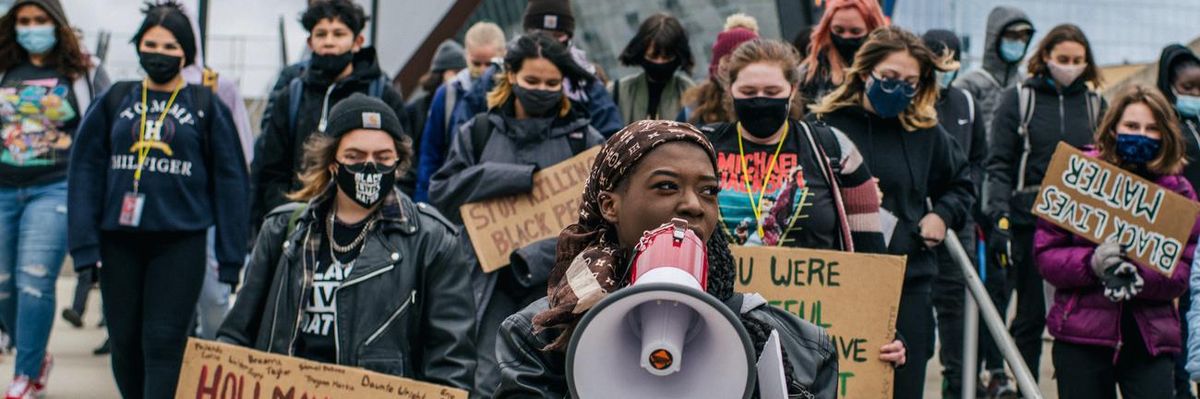
Roosevelt High School students and hundreds of other pupils from local schools took part in protests in downtown Minneapolis, Minnesota on April 19, 2021 as closing arguments were delivered in the trial of former police officer Derek Chauvin, who is accused of murdering unarmed Black man George Floyd last May.
The trial of former Minneapolis police officer Derek Chauvin--who is charged with second-degree unintentional murder, third-degree murder, and second-degree manslaughter in the death of unarmed Black man George Floyd last year--wrapped up on Monday as attorneys for both sides delivered lengthy closing statements as the city and nation began bracing for the jury's verdict.
"This case is exactly what you thought when you saw it first, when you saw that video."
--Steve Schleicher, prosecutor
Prosecutor Steve Schleicher opened by imploring the jury to use "common sense."
"What you saw, you saw," he said. "This case is exactly what you thought when you saw it first, when you saw that video."
"George Floyd's final words on May 25, 2020 were 'Please, I can't breathe,'" said Schleicher. "And he said those words to 'Mr. Officer.' He said those words to the defendant. He asked for help with his very last breath."
"The defendant heard him say that over and over," Schleicher continued. "He heard him, but he just didn't listen. He continued to push him down, to grind into him, to shimmy, to twist his hand for nine minutes and 29 seconds. He begged. George Floyd begged until he could speak no more, and the defendant continued this assault."
Schleicher added that Chuavin "had to know" that Floyd's life was in danger, yet continued pinning him to the street "with the unyielding pavement beneath him, as unyielding as the men who held him down."
Citing the Minneapolis Police Department's motto, "To protect with courage and to serve with compassion," and referring to May 25, 2020--the day the victim was killed--Schleicher said that "facing George Floyd that day that did not require one ounce of courage, and none was shown."
The prosecutor dismissed arguments by defense attorney Eric J. Nelson that Floyd died from a drug overdose, a bad heart, bystander-induced distraction, or emissions from a police car as "nonsense."
"This wasn't policing; this was murder," Schleicher concluded. "The defendant is guilty of all three counts. All of them. And there's no excuse."
Nelson's closing argument centered on the legal concept of reasonable doubt.
"In this case, the totality of the circumstances that were known to a reasonable police officer in the precise moment the force was used demonstrates that this was an authorized use of force, as unattractive as it may be," he argued. "And this is reasonable doubt."
At one point, Nelson repeated his earlier assertion that Floyd may have been feigning "a medical emergency in order to avoid being arrested."
After closing arguments cloncluded late Monday afternoon, Judge Peter Cahill further instructed the jury before its members were sequestered for deliberation.
Outside the Hennepin County Courthouse, the barbed wire and barriers manned by police and National Guard troops in anticipation of the jury's verdict were condemned by some of the Black Lives Matter and other protesters--many of them local high school students who walked out of class--gathered nearby.
More than 3,000 National Guard troops have been deployed in the Twin Cities in recent days, with more on standby. Hundreds of the protesters gathered outside the courthouse chanted "National Guard Go Home!"
In addition to protesting Floyd's killing, some of the students condemned recent police killings of young people.
"Last week, Adam Toledo, 13 years old. Just this week, Anthony Thompson Jr., 17 years old, who was shot at school," said one protester from Fridley High School in Minneapolis. "Since 2020, police have killed 21 young people. So if you thought police brutality was just for adults, you thought wrong. They're killing us. They're killing the young people. They're killing the future of this country."
Dear Common Dreams reader, It’s been nearly 30 years since I co-founded Common Dreams with my late wife, Lina Newhouser. We had the radical notion that journalism should serve the public good, not corporate profits. It was clear to us from the outset what it would take to build such a project. No paid advertisements. No corporate sponsors. No millionaire publisher telling us what to think or do. Many people said we wouldn't last a year, but we proved those doubters wrong. Together with a tremendous team of journalists and dedicated staff, we built an independent media outlet free from the constraints of profits and corporate control. Our mission has always been simple: To inform. To inspire. To ignite change for the common good. Building Common Dreams was not easy. Our survival was never guaranteed. When you take on the most powerful forces—Wall Street greed, fossil fuel industry destruction, Big Tech lobbyists, and uber-rich oligarchs who have spent billions upon billions rigging the economy and democracy in their favor—the only bulwark you have is supporters who believe in your work. But here’s the urgent message from me today. It's never been this bad out there. And it's never been this hard to keep us going. At the very moment Common Dreams is most needed, the threats we face are intensifying. We need your support now more than ever. We don't accept corporate advertising and never will. We don't have a paywall because we don't think people should be blocked from critical news based on their ability to pay. Everything we do is funded by the donations of readers like you. When everyone does the little they can afford, we are strong. But if that support retreats or dries up, so do we. Will you donate now to make sure Common Dreams not only survives but thrives? —Craig Brown, Co-founder |
The trial of former Minneapolis police officer Derek Chauvin--who is charged with second-degree unintentional murder, third-degree murder, and second-degree manslaughter in the death of unarmed Black man George Floyd last year--wrapped up on Monday as attorneys for both sides delivered lengthy closing statements as the city and nation began bracing for the jury's verdict.
"This case is exactly what you thought when you saw it first, when you saw that video."
--Steve Schleicher, prosecutor
Prosecutor Steve Schleicher opened by imploring the jury to use "common sense."
"What you saw, you saw," he said. "This case is exactly what you thought when you saw it first, when you saw that video."
"George Floyd's final words on May 25, 2020 were 'Please, I can't breathe,'" said Schleicher. "And he said those words to 'Mr. Officer.' He said those words to the defendant. He asked for help with his very last breath."
"The defendant heard him say that over and over," Schleicher continued. "He heard him, but he just didn't listen. He continued to push him down, to grind into him, to shimmy, to twist his hand for nine minutes and 29 seconds. He begged. George Floyd begged until he could speak no more, and the defendant continued this assault."
Schleicher added that Chuavin "had to know" that Floyd's life was in danger, yet continued pinning him to the street "with the unyielding pavement beneath him, as unyielding as the men who held him down."
Citing the Minneapolis Police Department's motto, "To protect with courage and to serve with compassion," and referring to May 25, 2020--the day the victim was killed--Schleicher said that "facing George Floyd that day that did not require one ounce of courage, and none was shown."
The prosecutor dismissed arguments by defense attorney Eric J. Nelson that Floyd died from a drug overdose, a bad heart, bystander-induced distraction, or emissions from a police car as "nonsense."
"This wasn't policing; this was murder," Schleicher concluded. "The defendant is guilty of all three counts. All of them. And there's no excuse."
Nelson's closing argument centered on the legal concept of reasonable doubt.
"In this case, the totality of the circumstances that were known to a reasonable police officer in the precise moment the force was used demonstrates that this was an authorized use of force, as unattractive as it may be," he argued. "And this is reasonable doubt."
At one point, Nelson repeated his earlier assertion that Floyd may have been feigning "a medical emergency in order to avoid being arrested."
After closing arguments cloncluded late Monday afternoon, Judge Peter Cahill further instructed the jury before its members were sequestered for deliberation.
Outside the Hennepin County Courthouse, the barbed wire and barriers manned by police and National Guard troops in anticipation of the jury's verdict were condemned by some of the Black Lives Matter and other protesters--many of them local high school students who walked out of class--gathered nearby.
More than 3,000 National Guard troops have been deployed in the Twin Cities in recent days, with more on standby. Hundreds of the protesters gathered outside the courthouse chanted "National Guard Go Home!"
In addition to protesting Floyd's killing, some of the students condemned recent police killings of young people.
"Last week, Adam Toledo, 13 years old. Just this week, Anthony Thompson Jr., 17 years old, who was shot at school," said one protester from Fridley High School in Minneapolis. "Since 2020, police have killed 21 young people. So if you thought police brutality was just for adults, you thought wrong. They're killing us. They're killing the young people. They're killing the future of this country."
The trial of former Minneapolis police officer Derek Chauvin--who is charged with second-degree unintentional murder, third-degree murder, and second-degree manslaughter in the death of unarmed Black man George Floyd last year--wrapped up on Monday as attorneys for both sides delivered lengthy closing statements as the city and nation began bracing for the jury's verdict.
"This case is exactly what you thought when you saw it first, when you saw that video."
--Steve Schleicher, prosecutor
Prosecutor Steve Schleicher opened by imploring the jury to use "common sense."
"What you saw, you saw," he said. "This case is exactly what you thought when you saw it first, when you saw that video."
"George Floyd's final words on May 25, 2020 were 'Please, I can't breathe,'" said Schleicher. "And he said those words to 'Mr. Officer.' He said those words to the defendant. He asked for help with his very last breath."
"The defendant heard him say that over and over," Schleicher continued. "He heard him, but he just didn't listen. He continued to push him down, to grind into him, to shimmy, to twist his hand for nine minutes and 29 seconds. He begged. George Floyd begged until he could speak no more, and the defendant continued this assault."
Schleicher added that Chuavin "had to know" that Floyd's life was in danger, yet continued pinning him to the street "with the unyielding pavement beneath him, as unyielding as the men who held him down."
Citing the Minneapolis Police Department's motto, "To protect with courage and to serve with compassion," and referring to May 25, 2020--the day the victim was killed--Schleicher said that "facing George Floyd that day that did not require one ounce of courage, and none was shown."
The prosecutor dismissed arguments by defense attorney Eric J. Nelson that Floyd died from a drug overdose, a bad heart, bystander-induced distraction, or emissions from a police car as "nonsense."
"This wasn't policing; this was murder," Schleicher concluded. "The defendant is guilty of all three counts. All of them. And there's no excuse."
Nelson's closing argument centered on the legal concept of reasonable doubt.
"In this case, the totality of the circumstances that were known to a reasonable police officer in the precise moment the force was used demonstrates that this was an authorized use of force, as unattractive as it may be," he argued. "And this is reasonable doubt."
At one point, Nelson repeated his earlier assertion that Floyd may have been feigning "a medical emergency in order to avoid being arrested."
After closing arguments cloncluded late Monday afternoon, Judge Peter Cahill further instructed the jury before its members were sequestered for deliberation.
Outside the Hennepin County Courthouse, the barbed wire and barriers manned by police and National Guard troops in anticipation of the jury's verdict were condemned by some of the Black Lives Matter and other protesters--many of them local high school students who walked out of class--gathered nearby.
More than 3,000 National Guard troops have been deployed in the Twin Cities in recent days, with more on standby. Hundreds of the protesters gathered outside the courthouse chanted "National Guard Go Home!"
In addition to protesting Floyd's killing, some of the students condemned recent police killings of young people.
"Last week, Adam Toledo, 13 years old. Just this week, Anthony Thompson Jr., 17 years old, who was shot at school," said one protester from Fridley High School in Minneapolis. "Since 2020, police have killed 21 young people. So if you thought police brutality was just for adults, you thought wrong. They're killing us. They're killing the young people. They're killing the future of this country."