SUBSCRIBE TO OUR FREE NEWSLETTER
Daily news & progressive opinion—funded by the people, not the corporations—delivered straight to your inbox.
5
#000000
#FFFFFF
To donate by check, phone, or other method, see our More Ways to Give page.
Daily news & progressive opinion—funded by the people, not the corporations—delivered straight to your inbox.
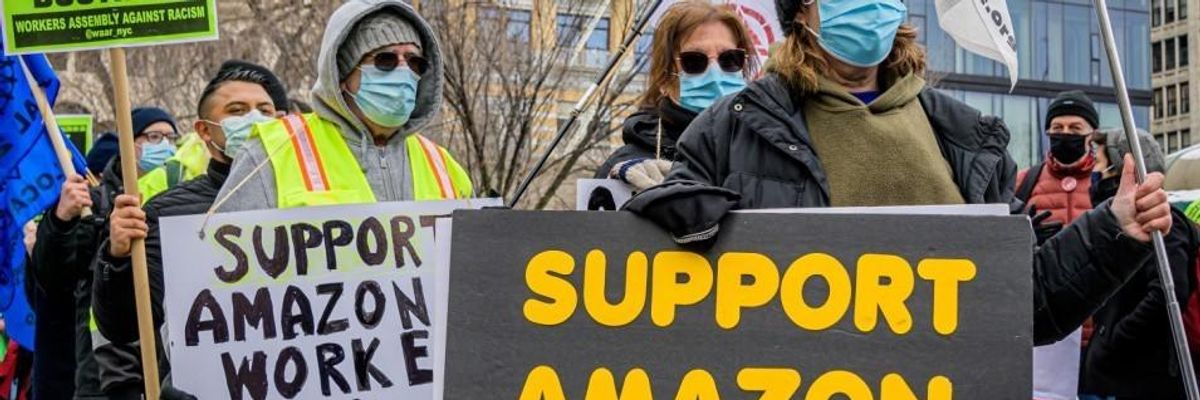
Participants seen holding signs and marching on a picket line during a solidarity event in Manhattan showing support for Amazon workers in Bessemer, Alabama on February 20, 2021. (Photo: Erik McGregor/LightRocket via Getty Images)
The Retail, Wholesale, and Department Store Union on Monday formally filed nearly two dozen objections to Amazon's conduct during the closely watched Bessemer, Alabama organizing drive, which the company defeated with an aggressive counter-campaign that observers say was replete with abusive and legally dubious activity.
In its 23 complaints (pdf) to the National Labor Relations Board (NLRB), the RWDSU accuses Amazon of a range of "illegal conduct" during the union election, including threatening workers with a loss of pay, benefits, and time off; removing workers who supported the union from mandatory trainings; and creating "the impression of surveillance" by installing a ballot-collection box in the employee parking lot.
"Amazon knew full well that unless they did everything they possibly could, even illegal activity, their workers would have continued supporting the union."
--Stuart Appelbaum, RWDSU
RWDSU, the union that attempted to organize the roughly 6,000 Bessemer workers, argued that its objections "both separately and cumulatively constitute grounds" to set aside the election results that were tallied by the NLRB earlier this month.
"Amazon knew full well that unless they did everything they possibly could, even illegal activity, their workers would have continued supporting the union," RWDSU president Stuart Appelbaum said in a statement, alluding to the union's success in getting more than 3,000 Bessemer warehouse workers to sign union cards.
The union was ultimately only able to convert 738 of those 3,000-plus cards into yes votes, a massive gap that Appelbaum attributed to Amazon's months-long propaganda and intimidation effort.
"That's why they required all their employees to attend lecture after lecture, filled with mistruths and lies, where workers had to listen to the company demand they oppose the union," said Appelbaum. "That's why they flooded the internet, the airwaves, and social media with ads spreading misinformation. That's why they brought in dozens of outsiders and union-busters to walk the floor of the warehouse. That's why they bombarded people with signs throughout the facility and with text messages and calls at home."
"Amazon has left no stone unturned in its efforts to gaslight its own employees," Appelbaum added. "We won't let Amazon's lies, deception, and illegal activities go unchallenged."
In the coming weeks, the NLRB will likely hold hearings to review the evidence behind the union's charges and determine whether Amazon's conduct merits an election do-over.
After the initial results signaled a resounding defeat for the against-the-odds union drive, activists and organizers argued that the Bessemer election is a case in point for why the Senate must urgently pass the Protecting the Right to Organize (PRO) Act, a proposed overhaul of U.S. labor law that would ban many of the coercive tactics Amazon successfully utilized.
"The two most important weapons that Amazon deployed against the union were perfectly legal under current law: 1) the near-daily use of captive audience meetings, which were declared lawful by the NLRB after the Taft-Hartley Act's passage, and 2) the gerrymandering of the bargaining unit in the preelection hearings," labor lawyer Brandon Magner wrote for Jacobin last week.
"The Protecting the Right to Organize Act," Magner noted, "would make these tactics unlawful by declaring captive audience meetings an unfair labor practice and by removing employers' ability to litigate the appropriateness of their workers' bargaining units in the pivotal early stages."
Dear Common Dreams reader, It’s been nearly 30 years since I co-founded Common Dreams with my late wife, Lina Newhouser. We had the radical notion that journalism should serve the public good, not corporate profits. It was clear to us from the outset what it would take to build such a project. No paid advertisements. No corporate sponsors. No millionaire publisher telling us what to think or do. Many people said we wouldn't last a year, but we proved those doubters wrong. Together with a tremendous team of journalists and dedicated staff, we built an independent media outlet free from the constraints of profits and corporate control. Our mission has always been simple: To inform. To inspire. To ignite change for the common good. Building Common Dreams was not easy. Our survival was never guaranteed. When you take on the most powerful forces—Wall Street greed, fossil fuel industry destruction, Big Tech lobbyists, and uber-rich oligarchs who have spent billions upon billions rigging the economy and democracy in their favor—the only bulwark you have is supporters who believe in your work. But here’s the urgent message from me today. It's never been this bad out there. And it's never been this hard to keep us going. At the very moment Common Dreams is most needed, the threats we face are intensifying. We need your support now more than ever. We don't accept corporate advertising and never will. We don't have a paywall because we don't think people should be blocked from critical news based on their ability to pay. Everything we do is funded by the donations of readers like you. When everyone does the little they can afford, we are strong. But if that support retreats or dries up, so do we. Will you donate now to make sure Common Dreams not only survives but thrives? —Craig Brown, Co-founder |
The Retail, Wholesale, and Department Store Union on Monday formally filed nearly two dozen objections to Amazon's conduct during the closely watched Bessemer, Alabama organizing drive, which the company defeated with an aggressive counter-campaign that observers say was replete with abusive and legally dubious activity.
In its 23 complaints (pdf) to the National Labor Relations Board (NLRB), the RWDSU accuses Amazon of a range of "illegal conduct" during the union election, including threatening workers with a loss of pay, benefits, and time off; removing workers who supported the union from mandatory trainings; and creating "the impression of surveillance" by installing a ballot-collection box in the employee parking lot.
"Amazon knew full well that unless they did everything they possibly could, even illegal activity, their workers would have continued supporting the union."
--Stuart Appelbaum, RWDSU
RWDSU, the union that attempted to organize the roughly 6,000 Bessemer workers, argued that its objections "both separately and cumulatively constitute grounds" to set aside the election results that were tallied by the NLRB earlier this month.
"Amazon knew full well that unless they did everything they possibly could, even illegal activity, their workers would have continued supporting the union," RWDSU president Stuart Appelbaum said in a statement, alluding to the union's success in getting more than 3,000 Bessemer warehouse workers to sign union cards.
The union was ultimately only able to convert 738 of those 3,000-plus cards into yes votes, a massive gap that Appelbaum attributed to Amazon's months-long propaganda and intimidation effort.
"That's why they required all their employees to attend lecture after lecture, filled with mistruths and lies, where workers had to listen to the company demand they oppose the union," said Appelbaum. "That's why they flooded the internet, the airwaves, and social media with ads spreading misinformation. That's why they brought in dozens of outsiders and union-busters to walk the floor of the warehouse. That's why they bombarded people with signs throughout the facility and with text messages and calls at home."
"Amazon has left no stone unturned in its efforts to gaslight its own employees," Appelbaum added. "We won't let Amazon's lies, deception, and illegal activities go unchallenged."
In the coming weeks, the NLRB will likely hold hearings to review the evidence behind the union's charges and determine whether Amazon's conduct merits an election do-over.
After the initial results signaled a resounding defeat for the against-the-odds union drive, activists and organizers argued that the Bessemer election is a case in point for why the Senate must urgently pass the Protecting the Right to Organize (PRO) Act, a proposed overhaul of U.S. labor law that would ban many of the coercive tactics Amazon successfully utilized.
"The two most important weapons that Amazon deployed against the union were perfectly legal under current law: 1) the near-daily use of captive audience meetings, which were declared lawful by the NLRB after the Taft-Hartley Act's passage, and 2) the gerrymandering of the bargaining unit in the preelection hearings," labor lawyer Brandon Magner wrote for Jacobin last week.
"The Protecting the Right to Organize Act," Magner noted, "would make these tactics unlawful by declaring captive audience meetings an unfair labor practice and by removing employers' ability to litigate the appropriateness of their workers' bargaining units in the pivotal early stages."
The Retail, Wholesale, and Department Store Union on Monday formally filed nearly two dozen objections to Amazon's conduct during the closely watched Bessemer, Alabama organizing drive, which the company defeated with an aggressive counter-campaign that observers say was replete with abusive and legally dubious activity.
In its 23 complaints (pdf) to the National Labor Relations Board (NLRB), the RWDSU accuses Amazon of a range of "illegal conduct" during the union election, including threatening workers with a loss of pay, benefits, and time off; removing workers who supported the union from mandatory trainings; and creating "the impression of surveillance" by installing a ballot-collection box in the employee parking lot.
"Amazon knew full well that unless they did everything they possibly could, even illegal activity, their workers would have continued supporting the union."
--Stuart Appelbaum, RWDSU
RWDSU, the union that attempted to organize the roughly 6,000 Bessemer workers, argued that its objections "both separately and cumulatively constitute grounds" to set aside the election results that were tallied by the NLRB earlier this month.
"Amazon knew full well that unless they did everything they possibly could, even illegal activity, their workers would have continued supporting the union," RWDSU president Stuart Appelbaum said in a statement, alluding to the union's success in getting more than 3,000 Bessemer warehouse workers to sign union cards.
The union was ultimately only able to convert 738 of those 3,000-plus cards into yes votes, a massive gap that Appelbaum attributed to Amazon's months-long propaganda and intimidation effort.
"That's why they required all their employees to attend lecture after lecture, filled with mistruths and lies, where workers had to listen to the company demand they oppose the union," said Appelbaum. "That's why they flooded the internet, the airwaves, and social media with ads spreading misinformation. That's why they brought in dozens of outsiders and union-busters to walk the floor of the warehouse. That's why they bombarded people with signs throughout the facility and with text messages and calls at home."
"Amazon has left no stone unturned in its efforts to gaslight its own employees," Appelbaum added. "We won't let Amazon's lies, deception, and illegal activities go unchallenged."
In the coming weeks, the NLRB will likely hold hearings to review the evidence behind the union's charges and determine whether Amazon's conduct merits an election do-over.
After the initial results signaled a resounding defeat for the against-the-odds union drive, activists and organizers argued that the Bessemer election is a case in point for why the Senate must urgently pass the Protecting the Right to Organize (PRO) Act, a proposed overhaul of U.S. labor law that would ban many of the coercive tactics Amazon successfully utilized.
"The two most important weapons that Amazon deployed against the union were perfectly legal under current law: 1) the near-daily use of captive audience meetings, which were declared lawful by the NLRB after the Taft-Hartley Act's passage, and 2) the gerrymandering of the bargaining unit in the preelection hearings," labor lawyer Brandon Magner wrote for Jacobin last week.
"The Protecting the Right to Organize Act," Magner noted, "would make these tactics unlawful by declaring captive audience meetings an unfair labor practice and by removing employers' ability to litigate the appropriateness of their workers' bargaining units in the pivotal early stages."