SUBSCRIBE TO OUR FREE NEWSLETTER
Daily news & progressive opinion—funded by the people, not the corporations—delivered straight to your inbox.
5
#000000
#FFFFFF
To donate by check, phone, or other method, see our More Ways to Give page.
Daily news & progressive opinion—funded by the people, not the corporations—delivered straight to your inbox.
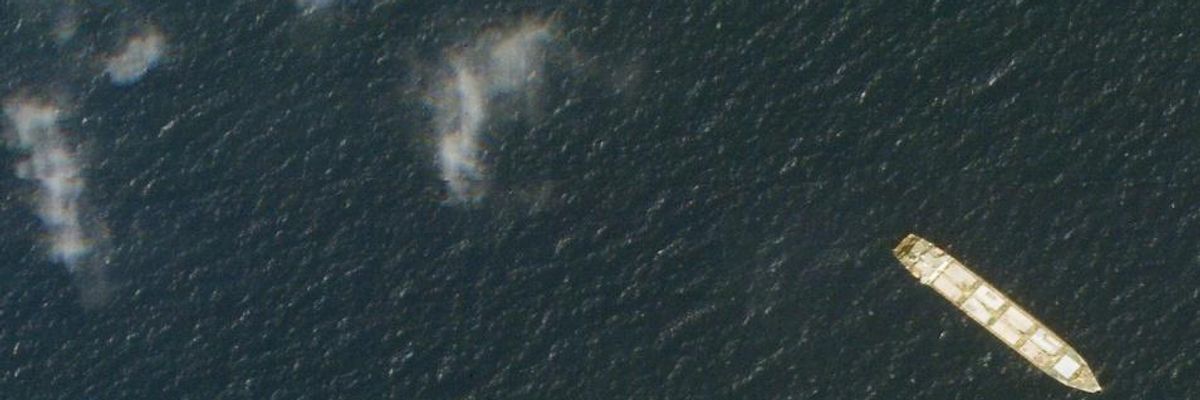
Satellite photo shows the Iranian cargo ship MV Saviz in the Red Sea off the coast of Yemen in October 2020. (Photo: Planet Labs Inc./AP file)
This is a developing story... Check back for possible updates...
Israel reportedly informed U.S. officials that it was behind a Tuesday mine attack on an Iranian vessel stationed in the Red Sea, a dangerous escalation that came on the same day American and Iranian negotiators took part in European-led talks in Vienna on the 2015 nuclear agreement.
The timing of the attack, which Iranian media outlets reported Tuesday without assigning blame, raised suspicions that it was carried out with the express purpose of undermining steps toward a diplomatic solution on the nuclear accord. In 2018, U.S. President Donald Trump violated the agreement, which Israel's right-wing government has opposed from the beginning.
"Israel appears to be stepping up attacks on Iran to undermine diplomacy," argued Mohammad Ali Shabani, editor of Amwaj.media. "Same Catch 22 for Tehran as before: respond, and get blamed. Don't respond, and invite further attacks. One exit: Statements of condemnation from Iran's counterparts in Vienna."
Jamal Abdi, president of the National Iranian American Council, tweeted in response to the mine attack that "some U.S. lawmakers advocate for Israel to be in the room for any talks with Iran, presumably so they can blow negotiations up from the inside as well as the outside."
The New York Times reported that while Israeli officials had yet to publicly comment on the attack as of Tuesday night, "an American official said the Israelis had notified the United States that its forces had struck the [Iranian] vessel at about 7:30 am local time."
"There was no official Iranian confirmation of the attack as of Tuesday night," the Times noted, "but several Telegram social media channels operated by members of the Revolutionary Guards blamed Israel for the explosion."
Saeed Khatizadeh, a spokesperson for Iran's foreign ministry, told reporters Wednesday morning that "no fatalities were caused by the incident, and technical evaluations on how the incident occurred and its origins are underway."
The reported Israeli attack took place as Biden administration officials joined representatives from Europe, Iran, and other parties to the nuclear accord to discuss a potential U.S. return to the 2015 agreement, which Biden says he supports.
Abbas Araghchi, Iran's deputy foreign minister and lead negotiator in the talks, said Tuesday that the talks are on "the right track" but "it's too soon to say it has been successful."
Anti-war groups in the United States are hoping for a diplomatic breakthrough following years of saber-rattling by Trump, whose aggressive rhetoric and actions repeatedly dragged the U.S. and Iran to the brink of all-out military conflict.
"The American people, and the Iranian-American community in particular, want the Biden administration to resolve our ongoing disputes with Iran through diplomacy," Abdi said in a statement earlier this week. "Under Trump, the specter of war loomed large and was only narrowly avoided. It is encouraging to see renewed momentum toward a return to the deal under Biden."
"The U.S. can't afford to let this window pass without restoring the strong nonproliferation agreement that already navigated the difficult politics of Washington and Tehran," he added. "It is time to reseal the deal."
Dear Common Dreams reader, It’s been nearly 30 years since I co-founded Common Dreams with my late wife, Lina Newhouser. We had the radical notion that journalism should serve the public good, not corporate profits. It was clear to us from the outset what it would take to build such a project. No paid advertisements. No corporate sponsors. No millionaire publisher telling us what to think or do. Many people said we wouldn't last a year, but we proved those doubters wrong. Together with a tremendous team of journalists and dedicated staff, we built an independent media outlet free from the constraints of profits and corporate control. Our mission has always been simple: To inform. To inspire. To ignite change for the common good. Building Common Dreams was not easy. Our survival was never guaranteed. When you take on the most powerful forces—Wall Street greed, fossil fuel industry destruction, Big Tech lobbyists, and uber-rich oligarchs who have spent billions upon billions rigging the economy and democracy in their favor—the only bulwark you have is supporters who believe in your work. But here’s the urgent message from me today. It's never been this bad out there. And it's never been this hard to keep us going. At the very moment Common Dreams is most needed, the threats we face are intensifying. We need your support now more than ever. We don't accept corporate advertising and never will. We don't have a paywall because we don't think people should be blocked from critical news based on their ability to pay. Everything we do is funded by the donations of readers like you. When everyone does the little they can afford, we are strong. But if that support retreats or dries up, so do we. Will you donate now to make sure Common Dreams not only survives but thrives? —Craig Brown, Co-founder |
This is a developing story... Check back for possible updates...
Israel reportedly informed U.S. officials that it was behind a Tuesday mine attack on an Iranian vessel stationed in the Red Sea, a dangerous escalation that came on the same day American and Iranian negotiators took part in European-led talks in Vienna on the 2015 nuclear agreement.
The timing of the attack, which Iranian media outlets reported Tuesday without assigning blame, raised suspicions that it was carried out with the express purpose of undermining steps toward a diplomatic solution on the nuclear accord. In 2018, U.S. President Donald Trump violated the agreement, which Israel's right-wing government has opposed from the beginning.
"Israel appears to be stepping up attacks on Iran to undermine diplomacy," argued Mohammad Ali Shabani, editor of Amwaj.media. "Same Catch 22 for Tehran as before: respond, and get blamed. Don't respond, and invite further attacks. One exit: Statements of condemnation from Iran's counterparts in Vienna."
Jamal Abdi, president of the National Iranian American Council, tweeted in response to the mine attack that "some U.S. lawmakers advocate for Israel to be in the room for any talks with Iran, presumably so they can blow negotiations up from the inside as well as the outside."
The New York Times reported that while Israeli officials had yet to publicly comment on the attack as of Tuesday night, "an American official said the Israelis had notified the United States that its forces had struck the [Iranian] vessel at about 7:30 am local time."
"There was no official Iranian confirmation of the attack as of Tuesday night," the Times noted, "but several Telegram social media channels operated by members of the Revolutionary Guards blamed Israel for the explosion."
Saeed Khatizadeh, a spokesperson for Iran's foreign ministry, told reporters Wednesday morning that "no fatalities were caused by the incident, and technical evaluations on how the incident occurred and its origins are underway."
The reported Israeli attack took place as Biden administration officials joined representatives from Europe, Iran, and other parties to the nuclear accord to discuss a potential U.S. return to the 2015 agreement, which Biden says he supports.
Abbas Araghchi, Iran's deputy foreign minister and lead negotiator in the talks, said Tuesday that the talks are on "the right track" but "it's too soon to say it has been successful."
Anti-war groups in the United States are hoping for a diplomatic breakthrough following years of saber-rattling by Trump, whose aggressive rhetoric and actions repeatedly dragged the U.S. and Iran to the brink of all-out military conflict.
"The American people, and the Iranian-American community in particular, want the Biden administration to resolve our ongoing disputes with Iran through diplomacy," Abdi said in a statement earlier this week. "Under Trump, the specter of war loomed large and was only narrowly avoided. It is encouraging to see renewed momentum toward a return to the deal under Biden."
"The U.S. can't afford to let this window pass without restoring the strong nonproliferation agreement that already navigated the difficult politics of Washington and Tehran," he added. "It is time to reseal the deal."
This is a developing story... Check back for possible updates...
Israel reportedly informed U.S. officials that it was behind a Tuesday mine attack on an Iranian vessel stationed in the Red Sea, a dangerous escalation that came on the same day American and Iranian negotiators took part in European-led talks in Vienna on the 2015 nuclear agreement.
The timing of the attack, which Iranian media outlets reported Tuesday without assigning blame, raised suspicions that it was carried out with the express purpose of undermining steps toward a diplomatic solution on the nuclear accord. In 2018, U.S. President Donald Trump violated the agreement, which Israel's right-wing government has opposed from the beginning.
"Israel appears to be stepping up attacks on Iran to undermine diplomacy," argued Mohammad Ali Shabani, editor of Amwaj.media. "Same Catch 22 for Tehran as before: respond, and get blamed. Don't respond, and invite further attacks. One exit: Statements of condemnation from Iran's counterparts in Vienna."
Jamal Abdi, president of the National Iranian American Council, tweeted in response to the mine attack that "some U.S. lawmakers advocate for Israel to be in the room for any talks with Iran, presumably so they can blow negotiations up from the inside as well as the outside."
The New York Times reported that while Israeli officials had yet to publicly comment on the attack as of Tuesday night, "an American official said the Israelis had notified the United States that its forces had struck the [Iranian] vessel at about 7:30 am local time."
"There was no official Iranian confirmation of the attack as of Tuesday night," the Times noted, "but several Telegram social media channels operated by members of the Revolutionary Guards blamed Israel for the explosion."
Saeed Khatizadeh, a spokesperson for Iran's foreign ministry, told reporters Wednesday morning that "no fatalities were caused by the incident, and technical evaluations on how the incident occurred and its origins are underway."
The reported Israeli attack took place as Biden administration officials joined representatives from Europe, Iran, and other parties to the nuclear accord to discuss a potential U.S. return to the 2015 agreement, which Biden says he supports.
Abbas Araghchi, Iran's deputy foreign minister and lead negotiator in the talks, said Tuesday that the talks are on "the right track" but "it's too soon to say it has been successful."
Anti-war groups in the United States are hoping for a diplomatic breakthrough following years of saber-rattling by Trump, whose aggressive rhetoric and actions repeatedly dragged the U.S. and Iran to the brink of all-out military conflict.
"The American people, and the Iranian-American community in particular, want the Biden administration to resolve our ongoing disputes with Iran through diplomacy," Abdi said in a statement earlier this week. "Under Trump, the specter of war loomed large and was only narrowly avoided. It is encouraging to see renewed momentum toward a return to the deal under Biden."
"The U.S. can't afford to let this window pass without restoring the strong nonproliferation agreement that already navigated the difficult politics of Washington and Tehran," he added. "It is time to reseal the deal."