

SUBSCRIBE TO OUR FREE NEWSLETTER
Daily news & progressive opinion—funded by the people, not the corporations—delivered straight to your inbox.
5
#000000
#FFFFFF
To donate by check, phone, or other method, see our More Ways to Give page.
Daily news & progressive opinion—funded by the people, not the corporations—delivered straight to your inbox.
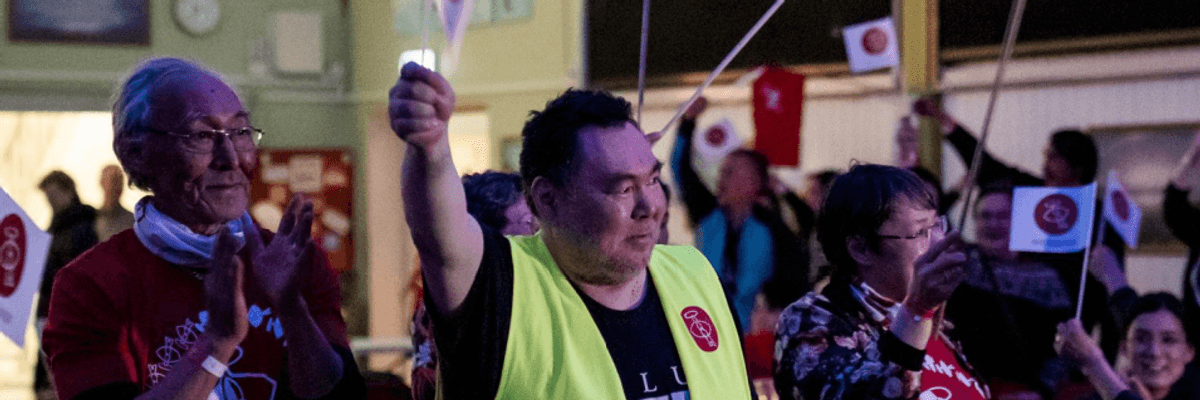
Members of the Inuit Ataqatigiit (AI) Party wave party flags as they celebrate following the exit polls results of the legislative election in Nuuk, on April 6, 2021. Greenland went to the polls on April 6 after an election campaign focused on a disputed mining project in the autonomous Danish territory, as the Arctic island confronts the impact of global warming. (Photo: Emil Helms / Ritzau Scanpix / AFP)
Members of the left-wing and Indigenous-led Inuit Ataqatigiit (AI) party in Greenland celebrated late Tuesday after winning a majority of parliamentary seats in national elections and vowed to use their new power to block controversial rare-earth mining projects in the country.
Poll results released Wednesday morning showed that the Inuit Ataqatigiit won 36.6 percent of the vote compared to the 29 percent garnered by the center-left Siumut party, which has dominated domestic politics since Greenland won autonomy from Denmark in 1979. If those margins hold, according to the Associated Press, AI is expected to grab 12 out of the 31 seats in the Inatsisartut, the local parliament, a 50 percent increase from the 8 seats it currently holds.
As Agence France-Presse reports:
The dividing line between the two parties was whether to authorise a controversial giant rare earth and uranium mining project, which is currently the subject of public hearings.
The Kuannersuit deposit, in the island's south, is considered one of the world's richest in uranium and rare earth minerals--a group of 17 metals used as components in everything from smartphones to electric cars and weapons.
IA has called for a moratorium on uranium mining, which would effectively put a halt to the project.
According to Reuters, the results cast "doubt on the mining complex at Kvanefjeld in the south of the Arctic island and sends a strong signal to international mining companies wanting to exploit Greenland's vast untapped mineral resources."
"The people have spoken," IA leader Mute Egede told local news oultet DR when asked about Kvanefjeld. "It won't happen."
"We must listen to the voters who are worried," he said. "We say no to uranium mining."
In other comments following the party's victory, Egede said, "There are two issues that have been important in this election campaign: people's living conditions is one. And then there is our health and the environment."
"It's not that Greenlanders don't want mining, but they don't want dirty mining," Mered added. "Greenlanders are sending a strong message that for them it's not worth sacrificing the environment to achieve independence and economic development."
Dear Common Dreams reader, It’s been nearly 30 years since I co-founded Common Dreams with my late wife, Lina Newhouser. We had the radical notion that journalism should serve the public good, not corporate profits. It was clear to us from the outset what it would take to build such a project. No paid advertisements. No corporate sponsors. No millionaire publisher telling us what to think or do. Many people said we wouldn't last a year, but we proved those doubters wrong. Together with a tremendous team of journalists and dedicated staff, we built an independent media outlet free from the constraints of profits and corporate control. Our mission has always been simple: To inform. To inspire. To ignite change for the common good. Building Common Dreams was not easy. Our survival was never guaranteed. When you take on the most powerful forces—Wall Street greed, fossil fuel industry destruction, Big Tech lobbyists, and uber-rich oligarchs who have spent billions upon billions rigging the economy and democracy in their favor—the only bulwark you have is supporters who believe in your work. But here’s the urgent message from me today. It's never been this bad out there. And it's never been this hard to keep us going. At the very moment Common Dreams is most needed, the threats we face are intensifying. We need your support now more than ever. We don't accept corporate advertising and never will. We don't have a paywall because we don't think people should be blocked from critical news based on their ability to pay. Everything we do is funded by the donations of readers like you. When everyone does the little they can afford, we are strong. But if that support retreats or dries up, so do we. Will you donate now to make sure Common Dreams not only survives but thrives? —Craig Brown, Co-founder |
Members of the left-wing and Indigenous-led Inuit Ataqatigiit (AI) party in Greenland celebrated late Tuesday after winning a majority of parliamentary seats in national elections and vowed to use their new power to block controversial rare-earth mining projects in the country.
Poll results released Wednesday morning showed that the Inuit Ataqatigiit won 36.6 percent of the vote compared to the 29 percent garnered by the center-left Siumut party, which has dominated domestic politics since Greenland won autonomy from Denmark in 1979. If those margins hold, according to the Associated Press, AI is expected to grab 12 out of the 31 seats in the Inatsisartut, the local parliament, a 50 percent increase from the 8 seats it currently holds.
As Agence France-Presse reports:
The dividing line between the two parties was whether to authorise a controversial giant rare earth and uranium mining project, which is currently the subject of public hearings.
The Kuannersuit deposit, in the island's south, is considered one of the world's richest in uranium and rare earth minerals--a group of 17 metals used as components in everything from smartphones to electric cars and weapons.
IA has called for a moratorium on uranium mining, which would effectively put a halt to the project.
According to Reuters, the results cast "doubt on the mining complex at Kvanefjeld in the south of the Arctic island and sends a strong signal to international mining companies wanting to exploit Greenland's vast untapped mineral resources."
"The people have spoken," IA leader Mute Egede told local news oultet DR when asked about Kvanefjeld. "It won't happen."
"We must listen to the voters who are worried," he said. "We say no to uranium mining."
In other comments following the party's victory, Egede said, "There are two issues that have been important in this election campaign: people's living conditions is one. And then there is our health and the environment."
"It's not that Greenlanders don't want mining, but they don't want dirty mining," Mered added. "Greenlanders are sending a strong message that for them it's not worth sacrificing the environment to achieve independence and economic development."
Members of the left-wing and Indigenous-led Inuit Ataqatigiit (AI) party in Greenland celebrated late Tuesday after winning a majority of parliamentary seats in national elections and vowed to use their new power to block controversial rare-earth mining projects in the country.
Poll results released Wednesday morning showed that the Inuit Ataqatigiit won 36.6 percent of the vote compared to the 29 percent garnered by the center-left Siumut party, which has dominated domestic politics since Greenland won autonomy from Denmark in 1979. If those margins hold, according to the Associated Press, AI is expected to grab 12 out of the 31 seats in the Inatsisartut, the local parliament, a 50 percent increase from the 8 seats it currently holds.
As Agence France-Presse reports:
The dividing line between the two parties was whether to authorise a controversial giant rare earth and uranium mining project, which is currently the subject of public hearings.
The Kuannersuit deposit, in the island's south, is considered one of the world's richest in uranium and rare earth minerals--a group of 17 metals used as components in everything from smartphones to electric cars and weapons.
IA has called for a moratorium on uranium mining, which would effectively put a halt to the project.
According to Reuters, the results cast "doubt on the mining complex at Kvanefjeld in the south of the Arctic island and sends a strong signal to international mining companies wanting to exploit Greenland's vast untapped mineral resources."
"The people have spoken," IA leader Mute Egede told local news oultet DR when asked about Kvanefjeld. "It won't happen."
"We must listen to the voters who are worried," he said. "We say no to uranium mining."
In other comments following the party's victory, Egede said, "There are two issues that have been important in this election campaign: people's living conditions is one. And then there is our health and the environment."
"It's not that Greenlanders don't want mining, but they don't want dirty mining," Mered added. "Greenlanders are sending a strong message that for them it's not worth sacrificing the environment to achieve independence and economic development."

