SUBSCRIBE TO OUR FREE NEWSLETTER
Daily news & progressive opinion—funded by the people, not the corporations—delivered straight to your inbox.
5
#000000
#FFFFFF
To donate by check, phone, or other method, see our More Ways to Give page.
Daily news & progressive opinion—funded by the people, not the corporations—delivered straight to your inbox.
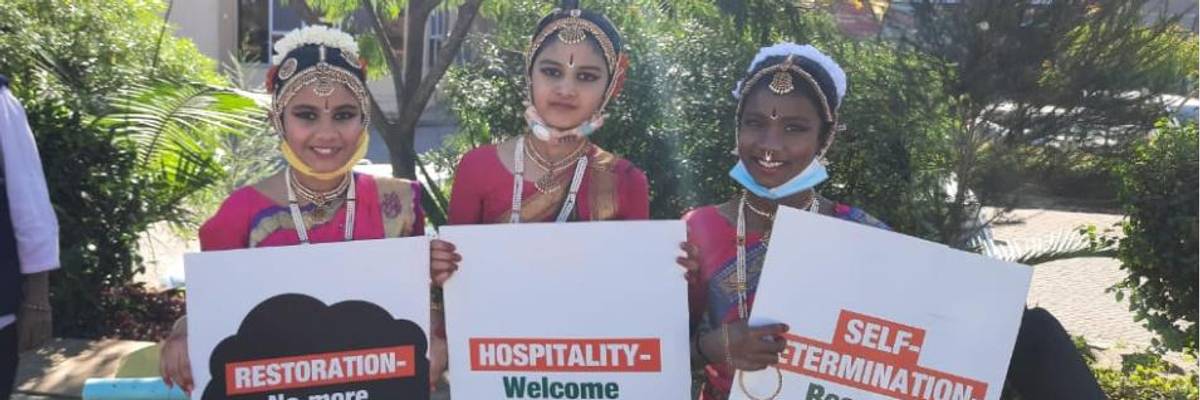
People of various faiths around the world on Thursday joined a day of action for climate justice. (Photo: Philbert Aganyo/Twitter)
"We envision a world transformed, in which humanity in all its diversity has developed a shared reverence for life on Earth."
So declares a new joint statement--entitled "Sacred People, Sacred Earth"--supported by religious groups and leaders across the globe who planned more than 400 events in over 40 countries for Thursday in what organizers are calling the largest-ever faith-based day of action for climate justice.
"A far better future is possible if our collective response to the pandemic and the climate crisis is guided by compassion, love, and justice at a scale that meets this moment."
--"Sacred People, Sacred Earth" statement
The unified call and day of action, co-sponsored by over 120 religious groups representing more than 100 million members, come as countries pour money into coronavirus relief and recovery efforts.
"A far better future is possible if our collective response to the pandemic and the climate crisis is guided by compassion, love, and justice at a scale that meets this moment," says the multi-faith statement directed at governments and financial institutions. "We must not only provide the relief that so many need to survive. We must create a new culture, politics, and economy of life that heals people and planet."
"Together, we are building resilient, caring communities and economies that meet everyone's needs and protect the planet," the statement adds. "The era of conquest, extraction, and exploitation has given way to cooperation and community. The good life is one of connectedness--with each other and all of nature."
Grassroots religious activists also released 10 specific demands, which were backed by over 200 faith leaders including the Vatican's Cardinal Peter Turkson, Buddhist author Joanna Macy, and Muslim-American scholar Imam Zaid Shakir.
Other supporters include former Archbishop of Canterbury Rowan Williams; Dr. Francis Kuria, secretary general of the African Council of Religious Leaders; Swami Chidanad Saraswati, president of Parmarth Niketan; and Dr. Azza Karam and Rabbi David Rosen, respectively secretary general and co-president of Religions for Peace.
"Climate-induced floods, droughts, and wildfires are now a worldwide, everyday apocalypse," noted Nana Firman, an Indonesian Muslim activist with GreenFaith International Network, which coordinated the demands and actions.
"Grassroots people of faith are rising everywhere to reclaim our religions."
--Rev. Fletcher Harper, Greenfaith
"It is always those among us who've done least to cause the problem who suffer the worst: racial and ethnic minorities, the poor, elders, young children, women," Firman added. "These demands are the moral criteria by which government or financial sector commitments must be measured."
In a statement, Rev. Fletcher Harper, executive director of Greenfaith, a multi-faith alliance, explained some of the motivation behind the day of action.
"Religious extremists around the globe are backing the authoritarian governments and extractive industries which are destroying the planet," he said. "There's nothing ethical about what these fundamentalist faith groups are doing. Grassroots people of faith are rising everywhere to reclaim our religions."
Supporters and participants from around the world updates on social media with the hashtags #SacredPeopleSacredEarth and #Faiths4Climate.
"No religious tradition sanctions the destruction of nature," said Catholic lay leader Thea Ormerod, founder of the multi-faith Australian Religious Response to Climate Change and a Greenfaith founding partner. "Yet this is exactly what governments, financial institutions, and major corporations are doing."
"Our faiths are compelling us to go out from our churches, mosques, and temples, and into the streets to make our voices heard," Ormerod added.
The religious activists are taking to the streets as governments signed on to the Paris agreement are unveiling updated pledges to cut emissions ahead of the 2021 United Nations Climate Change Conference (COP26) scheduled for November.
According to Francesca de Gasparis, executive director of Southern African Faith Communities Environment Institute and another Greenfaith founding partner: "The world needs strong, principled climate action immediately."
"Faith communities have issued statements, fatwas, encyclicals, and more on climate change," de Gasparis said. "What's needed now is binding legislation."
Actions were held in Australia, Brazil, Canada, Chile, France, Germany, Honduras, Indonesia, India, Kenya, Nigeria, Panama, South Africa, the United Kingdom, the United States, Vanuatu, and over two dozen more countries. The activists, as the statement explains, urge decision-makers to stop perpetuating "an outdated economic system that relies on fossil fuels and the destruction of the very forests, waters, oceans, and soils that make life possible."
"This gap between what's needed and what is happening is morally reprehensible."
--Arianne van Andel, Alianza Interreligiosa y Espiritual por el Clima
"Instead they should accelerate renewable energy development; ensure universal access to clean water and air, affordable clean energy, and food grown with respect for the land; create jobs paying family-sustaining wages to workers in safe conditions," says the joint faith statement, which also calls for rich countries to "take responsibility for a larger share of emissions reductions to support a global just transition" and prepare to welcome people displaced by the Covid-19 and climate crises.
Arianne van Andel, coordinator of Chile's Alianza Interreligiosa y Espiritual por el Clima, blasted political and financial leaders for failing to take the ambitious action that scientists have long warned is needed to address the climate emergency.
"Fossil fuel development and deforestation continue to grow," said van Andel. "Indigenous people and environmental defenders are met with violence when they stand for what is right, while governments and corporations look the other way."
"After decades of knowing how serious this problem is," she added, "this gap between what's needed and what is happening is morally reprehensible."
This country and this world are at a monumental crossroads. US voters have an opportunity to beat back the forces of fascism and confront the billionaires who are rigging the economy, our media system, and our democracy, making it increasingly impossible for ordinary people to get by. We’re not just talking about the election. We’re talking about what must be done once these fascist elements are vanquished from power. We need a bolder set of solutions than what either major party has so far been willing to offer and a working-class movement ready to fight like hell for it. Trump didn't emerge from nowhere. The conditions that fueled MAGA authoritarianism were created by decades of radical neoliberal economic policies and a corrupt political system dominated by corporate interests. They slashed taxes on the super-rich, promising that the benefits would trickle down. They said giveaways to the corporate titans would make life more affordable for the rest of us. It was all bullshit. And when a bitter, betrayed populace searches for someone to blame, right-wing demagogues have little trouble finding scapegoats. People know when they're being lied to, but you won't hear any of this from the corporate media. Only independent journalism—powered and funded by people who believe in building a better world—can deliver truly trustworthy daily news. If you share our vision, please contribute whatever you can to sustain our work. |
"We envision a world transformed, in which humanity in all its diversity has developed a shared reverence for life on Earth."
So declares a new joint statement--entitled "Sacred People, Sacred Earth"--supported by religious groups and leaders across the globe who planned more than 400 events in over 40 countries for Thursday in what organizers are calling the largest-ever faith-based day of action for climate justice.
"A far better future is possible if our collective response to the pandemic and the climate crisis is guided by compassion, love, and justice at a scale that meets this moment."
--"Sacred People, Sacred Earth" statement
The unified call and day of action, co-sponsored by over 120 religious groups representing more than 100 million members, come as countries pour money into coronavirus relief and recovery efforts.
"A far better future is possible if our collective response to the pandemic and the climate crisis is guided by compassion, love, and justice at a scale that meets this moment," says the multi-faith statement directed at governments and financial institutions. "We must not only provide the relief that so many need to survive. We must create a new culture, politics, and economy of life that heals people and planet."
"Together, we are building resilient, caring communities and economies that meet everyone's needs and protect the planet," the statement adds. "The era of conquest, extraction, and exploitation has given way to cooperation and community. The good life is one of connectedness--with each other and all of nature."
Grassroots religious activists also released 10 specific demands, which were backed by over 200 faith leaders including the Vatican's Cardinal Peter Turkson, Buddhist author Joanna Macy, and Muslim-American scholar Imam Zaid Shakir.
Other supporters include former Archbishop of Canterbury Rowan Williams; Dr. Francis Kuria, secretary general of the African Council of Religious Leaders; Swami Chidanad Saraswati, president of Parmarth Niketan; and Dr. Azza Karam and Rabbi David Rosen, respectively secretary general and co-president of Religions for Peace.
"Climate-induced floods, droughts, and wildfires are now a worldwide, everyday apocalypse," noted Nana Firman, an Indonesian Muslim activist with GreenFaith International Network, which coordinated the demands and actions.
"Grassroots people of faith are rising everywhere to reclaim our religions."
--Rev. Fletcher Harper, Greenfaith
"It is always those among us who've done least to cause the problem who suffer the worst: racial and ethnic minorities, the poor, elders, young children, women," Firman added. "These demands are the moral criteria by which government or financial sector commitments must be measured."
In a statement, Rev. Fletcher Harper, executive director of Greenfaith, a multi-faith alliance, explained some of the motivation behind the day of action.
"Religious extremists around the globe are backing the authoritarian governments and extractive industries which are destroying the planet," he said. "There's nothing ethical about what these fundamentalist faith groups are doing. Grassroots people of faith are rising everywhere to reclaim our religions."
Supporters and participants from around the world updates on social media with the hashtags #SacredPeopleSacredEarth and #Faiths4Climate.
"No religious tradition sanctions the destruction of nature," said Catholic lay leader Thea Ormerod, founder of the multi-faith Australian Religious Response to Climate Change and a Greenfaith founding partner. "Yet this is exactly what governments, financial institutions, and major corporations are doing."
"Our faiths are compelling us to go out from our churches, mosques, and temples, and into the streets to make our voices heard," Ormerod added.
The religious activists are taking to the streets as governments signed on to the Paris agreement are unveiling updated pledges to cut emissions ahead of the 2021 United Nations Climate Change Conference (COP26) scheduled for November.
According to Francesca de Gasparis, executive director of Southern African Faith Communities Environment Institute and another Greenfaith founding partner: "The world needs strong, principled climate action immediately."
"Faith communities have issued statements, fatwas, encyclicals, and more on climate change," de Gasparis said. "What's needed now is binding legislation."
Actions were held in Australia, Brazil, Canada, Chile, France, Germany, Honduras, Indonesia, India, Kenya, Nigeria, Panama, South Africa, the United Kingdom, the United States, Vanuatu, and over two dozen more countries. The activists, as the statement explains, urge decision-makers to stop perpetuating "an outdated economic system that relies on fossil fuels and the destruction of the very forests, waters, oceans, and soils that make life possible."
"This gap between what's needed and what is happening is morally reprehensible."
--Arianne van Andel, Alianza Interreligiosa y Espiritual por el Clima
"Instead they should accelerate renewable energy development; ensure universal access to clean water and air, affordable clean energy, and food grown with respect for the land; create jobs paying family-sustaining wages to workers in safe conditions," says the joint faith statement, which also calls for rich countries to "take responsibility for a larger share of emissions reductions to support a global just transition" and prepare to welcome people displaced by the Covid-19 and climate crises.
Arianne van Andel, coordinator of Chile's Alianza Interreligiosa y Espiritual por el Clima, blasted political and financial leaders for failing to take the ambitious action that scientists have long warned is needed to address the climate emergency.
"Fossil fuel development and deforestation continue to grow," said van Andel. "Indigenous people and environmental defenders are met with violence when they stand for what is right, while governments and corporations look the other way."
"After decades of knowing how serious this problem is," she added, "this gap between what's needed and what is happening is morally reprehensible."