SUBSCRIBE TO OUR FREE NEWSLETTER
Daily news & progressive opinion—funded by the people, not the corporations—delivered straight to your inbox.
5
#000000
#FFFFFF
To donate by check, phone, or other method, see our More Ways to Give page.
Daily news & progressive opinion—funded by the people, not the corporations—delivered straight to your inbox.
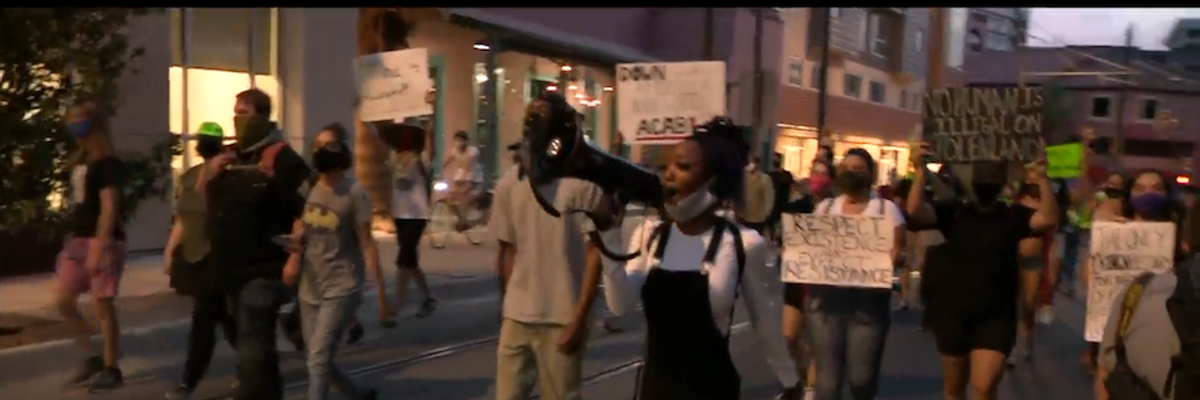
Demonstrators took to the streets in Tuscon Wednesday night over the killing of Carlos Ingram Lopez. (Photo: screenshot/KVOA)
Video of the police killing of Tucson, Arizona resident Carlos Ingram Lopez in April was released to the public on Wednesday, prompting outcry over systemic racism and police brutality from critics and the city's police chief offering his resignation.
"Carlos Ingram Lopez should still be alive today," the ACLU tweeted in response to the release of the footage.
Police were called to Lopez's grandmother's residence on April 21 because Lopez was intoxicated and behaving erratically. Officers pinned Lopez to the ground, cuffing him, and left him lying on his face for 12 minutes as he repeatedly said he could not breathe and called for his grandmother.
"We've said this before--police should not be first responders to calls involving behavioral health and drug use," Drug Policy Alliance (DPA) incoming executive director Kassandra Frederique said in a statement. "When Carlos' grandmother called the police because of his irregular behavior, she did not expect that they would kill her grandson."
Tucson chief of police Chris Magnus offered his resignation Wednesday at a press conference releasing the video. The officers involved in the killing have all resigned and are the subject of a criminal investigation.
City council member Lane Santa Cruz, who drew attention to the killing Tuesday before the release of the video, urged the public to concentrate on the behavior of police rather than on the chief's resignation.
"Now everybody's talking about the resignation and not about what unfolded when the family called 911 for help," Santa Cruz told the Arizona Republic. "He gets to leave and for those of us where Tucson is home, we don't get to go anywhere and we have to now deal with this head-on."
The ongoing protest movement for Black lives and against police brutality is making headway into Latin communities as well, as the New York Times reported:
The disclosure of Mr. Lopez's death comes at a time when many Latinos around the United States are calling for changes in how police treat their communities, echoing similar calls by African-Americans. Last week in California, outrage emerged over the killing of Andres Guardado, an 18-year-old Latino student and security guard, by a Los Angeles County sheriff's deputy. The episode in Tucson occurred about a month before George Floyd, a black man, was killed by police officers in Minneapolis, igniting protests throughout the country.
DPA's Frederique also connected Lopez's killing to the broader movement and called for a re-evaluation of U.S. policing.
"The Wendy's employee that called the police on Rayshard Brooks also did not expect they would take his life, neither did the store owner that called the police on George Floyd," said Frederique. "These incidents clearly could have been handled better by an unarmed, non-police responder trained in mental health and harm reduction."
"It is time to reevaluate what has fallen under the incredibly bloated scope of the police," Frederique added, "and begin redirecting resources towards appropriate community resources better suited for these kinds of situations."
Protesters filled Tucson streets Wednesday after the release of the video. A vigil for Lopez is scheduled for Thursday night.
Watch the footage--viewers are warned it is disturbing:
Dear Common Dreams reader, It’s been nearly 30 years since I co-founded Common Dreams with my late wife, Lina Newhouser. We had the radical notion that journalism should serve the public good, not corporate profits. It was clear to us from the outset what it would take to build such a project. No paid advertisements. No corporate sponsors. No millionaire publisher telling us what to think or do. Many people said we wouldn't last a year, but we proved those doubters wrong. Together with a tremendous team of journalists and dedicated staff, we built an independent media outlet free from the constraints of profits and corporate control. Our mission has always been simple: To inform. To inspire. To ignite change for the common good. Building Common Dreams was not easy. Our survival was never guaranteed. When you take on the most powerful forces—Wall Street greed, fossil fuel industry destruction, Big Tech lobbyists, and uber-rich oligarchs who have spent billions upon billions rigging the economy and democracy in their favor—the only bulwark you have is supporters who believe in your work. But here’s the urgent message from me today. It's never been this bad out there. And it's never been this hard to keep us going. At the very moment Common Dreams is most needed, the threats we face are intensifying. We need your support now more than ever. We don't accept corporate advertising and never will. We don't have a paywall because we don't think people should be blocked from critical news based on their ability to pay. Everything we do is funded by the donations of readers like you. When everyone does the little they can afford, we are strong. But if that support retreats or dries up, so do we. Will you donate now to make sure Common Dreams not only survives but thrives? —Craig Brown, Co-founder |
Video of the police killing of Tucson, Arizona resident Carlos Ingram Lopez in April was released to the public on Wednesday, prompting outcry over systemic racism and police brutality from critics and the city's police chief offering his resignation.
"Carlos Ingram Lopez should still be alive today," the ACLU tweeted in response to the release of the footage.
Police were called to Lopez's grandmother's residence on April 21 because Lopez was intoxicated and behaving erratically. Officers pinned Lopez to the ground, cuffing him, and left him lying on his face for 12 minutes as he repeatedly said he could not breathe and called for his grandmother.
"We've said this before--police should not be first responders to calls involving behavioral health and drug use," Drug Policy Alliance (DPA) incoming executive director Kassandra Frederique said in a statement. "When Carlos' grandmother called the police because of his irregular behavior, she did not expect that they would kill her grandson."
Tucson chief of police Chris Magnus offered his resignation Wednesday at a press conference releasing the video. The officers involved in the killing have all resigned and are the subject of a criminal investigation.
City council member Lane Santa Cruz, who drew attention to the killing Tuesday before the release of the video, urged the public to concentrate on the behavior of police rather than on the chief's resignation.
"Now everybody's talking about the resignation and not about what unfolded when the family called 911 for help," Santa Cruz told the Arizona Republic. "He gets to leave and for those of us where Tucson is home, we don't get to go anywhere and we have to now deal with this head-on."
The ongoing protest movement for Black lives and against police brutality is making headway into Latin communities as well, as the New York Times reported:
The disclosure of Mr. Lopez's death comes at a time when many Latinos around the United States are calling for changes in how police treat their communities, echoing similar calls by African-Americans. Last week in California, outrage emerged over the killing of Andres Guardado, an 18-year-old Latino student and security guard, by a Los Angeles County sheriff's deputy. The episode in Tucson occurred about a month before George Floyd, a black man, was killed by police officers in Minneapolis, igniting protests throughout the country.
DPA's Frederique also connected Lopez's killing to the broader movement and called for a re-evaluation of U.S. policing.
"The Wendy's employee that called the police on Rayshard Brooks also did not expect they would take his life, neither did the store owner that called the police on George Floyd," said Frederique. "These incidents clearly could have been handled better by an unarmed, non-police responder trained in mental health and harm reduction."
"It is time to reevaluate what has fallen under the incredibly bloated scope of the police," Frederique added, "and begin redirecting resources towards appropriate community resources better suited for these kinds of situations."
Protesters filled Tucson streets Wednesday after the release of the video. A vigil for Lopez is scheduled for Thursday night.
Watch the footage--viewers are warned it is disturbing:
Video of the police killing of Tucson, Arizona resident Carlos Ingram Lopez in April was released to the public on Wednesday, prompting outcry over systemic racism and police brutality from critics and the city's police chief offering his resignation.
"Carlos Ingram Lopez should still be alive today," the ACLU tweeted in response to the release of the footage.
Police were called to Lopez's grandmother's residence on April 21 because Lopez was intoxicated and behaving erratically. Officers pinned Lopez to the ground, cuffing him, and left him lying on his face for 12 minutes as he repeatedly said he could not breathe and called for his grandmother.
"We've said this before--police should not be first responders to calls involving behavioral health and drug use," Drug Policy Alliance (DPA) incoming executive director Kassandra Frederique said in a statement. "When Carlos' grandmother called the police because of his irregular behavior, she did not expect that they would kill her grandson."
Tucson chief of police Chris Magnus offered his resignation Wednesday at a press conference releasing the video. The officers involved in the killing have all resigned and are the subject of a criminal investigation.
City council member Lane Santa Cruz, who drew attention to the killing Tuesday before the release of the video, urged the public to concentrate on the behavior of police rather than on the chief's resignation.
"Now everybody's talking about the resignation and not about what unfolded when the family called 911 for help," Santa Cruz told the Arizona Republic. "He gets to leave and for those of us where Tucson is home, we don't get to go anywhere and we have to now deal with this head-on."
The ongoing protest movement for Black lives and against police brutality is making headway into Latin communities as well, as the New York Times reported:
The disclosure of Mr. Lopez's death comes at a time when many Latinos around the United States are calling for changes in how police treat their communities, echoing similar calls by African-Americans. Last week in California, outrage emerged over the killing of Andres Guardado, an 18-year-old Latino student and security guard, by a Los Angeles County sheriff's deputy. The episode in Tucson occurred about a month before George Floyd, a black man, was killed by police officers in Minneapolis, igniting protests throughout the country.
DPA's Frederique also connected Lopez's killing to the broader movement and called for a re-evaluation of U.S. policing.
"The Wendy's employee that called the police on Rayshard Brooks also did not expect they would take his life, neither did the store owner that called the police on George Floyd," said Frederique. "These incidents clearly could have been handled better by an unarmed, non-police responder trained in mental health and harm reduction."
"It is time to reevaluate what has fallen under the incredibly bloated scope of the police," Frederique added, "and begin redirecting resources towards appropriate community resources better suited for these kinds of situations."
Protesters filled Tucson streets Wednesday after the release of the video. A vigil for Lopez is scheduled for Thursday night.
Watch the footage--viewers are warned it is disturbing: