SUBSCRIBE TO OUR FREE NEWSLETTER
Daily news & progressive opinion—funded by the people, not the corporations—delivered straight to your inbox.
5
#000000
#FFFFFF
To donate by check, phone, or other method, see our More Ways to Give page.
Daily news & progressive opinion—funded by the people, not the corporations—delivered straight to your inbox.
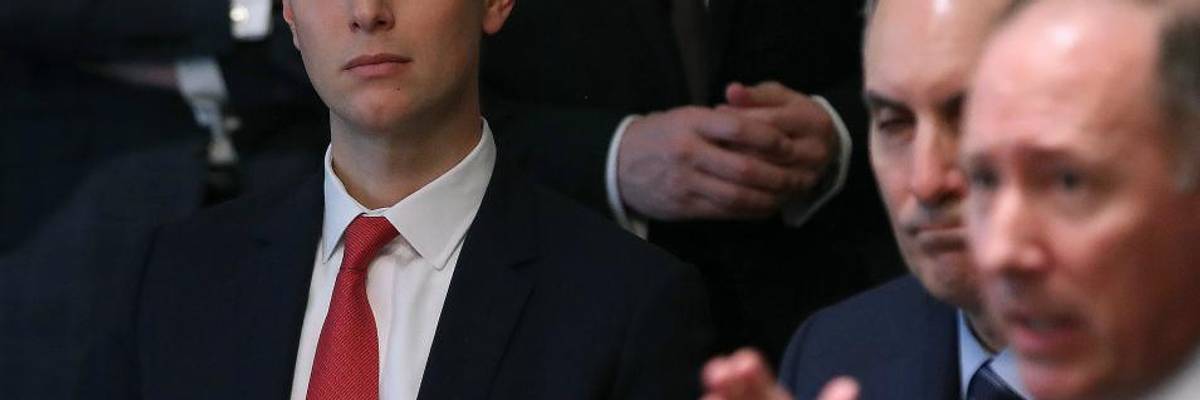
White House senior adviser Jared Kushner attends a meeting with President Donald Trump and several CEOs of major banks discussing the coronavirus response during a meeting in the Cabinet Room at the White House on March 11, 2020 in Washington, D.C. (Photo: Mark Wilson/Getty Images)
Executives and lobbyists from some of the most profitable private equity firms in the U.S. are aggressively pressuring members of Congress and Trump administration officials to ensure that the huge investment companies are able to benefit from coronavirus stimulus funding--including a $350 billion relief program intended to help struggling small businesses.
NBC News reported Saturday that investment giant Apollo Global Management sent an email last week to Jared Kushner--President Donald Trump's son-in-law and senior adviser--as well as other White House officials pleading with the administration to "relax rules on coronavirus relief money in a way that would benefit the company."
"We're going to have our radar up on how private equity is going to try to maneuver this whole issue. Our argument is that private-equity companies shouldn't be trying to milk the small-business side."
--Sen. Ron Wyden
"But Apollo is not just any business: It made a $184 million loan in 2017 to Kushner Companies, the real estate company in which Jared Kushner... retains an interest," NBC noted.
Apollo's overture to Kushner was part of what the Washington Post on Monday described as a "rush of behind-the-scenes jockeying" by private equity firms as banks--under the guidance of the Treasury Department--begin distributing loans authorized by the multi-trillion-dollar Coronavirus Aid, Relief, and Economic Security (CARES) Act, which Trump signed into law late last month.
Several private equity titans, including Blackstone group CEO Stephen Schwarzman, took part in a conference call Trump hosted late last month as the coronavirus spread rapidly across the U.S. and sent the economy into a tailspin. The firms are now, according to reporting from various outlets, urging lawmakers and the White House to relieve federal restrictions that bar many small businesses backed by private equity from receiving funding from the $350 billion Paycheck Protection Program.
But progressive lawmakers are raising alarm about private equity firms' efforts, particularly given the industry's sordid record of buying up companies and wringing as much profit out of them as possible before laying off workers en masse. The destructive impact of the private equity industry's business model is currently being felt in hospitals, restaurants, and other sectors as the coronavirus outbreak rattles the entire U.S. economy.
"I think the private equity industry can pull itself up from its trillion-dollar bootstraps," Rep. Mark Pocan (D-Wis.), co-chair of the Congressional Progressive Caucus, tweeted Monday, alluding to the fact that the industry started 2020 with $1.5 trillion in unspent capital. "I'm going to focus on helping working families."
Sen. Ron Wyden (D-Ore.), the top Democrat on the Senate Finance Committee, told the Post that Congress must keep a close eye on private equity companies' behavior as economic stimulus efforts continue.
"Private equity may be in the eye of the storm, but it certainly doesn't need a bailout."
--Shuli Ren, Bloomberg
"We're going to have our radar up on how private equity is going to try to maneuver this whole issue," said Wyden. "Our argument is that private-equity companies shouldn't be trying to milk the small-business side."
Under current federal regulations known as "affiliation rules," small companies backed by private equity funding are not able to qualify for Small Business Administration relief loans if the companies in the firm's portfolio collectively have more than 500 employees--the limit established by the Paycheck Protection Program.
"Businesses must report if they have major investors, and they are blocked from the program on the theory that they can borrow money from their larger and deep-pocketed private-equity backers, rather than taxpayers," the Post explained. "The purpose is to make sure that businesses truly owned and operated by individuals can benefit from the loan, rather than opening the funds to companies that must answer to the interests of shareholders and parent companies."
But on Friday, the Post reported, "the financial industry secured a modest victory: The Treasury Department issued guidance waiving the rule for a small subset of small businesses backed by private equity and venture capital, to include those in the accommodations and food-service industries, as well as franchisees."
Bloomberg's Shuli Ren wrote in a column Monday that private equity firms looking for taxpayer bailout money "should get to the back of the line."
"Private equity may be in the eye of the storm, but it certainly doesn't need a bailout," wrote Ren. "These firms came out of the collapse of Lehman Brothers fairly unscathed. Perhaps the coronavirus could finally teach them a lesson: Using cheap debt to pay themselves dividends isn't such a savvy investment model after all."
Dear Common Dreams reader, It’s been nearly 30 years since I co-founded Common Dreams with my late wife, Lina Newhouser. We had the radical notion that journalism should serve the public good, not corporate profits. It was clear to us from the outset what it would take to build such a project. No paid advertisements. No corporate sponsors. No millionaire publisher telling us what to think or do. Many people said we wouldn't last a year, but we proved those doubters wrong. Together with a tremendous team of journalists and dedicated staff, we built an independent media outlet free from the constraints of profits and corporate control. Our mission has always been simple: To inform. To inspire. To ignite change for the common good. Building Common Dreams was not easy. Our survival was never guaranteed. When you take on the most powerful forces—Wall Street greed, fossil fuel industry destruction, Big Tech lobbyists, and uber-rich oligarchs who have spent billions upon billions rigging the economy and democracy in their favor—the only bulwark you have is supporters who believe in your work. But here’s the urgent message from me today. It's never been this bad out there. And it's never been this hard to keep us going. At the very moment Common Dreams is most needed, the threats we face are intensifying. We need your support now more than ever. We don't accept corporate advertising and never will. We don't have a paywall because we don't think people should be blocked from critical news based on their ability to pay. Everything we do is funded by the donations of readers like you. When everyone does the little they can afford, we are strong. But if that support retreats or dries up, so do we. Will you donate now to make sure Common Dreams not only survives but thrives? —Craig Brown, Co-founder |
Executives and lobbyists from some of the most profitable private equity firms in the U.S. are aggressively pressuring members of Congress and Trump administration officials to ensure that the huge investment companies are able to benefit from coronavirus stimulus funding--including a $350 billion relief program intended to help struggling small businesses.
NBC News reported Saturday that investment giant Apollo Global Management sent an email last week to Jared Kushner--President Donald Trump's son-in-law and senior adviser--as well as other White House officials pleading with the administration to "relax rules on coronavirus relief money in a way that would benefit the company."
"We're going to have our radar up on how private equity is going to try to maneuver this whole issue. Our argument is that private-equity companies shouldn't be trying to milk the small-business side."
--Sen. Ron Wyden
"But Apollo is not just any business: It made a $184 million loan in 2017 to Kushner Companies, the real estate company in which Jared Kushner... retains an interest," NBC noted.
Apollo's overture to Kushner was part of what the Washington Post on Monday described as a "rush of behind-the-scenes jockeying" by private equity firms as banks--under the guidance of the Treasury Department--begin distributing loans authorized by the multi-trillion-dollar Coronavirus Aid, Relief, and Economic Security (CARES) Act, which Trump signed into law late last month.
Several private equity titans, including Blackstone group CEO Stephen Schwarzman, took part in a conference call Trump hosted late last month as the coronavirus spread rapidly across the U.S. and sent the economy into a tailspin. The firms are now, according to reporting from various outlets, urging lawmakers and the White House to relieve federal restrictions that bar many small businesses backed by private equity from receiving funding from the $350 billion Paycheck Protection Program.
But progressive lawmakers are raising alarm about private equity firms' efforts, particularly given the industry's sordid record of buying up companies and wringing as much profit out of them as possible before laying off workers en masse. The destructive impact of the private equity industry's business model is currently being felt in hospitals, restaurants, and other sectors as the coronavirus outbreak rattles the entire U.S. economy.
"I think the private equity industry can pull itself up from its trillion-dollar bootstraps," Rep. Mark Pocan (D-Wis.), co-chair of the Congressional Progressive Caucus, tweeted Monday, alluding to the fact that the industry started 2020 with $1.5 trillion in unspent capital. "I'm going to focus on helping working families."
Sen. Ron Wyden (D-Ore.), the top Democrat on the Senate Finance Committee, told the Post that Congress must keep a close eye on private equity companies' behavior as economic stimulus efforts continue.
"Private equity may be in the eye of the storm, but it certainly doesn't need a bailout."
--Shuli Ren, Bloomberg
"We're going to have our radar up on how private equity is going to try to maneuver this whole issue," said Wyden. "Our argument is that private-equity companies shouldn't be trying to milk the small-business side."
Under current federal regulations known as "affiliation rules," small companies backed by private equity funding are not able to qualify for Small Business Administration relief loans if the companies in the firm's portfolio collectively have more than 500 employees--the limit established by the Paycheck Protection Program.
"Businesses must report if they have major investors, and they are blocked from the program on the theory that they can borrow money from their larger and deep-pocketed private-equity backers, rather than taxpayers," the Post explained. "The purpose is to make sure that businesses truly owned and operated by individuals can benefit from the loan, rather than opening the funds to companies that must answer to the interests of shareholders and parent companies."
But on Friday, the Post reported, "the financial industry secured a modest victory: The Treasury Department issued guidance waiving the rule for a small subset of small businesses backed by private equity and venture capital, to include those in the accommodations and food-service industries, as well as franchisees."
Bloomberg's Shuli Ren wrote in a column Monday that private equity firms looking for taxpayer bailout money "should get to the back of the line."
"Private equity may be in the eye of the storm, but it certainly doesn't need a bailout," wrote Ren. "These firms came out of the collapse of Lehman Brothers fairly unscathed. Perhaps the coronavirus could finally teach them a lesson: Using cheap debt to pay themselves dividends isn't such a savvy investment model after all."
Executives and lobbyists from some of the most profitable private equity firms in the U.S. are aggressively pressuring members of Congress and Trump administration officials to ensure that the huge investment companies are able to benefit from coronavirus stimulus funding--including a $350 billion relief program intended to help struggling small businesses.
NBC News reported Saturday that investment giant Apollo Global Management sent an email last week to Jared Kushner--President Donald Trump's son-in-law and senior adviser--as well as other White House officials pleading with the administration to "relax rules on coronavirus relief money in a way that would benefit the company."
"We're going to have our radar up on how private equity is going to try to maneuver this whole issue. Our argument is that private-equity companies shouldn't be trying to milk the small-business side."
--Sen. Ron Wyden
"But Apollo is not just any business: It made a $184 million loan in 2017 to Kushner Companies, the real estate company in which Jared Kushner... retains an interest," NBC noted.
Apollo's overture to Kushner was part of what the Washington Post on Monday described as a "rush of behind-the-scenes jockeying" by private equity firms as banks--under the guidance of the Treasury Department--begin distributing loans authorized by the multi-trillion-dollar Coronavirus Aid, Relief, and Economic Security (CARES) Act, which Trump signed into law late last month.
Several private equity titans, including Blackstone group CEO Stephen Schwarzman, took part in a conference call Trump hosted late last month as the coronavirus spread rapidly across the U.S. and sent the economy into a tailspin. The firms are now, according to reporting from various outlets, urging lawmakers and the White House to relieve federal restrictions that bar many small businesses backed by private equity from receiving funding from the $350 billion Paycheck Protection Program.
But progressive lawmakers are raising alarm about private equity firms' efforts, particularly given the industry's sordid record of buying up companies and wringing as much profit out of them as possible before laying off workers en masse. The destructive impact of the private equity industry's business model is currently being felt in hospitals, restaurants, and other sectors as the coronavirus outbreak rattles the entire U.S. economy.
"I think the private equity industry can pull itself up from its trillion-dollar bootstraps," Rep. Mark Pocan (D-Wis.), co-chair of the Congressional Progressive Caucus, tweeted Monday, alluding to the fact that the industry started 2020 with $1.5 trillion in unspent capital. "I'm going to focus on helping working families."
Sen. Ron Wyden (D-Ore.), the top Democrat on the Senate Finance Committee, told the Post that Congress must keep a close eye on private equity companies' behavior as economic stimulus efforts continue.
"Private equity may be in the eye of the storm, but it certainly doesn't need a bailout."
--Shuli Ren, Bloomberg
"We're going to have our radar up on how private equity is going to try to maneuver this whole issue," said Wyden. "Our argument is that private-equity companies shouldn't be trying to milk the small-business side."
Under current federal regulations known as "affiliation rules," small companies backed by private equity funding are not able to qualify for Small Business Administration relief loans if the companies in the firm's portfolio collectively have more than 500 employees--the limit established by the Paycheck Protection Program.
"Businesses must report if they have major investors, and they are blocked from the program on the theory that they can borrow money from their larger and deep-pocketed private-equity backers, rather than taxpayers," the Post explained. "The purpose is to make sure that businesses truly owned and operated by individuals can benefit from the loan, rather than opening the funds to companies that must answer to the interests of shareholders and parent companies."
But on Friday, the Post reported, "the financial industry secured a modest victory: The Treasury Department issued guidance waiving the rule for a small subset of small businesses backed by private equity and venture capital, to include those in the accommodations and food-service industries, as well as franchisees."
Bloomberg's Shuli Ren wrote in a column Monday that private equity firms looking for taxpayer bailout money "should get to the back of the line."
"Private equity may be in the eye of the storm, but it certainly doesn't need a bailout," wrote Ren. "These firms came out of the collapse of Lehman Brothers fairly unscathed. Perhaps the coronavirus could finally teach them a lesson: Using cheap debt to pay themselves dividends isn't such a savvy investment model after all."