

SUBSCRIBE TO OUR FREE NEWSLETTER
Daily news & progressive opinion—funded by the people, not the corporations—delivered straight to your inbox.
5
#000000
#FFFFFF
To donate by check, phone, or other method, see our More Ways to Give page.
Daily news & progressive opinion—funded by the people, not the corporations—delivered straight to your inbox.
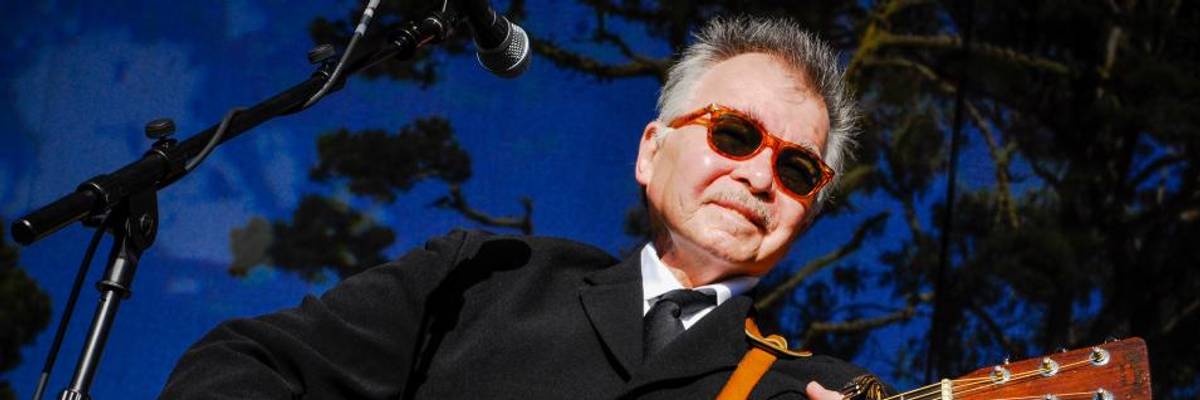
John Prine performs on stage at Hardly Strictly Bluegrass festival in Golden Gate Park, San Francisco, California on 2nd October, 2009. (Photo: Anthony Pidgeon/Redferns)
John Prine, one of America's most cherished songwriters and folk artists, died on Tuesday following a battle with the coronavirus. He was 73.
A national outpouring of grief soon followed after news of his death was reported.
"Prine," wrote Stephen L. Betts and Patrick Doyle for Rolling Stone, "who for five decades wrote rich, plain-spoken songs that chronicled the struggles and stories of everyday working people and changed the face of modern American roots music, died Tuesday at Nashville's Vanderbilt University Medical Center."
According to his family, the cause was complications related to coronavirus, or Covid-19.
A legend in Nashville and among folk and alt-country music devotees, Prine was more revered than he was famous. According to Rolling Stone:
As a songwriter, Prine was admired by Bob Dylan, Kris Kristofferson, and others, known for his ability to mine seemingly ordinary experiences -- he wrote many of his classics as a mailman in Maywood, Illinois -- for revelatory songs that covered the full spectrum of the human experience. There's "Hello in There," about the devastating loneliness of an elderly couple; "Sam Stone," a portrait of a drug-addicted Vietnam soldier suffering from PTSD; and "Paradise," an ode to his parents' strip-mined hometown of Paradise, Kentucky, which became an environmental anthem. Prine tackled these subjects with empathy and humor, with an eye for "the in-between spaces," the moments people don't talk about, he told Rolling Stone in 2017.
Prine playing "Sam Stone", one of his early hits and best known songs about the Vietnam War:
"Beloved, of course, in the roots music community," writes Hilary Saunders for No Depression, "Prine was also greatly respected around the world for his vivid, often humorous storytelling. Beginning with his 1971 self-titled album--a record that Rolling Stone dubbed one of the 500 greatest of all time, replete with classics like "Paradise" and "Angel from Montgomery"" -- and through to his 2018 LP Tree of Forgiveness, Prine captured the simplicities and the complexities of the human existence in stark and stunning glory."
Heartfelt memories and condolences spread on social media in the wake of his death:
While no shortage of great songs in Prine's repetoire, this writer (digging out one of the most memorable and impressive performances of Prine's from a concert many years ago) picks Lake Marie:
And the song goes: "Standing by peaceful waters....Standing by peaceful waters. Ohhh why oh, why oh."
And the song ends, but not without a fight and a riveting bit of guitar, like this: "Ahhhh baby, we gotta go now. We gotta go now."
Dear Common Dreams reader, It’s been nearly 30 years since I co-founded Common Dreams with my late wife, Lina Newhouser. We had the radical notion that journalism should serve the public good, not corporate profits. It was clear to us from the outset what it would take to build such a project. No paid advertisements. No corporate sponsors. No millionaire publisher telling us what to think or do. Many people said we wouldn't last a year, but we proved those doubters wrong. Together with a tremendous team of journalists and dedicated staff, we built an independent media outlet free from the constraints of profits and corporate control. Our mission has always been simple: To inform. To inspire. To ignite change for the common good. Building Common Dreams was not easy. Our survival was never guaranteed. When you take on the most powerful forces—Wall Street greed, fossil fuel industry destruction, Big Tech lobbyists, and uber-rich oligarchs who have spent billions upon billions rigging the economy and democracy in their favor—the only bulwark you have is supporters who believe in your work. But here’s the urgent message from me today. It's never been this bad out there. And it's never been this hard to keep us going. At the very moment Common Dreams is most needed, the threats we face are intensifying. We need your support now more than ever. We don't accept corporate advertising and never will. We don't have a paywall because we don't think people should be blocked from critical news based on their ability to pay. Everything we do is funded by the donations of readers like you. When everyone does the little they can afford, we are strong. But if that support retreats or dries up, so do we. Will you donate now to make sure Common Dreams not only survives but thrives? —Craig Brown, Co-founder |
John Prine, one of America's most cherished songwriters and folk artists, died on Tuesday following a battle with the coronavirus. He was 73.
A national outpouring of grief soon followed after news of his death was reported.
"Prine," wrote Stephen L. Betts and Patrick Doyle for Rolling Stone, "who for five decades wrote rich, plain-spoken songs that chronicled the struggles and stories of everyday working people and changed the face of modern American roots music, died Tuesday at Nashville's Vanderbilt University Medical Center."
According to his family, the cause was complications related to coronavirus, or Covid-19.
A legend in Nashville and among folk and alt-country music devotees, Prine was more revered than he was famous. According to Rolling Stone:
As a songwriter, Prine was admired by Bob Dylan, Kris Kristofferson, and others, known for his ability to mine seemingly ordinary experiences -- he wrote many of his classics as a mailman in Maywood, Illinois -- for revelatory songs that covered the full spectrum of the human experience. There's "Hello in There," about the devastating loneliness of an elderly couple; "Sam Stone," a portrait of a drug-addicted Vietnam soldier suffering from PTSD; and "Paradise," an ode to his parents' strip-mined hometown of Paradise, Kentucky, which became an environmental anthem. Prine tackled these subjects with empathy and humor, with an eye for "the in-between spaces," the moments people don't talk about, he told Rolling Stone in 2017.
Prine playing "Sam Stone", one of his early hits and best known songs about the Vietnam War:
"Beloved, of course, in the roots music community," writes Hilary Saunders for No Depression, "Prine was also greatly respected around the world for his vivid, often humorous storytelling. Beginning with his 1971 self-titled album--a record that Rolling Stone dubbed one of the 500 greatest of all time, replete with classics like "Paradise" and "Angel from Montgomery"" -- and through to his 2018 LP Tree of Forgiveness, Prine captured the simplicities and the complexities of the human existence in stark and stunning glory."
Heartfelt memories and condolences spread on social media in the wake of his death:
While no shortage of great songs in Prine's repetoire, this writer (digging out one of the most memorable and impressive performances of Prine's from a concert many years ago) picks Lake Marie:
And the song goes: "Standing by peaceful waters....Standing by peaceful waters. Ohhh why oh, why oh."
And the song ends, but not without a fight and a riveting bit of guitar, like this: "Ahhhh baby, we gotta go now. We gotta go now."
John Prine, one of America's most cherished songwriters and folk artists, died on Tuesday following a battle with the coronavirus. He was 73.
A national outpouring of grief soon followed after news of his death was reported.
"Prine," wrote Stephen L. Betts and Patrick Doyle for Rolling Stone, "who for five decades wrote rich, plain-spoken songs that chronicled the struggles and stories of everyday working people and changed the face of modern American roots music, died Tuesday at Nashville's Vanderbilt University Medical Center."
According to his family, the cause was complications related to coronavirus, or Covid-19.
A legend in Nashville and among folk and alt-country music devotees, Prine was more revered than he was famous. According to Rolling Stone:
As a songwriter, Prine was admired by Bob Dylan, Kris Kristofferson, and others, known for his ability to mine seemingly ordinary experiences -- he wrote many of his classics as a mailman in Maywood, Illinois -- for revelatory songs that covered the full spectrum of the human experience. There's "Hello in There," about the devastating loneliness of an elderly couple; "Sam Stone," a portrait of a drug-addicted Vietnam soldier suffering from PTSD; and "Paradise," an ode to his parents' strip-mined hometown of Paradise, Kentucky, which became an environmental anthem. Prine tackled these subjects with empathy and humor, with an eye for "the in-between spaces," the moments people don't talk about, he told Rolling Stone in 2017.
Prine playing "Sam Stone", one of his early hits and best known songs about the Vietnam War:
"Beloved, of course, in the roots music community," writes Hilary Saunders for No Depression, "Prine was also greatly respected around the world for his vivid, often humorous storytelling. Beginning with his 1971 self-titled album--a record that Rolling Stone dubbed one of the 500 greatest of all time, replete with classics like "Paradise" and "Angel from Montgomery"" -- and through to his 2018 LP Tree of Forgiveness, Prine captured the simplicities and the complexities of the human existence in stark and stunning glory."
Heartfelt memories and condolences spread on social media in the wake of his death:
While no shortage of great songs in Prine's repetoire, this writer (digging out one of the most memorable and impressive performances of Prine's from a concert many years ago) picks Lake Marie:
And the song goes: "Standing by peaceful waters....Standing by peaceful waters. Ohhh why oh, why oh."
And the song ends, but not without a fight and a riveting bit of guitar, like this: "Ahhhh baby, we gotta go now. We gotta go now."

