SUBSCRIBE TO OUR FREE NEWSLETTER
Daily news & progressive opinion—funded by the people, not the corporations—delivered straight to your inbox.
5
#000000
#FFFFFF
To donate by check, phone, or other method, see our More Ways to Give page.
Daily news & progressive opinion—funded by the people, not the corporations—delivered straight to your inbox.
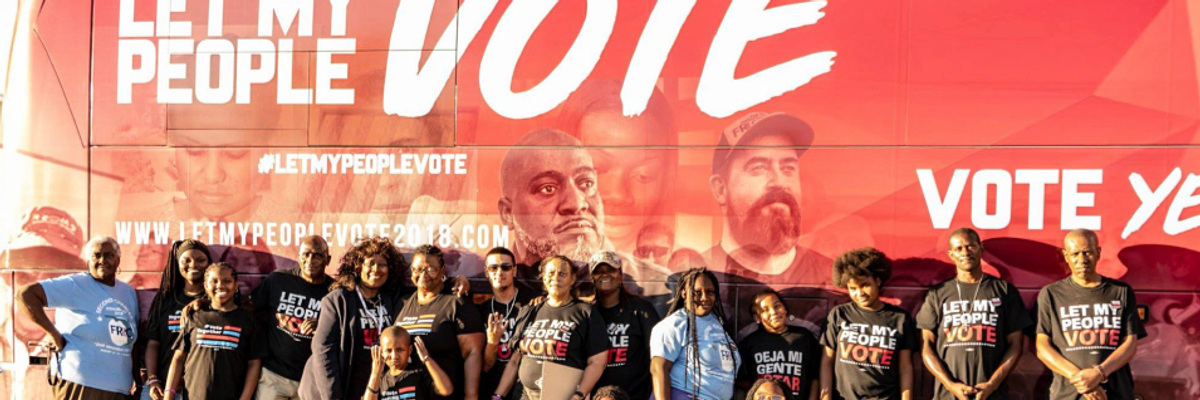
Florida voters in November 2018 overwhelmingly approved a constitutional amendment to restore voting rights to 1.4 million people with past felony convictions. (Photo: Public Citizen/Twitter)
Florida's state Supreme Court on Thursday ruled in favor of denying convicted felons the right to vote if they do not pay fines and fees associated with their incarceration, a decision that was immediately assailed by rights activists as an unconstitutional and immoral poll tax.
In a statement condemning the ruling (pdf), the American Civil Liberties Union (ACLU), ACLU of Florida, Brennan Center for Justice at NYU School of Law and NAACP Legal Defense and Educational Fund said the ruling "does not--indeed, cannot--alter what the U.S. Constitution requires."
"A federal court has already held that the state cannot deny people the right to vote because of their inability to pay financial obligations," the groups said in their statement.
The court ruled that "all terms of sentence" in the law included fines and fees because they are included in "any portion of a sentence that is contained in the four corners of the sentencing document."
Felons in Florida had their right to vote once restored by public ballot "upon completion of all terms of sentence including parole or probation" in 2018, but the state's GOP-led government has worked to undermine the right.
As Common Dreams reported, the state GOP in 2019 passed legislation implementing the modern-day poll tax--drawing criticism from progressive groups and rights advocates. The court's affirmation of the legality of the law is the latest step in the process of reversing the initiative.
"The Florida Supreme Court's decision is disappointing and cuts the 1.4 million people who voters expressly intended to re-enfranchise almost in half," said the Southern Poverty Law Center's deputy legal director, Nancy Abudu. "By holding Floridians' right to vote hostage, the Florida Supreme Court is permitting the unconstitutional modern-day poll tax."
Kira Lerner, a journalist with The Appeal--referring to her reporting with Daniel Nichanian in July 2019 on earlier attempts to re-disenfranchise Florida felons--noted that financial obligations from the sentencing documents make up a small amount of the owed fines.
"Carlos Martinez, the elected public defender in Miami-Dade, told us he estimates that financial obligations are not listed on the sentencing documents for 90 percent of people with outstanding fines and fees in the county," said Lerner.
However, as Nichanian and Lerner pointed out, that is open to the discretion of the counties.
"This interpretation is up to the individual counties and we're likely to see a broader interpretation and more disenfranchisement in more conservative counties," Lerner said.
The bottom line, said the ACLU and affiliated groups, is that the policy represents an unconstitutional poll tax.
"Florida cannot violate the U.S. Constitution's protections," the groups said in their letter. "The right to vote cannot be contingent on the ability to pay."
Dear Common Dreams reader, It’s been nearly 30 years since I co-founded Common Dreams with my late wife, Lina Newhouser. We had the radical notion that journalism should serve the public good, not corporate profits. It was clear to us from the outset what it would take to build such a project. No paid advertisements. No corporate sponsors. No millionaire publisher telling us what to think or do. Many people said we wouldn't last a year, but we proved those doubters wrong. Together with a tremendous team of journalists and dedicated staff, we built an independent media outlet free from the constraints of profits and corporate control. Our mission has always been simple: To inform. To inspire. To ignite change for the common good. Building Common Dreams was not easy. Our survival was never guaranteed. When you take on the most powerful forces—Wall Street greed, fossil fuel industry destruction, Big Tech lobbyists, and uber-rich oligarchs who have spent billions upon billions rigging the economy and democracy in their favor—the only bulwark you have is supporters who believe in your work. But here’s the urgent message from me today. It's never been this bad out there. And it's never been this hard to keep us going. At the very moment Common Dreams is most needed, the threats we face are intensifying. We need your support now more than ever. We don't accept corporate advertising and never will. We don't have a paywall because we don't think people should be blocked from critical news based on their ability to pay. Everything we do is funded by the donations of readers like you. When everyone does the little they can afford, we are strong. But if that support retreats or dries up, so do we. Will you donate now to make sure Common Dreams not only survives but thrives? —Craig Brown, Co-founder |
Florida's state Supreme Court on Thursday ruled in favor of denying convicted felons the right to vote if they do not pay fines and fees associated with their incarceration, a decision that was immediately assailed by rights activists as an unconstitutional and immoral poll tax.
In a statement condemning the ruling (pdf), the American Civil Liberties Union (ACLU), ACLU of Florida, Brennan Center for Justice at NYU School of Law and NAACP Legal Defense and Educational Fund said the ruling "does not--indeed, cannot--alter what the U.S. Constitution requires."
"A federal court has already held that the state cannot deny people the right to vote because of their inability to pay financial obligations," the groups said in their statement.
The court ruled that "all terms of sentence" in the law included fines and fees because they are included in "any portion of a sentence that is contained in the four corners of the sentencing document."
Felons in Florida had their right to vote once restored by public ballot "upon completion of all terms of sentence including parole or probation" in 2018, but the state's GOP-led government has worked to undermine the right.
As Common Dreams reported, the state GOP in 2019 passed legislation implementing the modern-day poll tax--drawing criticism from progressive groups and rights advocates. The court's affirmation of the legality of the law is the latest step in the process of reversing the initiative.
"The Florida Supreme Court's decision is disappointing and cuts the 1.4 million people who voters expressly intended to re-enfranchise almost in half," said the Southern Poverty Law Center's deputy legal director, Nancy Abudu. "By holding Floridians' right to vote hostage, the Florida Supreme Court is permitting the unconstitutional modern-day poll tax."
Kira Lerner, a journalist with The Appeal--referring to her reporting with Daniel Nichanian in July 2019 on earlier attempts to re-disenfranchise Florida felons--noted that financial obligations from the sentencing documents make up a small amount of the owed fines.
"Carlos Martinez, the elected public defender in Miami-Dade, told us he estimates that financial obligations are not listed on the sentencing documents for 90 percent of people with outstanding fines and fees in the county," said Lerner.
However, as Nichanian and Lerner pointed out, that is open to the discretion of the counties.
"This interpretation is up to the individual counties and we're likely to see a broader interpretation and more disenfranchisement in more conservative counties," Lerner said.
The bottom line, said the ACLU and affiliated groups, is that the policy represents an unconstitutional poll tax.
"Florida cannot violate the U.S. Constitution's protections," the groups said in their letter. "The right to vote cannot be contingent on the ability to pay."
Florida's state Supreme Court on Thursday ruled in favor of denying convicted felons the right to vote if they do not pay fines and fees associated with their incarceration, a decision that was immediately assailed by rights activists as an unconstitutional and immoral poll tax.
In a statement condemning the ruling (pdf), the American Civil Liberties Union (ACLU), ACLU of Florida, Brennan Center for Justice at NYU School of Law and NAACP Legal Defense and Educational Fund said the ruling "does not--indeed, cannot--alter what the U.S. Constitution requires."
"A federal court has already held that the state cannot deny people the right to vote because of their inability to pay financial obligations," the groups said in their statement.
The court ruled that "all terms of sentence" in the law included fines and fees because they are included in "any portion of a sentence that is contained in the four corners of the sentencing document."
Felons in Florida had their right to vote once restored by public ballot "upon completion of all terms of sentence including parole or probation" in 2018, but the state's GOP-led government has worked to undermine the right.
As Common Dreams reported, the state GOP in 2019 passed legislation implementing the modern-day poll tax--drawing criticism from progressive groups and rights advocates. The court's affirmation of the legality of the law is the latest step in the process of reversing the initiative.
"The Florida Supreme Court's decision is disappointing and cuts the 1.4 million people who voters expressly intended to re-enfranchise almost in half," said the Southern Poverty Law Center's deputy legal director, Nancy Abudu. "By holding Floridians' right to vote hostage, the Florida Supreme Court is permitting the unconstitutional modern-day poll tax."
Kira Lerner, a journalist with The Appeal--referring to her reporting with Daniel Nichanian in July 2019 on earlier attempts to re-disenfranchise Florida felons--noted that financial obligations from the sentencing documents make up a small amount of the owed fines.
"Carlos Martinez, the elected public defender in Miami-Dade, told us he estimates that financial obligations are not listed on the sentencing documents for 90 percent of people with outstanding fines and fees in the county," said Lerner.
However, as Nichanian and Lerner pointed out, that is open to the discretion of the counties.
"This interpretation is up to the individual counties and we're likely to see a broader interpretation and more disenfranchisement in more conservative counties," Lerner said.
The bottom line, said the ACLU and affiliated groups, is that the policy represents an unconstitutional poll tax.
"Florida cannot violate the U.S. Constitution's protections," the groups said in their letter. "The right to vote cannot be contingent on the ability to pay."