SUBSCRIBE TO OUR FREE NEWSLETTER
Daily news & progressive opinion—funded by the people, not the corporations—delivered straight to your inbox.
5
#000000
#FFFFFF
To donate by check, phone, or other method, see our More Ways to Give page.
Daily news & progressive opinion—funded by the people, not the corporations—delivered straight to your inbox.
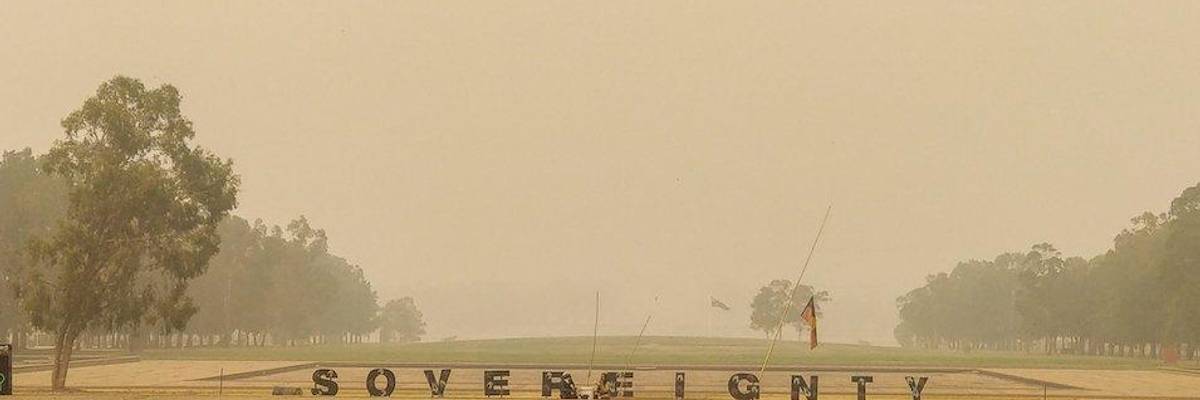
Canberra, Australia on Wednesday was so smoky that visibility past a few hundred yards was virtually non-existent. (Photo: RedFiddler/Twitter)
Smoke from the continuing, disastrous bushfires ringing Australia has delivered the country's capital Canberra its worst air quality on record--a stark reminder to the government that the crisis is not ending anytime soon.
"This is an exceptional time for Canberra," Australia's acting chief health officer, Dr. Paul Dugdale, told the Guardian, "usually our air quality is among the best in the world."
According to the Guardian:
Dugdale said the smoke was the worst since the 2003 bushfires and was "certainly the worst" since air quality monitoring started in the city 15 years ago.
Air quality index readings in Canberra city were at 3,463 on Wednesday afternoon, according to the ACT Health website. Ratings of more than 200 are considered hazardous. The suburb of Monash showed levels at 4,650 and Florey was at 3,508.
Bushfires in Australia have been burning for months, with no end in sight. The crisis has only gotten worse in recent weeks as the flames encircle the country.
As Common Dreams reported on Monday, residents of the Victoria town of Mallacoota were forced to flee into the water as the fires consumed their homes.
On Wednesday, the Australian Navy mobilized to bring aid to those trapped in Victoria.
Two ships now headed for the southeastern state "will be able to provide humanitarian assistance and disaster relief support including beach recovery of isolated civilians and shore logistic support to isolated people," said a Defence Force spokesperson.
Images from Canberra on Wednesday showed a hazy, grey-yellow New Year's sky and low visibility on the ground.
Photojournalist Matthew Abbot, on the ground in Australia, noted the timing of the fires and the new decade in a tweet.
"My last day of the decade felt like the apocalypse," said Abbot.
Choked-out skies were not just found in Canberra. Over 2,500 miles across the ocean, in New Zealand, residents shared photos of the smoky haze in their country.
Hikers on the Tasman Glacier on New Zealand's South Island posted video of the smoke at the landmark.
"We can actually smell the burning here in Christchurch," said one Twitter user.
Observers shared graphical representations of the scope and scale of the disaster on social media.
Guardian Australia journalist David Marr in a column Tuesday said that because the smoke from the current fires was beyond what Australia is used to in normal fire seasons, the crisis is harder to ignore.
"We're used to a day or two in town when there's a bit of smoke about and the light turns a horrible yellow," wrote Marr. "That's every summer. But this is different. Deep in cities, miles from the fire front, the smoke is so thick you can't see to the end of the street."
But the crisis is unlikely to move the pro-emissions position of Prime Minister Scott Morrison, a supporter of fossil fuels and extractive resources.
According to the New York Times:
As Australia has seen a surge of climate activism in recent months, Mr. Morrison has gone so far as to suggest that the government should outlaw efforts by environmental groups to pressure businesses with rallies and boycotts. Other members of Mr. Morrison's government have answered calls for action with insults; the deputy prime minister called people who care about global warming "raving inner-city lunatics."
Morrison's attempts to "spin" the conversation around the bushfires away from the climate crisis, wrote the Guardian's Lenore Taylor, won't work in the face of the current disaster.
"Yes, we've always had fires, but not like this, and everyone knows it, no matter how diligently some news organizations compile lists of blazes from the past," Taylor wrote. "And we also know why the prime minister would seek to present this catastrophe as bad, but also somehow as situation normal."
Dear Common Dreams reader, It’s been nearly 30 years since I co-founded Common Dreams with my late wife, Lina Newhouser. We had the radical notion that journalism should serve the public good, not corporate profits. It was clear to us from the outset what it would take to build such a project. No paid advertisements. No corporate sponsors. No millionaire publisher telling us what to think or do. Many people said we wouldn't last a year, but we proved those doubters wrong. Together with a tremendous team of journalists and dedicated staff, we built an independent media outlet free from the constraints of profits and corporate control. Our mission has always been simple: To inform. To inspire. To ignite change for the common good. Building Common Dreams was not easy. Our survival was never guaranteed. When you take on the most powerful forces—Wall Street greed, fossil fuel industry destruction, Big Tech lobbyists, and uber-rich oligarchs who have spent billions upon billions rigging the economy and democracy in their favor—the only bulwark you have is supporters who believe in your work. But here’s the urgent message from me today. It's never been this bad out there. And it's never been this hard to keep us going. At the very moment Common Dreams is most needed, the threats we face are intensifying. We need your support now more than ever. We don't accept corporate advertising and never will. We don't have a paywall because we don't think people should be blocked from critical news based on their ability to pay. Everything we do is funded by the donations of readers like you. When everyone does the little they can afford, we are strong. But if that support retreats or dries up, so do we. Will you donate now to make sure Common Dreams not only survives but thrives? —Craig Brown, Co-founder |
Smoke from the continuing, disastrous bushfires ringing Australia has delivered the country's capital Canberra its worst air quality on record--a stark reminder to the government that the crisis is not ending anytime soon.
"This is an exceptional time for Canberra," Australia's acting chief health officer, Dr. Paul Dugdale, told the Guardian, "usually our air quality is among the best in the world."
According to the Guardian:
Dugdale said the smoke was the worst since the 2003 bushfires and was "certainly the worst" since air quality monitoring started in the city 15 years ago.
Air quality index readings in Canberra city were at 3,463 on Wednesday afternoon, according to the ACT Health website. Ratings of more than 200 are considered hazardous. The suburb of Monash showed levels at 4,650 and Florey was at 3,508.
Bushfires in Australia have been burning for months, with no end in sight. The crisis has only gotten worse in recent weeks as the flames encircle the country.
As Common Dreams reported on Monday, residents of the Victoria town of Mallacoota were forced to flee into the water as the fires consumed their homes.
On Wednesday, the Australian Navy mobilized to bring aid to those trapped in Victoria.
Two ships now headed for the southeastern state "will be able to provide humanitarian assistance and disaster relief support including beach recovery of isolated civilians and shore logistic support to isolated people," said a Defence Force spokesperson.
Images from Canberra on Wednesday showed a hazy, grey-yellow New Year's sky and low visibility on the ground.
Photojournalist Matthew Abbot, on the ground in Australia, noted the timing of the fires and the new decade in a tweet.
"My last day of the decade felt like the apocalypse," said Abbot.
Choked-out skies were not just found in Canberra. Over 2,500 miles across the ocean, in New Zealand, residents shared photos of the smoky haze in their country.
Hikers on the Tasman Glacier on New Zealand's South Island posted video of the smoke at the landmark.
"We can actually smell the burning here in Christchurch," said one Twitter user.
Observers shared graphical representations of the scope and scale of the disaster on social media.
Guardian Australia journalist David Marr in a column Tuesday said that because the smoke from the current fires was beyond what Australia is used to in normal fire seasons, the crisis is harder to ignore.
"We're used to a day or two in town when there's a bit of smoke about and the light turns a horrible yellow," wrote Marr. "That's every summer. But this is different. Deep in cities, miles from the fire front, the smoke is so thick you can't see to the end of the street."
But the crisis is unlikely to move the pro-emissions position of Prime Minister Scott Morrison, a supporter of fossil fuels and extractive resources.
According to the New York Times:
As Australia has seen a surge of climate activism in recent months, Mr. Morrison has gone so far as to suggest that the government should outlaw efforts by environmental groups to pressure businesses with rallies and boycotts. Other members of Mr. Morrison's government have answered calls for action with insults; the deputy prime minister called people who care about global warming "raving inner-city lunatics."
Morrison's attempts to "spin" the conversation around the bushfires away from the climate crisis, wrote the Guardian's Lenore Taylor, won't work in the face of the current disaster.
"Yes, we've always had fires, but not like this, and everyone knows it, no matter how diligently some news organizations compile lists of blazes from the past," Taylor wrote. "And we also know why the prime minister would seek to present this catastrophe as bad, but also somehow as situation normal."
Smoke from the continuing, disastrous bushfires ringing Australia has delivered the country's capital Canberra its worst air quality on record--a stark reminder to the government that the crisis is not ending anytime soon.
"This is an exceptional time for Canberra," Australia's acting chief health officer, Dr. Paul Dugdale, told the Guardian, "usually our air quality is among the best in the world."
According to the Guardian:
Dugdale said the smoke was the worst since the 2003 bushfires and was "certainly the worst" since air quality monitoring started in the city 15 years ago.
Air quality index readings in Canberra city were at 3,463 on Wednesday afternoon, according to the ACT Health website. Ratings of more than 200 are considered hazardous. The suburb of Monash showed levels at 4,650 and Florey was at 3,508.
Bushfires in Australia have been burning for months, with no end in sight. The crisis has only gotten worse in recent weeks as the flames encircle the country.
As Common Dreams reported on Monday, residents of the Victoria town of Mallacoota were forced to flee into the water as the fires consumed their homes.
On Wednesday, the Australian Navy mobilized to bring aid to those trapped in Victoria.
Two ships now headed for the southeastern state "will be able to provide humanitarian assistance and disaster relief support including beach recovery of isolated civilians and shore logistic support to isolated people," said a Defence Force spokesperson.
Images from Canberra on Wednesday showed a hazy, grey-yellow New Year's sky and low visibility on the ground.
Photojournalist Matthew Abbot, on the ground in Australia, noted the timing of the fires and the new decade in a tweet.
"My last day of the decade felt like the apocalypse," said Abbot.
Choked-out skies were not just found in Canberra. Over 2,500 miles across the ocean, in New Zealand, residents shared photos of the smoky haze in their country.
Hikers on the Tasman Glacier on New Zealand's South Island posted video of the smoke at the landmark.
"We can actually smell the burning here in Christchurch," said one Twitter user.
Observers shared graphical representations of the scope and scale of the disaster on social media.
Guardian Australia journalist David Marr in a column Tuesday said that because the smoke from the current fires was beyond what Australia is used to in normal fire seasons, the crisis is harder to ignore.
"We're used to a day or two in town when there's a bit of smoke about and the light turns a horrible yellow," wrote Marr. "That's every summer. But this is different. Deep in cities, miles from the fire front, the smoke is so thick you can't see to the end of the street."
But the crisis is unlikely to move the pro-emissions position of Prime Minister Scott Morrison, a supporter of fossil fuels and extractive resources.
According to the New York Times:
As Australia has seen a surge of climate activism in recent months, Mr. Morrison has gone so far as to suggest that the government should outlaw efforts by environmental groups to pressure businesses with rallies and boycotts. Other members of Mr. Morrison's government have answered calls for action with insults; the deputy prime minister called people who care about global warming "raving inner-city lunatics."
Morrison's attempts to "spin" the conversation around the bushfires away from the climate crisis, wrote the Guardian's Lenore Taylor, won't work in the face of the current disaster.
"Yes, we've always had fires, but not like this, and everyone knows it, no matter how diligently some news organizations compile lists of blazes from the past," Taylor wrote. "And we also know why the prime minister would seek to present this catastrophe as bad, but also somehow as situation normal."