

SUBSCRIBE TO OUR FREE NEWSLETTER
Daily news & progressive opinion—funded by the people, not the corporations—delivered straight to your inbox.
5
#000000
#FFFFFF
To donate by check, phone, or other method, see our More Ways to Give page.
Daily news & progressive opinion—funded by the people, not the corporations—delivered straight to your inbox.
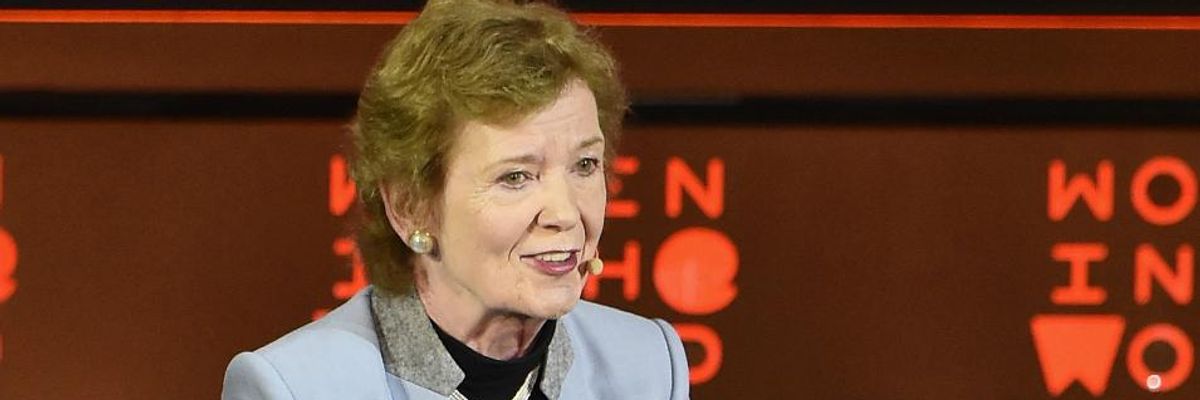
Mary Robinson, former president of Ireland and the founder of the Mary Robinson Foundation for Climate Justice, speaks at the Women In The World Summit on April 23, 2015 in New York City. (Photo: Mike Coppola/Getty Images)
Echoing what other critics stated last week, former Irish president Mary Robinson on Monday warned that while some forms of "disruption" are necessary and good, it will set the global climate movement backwards if Extinction Rebellion activists or others "alienate the public" by taking aim at the wrong targets or make unforced tactical mistakes.
"So far, on the whole, they have been quite clever, they've been funny," said Robinson during a talk at the at the Aurora Forum in Armenia on Monday when asked about Extinction Rebellion (XR)--a movement launched last year which has staged coordinated direct actions around the globe in recent weeks.
"They've been apologetic for the disruption caused because they don't want to alienate the public," Robinson added. "But then there are some who want to go further. I think it is very, very important that the public display of disruption is seen by the public as being in their interests, and that has happened. But if they lose that, that would be very serious."
Unlike other climate campaigners, XR has made social disruption--including blocking roads, access to corporate or government buildings, and shutting down airport terminals--the driving force of its activism.
Last week, when a small group of XR-affiliated demonstrators shut down a commuter train during morning rush-hour there was immediate pushback from within the organization and without. As Common Dreams reported Friday:
Commuters' furious reaction to the protest appeared to validate concerns that the action would alienate potential and necessary working-class allies and fuel perception of the movement as out of touch with the material concerns of vulnerable people.
In the early hours of Thursday morning, several XR-aligned activists climbed atop an electric train at Canning Town station in London and glued themselves to one car. As commuters filled the platform, many shouted at the demonstrators and one man dragged an activist off the train.
"I need to get to work! I have to feed my kids!" one person yelled from the packed platform.
Speaking of the broader climate justice movement, including the global #FridaysforFuture and #ClimateStrike movement inspired by Swedish activist Greta Thunberg and other students, Robinson said "what they're saying--which is correct--is that we, the adults in this world, are not guaranteeing them a safe future; a livable future."
Robinson, the former special UN envoy on climate and the environment, said she was at the General Assembly in New York City last month when Thunberg spoke to those world leaders gathered for the Climate Action Summit.
"And when I heard [Thunberg] say, 'You have stolen my childhood'--a 16-year-old--I cried, actually," Robinson said. "I thought, this is not fair."
With global inaction still ruling the day, Robinson suggests these massive grassroots efforts around the world are more necessary than ever.
"I see no significant move on the part of emitters to change," she said. "So now I feel it's time for disruption--and disruption takes many forms."
"Disruption can be litigation, disruption can be shareholder questions at meetings, disruption of a very effective thought can be when investors are warning about being invested in stranded assets," Robinson continued. "Disruption can be bottom up the schoolchildren, the young people, the Extinction Rebellion, the women leaders. But most effective is the investors. If they can really move that needle, it can move very fast."
Dear Common Dreams reader, It’s been nearly 30 years since I co-founded Common Dreams with my late wife, Lina Newhouser. We had the radical notion that journalism should serve the public good, not corporate profits. It was clear to us from the outset what it would take to build such a project. No paid advertisements. No corporate sponsors. No millionaire publisher telling us what to think or do. Many people said we wouldn't last a year, but we proved those doubters wrong. Together with a tremendous team of journalists and dedicated staff, we built an independent media outlet free from the constraints of profits and corporate control. Our mission has always been simple: To inform. To inspire. To ignite change for the common good. Building Common Dreams was not easy. Our survival was never guaranteed. When you take on the most powerful forces—Wall Street greed, fossil fuel industry destruction, Big Tech lobbyists, and uber-rich oligarchs who have spent billions upon billions rigging the economy and democracy in their favor—the only bulwark you have is supporters who believe in your work. But here’s the urgent message from me today. It's never been this bad out there. And it's never been this hard to keep us going. At the very moment Common Dreams is most needed, the threats we face are intensifying. We need your support now more than ever. We don't accept corporate advertising and never will. We don't have a paywall because we don't think people should be blocked from critical news based on their ability to pay. Everything we do is funded by the donations of readers like you. When everyone does the little they can afford, we are strong. But if that support retreats or dries up, so do we. Will you donate now to make sure Common Dreams not only survives but thrives? —Craig Brown, Co-founder |
Echoing what other critics stated last week, former Irish president Mary Robinson on Monday warned that while some forms of "disruption" are necessary and good, it will set the global climate movement backwards if Extinction Rebellion activists or others "alienate the public" by taking aim at the wrong targets or make unforced tactical mistakes.
"So far, on the whole, they have been quite clever, they've been funny," said Robinson during a talk at the at the Aurora Forum in Armenia on Monday when asked about Extinction Rebellion (XR)--a movement launched last year which has staged coordinated direct actions around the globe in recent weeks.
"They've been apologetic for the disruption caused because they don't want to alienate the public," Robinson added. "But then there are some who want to go further. I think it is very, very important that the public display of disruption is seen by the public as being in their interests, and that has happened. But if they lose that, that would be very serious."
Unlike other climate campaigners, XR has made social disruption--including blocking roads, access to corporate or government buildings, and shutting down airport terminals--the driving force of its activism.
Last week, when a small group of XR-affiliated demonstrators shut down a commuter train during morning rush-hour there was immediate pushback from within the organization and without. As Common Dreams reported Friday:
Commuters' furious reaction to the protest appeared to validate concerns that the action would alienate potential and necessary working-class allies and fuel perception of the movement as out of touch with the material concerns of vulnerable people.
In the early hours of Thursday morning, several XR-aligned activists climbed atop an electric train at Canning Town station in London and glued themselves to one car. As commuters filled the platform, many shouted at the demonstrators and one man dragged an activist off the train.
"I need to get to work! I have to feed my kids!" one person yelled from the packed platform.
Speaking of the broader climate justice movement, including the global #FridaysforFuture and #ClimateStrike movement inspired by Swedish activist Greta Thunberg and other students, Robinson said "what they're saying--which is correct--is that we, the adults in this world, are not guaranteeing them a safe future; a livable future."
Robinson, the former special UN envoy on climate and the environment, said she was at the General Assembly in New York City last month when Thunberg spoke to those world leaders gathered for the Climate Action Summit.
"And when I heard [Thunberg] say, 'You have stolen my childhood'--a 16-year-old--I cried, actually," Robinson said. "I thought, this is not fair."
With global inaction still ruling the day, Robinson suggests these massive grassroots efforts around the world are more necessary than ever.
"I see no significant move on the part of emitters to change," she said. "So now I feel it's time for disruption--and disruption takes many forms."
"Disruption can be litigation, disruption can be shareholder questions at meetings, disruption of a very effective thought can be when investors are warning about being invested in stranded assets," Robinson continued. "Disruption can be bottom up the schoolchildren, the young people, the Extinction Rebellion, the women leaders. But most effective is the investors. If they can really move that needle, it can move very fast."
Echoing what other critics stated last week, former Irish president Mary Robinson on Monday warned that while some forms of "disruption" are necessary and good, it will set the global climate movement backwards if Extinction Rebellion activists or others "alienate the public" by taking aim at the wrong targets or make unforced tactical mistakes.
"So far, on the whole, they have been quite clever, they've been funny," said Robinson during a talk at the at the Aurora Forum in Armenia on Monday when asked about Extinction Rebellion (XR)--a movement launched last year which has staged coordinated direct actions around the globe in recent weeks.
"They've been apologetic for the disruption caused because they don't want to alienate the public," Robinson added. "But then there are some who want to go further. I think it is very, very important that the public display of disruption is seen by the public as being in their interests, and that has happened. But if they lose that, that would be very serious."
Unlike other climate campaigners, XR has made social disruption--including blocking roads, access to corporate or government buildings, and shutting down airport terminals--the driving force of its activism.
Last week, when a small group of XR-affiliated demonstrators shut down a commuter train during morning rush-hour there was immediate pushback from within the organization and without. As Common Dreams reported Friday:
Commuters' furious reaction to the protest appeared to validate concerns that the action would alienate potential and necessary working-class allies and fuel perception of the movement as out of touch with the material concerns of vulnerable people.
In the early hours of Thursday morning, several XR-aligned activists climbed atop an electric train at Canning Town station in London and glued themselves to one car. As commuters filled the platform, many shouted at the demonstrators and one man dragged an activist off the train.
"I need to get to work! I have to feed my kids!" one person yelled from the packed platform.
Speaking of the broader climate justice movement, including the global #FridaysforFuture and #ClimateStrike movement inspired by Swedish activist Greta Thunberg and other students, Robinson said "what they're saying--which is correct--is that we, the adults in this world, are not guaranteeing them a safe future; a livable future."
Robinson, the former special UN envoy on climate and the environment, said she was at the General Assembly in New York City last month when Thunberg spoke to those world leaders gathered for the Climate Action Summit.
"And when I heard [Thunberg] say, 'You have stolen my childhood'--a 16-year-old--I cried, actually," Robinson said. "I thought, this is not fair."
With global inaction still ruling the day, Robinson suggests these massive grassroots efforts around the world are more necessary than ever.
"I see no significant move on the part of emitters to change," she said. "So now I feel it's time for disruption--and disruption takes many forms."
"Disruption can be litigation, disruption can be shareholder questions at meetings, disruption of a very effective thought can be when investors are warning about being invested in stranded assets," Robinson continued. "Disruption can be bottom up the schoolchildren, the young people, the Extinction Rebellion, the women leaders. But most effective is the investors. If they can really move that needle, it can move very fast."

