SUBSCRIBE TO OUR FREE NEWSLETTER
Daily news & progressive opinion—funded by the people, not the corporations—delivered straight to your inbox.
5
#000000
#FFFFFF
To donate by check, phone, or other method, see our More Ways to Give page.
Daily news & progressive opinion—funded by the people, not the corporations—delivered straight to your inbox.
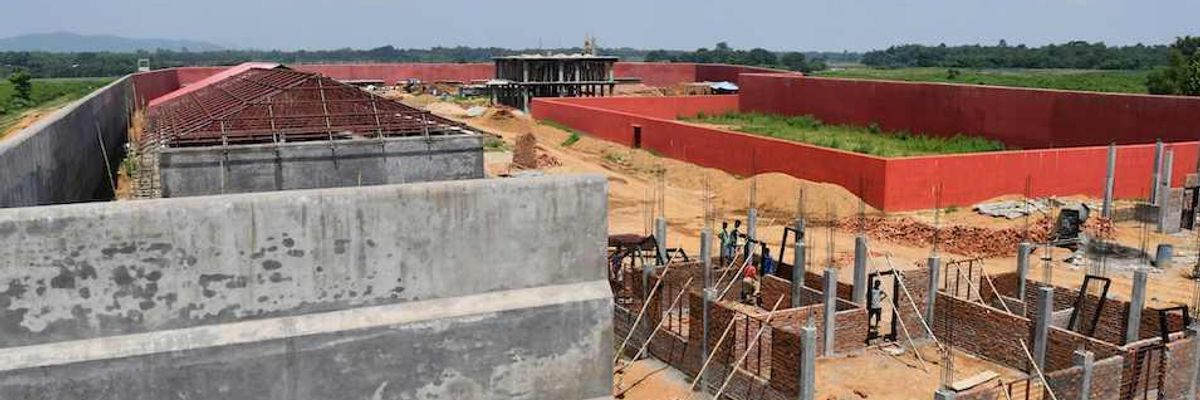
A laborer working on a new detention center being built for people who are not included in a "citizens register" in Kadamtola Gopalpur village, in Goalpara district, some 170km from Guwahati, the capital city of India's northeastern state of Assam. (Photo: Biju Boro/AFP/Getty Images)
Massive camps are being built in Assam, India to house 1.9 million people in the state whose citizenship is now in question due to the country's National Register of Citizens (NRC) law.
The NRC requires people who the government suspects of migrating illegally into India to prove their citizenship and family ties to the country through documentation going back decades. It's thus far only being applied in this way in Assam against the 31 million population state's minority communities.
Workers building the detention camps fear they may end up interned in the facilities, according to new reporting.
That the people working to construct the camps are themselves likely to be housed there is an irony not lost on laborer Sarojini Hajong, who told Reuters that workers had little choice in the face of poverty.
"Of course we are scared about what will happen," she said. "But what can we do? I need the money."
The massive camps are being built in Assam to house the 1.9 million people in the state whose citizenship is now in question due to the National Register of Citizens (NRC) law, which requires people who the government suspects of migrating illegally into India to prove their citizenship and family ties to the country through documentation going back decades. If the accused can't provide information proving their citizenship, they will be housed in the camps.
The historical parallel to the Holocaust was not lost on peace and conflict research professor Ashok Swain.
According to Reuters, migrants currently held by Indian authorities in Assam jails are in dire conditions, "deprived even of the rights of convicted prisoners." Rights group Amnesty International said in a statement that the crisis is only going to get worse.
"Assam is on the brink of a crisis which would not only lead to a loss of nationality and liberty of a large group of people but also erosion of their basic rights--severely affecting the lives of generations to come," Amnesty said
Imraan Siddiqi, executive director for the Council on American Islamic Relations (CAIR) of Arizona, tweeted that the camps and stripping of citizenship should be ringing alarm bells.
"If this isn't a red flag for the whole world," said Siddiqi, "I don't know what is."
Assam is one of a cluster of northeastern Indian states attached to the larger country by a narrow strip of land in the state of West Bengal and are bordered by the countries of Bangladesh, Nepal, Bhutan, Burma, and China. The list in Assam is targeted at migrants from Bangladesh, the Muslim-majority nation to the state's south.
But, as The Nation reported Tuesday, the law swept up non-Muslims as well, presenting a problem to Prime Minister Narendra Modi's ruling Bharatiya Janata Party (BJP).
Some in Modi's Hindu nationalist BJP want to see the NRC update reach beyond Assam. Shah, the minister of Home Affairs, has said he wants to spread the update to every state in India, and deport illegal immigrants from "every inch of the country's soil." Shah has also called Bangladeshi migrants "termites."
In a Wednesday Independent report on the Assam situation, the British paper revealed that the Indian government is taking steps to remedy that perceived problem by "bringing legislation to grant citizenship to Hindu, Sikh, and Buddhist immigrants from neighbouring countries."
"Muslim immigrants are not included in the law," the paper added.
It's hard to look at that behavior and come to any other conclusion than "the effort looks far more like an ethnic purge than anything like a census," K. Anis Ahmed, publisher of Bangladesh's Dhaka Tribune, wrote at The New York Times on Wednesday.
"The Indian government hardly even pretends otherwise," Ahmed added.
Historian Nikhil Pal Singh noted on Twitter that the Indian government's "terrifying" anti-Muslim policies are in many ways a byproduct of the more permissive international attitude toward Islamophobia in the wake of the 9/11 attacks, which took place 18 years ago Wednesday.
"A few years ago the U.S. military published a pamphlet predicting a future dominated by detention and detainee operations world-wide," said Singh. "This is the world that the global war on terror made."
City Lab reporter Tanvi Misra, in a tweet, implored her followers to pay attention to what the Indian government is doing.
"You're seeing what's happening here," said Misra, "right?"
Dear Common Dreams reader, It’s been nearly 30 years since I co-founded Common Dreams with my late wife, Lina Newhouser. We had the radical notion that journalism should serve the public good, not corporate profits. It was clear to us from the outset what it would take to build such a project. No paid advertisements. No corporate sponsors. No millionaire publisher telling us what to think or do. Many people said we wouldn't last a year, but we proved those doubters wrong. Together with a tremendous team of journalists and dedicated staff, we built an independent media outlet free from the constraints of profits and corporate control. Our mission has always been simple: To inform. To inspire. To ignite change for the common good. Building Common Dreams was not easy. Our survival was never guaranteed. When you take on the most powerful forces—Wall Street greed, fossil fuel industry destruction, Big Tech lobbyists, and uber-rich oligarchs who have spent billions upon billions rigging the economy and democracy in their favor—the only bulwark you have is supporters who believe in your work. But here’s the urgent message from me today. It's never been this bad out there. And it's never been this hard to keep us going. At the very moment Common Dreams is most needed, the threats we face are intensifying. We need your support now more than ever. We don't accept corporate advertising and never will. We don't have a paywall because we don't think people should be blocked from critical news based on their ability to pay. Everything we do is funded by the donations of readers like you. When everyone does the little they can afford, we are strong. But if that support retreats or dries up, so do we. Will you donate now to make sure Common Dreams not only survives but thrives? —Craig Brown, Co-founder |
Massive camps are being built in Assam, India to house 1.9 million people in the state whose citizenship is now in question due to the country's National Register of Citizens (NRC) law.
The NRC requires people who the government suspects of migrating illegally into India to prove their citizenship and family ties to the country through documentation going back decades. It's thus far only being applied in this way in Assam against the 31 million population state's minority communities.
Workers building the detention camps fear they may end up interned in the facilities, according to new reporting.
That the people working to construct the camps are themselves likely to be housed there is an irony not lost on laborer Sarojini Hajong, who told Reuters that workers had little choice in the face of poverty.
"Of course we are scared about what will happen," she said. "But what can we do? I need the money."
The massive camps are being built in Assam to house the 1.9 million people in the state whose citizenship is now in question due to the National Register of Citizens (NRC) law, which requires people who the government suspects of migrating illegally into India to prove their citizenship and family ties to the country through documentation going back decades. If the accused can't provide information proving their citizenship, they will be housed in the camps.
The historical parallel to the Holocaust was not lost on peace and conflict research professor Ashok Swain.
According to Reuters, migrants currently held by Indian authorities in Assam jails are in dire conditions, "deprived even of the rights of convicted prisoners." Rights group Amnesty International said in a statement that the crisis is only going to get worse.
"Assam is on the brink of a crisis which would not only lead to a loss of nationality and liberty of a large group of people but also erosion of their basic rights--severely affecting the lives of generations to come," Amnesty said
Imraan Siddiqi, executive director for the Council on American Islamic Relations (CAIR) of Arizona, tweeted that the camps and stripping of citizenship should be ringing alarm bells.
"If this isn't a red flag for the whole world," said Siddiqi, "I don't know what is."
Assam is one of a cluster of northeastern Indian states attached to the larger country by a narrow strip of land in the state of West Bengal and are bordered by the countries of Bangladesh, Nepal, Bhutan, Burma, and China. The list in Assam is targeted at migrants from Bangladesh, the Muslim-majority nation to the state's south.
But, as The Nation reported Tuesday, the law swept up non-Muslims as well, presenting a problem to Prime Minister Narendra Modi's ruling Bharatiya Janata Party (BJP).
Some in Modi's Hindu nationalist BJP want to see the NRC update reach beyond Assam. Shah, the minister of Home Affairs, has said he wants to spread the update to every state in India, and deport illegal immigrants from "every inch of the country's soil." Shah has also called Bangladeshi migrants "termites."
In a Wednesday Independent report on the Assam situation, the British paper revealed that the Indian government is taking steps to remedy that perceived problem by "bringing legislation to grant citizenship to Hindu, Sikh, and Buddhist immigrants from neighbouring countries."
"Muslim immigrants are not included in the law," the paper added.
It's hard to look at that behavior and come to any other conclusion than "the effort looks far more like an ethnic purge than anything like a census," K. Anis Ahmed, publisher of Bangladesh's Dhaka Tribune, wrote at The New York Times on Wednesday.
"The Indian government hardly even pretends otherwise," Ahmed added.
Historian Nikhil Pal Singh noted on Twitter that the Indian government's "terrifying" anti-Muslim policies are in many ways a byproduct of the more permissive international attitude toward Islamophobia in the wake of the 9/11 attacks, which took place 18 years ago Wednesday.
"A few years ago the U.S. military published a pamphlet predicting a future dominated by detention and detainee operations world-wide," said Singh. "This is the world that the global war on terror made."
City Lab reporter Tanvi Misra, in a tweet, implored her followers to pay attention to what the Indian government is doing.
"You're seeing what's happening here," said Misra, "right?"
Massive camps are being built in Assam, India to house 1.9 million people in the state whose citizenship is now in question due to the country's National Register of Citizens (NRC) law.
The NRC requires people who the government suspects of migrating illegally into India to prove their citizenship and family ties to the country through documentation going back decades. It's thus far only being applied in this way in Assam against the 31 million population state's minority communities.
Workers building the detention camps fear they may end up interned in the facilities, according to new reporting.
That the people working to construct the camps are themselves likely to be housed there is an irony not lost on laborer Sarojini Hajong, who told Reuters that workers had little choice in the face of poverty.
"Of course we are scared about what will happen," she said. "But what can we do? I need the money."
The massive camps are being built in Assam to house the 1.9 million people in the state whose citizenship is now in question due to the National Register of Citizens (NRC) law, which requires people who the government suspects of migrating illegally into India to prove their citizenship and family ties to the country through documentation going back decades. If the accused can't provide information proving their citizenship, they will be housed in the camps.
The historical parallel to the Holocaust was not lost on peace and conflict research professor Ashok Swain.
According to Reuters, migrants currently held by Indian authorities in Assam jails are in dire conditions, "deprived even of the rights of convicted prisoners." Rights group Amnesty International said in a statement that the crisis is only going to get worse.
"Assam is on the brink of a crisis which would not only lead to a loss of nationality and liberty of a large group of people but also erosion of their basic rights--severely affecting the lives of generations to come," Amnesty said
Imraan Siddiqi, executive director for the Council on American Islamic Relations (CAIR) of Arizona, tweeted that the camps and stripping of citizenship should be ringing alarm bells.
"If this isn't a red flag for the whole world," said Siddiqi, "I don't know what is."
Assam is one of a cluster of northeastern Indian states attached to the larger country by a narrow strip of land in the state of West Bengal and are bordered by the countries of Bangladesh, Nepal, Bhutan, Burma, and China. The list in Assam is targeted at migrants from Bangladesh, the Muslim-majority nation to the state's south.
But, as The Nation reported Tuesday, the law swept up non-Muslims as well, presenting a problem to Prime Minister Narendra Modi's ruling Bharatiya Janata Party (BJP).
Some in Modi's Hindu nationalist BJP want to see the NRC update reach beyond Assam. Shah, the minister of Home Affairs, has said he wants to spread the update to every state in India, and deport illegal immigrants from "every inch of the country's soil." Shah has also called Bangladeshi migrants "termites."
In a Wednesday Independent report on the Assam situation, the British paper revealed that the Indian government is taking steps to remedy that perceived problem by "bringing legislation to grant citizenship to Hindu, Sikh, and Buddhist immigrants from neighbouring countries."
"Muslim immigrants are not included in the law," the paper added.
It's hard to look at that behavior and come to any other conclusion than "the effort looks far more like an ethnic purge than anything like a census," K. Anis Ahmed, publisher of Bangladesh's Dhaka Tribune, wrote at The New York Times on Wednesday.
"The Indian government hardly even pretends otherwise," Ahmed added.
Historian Nikhil Pal Singh noted on Twitter that the Indian government's "terrifying" anti-Muslim policies are in many ways a byproduct of the more permissive international attitude toward Islamophobia in the wake of the 9/11 attacks, which took place 18 years ago Wednesday.
"A few years ago the U.S. military published a pamphlet predicting a future dominated by detention and detainee operations world-wide," said Singh. "This is the world that the global war on terror made."
City Lab reporter Tanvi Misra, in a tweet, implored her followers to pay attention to what the Indian government is doing.
"You're seeing what's happening here," said Misra, "right?"