SUBSCRIBE TO OUR FREE NEWSLETTER
Daily news & progressive opinion—funded by the people, not the corporations—delivered straight to your inbox.
5
#000000
#FFFFFF
To donate by check, phone, or other method, see our More Ways to Give page.
Daily news & progressive opinion—funded by the people, not the corporations—delivered straight to your inbox.
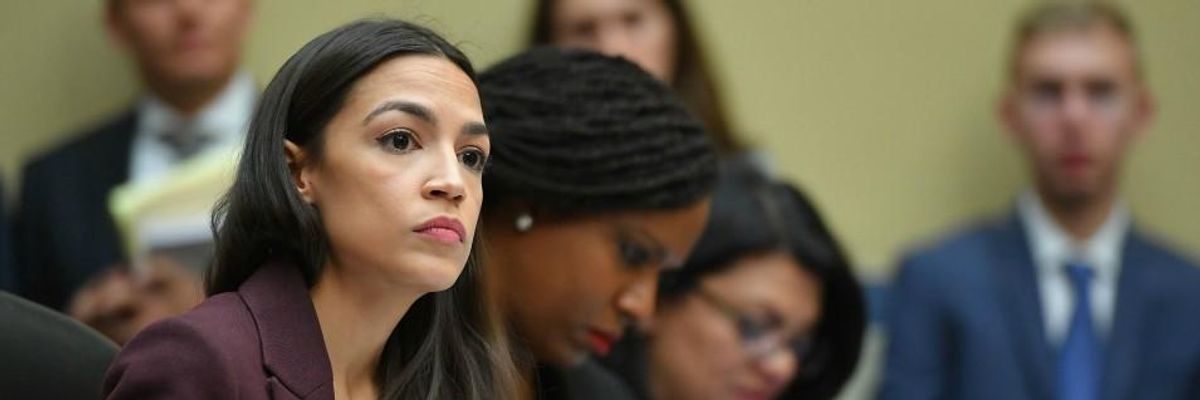
Rep. Alexandria Ocasio-Cortez (D-N.Y.) listens during a House Oversight and Reform Committee hearing in the Rayburn House Office Building on Capitol Hill in Washington, D.C. on February 27, 2019. (Photo: Mandel Ngan/AFP/Getty Images)
In response to criticism of her decision to block a small number of Twitter users, Rep. Alexandria Ocasio-Cortez on Thursday drew a clear distinction between those who engage in persistent "harrassment and abuse" and those who simply hold and express repugnant views--using Fox News host Laura Ingraham as an illustrative example of the latter.
"See? You're a neo-Nazi fan favorite and I don't block you for defending white supremacist viewpoints and mocking gun violence survivors," the New York Democrat tweeted at Ingraham.
Ocasio-Cortez's swipe at Ingraham came after the right-wing host attempted to correct the grammar of one of the congresswoman's earlier tweets, in which she defended her decision to block a select few Twitter users.
"I have 5.2 million followers. Less than 20 accounts are blocked for ongoing harassment. 0 are my constituents," Ocasio-Cortez wrote in response to Columbia University's Knight First Amendment Institute, which sent a letter urging the New York Democrat to "not to block Twitter users on the basis of viewpoint."
Ocasio-Cortez maintained she is not blocking Twitter users who disagree with her views, but those who are abusive.
"Harassment is not a viewpoint," said Ocasio-Cortez. "Some accounts, like [right-wing website] the Daily Caller, posted fake nude photos of me and abused my comments to spread it. No one is entitled to abuse."
The back-and-forth between Ocasio-Cortez and Ingraham comes after a federal appeals court ruled last month that public officials--including President Donald Trump--cannot block Twitter users "because they expressed views with which the official disagrees," a move that would violate the First Amendment.
But Ocasio-Cortez argued her decision to block a small number of Twitter accounts does not run afoul of First Amendment rights.
"People are free to speak whatever classist, racist, false, misogynistic, bigoted comments they'd like," the congresswoman wrote. "They do not have the right to force others to endure their harassment and abuse."
In its letter to Ocasio-Cortez, the Knight First Amendment Institute agreed with the congresswoman about the distinction between protected free speech and unprotected forms of harassment.
"We recognize that you may wish to block users for reasons that are both reasonable and constitutionally legitimate--for example, because their speech is threatening," the letter states. "We also recognize that abuse and harassment are significant problems on social media, especially for women and minorities, and that this abuse and harassment can deter speech and political participation that are crucial to our democracy."
In conclusion, Knight said it would be happy to work with the lawmaker on a social media policy that complies with the First Amendment while also helping to combat "threats, abuse, and harassment" that have become so prominent online.
Dear Common Dreams reader, It’s been nearly 30 years since I co-founded Common Dreams with my late wife, Lina Newhouser. We had the radical notion that journalism should serve the public good, not corporate profits. It was clear to us from the outset what it would take to build such a project. No paid advertisements. No corporate sponsors. No millionaire publisher telling us what to think or do. Many people said we wouldn't last a year, but we proved those doubters wrong. Together with a tremendous team of journalists and dedicated staff, we built an independent media outlet free from the constraints of profits and corporate control. Our mission has always been simple: To inform. To inspire. To ignite change for the common good. Building Common Dreams was not easy. Our survival was never guaranteed. When you take on the most powerful forces—Wall Street greed, fossil fuel industry destruction, Big Tech lobbyists, and uber-rich oligarchs who have spent billions upon billions rigging the economy and democracy in their favor—the only bulwark you have is supporters who believe in your work. But here’s the urgent message from me today. It's never been this bad out there. And it's never been this hard to keep us going. At the very moment Common Dreams is most needed, the threats we face are intensifying. We need your support now more than ever. We don't accept corporate advertising and never will. We don't have a paywall because we don't think people should be blocked from critical news based on their ability to pay. Everything we do is funded by the donations of readers like you. When everyone does the little they can afford, we are strong. But if that support retreats or dries up, so do we. Will you donate now to make sure Common Dreams not only survives but thrives? —Craig Brown, Co-founder |
In response to criticism of her decision to block a small number of Twitter users, Rep. Alexandria Ocasio-Cortez on Thursday drew a clear distinction between those who engage in persistent "harrassment and abuse" and those who simply hold and express repugnant views--using Fox News host Laura Ingraham as an illustrative example of the latter.
"See? You're a neo-Nazi fan favorite and I don't block you for defending white supremacist viewpoints and mocking gun violence survivors," the New York Democrat tweeted at Ingraham.
Ocasio-Cortez's swipe at Ingraham came after the right-wing host attempted to correct the grammar of one of the congresswoman's earlier tweets, in which she defended her decision to block a select few Twitter users.
"I have 5.2 million followers. Less than 20 accounts are blocked for ongoing harassment. 0 are my constituents," Ocasio-Cortez wrote in response to Columbia University's Knight First Amendment Institute, which sent a letter urging the New York Democrat to "not to block Twitter users on the basis of viewpoint."
Ocasio-Cortez maintained she is not blocking Twitter users who disagree with her views, but those who are abusive.
"Harassment is not a viewpoint," said Ocasio-Cortez. "Some accounts, like [right-wing website] the Daily Caller, posted fake nude photos of me and abused my comments to spread it. No one is entitled to abuse."
The back-and-forth between Ocasio-Cortez and Ingraham comes after a federal appeals court ruled last month that public officials--including President Donald Trump--cannot block Twitter users "because they expressed views with which the official disagrees," a move that would violate the First Amendment.
But Ocasio-Cortez argued her decision to block a small number of Twitter accounts does not run afoul of First Amendment rights.
"People are free to speak whatever classist, racist, false, misogynistic, bigoted comments they'd like," the congresswoman wrote. "They do not have the right to force others to endure their harassment and abuse."
In its letter to Ocasio-Cortez, the Knight First Amendment Institute agreed with the congresswoman about the distinction between protected free speech and unprotected forms of harassment.
"We recognize that you may wish to block users for reasons that are both reasonable and constitutionally legitimate--for example, because their speech is threatening," the letter states. "We also recognize that abuse and harassment are significant problems on social media, especially for women and minorities, and that this abuse and harassment can deter speech and political participation that are crucial to our democracy."
In conclusion, Knight said it would be happy to work with the lawmaker on a social media policy that complies with the First Amendment while also helping to combat "threats, abuse, and harassment" that have become so prominent online.
In response to criticism of her decision to block a small number of Twitter users, Rep. Alexandria Ocasio-Cortez on Thursday drew a clear distinction between those who engage in persistent "harrassment and abuse" and those who simply hold and express repugnant views--using Fox News host Laura Ingraham as an illustrative example of the latter.
"See? You're a neo-Nazi fan favorite and I don't block you for defending white supremacist viewpoints and mocking gun violence survivors," the New York Democrat tweeted at Ingraham.
Ocasio-Cortez's swipe at Ingraham came after the right-wing host attempted to correct the grammar of one of the congresswoman's earlier tweets, in which she defended her decision to block a select few Twitter users.
"I have 5.2 million followers. Less than 20 accounts are blocked for ongoing harassment. 0 are my constituents," Ocasio-Cortez wrote in response to Columbia University's Knight First Amendment Institute, which sent a letter urging the New York Democrat to "not to block Twitter users on the basis of viewpoint."
Ocasio-Cortez maintained she is not blocking Twitter users who disagree with her views, but those who are abusive.
"Harassment is not a viewpoint," said Ocasio-Cortez. "Some accounts, like [right-wing website] the Daily Caller, posted fake nude photos of me and abused my comments to spread it. No one is entitled to abuse."
The back-and-forth between Ocasio-Cortez and Ingraham comes after a federal appeals court ruled last month that public officials--including President Donald Trump--cannot block Twitter users "because they expressed views with which the official disagrees," a move that would violate the First Amendment.
But Ocasio-Cortez argued her decision to block a small number of Twitter accounts does not run afoul of First Amendment rights.
"People are free to speak whatever classist, racist, false, misogynistic, bigoted comments they'd like," the congresswoman wrote. "They do not have the right to force others to endure their harassment and abuse."
In its letter to Ocasio-Cortez, the Knight First Amendment Institute agreed with the congresswoman about the distinction between protected free speech and unprotected forms of harassment.
"We recognize that you may wish to block users for reasons that are both reasonable and constitutionally legitimate--for example, because their speech is threatening," the letter states. "We also recognize that abuse and harassment are significant problems on social media, especially for women and minorities, and that this abuse and harassment can deter speech and political participation that are crucial to our democracy."
In conclusion, Knight said it would be happy to work with the lawmaker on a social media policy that complies with the First Amendment while also helping to combat "threats, abuse, and harassment" that have become so prominent online.