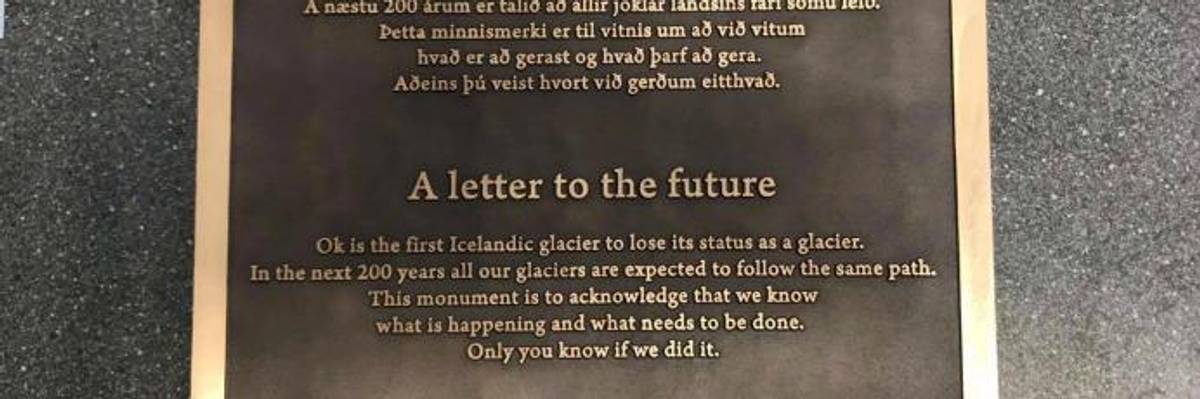
Text from the plaque that will mark the site where Ok glacier once was. (Photo: Rice University)
To Call Attention to "What's Being Lost" to Climate Crisis, Former Glacier to Receive Monument
"With this memorial, we want to underscore that it is up to us, the living, to collectively respond to the rapid loss of glaciers and the ongoing impacts of climate change."
A climate change victim in Iceland is set to be memorialized with a monument that underscores the urgent crisis.
The victim is the former Okjokull glacier in Borgarfjordur, which scientists say is the nation's first glacier lost to the climate crisis. Its plight was also the subject of the 2018 documentary "Not Ok" produced by Rice University anthropologists Cymene Howe and Dominic Boyer.
Earther first reported on the plaque on Saturday.
"With this memorial, we want to underscore that it is up to us, the living, to collectively respond to the rapid loss of glaciers and the ongoing impacts of climate change."
--Cymene Howe, Rice UniversityThe memorial monument will be installed during a Aug. 18 "un-glacier tour" and is entitled, "A letter to the future." It was authored by Icelandic writer Andri Snaer Magnason.
"Ok is the first Icelandic glacier to lose it status as a glacier," the text of the plaque reads. "In the next 200 years all our glaciers are expected to follow the same path."
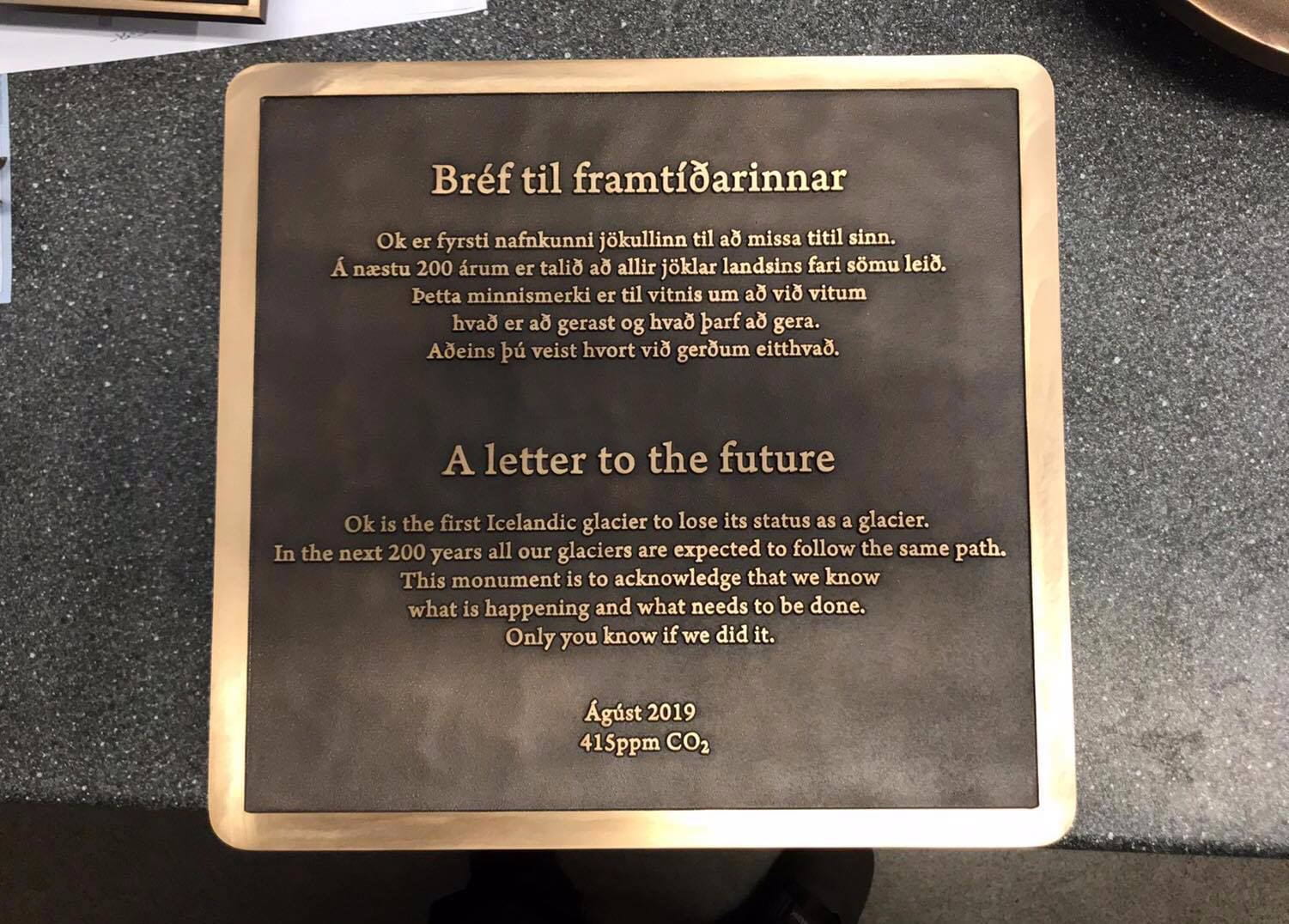
"This monument is to acknowledge that we know what is happening and what needs to be done," it says. "Only you know if we did it."
The bottom of the plaque reads "August 2019, 415ppm CO2." Atmospheric carbon dioxide levels hit that threshold--for the first time ever in human history--in May.
In a press statement released Thursday, Howe spoke about the goal of the memorial.
"This will be the first monument to a glacier lost to climate change anywhere in the world," he said. "By marking Ok's passing, we hope to draw attention to what is being lost as Earth's glaciers expire. These bodies of ice are the largest freshwater reserves on the planet and frozen within them are histories of the atmosphere. They are also often important cultural forms that are full of significance."
Boyer also warned that Ok's "fate will be shared by all of Iceland's glaciers unless we act now to radically curtail greenhouse gas emissions."
Howe, in his statement, suggested the monument should be seen as a call-to-action.
"One of our Icelandic colleagues put it very wisely when he said, 'Memorials are not for the dead; they are for the living,'" Howe said. "With this memorial, we want to underscore that it is up to us, the living, to collectively respond to the rapid loss of glaciers and the ongoing impacts of climate change."
The movie, the website for the documentary says, "is not a tale of spectacular, collapsing ice. Instead, it is a little film about a small glacier on a low mountain--a mountain who has been observing humans for a long time and has a few things to say to us."
Watch below to see a trailer for the film:
We are at a crossroads
This country and this world are at a monumental crossroads. In a few short weeks, US voters will have an opportunity to beat back the forces of fascism and confront the billionaires who are rigging the economy, our media system, and our democracy, making it increasingly impossible for ordinary people to get by. We’re not just talking about the election. We’re talking about what must be done once these fascist elements are vanquished from power. We need a bolder set of solutions than what either major party has so far been willing to offer and a working-class movement ready to fight like hell for it. Trump didn't emerge from nowhere. The conditions that fueled MAGA authoritarianism were created by decades of radical neoliberal economic policies and a corrupt political system dominated by corporate interests. They slashed taxes on the super-rich, promising that the benefits would trickle down. They said giveaways to the corporate titans would make life more affordable for the rest of us. It was all bullshit. And when a bitter, betrayed populace searches for someone to blame, right-wing demagogues have little trouble finding scapegoats. People know when they're being lied to, but you won't hear any of this from the corporate media. Only independent journalism—powered and funded by people who believe in building a better world—can deliver truly trustworthy daily news. Our Fall Campaign is underway, and we need your help. To power our newsroom through the rest of the year, we need to raise $125,000 by midnight on October 31. So if you share our vision, please contribute whatever you can to sustain our work. |
A climate change victim in Iceland is set to be memorialized with a monument that underscores the urgent crisis.
The victim is the former Okjokull glacier in Borgarfjordur, which scientists say is the nation's first glacier lost to the climate crisis. Its plight was also the subject of the 2018 documentary "Not Ok" produced by Rice University anthropologists Cymene Howe and Dominic Boyer.
Earther first reported on the plaque on Saturday.
"With this memorial, we want to underscore that it is up to us, the living, to collectively respond to the rapid loss of glaciers and the ongoing impacts of climate change."
--Cymene Howe, Rice UniversityThe memorial monument will be installed during a Aug. 18 "un-glacier tour" and is entitled, "A letter to the future." It was authored by Icelandic writer Andri Snaer Magnason.
"Ok is the first Icelandic glacier to lose it status as a glacier," the text of the plaque reads. "In the next 200 years all our glaciers are expected to follow the same path."
"This monument is to acknowledge that we know what is happening and what needs to be done," it says. "Only you know if we did it."
The bottom of the plaque reads "August 2019, 415ppm CO2." Atmospheric carbon dioxide levels hit that threshold--for the first time ever in human history--in May.
In a press statement released Thursday, Howe spoke about the goal of the memorial.
"This will be the first monument to a glacier lost to climate change anywhere in the world," he said. "By marking Ok's passing, we hope to draw attention to what is being lost as Earth's glaciers expire. These bodies of ice are the largest freshwater reserves on the planet and frozen within them are histories of the atmosphere. They are also often important cultural forms that are full of significance."
Boyer also warned that Ok's "fate will be shared by all of Iceland's glaciers unless we act now to radically curtail greenhouse gas emissions."
Howe, in his statement, suggested the monument should be seen as a call-to-action.
"One of our Icelandic colleagues put it very wisely when he said, 'Memorials are not for the dead; they are for the living,'" Howe said. "With this memorial, we want to underscore that it is up to us, the living, to collectively respond to the rapid loss of glaciers and the ongoing impacts of climate change."
The movie, the website for the documentary says, "is not a tale of spectacular, collapsing ice. Instead, it is a little film about a small glacier on a low mountain--a mountain who has been observing humans for a long time and has a few things to say to us."
Watch below to see a trailer for the film:
A climate change victim in Iceland is set to be memorialized with a monument that underscores the urgent crisis.
The victim is the former Okjokull glacier in Borgarfjordur, which scientists say is the nation's first glacier lost to the climate crisis. Its plight was also the subject of the 2018 documentary "Not Ok" produced by Rice University anthropologists Cymene Howe and Dominic Boyer.
Earther first reported on the plaque on Saturday.
"With this memorial, we want to underscore that it is up to us, the living, to collectively respond to the rapid loss of glaciers and the ongoing impacts of climate change."
--Cymene Howe, Rice UniversityThe memorial monument will be installed during a Aug. 18 "un-glacier tour" and is entitled, "A letter to the future." It was authored by Icelandic writer Andri Snaer Magnason.
"Ok is the first Icelandic glacier to lose it status as a glacier," the text of the plaque reads. "In the next 200 years all our glaciers are expected to follow the same path."
"This monument is to acknowledge that we know what is happening and what needs to be done," it says. "Only you know if we did it."
The bottom of the plaque reads "August 2019, 415ppm CO2." Atmospheric carbon dioxide levels hit that threshold--for the first time ever in human history--in May.
In a press statement released Thursday, Howe spoke about the goal of the memorial.
"This will be the first monument to a glacier lost to climate change anywhere in the world," he said. "By marking Ok's passing, we hope to draw attention to what is being lost as Earth's glaciers expire. These bodies of ice are the largest freshwater reserves on the planet and frozen within them are histories of the atmosphere. They are also often important cultural forms that are full of significance."
Boyer also warned that Ok's "fate will be shared by all of Iceland's glaciers unless we act now to radically curtail greenhouse gas emissions."
Howe, in his statement, suggested the monument should be seen as a call-to-action.
"One of our Icelandic colleagues put it very wisely when he said, 'Memorials are not for the dead; they are for the living,'" Howe said. "With this memorial, we want to underscore that it is up to us, the living, to collectively respond to the rapid loss of glaciers and the ongoing impacts of climate change."
The movie, the website for the documentary says, "is not a tale of spectacular, collapsing ice. Instead, it is a little film about a small glacier on a low mountain--a mountain who has been observing humans for a long time and has a few things to say to us."
Watch below to see a trailer for the film: