SUBSCRIBE TO OUR FREE NEWSLETTER
Daily news & progressive opinion—funded by the people, not the corporations—delivered straight to your inbox.
5
#000000
#FFFFFF
To donate by check, phone, or other method, see our More Ways to Give page.
A new report published Tuesday exposes the "widespread failure" of police forces across the United States to adequately protect and serve transgender people, and offers model policies and best practices to rectify this "systemic neglect."
"The solutions we offer can lead these communities and our nation's law enforcement to a more equitable future, but we must get there together."
--Mara Keisling, NCTE
The National Center for Transgender Equality (NCTE) worked with dozens of local and state groups to analyze how the nation's 25 largest police departments treat transgender people to produce the report, entitled Failing to Protect and Serve: Police Department Policies Towards Transgender People (pdf).
"As we make groundbreaking advancements towards transgender equality, many members of our communities continue to be affected by disproportionate contact with, and often by bias and abuse within, policing and the criminal justice system," the introduction reads.
The report points out that a recent survey found 58 percent of transgender people in the United States who encountered law enforcement in the past year said they experienced harassment, abuse, or other mistreatment.
NCTE's report issues grades for the scrutinized departments--from Atlanta to Boston to Chicago to San Francisco--based on 17 criteria, including bathroom access, department forms, medical care, respectful communication, search procedures, sexual misconduct, and training.
Over a two-year period, NCTE researchers evaluated publicly available policies and practices by "searching department websites, contacting each department, and consulting with local advocates and organizations invested in police reform."
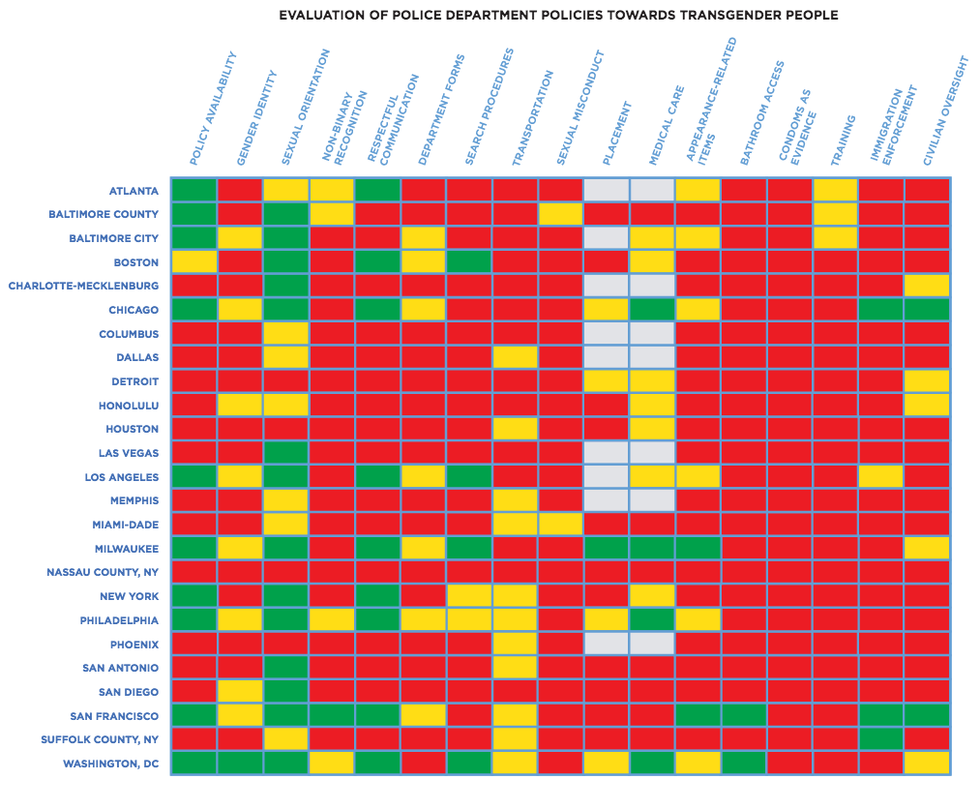
The report features individual department summaries as well as a color-coded chart that shows whether each department generally meets (green), partially meets (yellow), or either fails to address or contradicts (red) the researchers' model policies in each category. Gray indicates the department lacks holding facilities, meaning those categories aren't applicable.
Among the researchers' key findings:
"This report's findings show that while there has been some policy progress in recent years, police departments around the country have a long way to go to ensure safety and fairness and build trust with transgender communities," the report says. "We will not stop the widespread violence against trans people until we change how our communities are policed."
While the report outlines how police departments can improve their work in the 17 categories studied, NCTE also released a separate model policy document (pdf) Tuesday to help guide reforms.
"We will not stop the widespread violence against trans people until we change how our communities are policed."
--NCTE report
However, even if every proposed policy in the document were implemented, the report acknowledges, "it would not be enough to ensure that all transgender people are treated fairly by police. It is clear that the issues facing transgender people can't be separated from broader issues of police reform and oversight."
Additionally, police treatment of transgender people cannot be separated from broader societal trends and issues.
Since President Donald Trump and Vice President Mike Pence took office in 2017, the administration has enacted a series of anti-trans policies--purging transgender people from military service, enabling employment discrimination, rolling back protections for inmates, and even battling global efforts to ensure the human rights of the LGBTQ community. At the same time, hate crimes have risen, specifically hate-inspired homicides with LGBTQ victims--especially trans individuals and people of color.
"On the fiftieth anniversary of the Stonewall riots, transgender people of color remain targets of harassment, abuse, and violence," Mara Keisling, NCTE's executive director, said in a statement Tuesday.
"If we ever hope to end this crisis, police departments must evolve to meet the needs of the communities they have sworn to serve," Keisling added. "The solutions we offer can lead these communities and our nation's law enforcement to a more equitable future, but we must get there together."
A new report published Tuesday exposes the "widespread failure" of police forces across the United States to adequately protect and serve transgender people, and offers model policies and best practices to rectify this "systemic neglect."
"The solutions we offer can lead these communities and our nation's law enforcement to a more equitable future, but we must get there together."
--Mara Keisling, NCTE
The National Center for Transgender Equality (NCTE) worked with dozens of local and state groups to analyze how the nation's 25 largest police departments treat transgender people to produce the report, entitled Failing to Protect and Serve: Police Department Policies Towards Transgender People (pdf).
"As we make groundbreaking advancements towards transgender equality, many members of our communities continue to be affected by disproportionate contact with, and often by bias and abuse within, policing and the criminal justice system," the introduction reads.
The report points out that a recent survey found 58 percent of transgender people in the United States who encountered law enforcement in the past year said they experienced harassment, abuse, or other mistreatment.
NCTE's report issues grades for the scrutinized departments--from Atlanta to Boston to Chicago to San Francisco--based on 17 criteria, including bathroom access, department forms, medical care, respectful communication, search procedures, sexual misconduct, and training.
Over a two-year period, NCTE researchers evaluated publicly available policies and practices by "searching department websites, contacting each department, and consulting with local advocates and organizations invested in police reform."
The report features individual department summaries as well as a color-coded chart that shows whether each department generally meets (green), partially meets (yellow), or either fails to address or contradicts (red) the researchers' model policies in each category. Gray indicates the department lacks holding facilities, meaning those categories aren't applicable.
Among the researchers' key findings:
"This report's findings show that while there has been some policy progress in recent years, police departments around the country have a long way to go to ensure safety and fairness and build trust with transgender communities," the report says. "We will not stop the widespread violence against trans people until we change how our communities are policed."
While the report outlines how police departments can improve their work in the 17 categories studied, NCTE also released a separate model policy document (pdf) Tuesday to help guide reforms.
"We will not stop the widespread violence against trans people until we change how our communities are policed."
--NCTE report
However, even if every proposed policy in the document were implemented, the report acknowledges, "it would not be enough to ensure that all transgender people are treated fairly by police. It is clear that the issues facing transgender people can't be separated from broader issues of police reform and oversight."
Additionally, police treatment of transgender people cannot be separated from broader societal trends and issues.
Since President Donald Trump and Vice President Mike Pence took office in 2017, the administration has enacted a series of anti-trans policies--purging transgender people from military service, enabling employment discrimination, rolling back protections for inmates, and even battling global efforts to ensure the human rights of the LGBTQ community. At the same time, hate crimes have risen, specifically hate-inspired homicides with LGBTQ victims--especially trans individuals and people of color.
"On the fiftieth anniversary of the Stonewall riots, transgender people of color remain targets of harassment, abuse, and violence," Mara Keisling, NCTE's executive director, said in a statement Tuesday.
"If we ever hope to end this crisis, police departments must evolve to meet the needs of the communities they have sworn to serve," Keisling added. "The solutions we offer can lead these communities and our nation's law enforcement to a more equitable future, but we must get there together."
A new report published Tuesday exposes the "widespread failure" of police forces across the United States to adequately protect and serve transgender people, and offers model policies and best practices to rectify this "systemic neglect."
"The solutions we offer can lead these communities and our nation's law enforcement to a more equitable future, but we must get there together."
--Mara Keisling, NCTE
The National Center for Transgender Equality (NCTE) worked with dozens of local and state groups to analyze how the nation's 25 largest police departments treat transgender people to produce the report, entitled Failing to Protect and Serve: Police Department Policies Towards Transgender People (pdf).
"As we make groundbreaking advancements towards transgender equality, many members of our communities continue to be affected by disproportionate contact with, and often by bias and abuse within, policing and the criminal justice system," the introduction reads.
The report points out that a recent survey found 58 percent of transgender people in the United States who encountered law enforcement in the past year said they experienced harassment, abuse, or other mistreatment.
NCTE's report issues grades for the scrutinized departments--from Atlanta to Boston to Chicago to San Francisco--based on 17 criteria, including bathroom access, department forms, medical care, respectful communication, search procedures, sexual misconduct, and training.
Over a two-year period, NCTE researchers evaluated publicly available policies and practices by "searching department websites, contacting each department, and consulting with local advocates and organizations invested in police reform."
The report features individual department summaries as well as a color-coded chart that shows whether each department generally meets (green), partially meets (yellow), or either fails to address or contradicts (red) the researchers' model policies in each category. Gray indicates the department lacks holding facilities, meaning those categories aren't applicable.
Among the researchers' key findings:
"This report's findings show that while there has been some policy progress in recent years, police departments around the country have a long way to go to ensure safety and fairness and build trust with transgender communities," the report says. "We will not stop the widespread violence against trans people until we change how our communities are policed."
While the report outlines how police departments can improve their work in the 17 categories studied, NCTE also released a separate model policy document (pdf) Tuesday to help guide reforms.
"We will not stop the widespread violence against trans people until we change how our communities are policed."
--NCTE report
However, even if every proposed policy in the document were implemented, the report acknowledges, "it would not be enough to ensure that all transgender people are treated fairly by police. It is clear that the issues facing transgender people can't be separated from broader issues of police reform and oversight."
Additionally, police treatment of transgender people cannot be separated from broader societal trends and issues.
Since President Donald Trump and Vice President Mike Pence took office in 2017, the administration has enacted a series of anti-trans policies--purging transgender people from military service, enabling employment discrimination, rolling back protections for inmates, and even battling global efforts to ensure the human rights of the LGBTQ community. At the same time, hate crimes have risen, specifically hate-inspired homicides with LGBTQ victims--especially trans individuals and people of color.
"On the fiftieth anniversary of the Stonewall riots, transgender people of color remain targets of harassment, abuse, and violence," Mara Keisling, NCTE's executive director, said in a statement Tuesday.
"If we ever hope to end this crisis, police departments must evolve to meet the needs of the communities they have sworn to serve," Keisling added. "The solutions we offer can lead these communities and our nation's law enforcement to a more equitable future, but we must get there together."